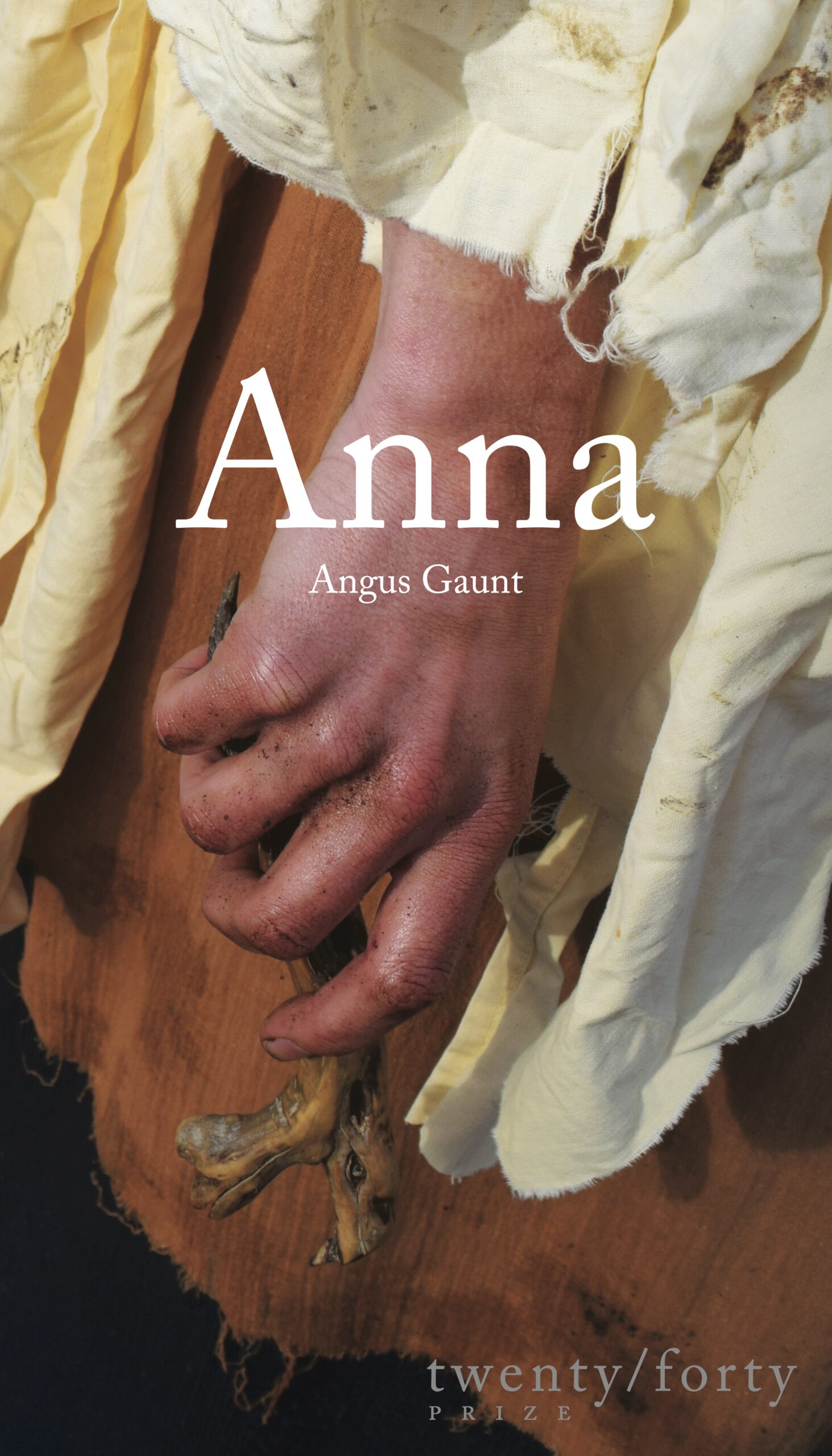
Last month, I posted on the winners of the 2025 Finlay Lloyd 20/40 Publishing Prize, of which Angus Gaunt’s Anna was one. I am thrilled with this prize, not only because I love the novella form, but because of the variety of stories we are seeing. So far the fiction winners have been an historical novel from Kim Kelly, a contemporary coming-of-age novel from Rebecca Burton, and an audacious “what if” story from PS Cottier and NG Hartland. Three very different books, and now Anna makes it four.
When I started reading Anna, I thought I was heading into a dystopian novel. It is told third person from Anna’s perspective, and starts with her walking in the woods. A young man is following her. The woods are not identified, and neither is the young man, but she recognises him as a guard from the place she’s just left. Through their initial interaction, we learn that “the war is over” and the gates had been opened. Therefore, she firmly implies, he has no jurisdiction over her.
Anna, we discover as her journey continues, is about 15 years old, and had been taken to a labour camp with her family about three years ago. Her parents had died but she’s hoping her remaining siblings are ahead of her, safe in the exodus she’d missed. We know nothing about the woods – but they do not sound Australian – nor do we know the time setting. It is cold. There are some generic animals and plants – deer, hares, mushrooms, berries. The story focuses on Anna’s thought processes and her survival. There is almost nothing about the sociopolitical situation that got her there. We do know that Anna and the guard speak different languages, which suggests an invasion or some sort of oppression of minorities, but Gaunt does not go there. The notes I made during my reading, include this: “Timeless, placeless, non-political, means not dystopian? More allegory?”
The judges don’t call it either of these, but on “why this book is different” they say:
Winter is only beginning to thaw in a remote forest as Anna treks for her survival, accompanied by someone she cannot trust. With distilled clarity, this short novel carries the reader on a journey from victimhood to self-possession.
So, it is about survival, or, more precisely, about the inner resources you need to develop to overcome a dire situation.
Anna is a moving and absorbing read. Gaunt quickly engages our sympathy for his protagonist, young and defenceless in the woods. The language in the first two paragraphs sets up uncertainty. It starts:
Anna had already walked further than she meant to, but did not want to go back, not yet. She was basking in the sun … also in the silence. She had not done something like this for a long time … (p. 9)
Then she stops and looks up, where she sees “a large predatory bird … floating on secret air currents, delicate wing tips spread”. “Predatory” but “delicate”. Should we be worried? Then she sees the young guard, later identified as Yevgeny. He’s very young, uncertain, and in a show of bravado he tries to shoot the bird, but fails. He’s never shot anything before. And so the narrative and its main characters are established. Anna is alert, sensitive, intelligent and has some nous and wisdom about her. The guard, also young, lacks confidence, experience and nous, and is confused about his role as a man, a soldier, a human. This makes him potentially dangerous but also vulnerable. We – like Anna – are on the watch for which way he might go.
And so the novel progresses as this uneasy, wary-of-each-other pair journey through the woods, looking for the railroad and its promise of civilisation. Early on, during a brief time when she and Yevgeny are not together and she has returned to the camp, Anna meets a dying man who gives her his last food. Then later, together, they come across a cottage containing a barely surviving couple.
This brings another literary form to mind, the journey narrative, the search for home, a new one or old one, and – perhaps – for self. In journey narratives, physical and spiritual or emotional challenges are faced, and people are met. The journeyer must rely on inner resources to overcome the challenges, including assessing whether the people met are to be trusted or not. This is what we watch Anna do. We are privy to her thoughts as she goes, as she draws together past knowledge and present experience, and we gain confidence in her ability to make good decisions. Nearly half way through the story, her mind drifts to the schoolroom. It is comforting, but she stops herself,
recognising that she was attracted by the emotion of it rather than its practical application. There was not room for emotion. She was glad of this thought. Feelings and emotion could only cloud the mind, waste precious resources. All resources were precious. Her mind was clear now. She had a choice to make and she made one. (p. 56)
Of course it’s not a straight line, and Anna, like any journeyer under stress, slips back several times before getting a grip once more.
Anna is beautiful to read, from the first sentence. The language is tight but expressive. The necessary tension is off-set by moments of tenderness and hope, not to mention some subtle foreshadowing. And the characterisation is warm and empathetic.
I concluded my post on last year’s winner, The thirty-one legs of Vladimir Putin, that it was an audacious “what if” story. Anna is also audacious, in a different way. It calls on the tropes of established forms, like allegory and the journey narrative, but makes them into something new, something that confronts issues like trust and power in a way that feels both modern and timeless.
Read for Novellas in November.

Angus Gaunt
Anna
Braidwood: Finlay Lloyd, 2025
110pp.
ISBN: 9780645927047
Review copy courtesy Finlay Lloyd.
 Whispering Gums
This sounds really good and I love the cover
Thanks Cathy … it’s a good one isn’t it.
I’m a little bit sorry that an Australian author should choose a ‘generic’ setting (and a young female protagonist, but that’s an argument we won’t get into). I agree it sounds as though Gaunt is riffing on established tropes. I can think of a few novels that involve setting out through icy woods for an uncertain destination, so I hope he brings something new to it.
I’m not sorry Bill. It adds to the uncertain atmosphere I think. Young female protagonist? Because he’s a male?
I can’t answer your last comment because I haven’t read enough of those sorts of stories to say. But my guess is that his focus on ideas like trust and how he resolves that – if you can call it resolve – is fresh.
Anna sounds like a wonderful novel, though I’m curious about your hesitation to call the novel “dystopian.” I thought the only requirement for the genre was that we had a society and it collapsed. Thus, we are in a dystopian landscape. I mean, basically the opposite of a utopia, right? Things also have to be not awesome. If society collapsed and we all just rode around on horses and ate fresh foods we grew ourselves on peaceful communes (I’m totally picturing Herland by Charlotte Perkins Gilman here).
Good question Melanie … it would probably not be wrong to call it dystopian because it does have a dystopian feel, but my definition of dystopian is that there is usually something clear about the society breaking down, that the author’s intention is to show what happens when society does whatever it is that has led to the dystopian. In this the focus is not on what happened or why. We have no idea what happened and it is not explored. There’s no sense of what could be done to “fix” things – we don’t even know what has to be fixed- there’s only what this young girl needs to do survive a potentially dire situation. Does this make you think differently?
No, but only because I don’t think I’ve read a book nor seen a movie in which the breakdown of society is explored in a dystopian narrative. We’re here, and this is how it is. Interesting!
That’s interesting Melanie. I think of classic dystopias like Animal farm, 1984, The handmaid’s
tale, and more recent ones that are climate change focused. In each of those you know what has led to dystopia. They may or may not explore then what you can do to change things, but you do know what led to it. So yes, they can be that situation you describe of we are here, how do we live. Cormac McCarthy’s The road is perhaps close to the type you are talking about. I did think about it when I was writing on this one, but even there, though it’s unspecific, there is a sense of some sort of destructive apocalypse.
Thanks for the discussion. It adds to thoughts about this book. I hope others read the comments, because I thought about mentioning The road when I talked about the journey form!
Your mention of The Road also brings Emily St. John Mandel’s novel Station Eleven to mind. Even though there is a lot to Station Eleven, the part that comes to mind first, for me, is the long walks between settlements that have developed as the group of actors move from place-to-place to perform plays and play music. On a superficial note, I saw your comment on Bookish Beck’s recent Serendipity post in which she encountered two characters named Angus who each committed a murder: it was the first thing I thought of, when I saw this book’s title. Oh, no! I thought that would be a Thing for her, but now I have been afflicted too.
Haha, Marcie re serendipity!
You know I haven’t read Station Eleven. It’s on my virtual TBR. Was on my reading group suggestion list but has dropped off. You have re-intrigued me.
Thanks for reading and reviewing all four of the books from this year’s 2025 Finlay Lloyd 20/40 Publishing Prize. I do love the novella form too and I keep meaning to look into these books, but at work it is easy to get distracted!
Thanks Brona – though I haven’t yet reviewed the second of this year’s winners, Touched. I have posted on it though, and hope to review it next week.
Pingback: This month in Aus Lit #15 – Reading Matters
Pingback: Anna, Angus Gaunt | The Australian Legend
Pingback: Read Indies 2026 #ReadIndies (Second Post) – Buried In Print
The first time I tried to read this, I couldn’t. The language is so simple, spare that I found my focus slipping past, whereas I actually needed to read even more slowly than usual, spend some time on each word.
On a different occasion, I was up to the task. And now I am so intrigued by the judges’ statement you’ve shared, this highlighting of the seasonality of the story, that it doesn’t take place in winter (which would have had one sort of symbolism) or in spring (another) but in the transition, between, on the hinge between seasons, just perfectly placed for a journey (lit and fig) that is still overbearing and difficult but is sometimes lightened by a sense of promise in the wings.
I really loved this book, for many reasons, but perhaps I am most delighted by the structure, which I think is heralded from the very beginning with that back-and-forward, in the character’s movement but also in her selfhood’s emergence, but then reinforced by her trick of moving in a straight line by dropping breadcrumbs (pieces of fabric) and then retracing and moving forward again, literally plotting her trajectory, and her burgeoning discovery of who she’ll be outside of the place she previously inhabited. (But my delight in that resulted in my overlooking the significance of the season. Nice Problem to Have.)
I’m so glad you liked it Marcie … and I love your thoughts on the season transition, and on the structure. I often think about structure but I don’t think I did so much here. Your thoughts on that backward-forward movement and her developing sense of self are great.
It felt to me like a book you might enjoy getting your head around, but you never know. I liked the overall unspecificity of it, the sense of a real person but also of every person who has to struggle.