It’s a year since I’ve posted on a Library of America (LOA) story, but I was driven to post on this one for two reasons. I have just posted a review of “The scapegoat” by Dunbar-Nelson’s first husband, Paul Dunbar, and, earlier this year, I reviewed “A carnival jangle”, written by Alice Dunbar-Nelson, before marriage when she was Alice Ruth Moore.
Alice Dunbar-Nelson
In my post on “A carnival jangle”, I provided a brief biography of Dunbar-Nelson, so I won’t repeat that here, except to remind us that she was a poet, journalist and political activist, born to a black mother and white father. She was prominent in the Harlem Renaissance, and lived in New Orleans for 21 years, as well as Boston, New York, and elsewhere.
In that bio, I also wrote that racism was an important issue for her, but that she also took a wider view of human rights. It is this point that I would like to explore further in this post, due to some ideas raised in LOA’s introduction to her story. They focus quite a bit on her relationship with Paul Laurence Dunbar, noting that the two communicated with each other by letter for a couple of years before meeting. Dunbar asked for her opinion on using “Negro dialect in Literature”, which he sometimes did. LOA shares her response, which was that she saw no problem with using dialect if you knew it and had “a special aptitude for dialect work” but that she saw no necessity to do so just because “one is a Negro or a Southerner”, and if, like her, you were “absolutely devoid of the ability to manage dialect“. This makes good sense, but the main thing I want to share is what she says next:
Now as to getting away from one’s race—well I haven’t much liking for these writers that wedge the Negro problem and social equality and long dissertations on the Negro in general into their stories. It’s too much like a quinine pill in jelly—I hope I’m not treading on your corns. Somehow, when I start a story, I always think of my folks (characters) as simple human beings, not as types of a race or an idea—and I seem to be on more friendly terms with them.
After detailing more of Dunbar-Nelson’s biography, LOA returns to the issue of subject matter, saying that “the ambiguity of racial identity for the Creole characters” in her stories resulted in several critics in recent decades arguing that
she “camouflaged the issue of race,” that she “spurned that racialized element of her identity,” or that she “shaped her tales of Creole life for white audiences.” In “Sister Josepha,” which we reprint below as our Story of the Week selection, the reader realizes that the lead character is not white only through descriptive hints (“brown hands,” “tropical beauty”) and by what the other nuns do not say about her.
However, continues LOA, another commentator, Caroline Gebhard had noted in a recent article that Dunbar-Nelson
“presumes that readers already read her work as ‘black.’” In the 1890s and early 1900s, most of Dunbar-Nelson’s stories, essays, and poems appeared in Black newspapers and magazines; The Monthly Review, for example, advertised itself as “the only illustrated periodical published by Negroes in this country.” … “Dunbar-Nelson knew she would be read as a Black author and never tried to pass in print,” Gebhard concludes. “To read Dunbar-Nelson’s fictions as addressing only white readers, which the accusation of passing implies, is to dismiss the fact that Dunbar-Nelson’s first and most loyal readers were African Americans.”
This point reminded me of the discussion my American friend Carolyn and I had about “The scapegoat” concerning the fact that it is almost completely set in the black community. White people are not identified, except for the Judge, so we have to work out, between the lines, who else might be white in that story. I think Paul Dunbar assumed we’d know – just as Alice Dunbar-Nelson did, according to Gebhard. It’s a lesson in how difficult it is to read out of one’s own time and culture.
It also reminded me of something more contemporary, a post I wrote in 2021. The focus was memoir, but the point was that ‘diverse writers’ are expected to write narrowly about their diversity, and their frustration that they are not encouraged to write, as Dunbar-Nelson explained, about “simple human beings, not as types of a race or an idea”.
“Sister Josepha”
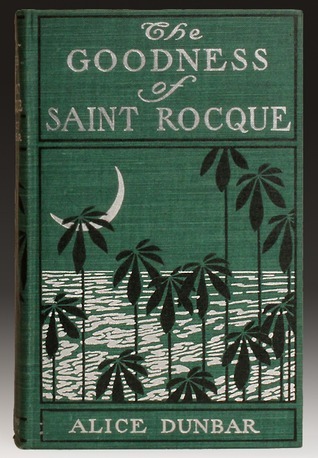
“Sister Josepha” appeared in Dunbar’s 1899 short story collection, The goodness of St Rocque and other stories, and can be read at the link below. It tells the story of a young three-year-old orphan named, Camille, who was left at a convent orphan asylum. The story opens 15 years later when this orphan has just finished her novitiate and is a fully-fledged sister, but she’s unsettled.
Dunbar tells us that when she was 15, and still Camille, she had “almost fully ripened into a glorious tropical beauty of the type that matures early” and had attracted the attention of a couple who offered to take her in. Her Mother Superior calls her in and makes the offer:
Camille stole a glance at her would-be guardians, and decided instantly, impulsively, finally. The woman suited her; but the man! It was doubtless intuition of the quick, vivacious sort which belonged to her blood that served her. Untutored in worldly knowledge, she could not divine the meaning of the pronounced leers and admiration of her physical charms which gleamed in the man’s face, but she knew it made her feel creepy, and stoutly refused to go.
To justify her decision to Mother Superior, who did not force her to go, she announces that she loves the convent and sisters, and would like to be one too. However, three years later, the life is palling for this lively young woman. She’s tired, and bored, and plans her escape, but this is a story about the few opportunities available to a young woman in her situation. Should she live the confining but secure life of a nun, or could she make it out in the world where she has no identity, no name other than Camille, and “a beauty that not even an ungainly bonnet and shaven head could hide”.
What lifts this story out of the large body of often cliched stories about young nuns like Camille/Sister Josepha is the situation and Dunbar’s expressive writing that subtly conveys the reality of our sister’s position. Race is never mentioned but there are hints regarding Camille’s background. This is a different story to “A carnival jangle” but no less powerful.
Alice Dunbar Nelson
“Sister Josepha” (1899)
First published: in The goodness of St Rocque and other stories
Available online: Library of America
 Whispering Gums
“absolutely devoid of the ability to manage dialect“ takes me immediately to the very real problem I had, except that it was more fundamental – an absolute inability to manage conversation !
In your book, MR? I don’t recollect that. But then, in memoir you don’t really have to include conversation do you? You can just describe it.
MR I agree, not that you are unable to write conversation, which I think that is far harder than it looks, but that conversation and dialect are irrevocably entwined.
It’s easy to say I want to write people, but race is often the most important thing to know about people, whether they are or not in a position of privilege, and I think Black writers since Zora Neale Hurston in particular, have used dialect to break out of the straight jacket imposed by white values.
That said, I’m not sure an orphan white 15 year old girl would want a “leering” foster father any more than a Black girl would.
Haha re your final point Bill … I think that’s right. I think race is probably important to know but just how important probably depends on the context and the story being told. If a story is being told completely within a community for example it is probably less important to know the “race” of that community, than if it is about communities intersecting particularly where one has power over another.
I really like that quote about not adding in racial concerns as the point of the story. When I try to voice this as a white woman, I sound like a racist. It’s hard to make it clear that I don’t want to read what is basically a morality tale. There was a big stretch in the US around the time that young adult novel The Hate U Give came out when lots of books specifically about police brutality, racism, etc. were the topic of novels. I think it had a lot to do with the Black Lives Matters protests in Missouri, and I understand that people were basically writing about a moment—which is important, but then there would be a big lesson or speech at the end telling us what to think. I don’t know that even younger readers, like teens, need that. If any book has a synopsis that include something like “this is a Queer feminist etc etc” or anything like that, I don’t want to read it because the lesson is more important than the story. People aren’t lessons, and we often fail to learn lessons everything something challenging happens because we’re just trying to get through it. It’s a similar concern that Zora Neale Hurston had, which I think I’ve mentioned plenty of times.
I was also interested in the part about how “white people are not identified.” It drives me INSANE when novelists choose to identify all non-white characters. Either don’t do it, or do it for everyone. I also hate how in older novels a character will be described as “brown” to mean they have a tan. I know this was in the days of bonnets and whatnot to avoid getting darker skin to suggest one had to work like a peasant, but in my modern head, it’s confusing. I have to remember a brown character in the way that we think of brown today would almost never be in an older novel unless that person was a slaver, servant, etc.
i always enjoy the thinking you bring to other people’s posts Melanie. Taking the last part first, context is so important and I think as readers we need to be aware of that. Here is a famous quote from Pride and prejudice:
‘”How very ill Eliza Bennet looks this morning, Mr. Darcy,” she cried; “I never in my life saw any one so much altered as she is since the winter. She is grown so brown and coarse! Louisa and I were agreeing that we should not have known her again.”
However little Mr. Darcy might have liked such an address, he contented himself with coolly replying that he perceived no other alteration than her being rather tanned — no miraculous consequence of travelling in the summer.’
As for the first, it’s a complex issue isn’t it. Sometimes the point of the novel IS the impact of race/oppression/colonialism/queerness or whatever, so some sort of identification is needed – but even so, the story doesn’t have to be didactic. Other times the story is set within a specific community but is not about their “difference”, just about their lives – about love, sadness, grief, ambition, jealousy, joy, quest, whatever. Then, of course, there’s no reason for the author to have to identify who they are in any detail.
No wonder you couldn’t resist writing about this story when it landed in your lap, on the heels of the other two!
Anyone enthralled by the discussion of how/whether to identify characters’ racial identities would love reading Toni Morrison’s short story Recitatif (which was published as a standalone novella with a fabulous introductory essay …to be enjoyed after the story).
Thanks Marcie … I will look out for that Morrison. I always read introductions at the end. Not only because I want to come to a story fresh but because I usually find the introduction more interesting when I know what they are talking about.
No wonder you couldn’t resist writing about this story when it landed in your lap, on the heels of the other two!
Anyone enthralled by the discussion of how/whether to identify characters’ racial identities would love reading Toni Morrison’s short story Recitatif (which was published as a standalone novella with a fabulous introductory essay …to be enjoyed after the story).