Around ten years ago, I wrote a post on National Arbor Day. It was inspired by a Library of America story. The thing is that then I didn’t, and I still don’t hear, about Arbor Day anymore. Indeed, Mr Gums and I reminisced that it was mainly through school that we heard about it at all. Nor do I hear much about National Eucalypt Day, which I wrote about 8 years ago. I do hear sometimes about various tree-planting initiatives, but I was surprised to hear on ABC Classic FM on the weekend that Sunday was National Tree Day! A bit of research took me to the National Tree Day website.
Here, I learned that it was established in 1996, by Planet Ark, and that it has “grown into Australia’s largest community tree planting and nature care event”. The site continues that it is “a call to action for all Australians to get their hands dirty and give back to their community”. I also learned that they run three tree days, whose dates for this year are:
- Schools Tree Day Friday 25th July 2025 (set for the last Friday in July)
- National Tree Day Sunday 27th July 2025 (set for the last Sunday in July)
- Tropical Tree Day Sunday 7th December 2025
I said above that I don’t hear about Arbor Day anymore, so I checked Wikipedia. Under Australia, on the Arbor Day article, it says:
Arbor Day has been observed in Australia since the first event took place in Adelaide, South Australia on the 20th June 1889. National Schools Tree Day is held on the last Friday of July for schools and National Tree Day the last Sunday in July throughout Australia. Many states have Arbour Day, although Victoria has an Arbour Week, which was suggested by Premier Rupert (Dick) Hamer in the 1980s.
The implication is that it is still observed. It doesn’t, though, seem to get much publicity. I could research this, but so could you if you are interested! Meanwhile, I plan to use this post to share some tree quotes from Australian novels, and a couple of tree-inspired covers, as my little tribute to National Tree Day.
My first quote is one I’ve shared before, because it’s my first memory of a tree playing a significant role in a novel. I’m referring to Ethel Turner’s children’s book, Seven little Australians (1894), and the death of our beloved Judy:
There was a tree falling, one of the great, gaunt, naked things that had been ringbarked long ago. All day it had swayed to and fro, rotten through and through; now there came up across the plain a puff of wind, and down it went before it. One wild ringing cry Judy gave, then she leaped across the ground, her arms outstretched to the little lad running with laughing eyes and lips straight to death.
This is realism. The tree has an important role to play in the plot. Another memorable novel featuring trees is Murray Bail’s Eucalyptus (1998). There is a narrative, of course, but it is framed around multiple species of gum trees, and opens with this:
We could begin with desertorum, common name hooked mallee … and anyway, the very word, desert-or-um, harks back to a stale version of the national landscape and from there in a more or less straight line onto the national character, all those linings of the soul and the larynx, which have their origin in the bush, so it is said, the poetic virtues (can you believe it?) of being belted about by droughts, bushfires, smelly sheep and so on; and let’s not forget the isolation …
As you can tell from the tone, the trees – although very real right down to their botanic descriptions – also set the novel’s tone and have something to say about Australian life and character.
More recent is Madelaine Dickie’s Red can origami (2019, my review). It is set in the Kimberley, but here is a description of a boab tree in Perth, a place where they don’t belong. It symbolises displacement:
The boab’s bark is cracked, its leaves are withered, and its roots strain from the soil, as if it’s planning on splitting town, hitching north.

There are more, but I’ll end with a writer who is loved for his landscape descriptions, Robbie Arnott. It’s hard to choose, but I’m going to use the one I used in my review of his novel, Limberlost, because it is a beautiful example of the landscape mirroring the emotions of the character moving through it. It occurs after a beautiful lovemaking scene:
Afterwards he’d driven them across the plateau through white-fingered fog, through ghostly stands of cider gums, through thick-needled pencil pines, through plains of button grass and tarns, through old rock and fresh lichen, until the road twisted and dived into a golden valley. Here at winter’s end, thousands of wattles had unfurled their gaudy colours. As they descended from the heights their vision was swarmed by the yellow fuzz. Every slope, every scree, every patch of forest, every glimpse through every window was a scene of flowering gold.
The book cover for this novel depicts what I assume is a stylised image of a Huon Pine with a boat, made by the protagonist using this wood.
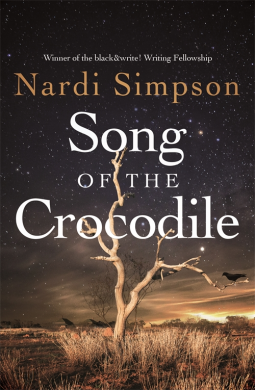
Trees – or parts of trees, like branches or bark – often feature on book covers, because trees evoke so much in our consciousness. I guess they are easy to stimulate emotions in readers. They can be majestic and grand, or stark and threatening, or soft and sheltering – and suggest the associated feelings.
However, in doing a little research for this post, I stumbled across an old discussion about trees on book covers for crime novels. One was a 2007 blog post titled “Fright time in the forest”. The post broke down the four ways trees had been used on crime novel covers. There are those
- used “more or less anthropomorphically–that is, as stand-ins for human-like monsters”
- used “to establish a sense of desolation and bleakness, or mystery”
- ominous-looking tree fronts, “on which the bark-encased stars loom belligerently overhead like villains preparing to fall upon and do violence to their victims”
- used to “convey a mysterious atmosphere” through effects like fog, snow, a nighttime sky.

Some of these overlap, I think, but I love the blogger’s conclusion, which suggests that
the designers of crime novels–like the storytellers who wanted to warn children off from wandering into the deep woods–have sought to associate trees with danger, disorientation, and despondency, all in the interests of book sales. One wonders whether this is healthy for the future of forests, a rapidly dwindling resource–or even healthy for the future of mankind, which might also become a dwindling resource.
I wonder whether book cover designers ever think of their larger responsibilities (besides garnering sales, I mean)!
I have strayed from where I started, which was to pay tribute to trees and share some favourite covers. However, this little discussion, which was picked up by England’s The Guardian was too interesting to ignore.
Any thoughts on trees in novels or on covers?
 Whispering Gums
Oh, Judy! I read Seven Little Australians over and over again as a child. Nearly twenty years I read it (in instalments) to my 8-year-old granddaughter Stella, and I couldn’t stop myself from crying when we got to this passage. Thanks for the reminder, Sue!
Sorry Teresa … somehow this went into Spam which I hand’t checked for a few days, obviously. I reckon I would cry again too if I read this.
Hi Sue, who doesn’t like a tree? Love them, and there so many novels that you can connect to trees. “Grow a Tree, Grow a life”. First Australian novel to mind, Tree of Man by Patrick White. Best, and one of my favourite, non fiction book is Underland by Robert MacFarlane. Lanny by Max Porter is also one of my favourite fiction novel about a tree. And you can’t go past the Faraway Tree by Enid Blyton, and of course the Mary Gibb books, Gum Nuts!!!
What a great array of books Meg across place and time. Love your suggestions.l, including of course, White.
Hi Sue, I just read “And all the lives we ever lived and all the lives to be, Are full of trees and changing leaves”. To the Lighthouse by Virginia Woolf.
And, an Australian novel which has a beautiful setting in Tasmanian forest, The Orchardist Daughter by Karen Viggers.
Oh yes, great quote Meg from To the lighthouse. And, thanks re Karen Viggers’ book. I did think of her when writing this post because most of her first novels have strong environmental themes, but when I came to listing my books I let it slip my mind. The orchardist’s daughter is a good one.
It does seem to me that there is quite a lot of use of trees on the covers of Aussie novels, ST: we are a bit thing about trees, Dowunder, I think – probably because there are never enough of ’em.
Haha MR … I guess that’s why we have all these tree planting days!
I think trees on covers are international though I do t know whether we have more. I read one comment that said they are particularly common for crime and fantasy (all those fairy trees, and dark woods?)
Hm, tree-related novels? Now you have my brain fizzing trying to think of any that I’ve read. Two came to mind: Sixteen Trees of the Somme by Lars Mytting which has a fabulous description of two types of wood I’ve never heard of before – flame birch and flame walnut. The other one is the Cone Gatherers by Robin Jenkins which features some impressively tall Scottish pines
Love that you have come up with two books Karen… I’ve heard of flame trees here but they are different to those two you name. I’d love to see a flame birch and walnut. I’m presuming they are strong red in flower like ours are.
I am a bit partial to a tree cover now that I think about it.
I sure am Theresa … how could I not be given my blog name!
Haha, of course!!!
If I think of the sort of Australian Lit I mostly read all I can picture is trees – Steve of the Peapickers walking through the Gippsland forests; Tom Collins out in the mulga; cannibal convicts lost in Tasmanian rainforests; and on and on.
I am currently reading Roughing it in the Bush, a Canadian classic memoir about carving a farm out of pine forests in the 1830s. Then there’s the also Canadian Arboreality which some of us read; but come up with an Australian tree-ish title, the best I can manage is Future Girl by Asphyxia in which every single tree in Melbourne, including the Royal Botanic Gardens, has been chopped down.
Thanks Bill. Great Aussie examples.
When I searched my blog for trees on “tree” and “arbor”, near top of the list everyone was Arboreality! I’m guessing you’ve reviewed Future girl and I’ve forgotten it! It sounds like I should read it?
I reviewed Future Girl on my blog, and you can find it via the search box. I love an American collection of creative nonfiction from a small press called Limber by Angela Pelster. I also recommend the musical The Christmas Schooner, which is about transporting Christmas trees from northern Michigan, I believe, down to Chicago via boat on Lake Michigan. I rarely like musicals, but this one was lovely.
There is a story to the effect that a New York editor objected to some manuscript or another on the grounds that “it has trees in it.” I believe I heard this in connection with Breece Pancake’s stories, but it has the feeling of a legend.
Of course trees are big in American literature: fiction, poetry, history, and travel. Faulkner has forests and sawmills, Hemingway has the woods in Michigan and elsewhere. About the only lines of Longfellow I know begin “This is the forest primeval”. Robert Frost has plenty of trees in his poems. The historian Francis Parkman liked nothing better than to give one a couple of dense pages describing forest scenes. And there is always Thoreau’s <i>The Maine Woods</i>.
There are more trees in the eastern US than there were when Thoreau wrote–farmers sold their fields to builders; crops won’t grow in the shade, but people love trees to shade their houses.
Thanks for a great overview of trees in US literature George. I don’t know Breece Pancake but you inspired me to remember another American literary tree, A tree grows in Brooklyn!
You’ll find two reviews for Future Girl on my site, one by me, one by Melanie. It’s about a girl who is deaf in a future, dystopian Melbourne. Not your usual cup of tea.
Thanks Bill. I’m not averse to dystopian novels.
Hmmm the only other Australian book that jumps to mind is Inga Simpson’s Where the Trees Were with it’s beautiful bark cover and a story about arborglyphs/burial trees.
Thanks Brona … if I’d gone in my original book cover I would have used a Simpson one as her tree related covers are so good but then I got distracted, so I am glad you mentioned her.
Catherine McKinnon’s Storyland has an ancient fig tree on the cover which is repeatedly mentioned in the novel.
I also have a theory that there is one common theme that unites almost all Australian novels and it is this: the mention of a Moreton bag fig tree somewhere in its pages. Honestly, they pop up everywhere in both new and classic novels.
Thanks Kimbofo … that was another cover I had in my list. It’s a great one.
That’s interesting re the Moreton Bay Fig. I can’t say that I’ve noticed that, but it’s probably because I always notice gums! However, since I learnt to swim in a Moreton Bay, I am partial to these trees!
Happy Tree Day! Enjoyed all the tree quotes. I know they are all Australian writers you shared, but have you read The Overstory by Richard Powers? It is a marvelous multi-vocal novel that also includes the voice of trees.
We have Arbor Day here too at the end of April. I don’t know about national celebrations, but locally my city and county usually have tree planting events that are family friendly.
Thanks Stefanie… my reading group did Overstory but it was the end of the month my mother died (June 2020) and I just couldn’t read it. I was so sad. I have it on my kindle but have never managed to get back to it. It was greatly loved though.
I’m glad your area still celebrate that day.
I think there are a lot of “days” that don’t get noticed in a general way. Maybe it’s like television; we all used to watch (in each country, I assume) the same shows on the same evenings and discuss the next day. But now there are too many ways to watch and series/shows to follow. There’s a day for donuts (I approve).
On my “saved” shelf at the library (which is about 800 books long, even for this tiny library), there are probably 10 tree books. I can’t remember which was the first I added, but then the algorithm continued to “recommend” others and suddenly I had a mini-project (which I’ve, since, done my best to ignore). Oh, I think it was Suzanne Simard’s Finding the Mother Tree which started it off.
Yes good point about “days” Marcie. And yes, we used of course to do exactly what you are saying about TV. Now the conversation is more
Have you watched X?
Oh no, I haven’t heard of it, what platform is it on?
Y.
Darn it, I don’t have that platform. I don’t think I can manage another one.
You can get a free trial and then cancel
… etc etc etc
Nowhere near as much fun as really discussing last night’s episode!
And I love your “tree” project, even if you are pretending it’s not one at all.
LOL Yes, that’s the exact conversation. I suspect we all need to get better at rotating through different services, but we tend to get stuck.
It’s definitely not a project. /sideeye If it was a project, it would be a project I’m neglecting terribly. And that never happens. /chuckles
Oh good for you!! Never neglecting a project. I bow to you. Actually, I’m serious, because you do keep up with a lot of projects while I studiously avoid them because they just stress me out!
I also avoid streaming services so I’m usually a bystander on those conversations. (We only have the Apple service, and our local free SBS On Demand. This means we miss stuff, but we still have enough to see. I wish there were more pay-per-view options for people who want to pick and choose from different services.)
Heheh Well you know I was kidding. I’ve stopped adding to my MustReadEverything list of authors, because it’s embarrassing, this meaninglessness attached to “must”. Apparently I need not must-read them, and the world goes on spinning. It’s as though, simply by adding them to that list, I thought the work was done! But it’s true that even on a reduced-diet of projects, I’m still balancing quite a few. Somewhere online, there is a list of how many days/weeks it takes to finish certain TV series (the more popular ones, anyway) and you only have to look at a couple to realise that a single streaming service is all that anyone needs. If you’re only choosing one, I think Apple’s a great choice for their programming lineup.