It’s the first Saturday in March so here we are again at Six Degrees time. My favourite season of autumn – except that it leads to winter – has officially started. It’s sunny, warm and the leaves are just starting to turn. I hope the weather is lovely wherever you are. Now, I’ll get onto it … but first, if you don’t know how the #SixDegrees meme works, please check Kate’s blog – booksaremyfavouriteandbest.
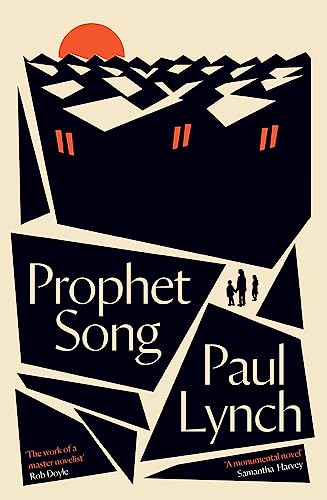
The first rule is that Kate sets our starting book. This month, it’s a book I wish I’d read – as it’s by an Irish writer and won the 2023 Booker Prize, Paul Lynch’s Prophet song – but of course I haven’t. GoodReads starts its description with, “A fearless portrait of a society on the brink as a mother faces a terrible choice”. On the Booker Prize website, there’s a reading guide for the book, which includes this question:
‘You need to relax, the GNSB are not the Stasi, they are just applying a little pressure, that is all,’ Larry tells Eilish at an early point in the story (page 28). Where does the irony lie in this statement with references to the Stasi, the secret police force of East Germany? And to what extent do you think the characters cling to the belief that a country as civilised as theirs could never descend into such a terrifying situation?

Well! Having considered a number of ways to go, I decided that here was the link for me, the Stasi! So, I am linking to Anna Funder’s nonfiction book, Stasiland (my review), for which she interviewed several Stasi men, as well as other East Germans who suffered at Stasi hands. It’s an unforgettable book.
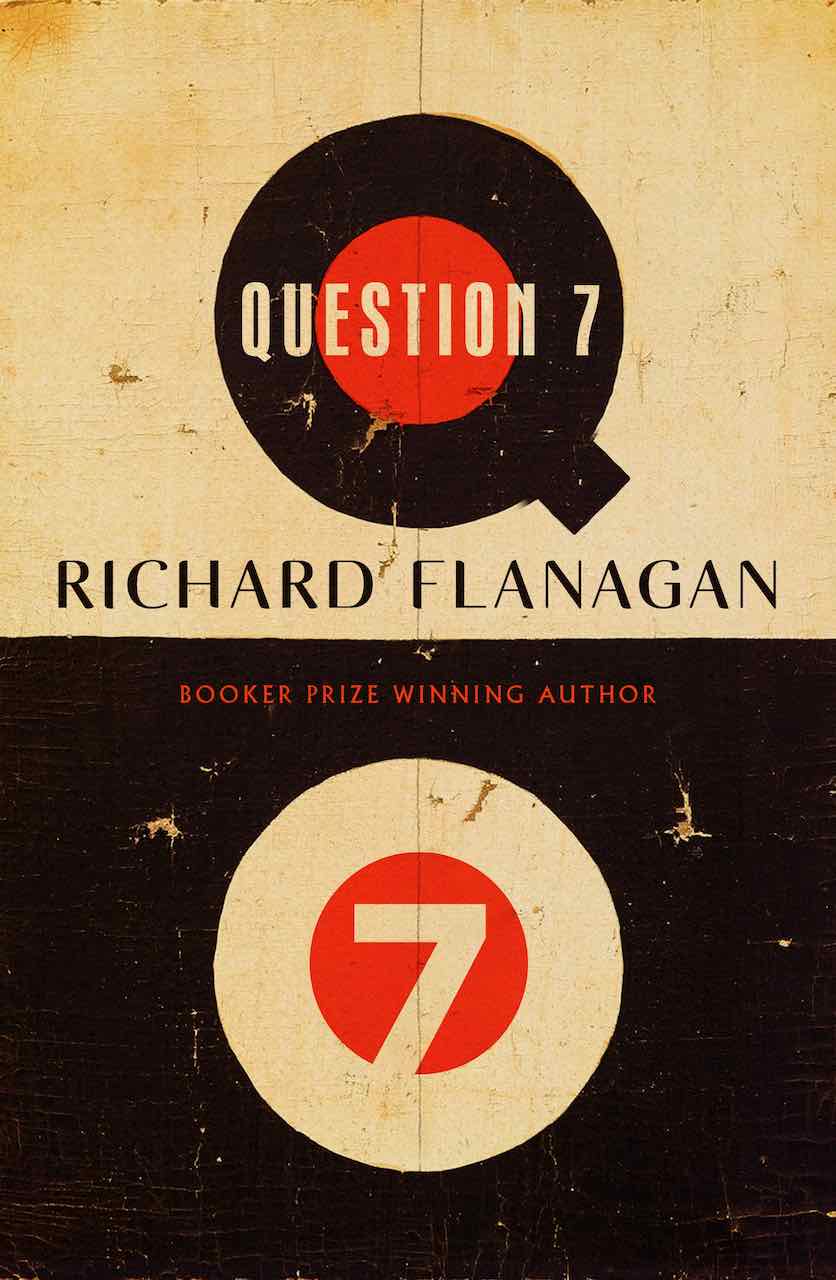
And, it won the Samuel Johnson Prize in 2004, now the Baillie Gifford Prize for Non-Fiction, which, according to the website, “rewards excellence in non-fiction writing, bringing the best in intelligent reflection on the world to new readers”. Twenty years after Funder, in 2024, the winner was Richard Flanagan’s Question 7 (my review), which I described in my post as “a humane book, a book about who we are and how we are, about what we do to each other and why”
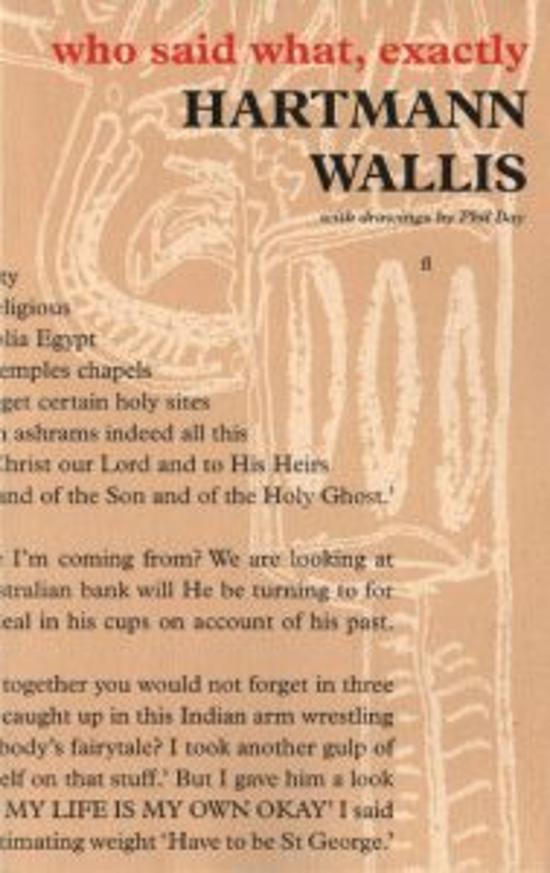
But, subject matter is not my link. Instead, I’m linking from Flanagan’s book about a question to a book whose title is a question, Hartmann Wallis’ Who said what, exactly (my review), though I admit there’s no question mark on the cover. Hartmann Wallis is one of the pseudonyms used by painter, printmaker and writer, Robin Wallace-Crabbe. Wikipedia says he uses this pseudonym to muse on subjects like “art, love/lust, loneliness and animals; usually with a tone of disdain regarding cruelty toward animals and our fellow man”. This is worthy of a link, but so is the fact that his book was illustrated by Phil Day. I have reviewed a few books where Day’s hand has been, including his own, A chink in the daisy chain.

However, I was surprised and delighted to notice that Phil Day is acknowledged as the artist of the beautiful rabbit on the cover of Melanie Cheng’s The burrow (my review). I assume it’s the same Phil Day – I’ve not been able to confirm it – and am making him, and The burrow, my link.
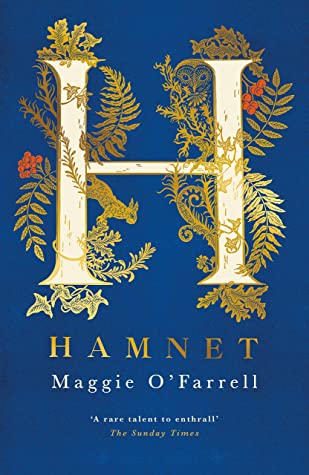
Now, I must move away from Australian authors as I shouldn’t be completely parochial, as good as our authors are! So, my next link is to another book in which a mother grieves for a child, albeit the child is 11, not a baby as in The burrow. The book is Maggie O’Farrell’s Hamnet (my review).
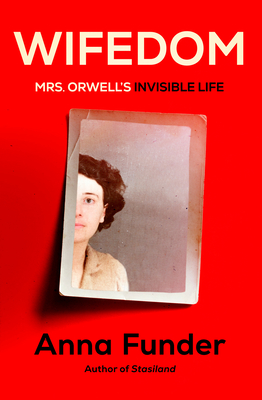
And finally, ok, I’m sorry, but I’m going to do it, I am returning to my first author, Anna Funder and her book Wifedom (my review), which does in non-fiction, what O’Farrell does in fiction, which is to bring into the light, the forgotten wife of a famous, much-lauded writer, Eileen O’Shaughnessy, wife of George Orwell.
So, five of my six books are by Australian writers, but their subject matter and settings roam widely and across some big questions. Four of my six books are by women. I guess there is a loose link back from last book to Prophet song, in that Lynch’s book is dystopian as are some of Orwell’s works.
And, have you read Prophet song and, regardless, what would you link to?
 Whispering Gums
Hi Sue, I’m about halfway through the audiobook of Prophet Song. It’s intense but superbly written. Not sure what I’d link it to – possibly 1984, as it has that kind of vibe.
Thanks Angela … and you neatly confirmed my pondering whether George Orwell might provide a circular link back from Wifedom.
I read Stasiland last year and really enjoyed it, it was my first book by Anna Funder. Then, having heard so many things about Wifedom I tried to read that too but wasn’t able to finish it. It felt like she was saying things that I just wasn’t articulate enough myself to get out, and some of it just hit a bit too close to home that as I was reading it, I was feeling increasingly angry and risking taking this more existential anger out on my other half. I will definitely read it at some point in the future, but perhaps when my kids are a bit older and we have a little more distance from this busy time of life.
Oh thanks Becky. I loved Stasiland and it sounds like you did too. I’m sorry that Wifedom was difficult for you, but good on you for giving up reading it when you recognised that. I have had books confront me too in the past. Shows how powerful reading can be doesn’t it? My kids are grown up, but I have been immersed in those early days recently, as during our downsizing I unearthed old correspondence from those times that I received from friends, and I now have time to read them. They took me right back to ALL the challenges of those times.
Hi Sue, I have read Prophet Song for my two book clubs. The majority liked it, even though it was very dark. I did like your links. I have kept to the dark side and Northern Ireland. Mine are Say Nothing by Patrick Radden Keeefe; Milkman by Anna Burns; Lies of Silence by Brian Moore; Reading in the Dark by Seamus Deanne; Cal by Bernard MacLaverty, and Trespasses by Louise Kennedy – all good reads!
Thanks Meg … I wonder if my reading group would like it. Anyhow, keeping to dark Northern Ireland sounds like a good approach. I’ve not heard of most of those – besides Milkman!
I’ve read ‘Prophet Song’ and I would probably set off on a dystopian set of linkages, which might include Tim Winton’s ‘Juice’.
Thanks Jennifer … I nearly did the dystopian approach. I think that’s a good one to do I think. Though perhaps the Stasi are pretty dystopian!
How about degree one as Michael Collins by Tim Pat Coogan, chosen because Collins was Irish and had a short and deadly way with the secret police employed by the UK.
Degree two shall be The Good Soldier Schweik by Jaroslav Hasek, because at the beginning pretty much all of Schweik’s neighborhood ends up briefly jailed for subversive remarks after the assassination of Franz Ferdinand.
Degree three is The Charterhouse of Parma by Stendhal, since some secret-police intrigue occurs there.
Degree four is Not I, by Joachim Fest, a story of what his family–adherents of the Weimar Republic–went through under the Nazi regime–immediate unemployment for his father, harassment of one sort or another.
Degree five is A Cloak of Light, a memoir by the novelist Wright Morris, since early on (1940) he is arrested by the city police of Greenville, North Carolina, as a suspicious character. He had some time before been locked up by the Italian police, as recounted in an earlier memoir, GSolo.
Degree six is Red Harvest by Dashiell Hammett, a sort of reductio ad absurdum of the detective novel, in which a detective creates chaos in a mining town to no very clear end.
I have not read anything by Paul Lynch.
So many versions of police and police stories here, George. Thanks. Michael Collins is a great start.
Just one question, would you recommend the Hammett.
The Hammett is probably worth reading, if you don’t mind the staggering mortality rate. It is not particularly long.
Thanks George … it would depend on how gruesome and graphic the mortality rate was. My guess is not so much?
Wonderful chain, Sue. I especially loved your question link from Flannagan to Wallis and the Orwell/Prophet song dystopian link. The cover of the Burrow is lovely–I’d pick it up for that alone, though the book sounds excellent too
Thanks Mallika… I’m glad you like that link. Sometimes I look hard to find a link to bring in a book that isn’t so well known, to give it a little bit of air.
Fun linking as always! I have read Prophet Song and it is most excellent as well as terrifying. I’d be inclined to go dark and link first to Sinclair Lewis’s book It Can’t Happen Here, and then link to Margaret Atwood’s Handmaid’s Tale. Then I think I’d have to figure out something a bit more hopeful to link to 🙂
Thanks Stefanie. I don’t know that Sinclair Lewis book. I guess I only know his most famous one Main Street ( though I just checked his Wikipedia page and realised I know a couple of others but not this one.) I like your thought of trying then to move to something more positive. Good idea!
I avoided the rush for Lewis’ book in 2016, but just recently rescribbled it onto my list. It fits with my reading year now anyway, with more classics for me than usual. But of course I wish it wasn’t still so relevant.
Love that you recently “rescribbled” Lewis into your book. I’d be interested to read it too but won’t be scribbling it onto my list I think.
(There seems to be a limit on the length of a reply chain.)
No, Hammett does not particularly dwell on the details of the killings.
Excellent … I’ll add this to my list – for Mr Gums and maybe me.
BTW Yes, there is. I can change it but with the indenting, the later comments become almost unreadable on devices like phones as each line ends up containing only a few characters.