Novellas in November 2024, Part 2 (New to my TBR)

November is over and, as I expected, I didn’t get to post much for Novellas in November. However, I did read a couple of novellas and started another short form work (ie nonfiction), and, more to the point, I did read some participants’ posts which resulted in my noting some “New to my TBR” options.

Last year I listed 8 “New to my TBR” options and, unusually for me, I actually read two of them. They were:

New to my TBR:

  • Jon Fosse, Aliss at the fire (translated by Damion Searles) (orig. pub 2003): Brona of This Reading Life was mesmerised by this book in which an elderly woman reflects on the disappearance of her husband some twenty-five years before, after taking his rowboat out into the fjord.
  • Pascal Garnier, Boxes (translated by Melanie Florence) (orig. pub. 2012?): Kimbofo of Reading Matters didn’t like this as much as other books she’s read by Garnier, but I’m intrigued. Strangely, given my interest in Fosse’s book, it’s about, says kimbofo, “a middle-aged man reeling from his young wife Emma’s sudden disappearance”. It appears that journalist Emma fails to return home from a work trip and is presumed dead.
  • Paul Griffiths, Tomb guardians (2021): Lisa of ANZLitLovers makes this story – about the guardians of the tomb from which Christ’s Resurrection took place – sound both interesting and entertaining.
  • Jean-Patrick Manchette, No room at the morgue (translated by Alyson Waters) (orig. pub. 1973): host Cathy of 746 Books attracted me to this one by describing it as French noir which “blends a taut mystery with a trenchant sense of ennui and regret”.
  • Hiroko Oyamada, The factory (translated by David Boyd) (2010): Karen of Booker Talk posted on this and caught my attention, partly because it’s Japanese, but more because factory settings intrigue me and she describes it as unsettling and bordering on the absurd. 
  • Evelyn Waugh, Love among the ruins (1953): Judith Stove commenting on my Part 1 post, recommended this dystopian novella. She write that “Waugh covers a lot of themes – the ‘ruins’ of the title, criminal rehabilitation, and the transformative power of love – as well as the assisted-death industry. Plenty of themes with relevance to our time!” It’s a while since I’ve read Waugh, and this appeals and sounds manageable in my time-poor life!

There are probably others but given my track record for actually reading books I spy, I think this is enough. Maybe some of them caught your eye too? I see that two caught host Cathy’s eye. Check out her post to see which ones! I must say that she reminded me that I’d also been attracted to Kate’s post on Carys Davies’ Clear, but I am not going to (formally, anyhow) add it to my list. It’s long enough.

Regardless, has Novella November affected your TBR pile this year?

Written for Novellas in November 2024. Thanks as always to Cathy and Rebecca for hosting this special month.

Monday musings on Australian literature: Books set at the beach

Summer has formally started here in the Southern Hemisphere, and in Australia that means (for most people), the beach. We have gorgeous beaches here – not that they are my go-to place – so I thought to share some books set at the beach, by the sea. Some of these may also be “beach reads” (see my post on that concept), but that idea, whatever it means to you, is not what is driving this selection. Rather, I’ve chosen these books for the different ways they explore the beach – or, the idea of the beach – in Australian culture.

This is a very selective list, and I’m presenting it in order of publication.

Beach set books

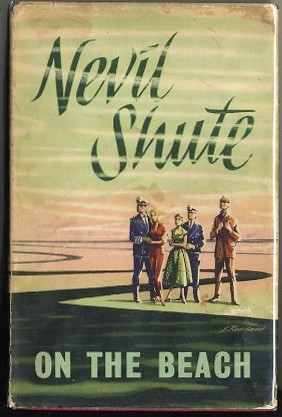
Nevil Shute, On the beach

Nevil Shute, On the beach (1957, read before blogging): Shute’s classic apocalyptic novel needs, surely, no introduction. It is perhaps a cheeky inclusion here as it is not so much set “on the beach” but in Melbourne where some of the last people alive on earth are awaiting death from radiation following a nuclear war in the Northern Hemisphere. The idea of beach, in fact, is more metaphoric, or allusive, than literal, though most covers show beach and/or sea scenes. This book keeps on keeping on. Only last year, Alexander Howard wrote in The Conversation that the Sydney Theatre Company was presenting the first stage adaptation, and commented that

Shute’s vision of humanity’s self-inflicted destruction is eerily resonant in our time of climate emergency. The nuclear threat remains, too, in our perilous historical moment of democratic backsliding and failing nuclear states.

Kathy Lette and Gabriel Carey, Puberty blues (1979, seen – but not read – before blogging): one of our most famous beach-set books, this is a coming-of-age novel about two friends growing up on Sydney’s beaches, and coming up against the gendered nature of the surfing community, where girls are accepted only so long as they support the males. Lette has described 70s surfing culture as “tribal and brutal”.

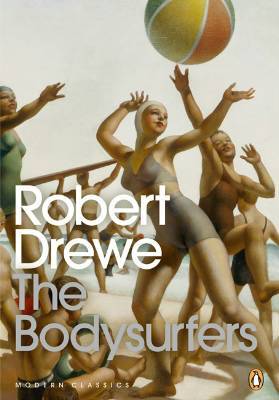
Robert Drewe, The bodysurfers

Robert Drewe, The bodysurfers (1983, on my TBR): Drewe regularly features the beach and/or the sea in his writing. Many of his books are titled for beach and sea themes. His novels and and short story collections include The rip, The drowner, and The true colour of the sea; his memoir is titled The shark net; and he edited an anthology titled The Penguin book of the beach. The bodysurfers is more a collection of interconnected short stories than a novel. According to the back cover blurb of my edition, it is “set among the surf and sandhills of the Australian beach – and the tidal changes of three generations of the Lang family”. Like many of the books I’m including here, it has been adapted to other media, in this case to film, television, radio and the theatre! I read the first two stories some time ago and loved the writing. I intend to finish it one day, which is why it is still on my bedside table.

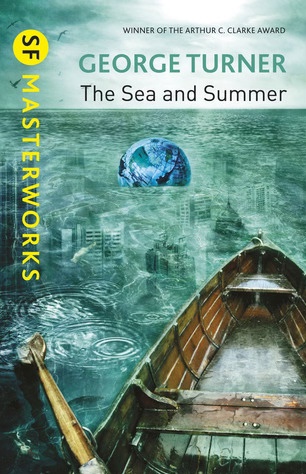
George Turner, The sea and summer (1987): like Shute’s novel, this is not exactly set on the beach, but this dystopian novel by Miles Franklin award-winner Turner is about climate change and the sea flooding the city – Melbourne again, in fact. Fourtriplezed, who comments on my blog occasionally, has reviewed this novel on goodreads. The book, he says, conveys a “dystopian nightmare” characterised by “greenhouse induced floods that make large tracts unlivable, worldwide economic collapse, over population, mass starvation”. He quotes from the novel:

“This is Elwood and there was a beach here once. I used to paddle here. Then the water came up and there were the storm years and the pollution, and the water became too filthy.”

Tim Winton, Breath (2008, my post): like Puberty blues, Breath is set amongst surfers, though on the Western Australian coast. Also like Puberty blues, it’s not so much about surfing as the cultural issues around it. In this case, the protagonist is male, and the focus is masculinity and risk-taking, and how the choices you make follow you. Winton, like Drewe, writes frequently about the beach and the sea but never simply. The sea and surfing offer necessary rejuvenation for Winton the person, but writer Winton uses it effectively to explore the themes that concern him about family and love, values and responsibility, lost males, and the environment.

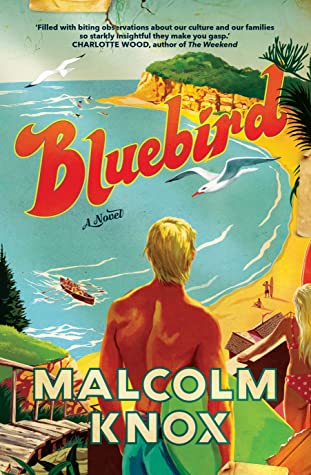
Malcolm Knox, Bluebird (2020, my review): a satirical novel set in a beachside suburb. I wrote in my post that it looks like a satire on all those beach communities that pepper Australia’s coasts – the middle-aged men who prefer surfing to working, the country-club set, the councils which sell out to developers, small-town racism and gay-bashing, and so on. However, I suggested that while a beach-town might be the setting, its satire is broader, reaching into wider aspects of contemporary Australian life – dysfunctional men and broken families, development, aged care, banking, local government, and so on. In other words, given Australians’ love for the beach, such a place makes the perfect, relatable, setting for his satire …

That seems a good point on which to end this little selection. The beach in Australia can mean and reference so many aspects of our lives and national psyche, from escape and relaxation through the many ways we relate, behave and think to apocalypse and dystopia.

Do you have favourite beach-set books, Australian or otherwise?

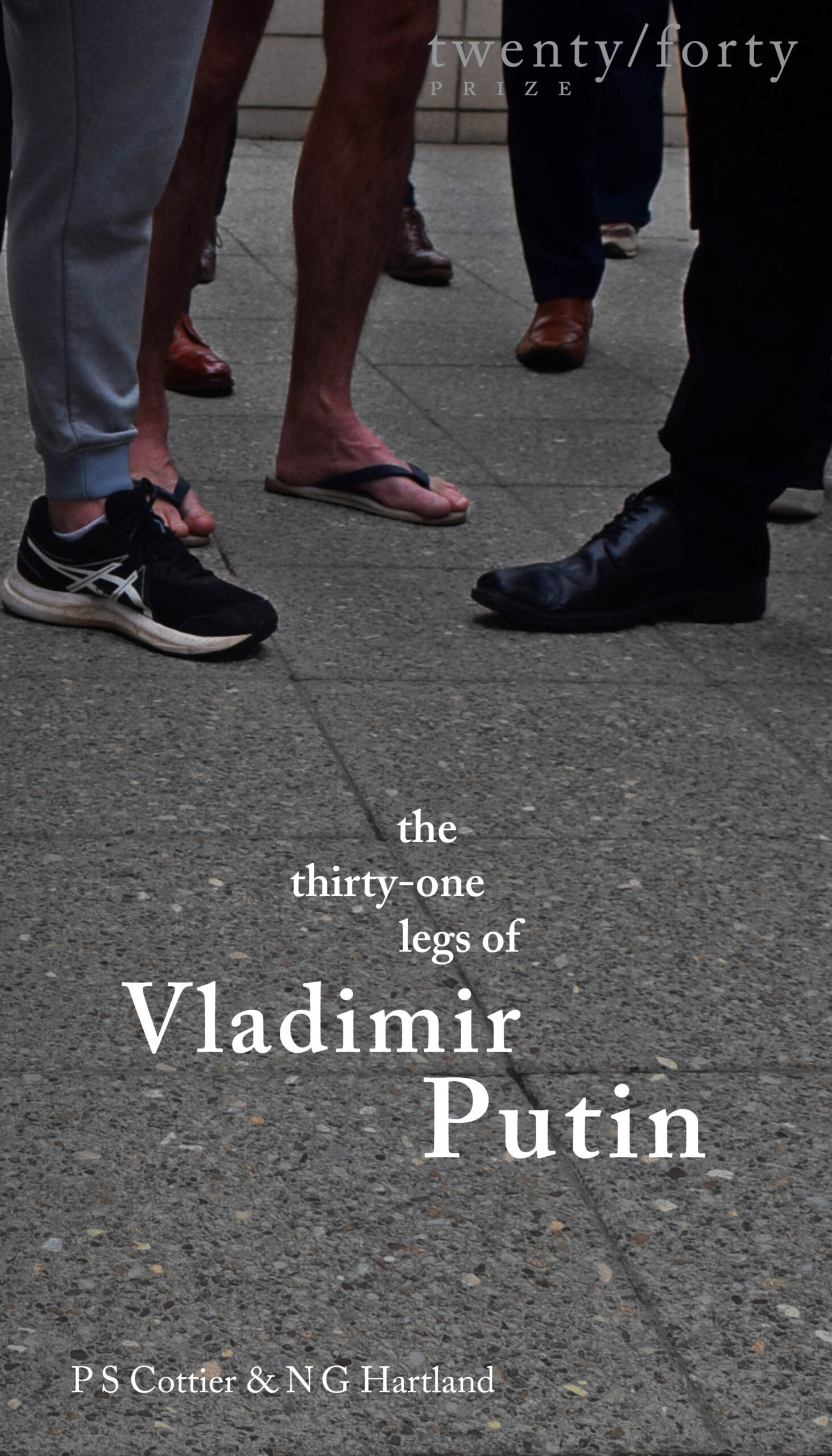
PS Cottier and NG Hartland, The thirty-one legs of Vladimir Putin (#BookReview)

Earlier this month, I posted on a conversation with the winners of the 2024 Finlay Lloyd 20/40 Publishing Prize, P S Cottier and N G Hartland, who wrote The thirty-one legs of Vladimir Putin, and Sonya Voumard, who wrote Tremor. On the surface, these books look very different, but conversation facilitator, Sally Pryor, found some similarities suggesting both explore ideas related to identity, one’s place in the world, and how we can be captured and defined by the systems within which we live. Having now read Cottier and Hartland’s novella, and having started Voumard’s memoir, I can see she has a point.

If you didn’t read my conversation post, you may be wondering what the heck this book with its curious title is about. Besides the fact that it’s a novella, which I love, I was attracted to it from the moment I saw it on the shortlist because the description said it “spirits us away on a comedic journey into a world where the reality and absurdity of political power are increasingly indistinguishable”. That sounded just too delicious and I was glad to see it win.

Ok, so I still haven’t told you what it’s about, but be patient, I’m getting there. The novella was inspired, said Cottier and Hartland, by the idea that there are such things as Putin “body doubles”. There is even a Wikipedia page about this “theory” so it is a thing, as they say! The titular “thirty-one legs” belong to 16 of these body doubles whose stories are told in the book. Sixteen, you ask? That doesn’t compute from 31? True, but one of the doubles only has one leg! How can that be, you might also ask, how can a “double” of two-legged Putin only have one leg? Good question, and I won’t give it away, but let’s just say that the idea epitomises the absurdity of the notion.

Now, this is a collaborative novel, and if I understood correctly from the conversation, Cottier and Hartland started by “pushing out” individual Putins. In fact, the novella reads rather like a set of interconnected short stories because each Putin stands alone, with minimal connection between them except they are all Putin doubles and most of them assume there must be others. However, there is a narrative arc to the whole. Each Putin tells us something about their recruitment and its impact on their lives, with some threads recurring through the different Putins, depending on their location and personality. Two Putins also bookend the story. Surfing Putin, Dave McDermott in Western Australia, opens the book in the Prologue and concludes it with his own story, while English Putin Samuel Chatswood starts off the stories proper, and returns with the penultimate story. Each chapter is titled with the name and location of a Putin, so we have, for example, “Maja Dahl, Oslo, Norway”, “Richie ‘The Putin’ Rogers, Cirencester, England”, “Joppe Stoepke, The Hague, Netherlands”, and “Andrei Galkin, Rostov-on-Don, Russia”.

The set-up, or plot, is simple. People from around the world who look like Putin have been recruited to act as Putin doubles should they be so needed. This recruitment has happened over twenty years, but the book is set post the Ukraine invasion, so our doubles suspect they will not be called upon to play Putin. Some are quite edgy about this, while others are more phlegmatic. For all of them, though, being paid – because paid they are, monthly, from an anonymous bank account – comes with questions, if not challenges.

Our first fully-fledged Putin, Samuel Chatswood from London, sets the scene. He tells us about his fears about being a double. Not only is he frequently teased about his resemblance to Putin and asked “why anyone would want to invade Ukraine?”, but he’s anxious because he has been increasingly getting dark looks from strangers since the Skripal poisoning. However, having recently spied another lookalike, he is “comforted” by the idea that “whatever suspicion and recriminations are possible, they are less likely to entangle me if I’m not the only Putin lookalike”. He also heralds the denouement, when he returns to find that such comfort might have been misplaced.

We meet all sorts of Putins, from the fearful, through the deluded, and the thoughtful, to the confident or more upbeat, but all ponder what being a Putin double means for them. For some their own identity gets lost in the role, and some are confused, or at least perplexed, about what’s expected of them. For others, like the resourceful Chilean, Sebastian Soto, it’s a business proposition, while several capitalise on their lookalike-ness. Steve Pinebrother in “International Waters”, for example, not only makes money, secretly, as a double but, publicly, as a performer on a cruise ship. Each one is beautifully individuated, and I find it hard to pick a favourite. There’s much humour in many of their stories, but there’s pathos too, particularly with those who get lost in – or fearful about – their roles. Life is not simple when you accept money without clarity, eh?

“the butterfly of truth does not need questions to emerge from its cocoon of facts”

So, what’s the takeaway. An obvious one is contemporary culture’s focus on appearance and its willingness to monetise looks without much substance behind it. But another is murkier. This novella, I’m tempted to say, could be read as an allegory of the changing world order. No matter where the Putins live, recent changes are unsettling them. The ground is shifting and they (we?) don’t know how to react. Do they bury their heads in the sand, believing it will be alright? Do they wait for the inevitable or, try to withdraw? Or do they take action, and if so, what action can they take? For French Putin, Hugo Fournier,

It matters not, I conclude, what is reality and what is an extravagant theory from a feverish mind. The answer of course is that I should trust no one. I am the only Putin who can, and will, look after me.

Is such isolationism the answer? Through their various Putins, Cottier and Hartland pose serious questions, including, what do we believe and what we can or should we do?

The thirty-one legs of Vladimir Putin is an audacious “what if” story. Its episodic approach works well in the novella form. Were the book much longer, the conceit would, I think, start to lose its freshness. As it is, there are enough Putins to provide a variety of stories, without becoming repetitive. The tone is light enough to be highly entertaining, but the content is informed and thoughtful enough to engage our minds. This book would make a perfect Christmas stocking stuffer, which is not to say I put it on a par with chocolates and scratchies, but that it is small in size, well-priced, physically lovely, and a thoroughly absorbing read.

Read for Novellas in November.

PS Cottier and NG Hartland
The thirty-one legs of Vladimir Putin
Braidwood: Finlay Lloyd, 2024
115pp.
ISBN: 9780645927016

Review copy courtesy Finlay Lloyd.