Summer has formally started here in the Southern Hemisphere, and in Australia that means (for most people), the beach. We have gorgeous beaches here – not that they are my go-to place – so I thought to share some books set at the beach, by the sea. Some of these may also be “beach reads” (see my post on that concept), but that idea, whatever it means to you, is not what is driving this selection. Rather, I’ve chosen these books for the different ways they explore the beach – or, the idea of the beach – in Australian culture.
This is a very selective list, and I’m presenting it in order of publication.
Beach set books
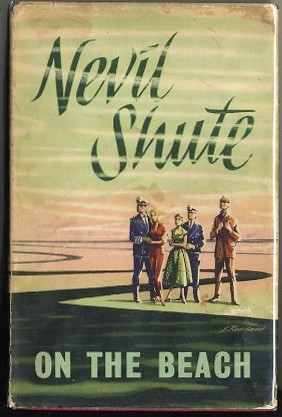
Nevil Shute, On the beach (1957, read before blogging): Shute’s classic apocalyptic novel needs, surely, no introduction. It is perhaps a cheeky inclusion here as it is not so much set “on the beach” but in Melbourne where some of the last people alive on earth are awaiting death from radiation following a nuclear war in the Northern Hemisphere. The idea of beach, in fact, is more metaphoric, or allusive, than literal, though most covers show beach and/or sea scenes. This book keeps on keeping on. Only last year, Alexander Howard wrote in The Conversation that the Sydney Theatre Company was presenting the first stage adaptation, and commented that
Shute’s vision of humanity’s self-inflicted destruction is eerily resonant in our time of climate emergency. The nuclear threat remains, too, in our perilous historical moment of democratic backsliding and failing nuclear states.
Kathy Lette and Gabriel Carey, Puberty blues (1979, seen – but not read – before blogging): one of our most famous beach-set books, this is a coming-of-age novel about two friends growing up on Sydney’s beaches, and coming up against the gendered nature of the surfing community, where girls are accepted only so long as they support the males. Lette has described 70s surfing culture as “tribal and brutal”.
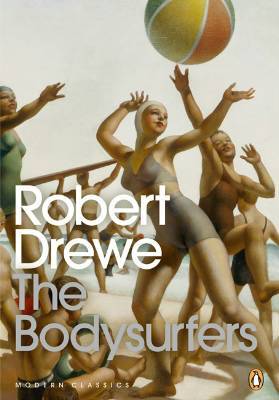
Robert Drewe, The bodysurfers (1983, on my TBR): Drewe regularly features the beach and/or the sea in his writing. Many of his books are titled for beach and sea themes. His novels and and short story collections include The rip, The drowner, and The true colour of the sea; his memoir is titled The shark net; and he edited an anthology titled The Penguin book of the beach. The bodysurfers is more a collection of interconnected short stories than a novel. According to the back cover blurb of my edition, it is “set among the surf and sandhills of the Australian beach – and the tidal changes of three generations of the Lang family”. Like many of the books I’m including here, it has been adapted to other media, in this case to film, television, radio and the theatre! I read the first two stories some time ago and loved the writing. I intend to finish it one day, which is why it is still on my bedside table.
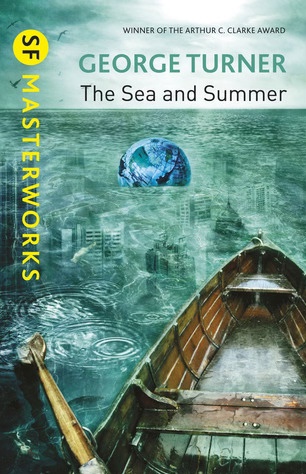
George Turner, The sea and summer (1987): like Shute’s novel, this is not exactly set on the beach, but this dystopian novel by Miles Franklin award-winner Turner is about climate change and the sea flooding the city – Melbourne again, in fact. Fourtriplezed, who comments on my blog occasionally, has reviewed this novel on goodreads. The book, he says, conveys a “dystopian nightmare” characterised by “greenhouse induced floods that make large tracts unlivable, worldwide economic collapse, over population, mass starvation”. He quotes from the novel:
“This is Elwood and there was a beach here once. I used to paddle here. Then the water came up and there were the storm years and the pollution, and the water became too filthy.”
Tim Winton, Breath (2008, my post): like Puberty blues, Breath is set amongst surfers, though on the Western Australian coast. Also like Puberty blues, it’s not so much about surfing as the cultural issues around it. In this case, the protagonist is male, and the focus is masculinity and risk-taking, and how the choices you make follow you. Winton, like Drewe, writes frequently about the beach and the sea but never simply. The sea and surfing offer necessary rejuvenation for Winton the person, but writer Winton uses it effectively to explore the themes that concern him about family and love, values and responsibility, lost males, and the environment.
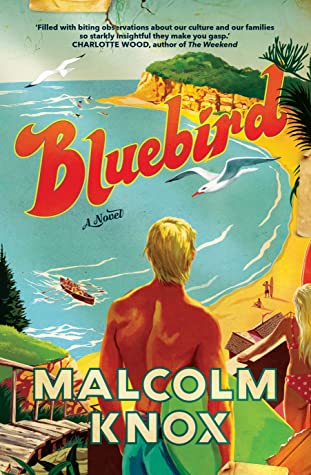
Malcolm Knox, Bluebird (2020, my review): a satirical novel set in a beachside suburb. I wrote in my post that it looks like a satire on all those beach communities that pepper Australia’s coasts – the middle-aged men who prefer surfing to working, the country-club set, the councils which sell out to developers, small-town racism and gay-bashing, and so on. However, I suggested that while a beach-town might be the setting, its satire is broader, reaching into wider aspects of contemporary Australian life – dysfunctional men and broken families, development, aged care, banking, local government, and so on. In other words, given Australians’ love for the beach, such a place makes the perfect, relatable, setting for his satire …
That seems a good point on which to end this little selection. The beach in Australia can mean and reference so many aspects of our lives and national psyche, from escape and relaxation through the many ways we relate, behave and think to apocalypse and dystopia.
Do you have favourite beach-set books, Australian or otherwise?
 Whispering Gums
My impression of Breath was that it was entirely about surfing, about two boys being introduced to the culture by an older surfer.
I gave Drewe’s The Shark Net to a woman who knew some of the people in it. It’s set on the river, rather than the beach.
You’d think that I could come up with another beach novel off the top of my head, but no, I think you’ve covered all the best ones. (Ruth Park has a drawing of a surf lifesaver in The Drums Go Bang but I forget why).
Oh no Bill, I think that’s just the plot of Breath. It is about far more than that. Did you read Breath, or is that your impression from what you’ve heard about it. I loved the way Winton made me feel the joy and terror of surfing, but as I recollect the novel opens with the two boys competing with each other about how long they can hold their breath under water (in a river), and there’s a strong sense that it’s about risk-taking, danger and masculinity. Then there’s the risk taking in big big surfs that occurs later in the novel. Then there’s the younger man-older woman scenario. It’s about masculinity, risk taking, and seeking danger in a way that’s not necessarily healthy.
Ah thanks about The shark net … I do remember its being set mostly in the suburbs rather than on any sort of water … but the title draws on sea/beach image doesn’t it, and nearly all the covers evoke the sea, so I think my argument re Drewe still stands?
I think there are a lot of beach set novels, but perhaps not in the genres that we mostly read? I think crime novels are a good source.
The young Drewe swims in the river at Dalkeith, downstream from UWA. The shark nets were for bull sharks in the river (which has some nice beaches, Perth is all sand, where we took/take the kids/grandkids).
I’ve read Breath, we could argue, but lets just say the beach is the setting.
Yes – Emma Viskic for instance.
We could argue about Breath but it probably wouldn’t achieve anything would it!
As for Shark Net, I was primarily referring to the title – not the content – to the fact that Drew’s draws on sea-words for his titles. I defy anyone not to think of the sea when they hear the word shark.
And yes, Emma Viskic was my first thought. But I think Peter Corris has some too. And presumably many more?
I’ve enjoyed a few novels set on my favorite beach at Isle of Palms in South Carolina, but can’t say that any one of them is my favorite.
Thanks Jeanne … is that because they are more beach reads!!?
Yes, pretty forgettable.
Any time I can find a novel that is set near one of Michigan’s Great Lakes, I’m always happy. Sometimes, the setting is actually Wisconsin, New York, or Canada, but they’re always the Great Lakes. I love them so dearly and can’t imagine what it will be like to live far from them while I’m doing my internship. It is not uncommon for me to jump in the car and drive to Lake Michigan on a whim, just to see it. When I was growing up, the destination was typically the Mackinac Bridge, though right now the freeway heading up there is, I believe, closed or reduced to one lane due to a giant, dangerous snowfall.
I can understand that Melanie … when it comes to water its rivers and lakes I love more than the sea. Maybe because they don’t feel so infinite!
When Fremantle Press wanted me to change my title, the only one I was prepared to put in its place was what that bastard Tim Winton then stole from me !!! [grin]
And I knew Malcolm Knox when he was, like me, working as a sub-titler at what was then the Australian Caption Centre. Good times: we all produced impeccable sub-titles, that never overlapped cuts and NEVER included phrases like “not understood” !!!
Just a couple of off-topic points for yer, ST … 😀
Always love your off-topic points MR. Which title did he steal? Not Eyrie?
The one you wrote about, woman !!!! – I’m not THAT MUCH off-topic ! [grin]
I thought you meant that at first but yours came a few years later so I started to second-guess myself. I never know where your mind is going to take me!
Me neither. 😀
Well what hope have we ordinary mortals got then 😀
Ah, you made me laugh out loud !
You’re welcome!☺️
I suppose the longest-standing beach read ) (hahaof my experience is the red sand beaches of Prince Edward Island, setting of L.M. Montgomery’s Anne of Green Gables but, even though the shore does feature in some volumes of that series, my sense of the importance of various settings in her fiction comes from her personal fondness for these places which features in her diaries more than any single book. (I might read On the Beach for Bill’s event in January, if I can’t get a copy of Henry Lawson’s short stories.)
Hi Sue, when I read the first couple lines of your Blog, I immediately thought of On the Beach. Also, watched Australian Story last night and Kathy Lette was on. So, her book Puberty Blues is fitting. Another one, a sad novel, Past the Shadows by Favel Parrett (I love the author’s name).
Thanks Meg .. I saw that too (a repeat as I’d seen it before) but it was so funny because I was working on the post as it came on. Of course Puberty Blues was on my list already. How could it not be.
I must read Past the Shallows. It nearly made the cut but I could quite feel the vibe for it!
I saw the STC production of On the Beach. When we walked in, the stage was already set up with a ‘living scene’ where the actors where lying around and playing on the beach rather like a Max Dupain photo, waiting for the action to start.
Favel Parrett’s book Past the Shallows features the beach as do many of Robbie Arnott’s stories.
Thanks Brona … how great to have seen that.
And thanks for Parrett. I nearly included both that one and Arnott but decided I liked the variety I had and not to make it longer. Perhaps I could have made it 8 or 10. However I’m very glad you’ve named them.
Thanks for linking my review, I am very humbled. A pity that the most popular on GR said the novels location was in Sydney. At least he read it I suppose.
The cover of The Bodysurfers, the painting Beach Pattern by Charles Meere is magnificent. The cover of Malcolm Knox’s Bluebird is good as well, I tend to like that style of postcard/poster art. I have only read one of Knox’s books, Secrets of the Jury Room, that I read after spending a month on jury duty. Good book.If I see him around I will add him to the far to big TBR.
Thanks fourtriplezed… ah Charles Meere. I did review a book on his art I think. That cover looked a bit familiar but I didn’t recognise it. I have the plain orange and white Penguin classics cover.
PS I like a lot of postcard / poster art too.