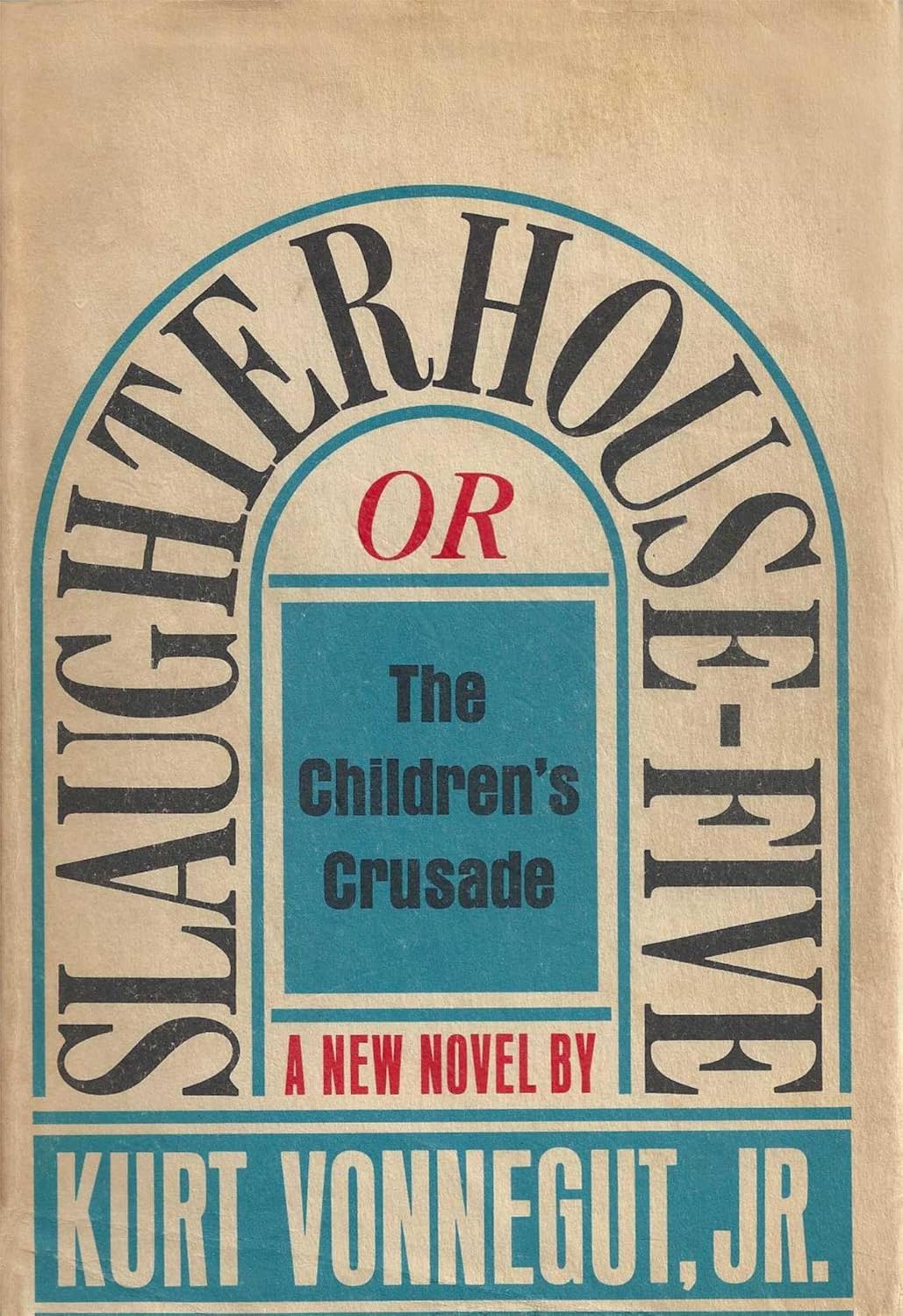
While my reading group’s main reading fare has, from the start, been contemporary fiction, we also mix it up a bit. We do non-fiction, for example, and most years we try to do a classic. Over the years we’ve done Jane Austen, Elizabeth von Arnim, Anton Chekhov, EM Forster, and Randolph Stow, to name a few. This year we turned to Kurt Vonnegut, and, because we couldn’t decide which book to do, we narrowed it to two – Cat’s cradle and Slaughterhouse-Five – and let members decide. You can tell from the post title which one I chose. This was because I have read Cat’s cradle, albeit decades ago. Most of the group, however, read Cat’s cradle, because they’d read Slaughterhouse-Five before.
So, Slaughterhouse-Five it is then – and I’m confronted by the old challenge of what to say about a classic, and a cult classic at that. This book has been analysed ad infinitum, and been found, as the decades have trundled by, to retain its relevance to new generations. However, before I say more, let me give a very brief synopsis, just in case there’s someone out there who doesn’t know the story.
“jumbled and jangled”
Ha, did I say brief synopsis? Easier said than done, but I’ll give it a try. Slaughterhouse-Five tells the story of Billy Pilgrim, from his early years, through his time as an American soldier during World War II including being in Dresden when it was bombed, to the post-war years. During his life, Billy is also abducted by flying saucer and taken to the planet of Tralfamadore, where he is displayed in a zoo. The critical issue underpinning all this is that Billy was damaged by his wartime experiences, something we now recognise as PTSD. Vonnegut conveys – and represents – Billy’s discombobulation, his trauma, through a complex non-linear, non-chronological narrative, in which Billy, who “has come unstuck in time”, travels not only back and forth through time, but also back and forth between Earth and Tralfamadore.
Slaughterhouse-Five is, as a result, a challenging, sometimes mystifying read, but it is also an exhilarating one, because Vonnegut tells his story through satire and absurdity, both of which I love. In the first chapter, the narrator, who is Vonnegut, tells us about writing the book we are now reading. As he hands his finished book to the publisher, he says
It is so short and jumbled and jangled, Sam, because there is nothing intelligent to say about a massacre.
Alongside the occasional appearance of this first-person narrator, we have the unsuccessful science fiction writer Kilgore Trout, who can also be read as a version – caricature – of Vonnegut. His “unpopularity was deserved”, the narrator tells us. “His prose was frightful. Only his ideas were good”. But, Billy loves him. We first meet Trout when Billy is introduced to him by Rosewater, another patient in the hospital to which Billy had committed himself when he feels he is “going crazy”:
Rosewater was twice as smart as Billy, but he and Billy were dealing with similar crises in similar ways. They had both found life meaningless, partly because of what they had seen in war. Rosewater, for instance, had shot a fourteen-year-old fireman, mistaking him for a German soldier. So it goes. And Billy had seen the greatest massacre in European history, which was the fire-bombing of Dresden. So it goes.
If you’ve read the novel, you will know that “so it goes” is its over-riding refrain. Used over 100 times, at moments of murder, death, and other disasters, it functions as a motif, one that both underlines and undermines the horror, by drawing attention to it, then passing it off. The constant opposition, in the novel, of the serious with the offhand keeps the reader unsettled, which is part of the point.
The occasional self-conscious appearance of the author/Vonnegut and the references to Kilgore Trout, along with its story-within-a-story framework, its wild playing with time and place, its fragmentary approach to storytelling, and its unapologetic undermining of “reality”, make this book a postmodern work, if that interests you. By this I mean what sort of work it is doesn’t matter, really. It’s what the work says or makes you feel that really counts. However, it’s these features and techniques which enable Vonnegut to convey what he wants to say in such a powerful way. The how of it is inseparable from the meaning of it.
Slaughterhouse-Five is said to be about many things, including war and pacifism, fate and free will, our experience of time. I could discuss each of these in turn, but the academics already have. I’ll simply say that my primary takeaway is that it’s about the absurdity and incomprehensibility of life and, by example, about how our everyman Billy Pilgrim copes (or doesn’t) with such life.
Slaughterhouse-Five was published at the height of the Vietnam War and the anti-war movement. It was, it seems, the right novel at the right time. Although Vonnegut had had some success before, this was the novel that apparently established him. I can see why. With wars just keeping on coming – and being just as horrific and absurd as the ones that came before them, I can also see why this novel continues to speak to new generations of readers. I mean, how can you not laugh at Billy on display in Tralfamadore:
Then he did exercises he had learned in the Army—straddle jumps, deep knee bends, sit-ups and push-ups. Most Tralfamadorians had no way of knowing Billy’s body and face were not beautiful. They supposed that he was a splendid specimen. This had a pleasant effect on Billy, who began to enjoy his body for the first time.
And, you know what? I’m going to leave you right here, because if this doesn’t convey why this book is such a complex, funny, humane read, I don’t know what will.
Kurt Vonnegut
Slaughterhouse-Five, or, The children’s crusade
Horizon Ridge Publishing, 2024 (Orig. pub. 1969)
199pp.
ASIN: B0D9SKLL68
 Whispering Gums
Wonderful, ST – terrific !!
My time, the time of Viet Nam and Aid (at Monash) to the NLF. Slaughterhouse V the book of the time. The dreadful Albert Langer, Darce Cassidy, Pete Steedman … what a collection of misfits and malcontents were Uni students. Did any of us (I was an involved and same-age employee, not a student) really understand Vonnegut’s tale ? I doubt it.
And I doubt he had any idea how he was going to grab readers’ attention.
Your review explains it.
Thanks so much MR … this was one of the fastest reviews I have written in a while because I just knew what I wanted to say. I’m so glad it made sense to you.
Timing for me.
For whatever reason in January, I decided to read all Vonnegut’s novels from his first to his last. I started with Player Piano, I am going to start Galapagos as soon as I finish my present read. I intend to keep going. Even his short stories and essays are no attractive. So far all have been very good reads with Slaughterhouse Five being the classic it is considered everywhere.
You wrote about Kilgoure Trout “His “unpopularity was deserved”, the narrator tells us. “His prose was frightful. Only his ideas were good”. The narrator sums up Vonnegut summing up himself. He writes, as you say about the absurdity and incomprehensibility of life. Is he a stylish prose writer? Not in my opinion. He just tells absurd tales mixing the human condition with the absurdity of life and adds inane Sci Fi into the mix that just works. He is an amazing writer for all the wrong and right reasons.
In terms of ideas that do not mix the absurd Sci Fi Mother Night is very good. This is a vastly underrated book IMO. Simplistically it is about a US Lord Haw Haw character. His other conventional style novel is Jailbird about a minor character jailed for Watergate. This book led me to the judicial murder of Nicola Sacco and Bartolomeo Vanzetti. Check them out. I had never heard of them but did they play a part in labour relations in the US in the 1920’s. And this book predicts the rise of Amazon. I read this on release and know I did not get it back then. Now I think it so good as to be close to
Slapstick is niche weird. I have no idea how to describe this other than that. Vonnegut claims it is the closest he “will ever come to writing an autobiography”.
I could go on.
Though their writing and ideas are poles apart from Vonnegut the only Australian authors I can think of that challenge me as much in terms of idiosyncrasy are David Ireland and occasionally Richard Flanagan.
Wow, thanks for all this fourtriplezed. What a coincidence that you are reading them all. Re Kilgore Trout, and “The narrator sums up Vonnegut summing up himself”. I hoped I implied that in my sentence but it probably wasn’t really clear. Sometimes I don’t want to labour points, but the result is that sometimes points are missed.
I enjoyed your analysis of his wider work (and of your broad comparison with Ireland and Flanagan. I haven’t read the former though he’s been on my shelves for yonks). I’m not sure what else I will get to read in the near future but I’d be open to it.
Sometimes it’s hard to find the right word for unique things, but slapstick works well enough, for me.
I just read back and I was going to say that Jailbird came close to “Classic Vonnegut when comparing to Slaughterhouse Five” Others may disagree on that. I should add that Slaughterhouse Five’s full title is Slaughterhouse-Five, or, The Children’s Crusade: A Duty-Dance with Death. Rather clever I think 🙂
As to Slapstick or Lonesome No More! (to give it its full title) it might be best to cut and paste my GR review………………………………..
Kurt Vonnegut’s 8th novel and he reaches new levels of niche weird.
The introduction is “Dedicated to the memory of Arthur Stanley Jefferson and Norvell Hardy, two angels of my time.”
This reader sees no Slaptsick per se in the story told, but he sure reads about being Lonesome no More.
Vonnegut gives the game away in the intro. He writes that “THIS IS THE CLOSEST I will ever come to writing an autobiography. I have called it “Slapstick” because it is grotesque, situational poetry—like the slapstick film comedies, especially those of Laurel and Hardy, of long ago. It is about what life feels like to me. There are all these tests of my limited agility and intelligence. They go on and on. The fundamental joke with Laurel and Hardy, it seems to me, was that they did their best with every test. They never failed to bargain in good faith with their destinies, and were screamingly adorable and funny on that account. • • • There was very little love in their films. There was often the situational poetry of marriage, which was something else again”
Let’s leave Kurt there and just say that to this reader this is genuinely strange but audacious fiction. Very niche. The passing Slaughterhouse Five readers was going to wander by this one, surely.
The plot includes;
The collapse of his relationship with his sister.
His none relationship with his parent’s.
Family schisms in general.
Any rich idiot can be the President of the US.
The coming of the Chinese as a world power
Pandemics.
And much more that I can hardly think about, such is this mixed up muddled up world of the life of Wilbur Daffodil-11 Swain. This is his memoir and as the President of the United States.
And this is how Kurt Vonnegut Jr felt when this strangely compelling mélange of oddness that is, to repeat him, the closest he “will ever come to writing an autobiography”?
If this is the case then he had one oddball of a relationship with his parents and his sister and all those around him.
Fascinating fourtriplezed, thanks for sharing all this.
BTW, I was going to include the full title of Slaughterhouse-five but, as a librarian I am trained to get my title from the title page and the title page of my Kindle edition just had the short title, while the cover had Slaughterhouse-Five, or, The Children’s Crusade. Weird.
You have tempted me to read this “closest to an autobiography” book/
Sacco and Vanzetti are super famous in the States.
I had to look them up Melanie … I thought I knew most of the big USA justice controversies but I don’t think I’d heard of them.
The review was exactly what was needed to outline such an unusual yet important novel. Nicely done :0)
I became aware of Vonnegut and this work through the surreal film adaptation fifty years ago. At the time I thought it merely some bizarre science fiction movie. But fortunately it stuck, and a subsequent reading of the book made me aware of this quite eccentric and interesting author.
The Dresden scenes depicted in the film were particularly chilling. Not, I imagine, anywhere near as indelibly distressing as Vonnegut’s first-hand, which infused him with a rage about the crime of Dresden and a healthy distrust of his government, even as a returned soldier at the height of war victory euphoria.
“We did not know we had that kind of a country that would bomb civilians, men, women and children. And we were going to find out soon that we were indeed that kind of a country – big time.“
Readers here might greatly enjoy listening to Kurt speak with Philip Adams in 2011 on ABC radio which amazingly survives in their online archive. The quote above is from that interview, along with many strongly expressed views on the subject. He was clearly a man of great compassion.
Hope the link survives posting…
https://www.abc.net.au/listen/programs/latenightlive/late-night-live-summer—kurt-vonnegut/3678034
Oh, and the 2011 date is a repost of the 2005 interview.
Thanks Throsby. Noted!
Thanks for that link. Much appreciated.
Thanks very much Throsby. As I said to MR, for some reason this post, despite the strangeness of the book, was one of the quickest ones I have written.
One of my reading group members who read Cat’s cradle, also watched the movie of Slaughterhouse-five. I haven’t seen it. Must try to find it. I will check out that link, which does seem to have survived your posting it. I think my setting allows one link per comment through.
I watched a video once of Kurt Vonnegut addressing a class of students who were hanging off his every word. His talk was quirky and interesting and he was so likeable. His prose might not be the best but he is an extraordinary storyteller.
At the end of the talk he said, ‘If this isn’t nice then I don’t know what is.’ I liked the saying so much I wrote it on a bit of paper and put it on my fridge as a reminder. Now, we say it, too, about all sorts of nice things. He used it as a refrain through his talk, much like ‘so it goes’ in the book.
Great Rose, I wonder if that’s on YouTube? I think I noticed a 1 hour talk to students but didn’t have time to see it. I was inspired to put this on my reading group’s suggestion list by the documentary on Vonnegut that did the rounds of the cinema a couple of years ago. It was fascinating.
Haha, love that quote. He clearly liked the power of the refrain!
Yes, I would definitely have watched the talk on YouTube.
I still feel happy when I think about how I felt when I watched it.
Sounds like I’ll have to seek out your doco.
DO, Rose, I think you would like it given you like him. It was called Kurt Vonnegut: Unstuck in time.
Great choice and great comments, Sue, thnx. KV was a master!
Jumping blogs, here’s a good old interview with PG about Maestro (bad sound quality, unfortunately). He s so down to earth and profound.
https://www.youtube.com/watch?v=1cefbI9TV0Y
cheers
Thanks Sean … I will try to watch that in my day of travelling tomorrow.
Thanks so much .
You’ve articulated for me, my jumbled thoughts about this remarkable book.
Like you I so enjoyed the absurdity and humanity in his writing. Interesting to hear that the review flowed so quickly for you.
Thanks so much P! Such a shame you couldn’t make the meeting.
I don’t know why this review came relatively easily but it was a relief!!
He is larger than life, and his quotes are thought provoking. I would love to chase down his short stories to read!
I’d be interested in his short stories too Forestwood.
I found one on the net via google. Most are held in library collections.
Cheers,
Amanda
Thanks Amanda … I’ll try to look it out.
I love this idea of Billy not being self-conscious because there is no one to compare him to. It reminds me of a study done in… I want to say Fiji…. where people had very low rates of eating disorders and low self-esteem, but that all changed when TV arrived on the island.
I read Slaughter-House Five last year, I believe, but I read Breakfast of Champions first, circa 2004. Kilgore Trout is in that book ,too. Then there is the novella Good Bless You, Mr. Rosewater, if you’re interested in seeing some of these characters elsewhere.
Thanks Melanie … I love it then satirical authors reuse characters … like a running joke. Carmel Bird does that a bit here too.
I’ve heard that story about TV being introduced though can’t recollect which island it was.
Fiji, I think
I’m wondering if it’s the same story I heard. I feel it was a different island but it was about TV. Yes, the story I know is about Yap … in a documentary made in 1980 (you won’t remember it!) called “Yap, how did you know we’d like TV”. It’s a memorable title. I can’t recollect the actual impact of TV but it wasn’t positive.
I pulled out a stack of novellas last year for NovNov for easy access. I then carefully packed them together in one of my moving boxes…I came across them earlier in the week and nearly started reading Slaughterhouse Five, but chose Animal Farm instead – satire by another name 🙂
Thanks Brona. Slaughterhouse-five is probably not a novella by some standards but I’d count it that way! I can understand your choosing Orwell right now.
MR, I was at Melb Uni so didn’t have to put up with Albert Langer. I can’t say I met him but I was in meetings he was at, meetings between the Melb and Monash Moratorium organising committees probably. Langer was CPA/ML, a Maoist. I was anarchist, so we were a long way apart, but it does mean I was aware of Sacco and Vanzetti.
Kurt Vonnegut has always been part of my reading. He represents a small but important stream of writing bridging SF and postmodernism, although I suspect the SF element led to him not being taken so seriously as he might have been, as Thomas Pynchon was for example.
I am impressed by 4ZZZ’s reading project. I have a number of Vonnegut’s jumbled up in my head and it would help to read them all and to write them up.
Thanks Bill … I must admit that the SF attribution applied ti Vonnegut always discouraged me so I was surprised by how “un-SF” this book really was. Yes, I know, you don’t have to tell me off for being too prejudiced! Like most “genres” it’s the formulaic, traditional ones that I don’t like!
Thanks Bill. I have got a fair bit out of this project as to him being better than just Slaughterhouse Five and Cats Cradle. Your comment about the SF element not being taken serious is probably true. There is a certain dated feel but on the other hand it is also a time very prescient. Why? IMO because the connections are based on humanist ideals. A kind of forced link to fantasy to allow us to face our humanity. This writing will only appeal to a certain type and those that are more Ayn Rand readers would consider him an extremist.
Jailbird’s RAMJAC corporation is the epitome of modern Amazon dominance and a mix of the the “Hold them captive” story about Chris Ellison of Perth-based the mining firm Mineral Resources. This has no Sci Fi element but works based on an improbable coincidence of the Jailbird meeting an old girlfriend on release. No Sci Fi at all links to humanist ideals permeate. Was this one taken seriously?
I am not sure I can explain this well. I do intend to have a serious read after I have read him out. There seems to be a world of analysis out there.
Not read Pynchon though I have 2 on the TBR. One day.
This – “There is a certain dated feel but on the other hand it is also a time very prescient. Why? IMO because the connections are based on humanist ideals.” – is sort of what makes a classic. With variations, but which I mean most classics feel a bit dated in some ways just because writing styles move on (even if they were innovative at the time) but it’s the relevance of what they say that keeps them worth reading. There’s a fine line there I think because a lot of writers deal with themes that could be seen to be universal but not all do it with sophistication or nuance. Hmmm … I know what I mean but am I making sense to others!
Thanks for this review. It’s so good to be reminded of that book and of Vonnegut in general. I read Slaughterhouse-Five when I was being a Conscientious Objector at the time of the Vietnamese War and, probably don’t need to say, I loved it. When I read it again recently I loved it again but was shocked to read in Vonnegut’s afterword that he had relied on the work of David Irvingfor his facts about the Dresden bombing. Irving has been exposed as having made stuff up so as to argue an equivalence between the Nazi mass murder of Jews and others and the war crimes of the allies
Oh fascinating Jonathan. My edition didn’t have that Afterword. But then I don’t know about David Irving so I wouldn’t have picked that up. What did David Irving make up? Was its impact on Vonnegut’s fictional version enough to spoil the book’s validity?
I don’t think it spoils the books validity at all. As I remember it, Irving grossly inflated the statistics – number of people killed, extent of damage to buildings etc. There’s a terrific movie about the woman who exposed him. The movie is Denial. The woman Deborah Lipstadt. Her book, which I haven’t read, is History on Trial. I think Irving also had some major run ins with Gitta Sereny, one of my heroes.
Thanks Jonathan … that’s good to hear. I suspected as much, that his inflating things wouldn’t necessarily change the experience. That film sounds worth looking out for.
PS I’ve fixed the typo.
Thank you!
Enjoyed your review! I read the book a few decades ago and so all the details are very fuzzy except how I felt at the part of the bombing of Dresden, a swirl of emotions including sick, horrified, and angry. Now you’ve gone and made me think I should re-read it sometime.
Haha, thanks Stefanie. I think this is one of those books that you can read multiple times same get something out of each time. A classic in other words.
Gosh, I read Mother Night just the other week and read Slaughterhouse 5 years ago. I do like his books – in some ways a sort of postmodern Mark Twain.
Oh, that’s an interesting comparison Ian … but I sort of guess where you are coming from. I need to read more Vonnegut.
His works, I feel that I’ve not done justice. I read a bunch way back, before I reliably logged my reads, intrigued first by their covers and, then, by the style-such short works generally, even shorter segments and scenes therein. Never understood any of it, really, but liked it. Then, when I did read three more attentively I felt a little intimdated in realising how much I had overlooked all those years before and I’ve yet to return with a more serious intent.