Another month, another Six Degrees. This is the only meme I do as a regular thing, and sometimes I wonder why I do it. It is fun to think about how to link books, so it’s always exciting to see what book Kate has chosen next. But, is it more than fun? Does it result in our choosing to read books we hadn’t considered before? Is its main value in keeping us connected? Are there other benefits or impacts? Any thoughts?
While you ponder that, I’ll just get on with it … if you don’t know how the #SixDegrees meme works, please check host Kate’s blog – booksaremyfavouriteandbest.
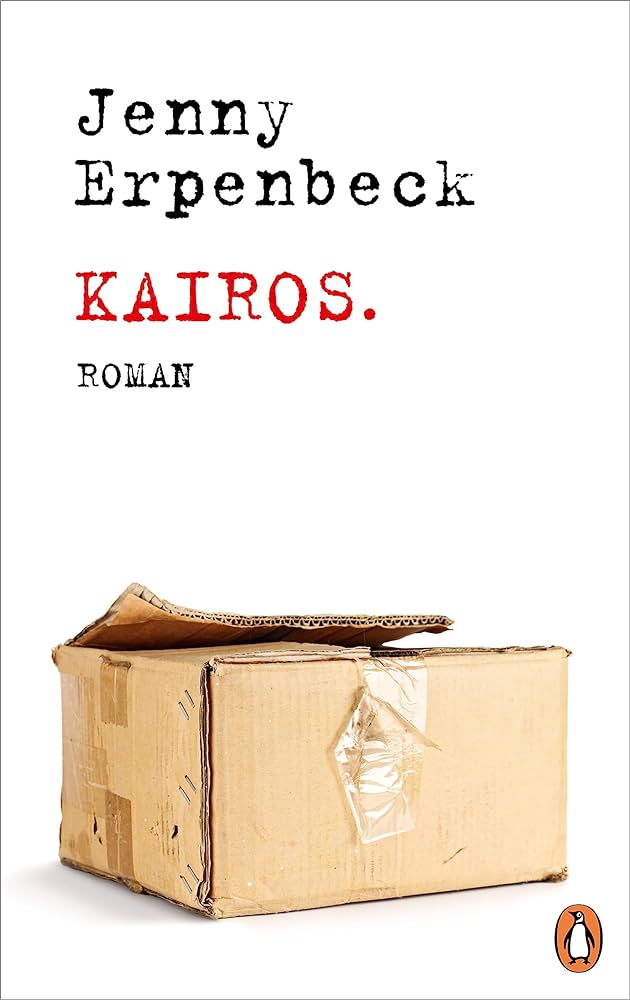
The first rule is that Kate sets our starting book. For this month she set the 2024 winner of the International Booker Prize, Jenny Erpenbeck’s Kairos (translated by Michael Hofmann). It is described at GoodReads as “a complicated love story set amidst swirling, cataclysmic events as the GDR collapses and an old world evaporates”. I’d like to read this one but suffice it to say I haven’t, to date.

I considered choosing another book set in or about the GDR, but I ended up choosing another translated German writer, without specific relevance to the GDR. My link is W.G. Sebald’s Austerlitz (my review), translated by Anthea Bell. If you know Sebald, you will know that this is no ordinary novel, but very broadly its central, titular character is a man who, traumatised by being a kindertransport refugee from Czechoslovakia in 1939, tries to recover his memory and his life some 50 years later.

My next link is to a book in which the protagonist translates Austerlitz, among other books, because translating great books is her hobby, her passion. The book is Rabih Alameddine’s An unnecessary woman (my review). My reading group read this novel, and we did a straw poll on which of the books the protgonist writes about we’d most like to read. There were several, but Austerlitz was the winner. An unnecessary woman is a beautiful book about readers and reading.
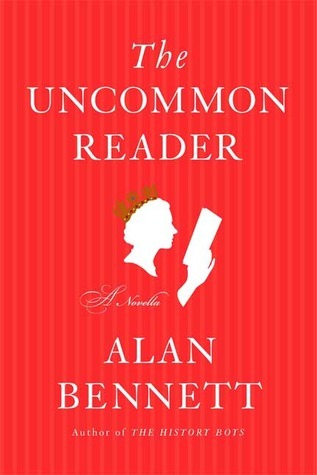
A very different reader is Alan Bennett’s in his novel The uncommon reader (my review). The reader is Queen Elizabeth II, and in his story she discovers reading through a mobile library that visits the palace grounds. In my post, I wrote that Bennett cheekily suggests what the impact might be on her family, staff and the politicians around her when reading becomes not only something she wants to do all the time (instead of her work) but also results in her starting to think and question. A whimsical but not unserious book about readers and reading.
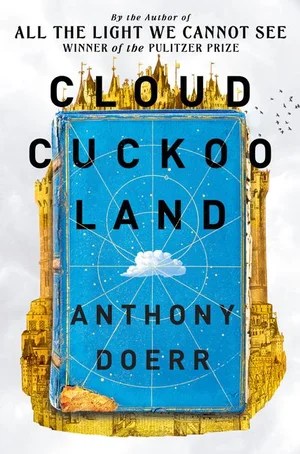
It’s no accident that Alan Bennett’s Queen discovers books through a library. Bennett is surely making a statement there too. A book which the librarians in my reading group loved for its love and promotion of libraries is Anthony Doerr’s Cloud Cuckoo Land (my review). Among other things, this novel is about the role played by librarians in fostering knowledge and reading. Doerr’s Dedication is “For the librarians then, now, and in the years to come”.

I cannot resist staying with the libraries and librarian theme. A character in Doerr’s book speaks of how endangered books are, “They die in fires or floods or in the mouths of worms or at the whims of tyrants. If they are not safeguarded, they go out of the world.” Librarians and readers safeguard books, and this is exactly what is happening in the first story in Rebecca Campbell’s dystopian book, Arboreality (my review). A librarian and university researcher are fighting desperately against time to save books which are being destroyed by climate-change induced floods and fires.

Besides its interest in books, Arboreality is – obviously – about trees. It features many trees, but one species provides a linking thread between the stories, the Golden Arbutus. A very different tree but an equally significant one in terms of the book is the greengage tree in Shokoofeh Azar’s The enlightenment of the greengage tree (my review), translated by Adrien Kijek (pseudonym). It is on top of this tree that the character Roza attains enlightenment. Coincidentally, in this Iran-set politically-driven novel, a library is burnt.
This chain has taken us around the world – but, unusually for me, not to Australia – and through time, from centuries past and into the future. Also unusually for me, four of my six writers are male. Finally, I’d like to draw your attention to a neat circle – my closing book, like the book that starts this month’s meme, is translated.
Now, the usual: have you read Kairos and, regardless, what would you link to?
 Whispering Gums
I loved The Uncommon Reader 🙂 Such fun.
I did too Kate … it was fun to link it here as I don’t think I’ve ever used it in a chain before.
I remenber Austerlitz as a fine book, and your next choices look worth a read: Bennett and Doer always produce good reads. Which means that I’m encouraged to keep a look out for all your choices this month. Thanks for an inspiring chain!
Woo hoo Margaret. The thing about this month’s chain is that it’s not so Australian focused as mine often are. I didn’t intend that but that’s how the links fell out!
I’ve also read Sebald’s The emigrants, but before blogging. He’s a good writer isn’t he. So sad he died when he did.
I love your linkup, I have two of those books on my TBR list.
Oh great Claire … care to say which ones? Would love to know.
The Enlightenment of the Greengage Tree and Cloud Cuckoo Land
Oh thanks for responding Claire. Both are good reads.
Do you really think a mobile library would every visit the palace? Sounds strange to me, considering I’ve seen photographs of their huge collection of books. Plus, I can’t imagine anyone having any problem with her reading. No matter, this is still a lovely chain!
Oh no I don’t Davida. It’s not meant to be taken as real, in that sense … it’s a “what if” story, a sort of fantasy. I think the point is what if she read the sort of books that increased her understanding of humanity. What then for monarchy? People with a vested interest in the status quo might worry about her reading!
Okay… I get it. Too bad she didn’t read more books about understanding humanity. It might not have destroyed the monarchy, but she might have been more understanding with her own family! (As in her sister, her son, and her grandson, to mention just three.)
Haha Davida … fair point.
Lovely chain! An Unnecessary Woman’s going stright on my list.
Thanks Susan … anyone called A Life in Books is sure to love it! It was recommended to me by my brother’s partner a few years ago. She loved it so much she read it two or three times in fairly quick succession. I can imagine reading it again.
The sense of “kairos” that seems to interest people today is III in Liddell and Scott, “more freq. of Time, exact or critical time, season, opportunity.” So
Degree one will be J.G.A. Pocock’s The Machiavellian Moment: Florentine Political Thought and the Atlantic Republican Tradition. (Well, the moment went on for some centuries.)
Degree two will be Martin Heidegger’s Being and Time. This I confess I haven’t opened in nearly 50 years. Something about not finding the exact or critical time for another visit, I guess.
Degree three will be W.V.O. Quine’s Word and Object, which I cherish for (among other things) the curious observation that “Our ordinary language shows a tiresome bias in its treatment of time. Relations of date are exalted grammatically as relations of position, weight, and color are not. This bias is of itself an inelegance, or breach of theoretical simplicity. [etc.]”
Degree four will be Dava Sobel’s Longitude, for one can determine longitude only as accurately as one can determine time, and John Harrison’s chronometer made accurate timekeeping at sea possible.
Degree five, switching to fiction, will be what else but In Search of Lost Time. I believe that Nabokov says that Proust considers that time is of the color of hawthorn blossoms: I don’t know what Quine would have to say about that.
Degree six will be Erpenbeck’s The End of Days, a collection of five short “books” amounting to long short stories or short novellas.
I have not read Kairos, but I have read the books I list, if not all of The End of Days.
Enjoyable and elegant as always George, starting with your Machiavellian moment. Is there a reason you haven’t read all of the Erpenbeck?
You are very kind! Some Christmases ago, somebody gave us a copy of two books by Erpenbeck. I have finished neither, probably because of distractions.
Not kind, truthful!
I understand distractions.
Very good! Austerlitz and Unnecessary Woman–wow! I loved Uncommon Reader. You’d like Mrs. Queen Takes the Train, too, if you like that one.
Thanks Lisa … I’ll look out for Mrs Queen takes a train.
Great chain and such a clever link between books two and three on your list!
Thanks Joanne … I felt it this chain I managed to escape my usual Australian focus, not that that is a bad thing but I feel do many of the books I link tend to be unknown to people. That’s good to a point but it’s also always nice to see something familiar in a list I think.
I love the discipline of the #6 degrees meme and it certainly has introduced me to many books I might otherwise have not met. My only problem is that I am unlikely to live to at least 250 years of age to read them all 😉
Haha Jennifer … I know exactly what you mean. Given I get through way fewer books than you, I’d need to live to at least 500!
You’ve reminded me that I have The enlightenment of the greengage tree on my bookshelf to read! The other books on your chain also looking interesting!
They are Melinda!
I loved The Uncommon Reader. So much fun! I haven’t read any of the other books in your chain, but I would like to read Cloud Cuckoo Land.
Thanks Helen, Cloud Cuckoo Land is a good read.
I often get good suggestions about what to read from others’ chains although it is sometimes frustrating when it’s for books not published in the US. Mostly, I enjoy seeing how people are inspired to link. I was very amused once when I picked up my 85-year-old mother for something and the first thing she said was, “You weren’t very inspired in your 6 Degrees yesterday!” I guess that means she’s a fan? Or at least a reader!
Oh I love that about your mother. They know us don’t they? My mother (she died in 2020) used to read my blog, and send me edits! (Her last career was an editor!)
The Uncommon Reader has been on my radar for years, but I have never managed to read it. I have also been curious about Cloud Cuckoo Land.
I very sporadically participate in 6 Degrees. I enjoy finding connections between books, even if by a thread. I do find books I would like to try on other participant’s posts, although I am not sure my lists do the same for other participants.
Thanks so much for responding to my question LF. I wonder if you took part this time. I will come check … both those books are good reads.
Books about East Germany I liked were Stasiland by Anna Funder and a memoir called Red Love by an author whose name I can’t recall – his parents were both critical believers in the system and gives a fascinating insight about its cruelties but also the nostalgia felt after it collapsed.
I loved Stasiland Ian, and if I’d gone the GDR route that would have been my link, but Red Love sounds really interesting.
Red Love by Maxim Leo.
Thank you, I will note this.
Whoohoo! I have read a couple of these. Austerlitz was a challenge, naturally, but engrossing not only for its message, but because one of my other blogging friends had a good mate who was part of the Kindertransport. Nevertheless, my enduring memory is the single sentence that spanned seven pages 🙂
Cloud Cuckoo Land I absolutely loved after reading an insightful review. I’m sure I already corresponded with you on that.
As for your commenters: Dava Sobell’s Longitude inspired me so much I went in search of the ultimate chronometer and found it in the Clockmakers Guild in a back lane of London. And Anna Funder’s Stasiland etched her name in my brain as a never to be forgotten author.
Thanks Gwendoline. I agree that Sebald is a challenge to read, his writing just flows despite the long sentences and lack of paragraphs, doesn’t it. And of course I agree re Cloud Cuckoo Land.
I’m with you about Funder and Stasiland. I have always meant to read Longitude, but somehow never have. I’m sure I’d like it!
Great chain. I have only read “The Uncommon Reader”, and “Cloud Cuckoo Land” is on my wishlist. Though, after reading your review, I probably should read “Austerlitz”.
Thanks for visiting my post:
https://momobookblog.blogspot.com/2024/07/six-degrees-of-separation-from-kairos.html
Thanks Marianne. There are no “shoulds” really in reading, otherwise I’m an abject failure, but Sebald is one of those writers worth trying to to fit into one’s reading schedule.
Yes, you are right there. I just like to read a well-rounded selection of literature and always put something on my wishlist that I think is worth reading. So, thanks.
Me too. I see that you are an Austen fan. We have that in common too!
Yes, I absolutely love everything about her writings.
Me too!
Oh that was fun as always! I haven’t read Kairos yet. It’s on my list but there are so many people in my library systems who want to read it that it’s going to be awhile. I did just finish reading Arboreality and and very much enjoyed it. I loved how the books saved in the beginning kept popping up decades later. 🙂
Thanks Stefanie … I love that you enjoyed Arboreality too, though I’m not surprised. It’s beautifully constructed isn’t it?
Yes! Even with the large gaps of time it feels like nothing is missed or forgotten and has such a smooth flowy feeling to it. Such a slim novel that packs in so much!
That’s a good way to describe it … “smooth flows feeling”.
I have a confession to make: I usually don’t read the Six Degrees posts as memes aren’t my thing. But I read this one and I’m glad I did. Books about reading, books and libraries are totally my thigns! I’ve read (and loved) Cloud Cuckoo Land, and your post reminded me that someone had recommend The Uncommon Reader to me. But I cannot for the life of me find a copy of Arboreality. It’s not at any of the five libraries where I have a membership and all the bookshops are out of stock. Will have to try harder…
Shame on you Angela!! Haha. I accept your apology and completely understand. This is the only meme I do, and I don’t read other memes on other blogs (besides #6 Degrees) because I’m not really interested in spending the time and energy on memes when I have so little time to read. (There seem to be hundreds of memes out there.) Sometimes I even wonder about doing this one, but in the end I enjoy trying to find ways of linking books. I think it reminds me of university days when I loved finding links in my studies within and across disciplines. Hmmm … that was a long response to your little confession!
Anyhow, I’m really glad you read this one and found something in it to interest you. I love books about reading and writing too – obviously. And I can imagine that you loved Cloud Cuckoo Land given your work. Re Arboreality, I bought the Kindle version, so I’m afraid I can’t even offer you my copy.
My German BFF, Heidi, sent me a copy of The Uncommon Reader for Christmas or Birthday once and I loved it as much as she did.
I don’t usually read these Six Degrees…posts, but I wanted to see what people have to say about Kairos. This is the second post I’ve read and neither of ya’ll have read it. LOL
Haha Jinjer … so sorry to have lured you in under false pretences! Let me just say that next month’s book will, I think, be the first starting book I’ve read this year. My hits on this seem to be getting fewer and fewer as the years roll on. BTW Have you read Kairos?
I have NOT read Kairos, and, after the reviews I’ve been reading, I don’t think I ever will. Doesn’t sound like my cup of tea.
I suspect that’s probably right. I’m intrigued but time is marching in and I imagine it will get me before get to the book.
I get what you mean, Jinjer. We often haven’t read the starter book but sometimes we get a copy and start reading. Like this time, I did that.
Here is my link:
https://momobookblog.blogspot.com/2024/07/six-degrees-of-separation-from-kairos.html
And so did The Chocolate Lady:
https://tcl-bookreviews.com/2024/07/06/tcls-6degrees-of-separation-for-july-6-2024/
You can see there what we thought.
Thanks Marianne. I did read The Chocolate Lady’s Six degrees.
Good
I only knew about Uncommon Reader and Cloud Cuckoo Land (both on my tbr for too long now).. and now i have four more books on that tbr.. Unnecessary woman is going to be my first pick there i think..
My post is here
And it’s a really great pick from this great lot I think, Vidya. Thanks for commenting and sharing your thoughts.
Periodically I check to see how far down I am with the Kairos opportunities at the library; I figure, eventually, I’ll “luck into” a copy. But I’m also not obsessing about it because there are so many other good choices. That’s what I appreciate about others’ participation in this meme (and someone else actually mentioned this too, above), because I have glanced in a book’s direction and then this chatter about it nudges it towards a different status, from intending-to-read to REALLY-intending-to-read (a negligible difference there, but, you know how those distinctions add up over time).
Haha Marcie, I sure do! (And thanks for your comment on the value of the meme.)