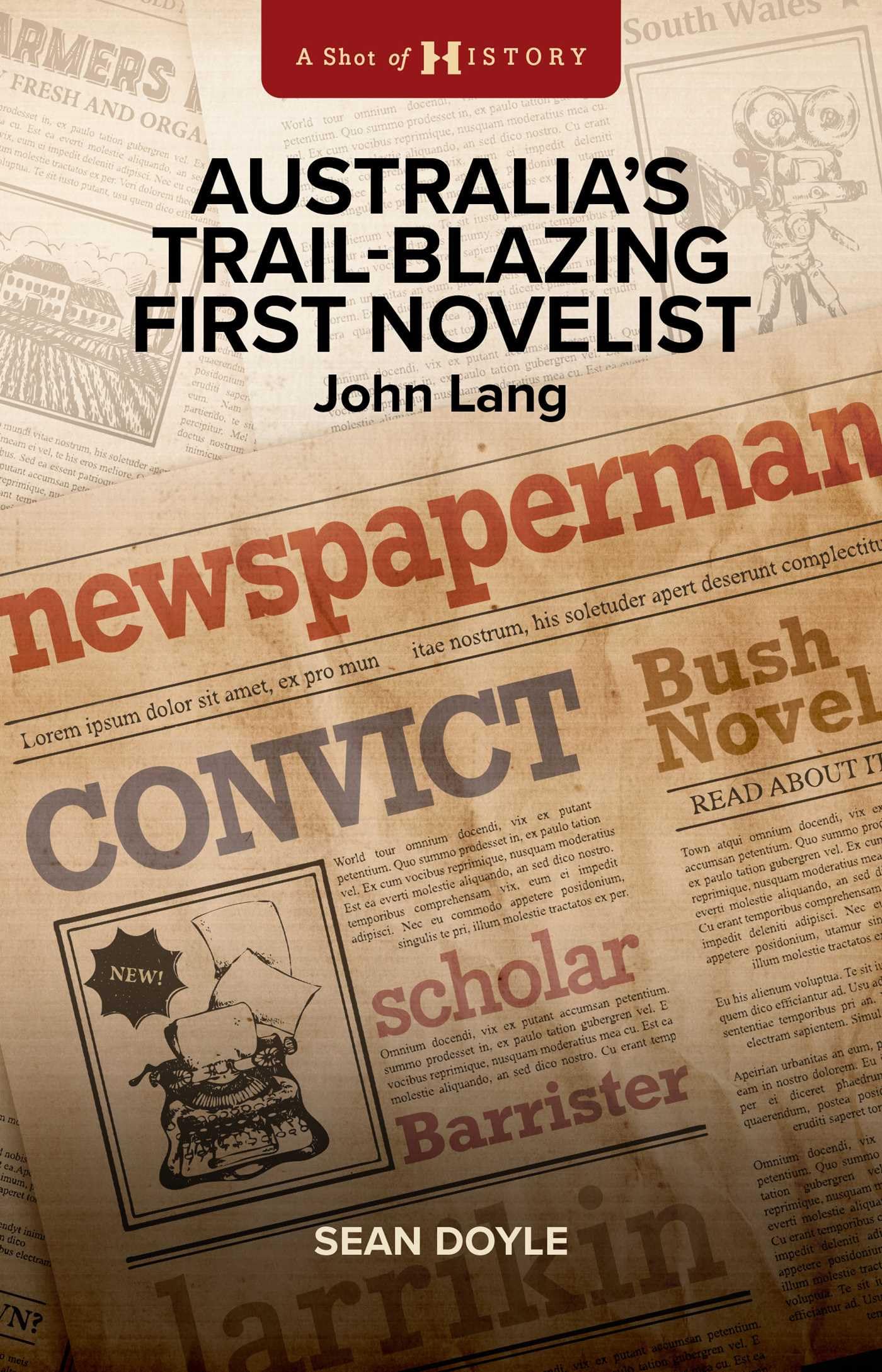
Sean Doyle’s literary biography, Australia’s trail-blazing first novelist: John Lang, provides insights not only into this “idiosyncratic” man, but into two colonial societies – Australia and India – through the early to mid nineteenth-century. Doyle’s is not the first biography of John Lang, but it’s the first I’ve read.
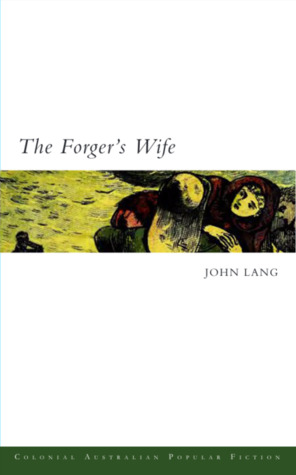
However, Lang (1816-64) himself is not new to me. In 2018, I reviewed his 1853 novel, The forger’s wife, when it was published by Grattan Street Press in their Colonial Australian Popular Fiction series. But, even that wasn’t my first mention of Lang, as I had written briefly about him in a 2012 Monday Musings on Australia’s “pioneer novelists”. In that post, I wrote that he was born at Parramatta, went to Cambridge in 1838 where he became a barrister, and returned to Sydney in 1841, before leaving again a few years later to live in India and England. All this is covered in excellent detail in Doyle’s biography (with relevant clarifications).
I also noted that, according to (my 1994 edition of) The Oxford companion to Australian literature, “the enigma surrounding the life and personality of John Lang has not, even a century later and in spite of considerable literary research, been completely solved”. It is, however, believed he wrote the fiction work, Legends of Australia, which was anonymously published in 1842. The Oxford companion suggests that authorship of this “would entitle Lang to the distinction of being the first Australian-born novelist”. I added that there is a 2005 biography of Lang by Victor Crittenden, whose title says a lot: John Lang: Australia’s larrikin writer: barrister, novelist, journalist and gentleman. He was a contributor to Charles Dickens’ periodical Household Words. All of this is also covered by Doyle, but with additional research, which confirms some of the information that the Oxford companion writers “believed”.
Sean Doyle opens his book with a Preface which sets his biographer’s ground rules. Arguing that the richness of Lang’s life is in the details, he admits that not only did Lang lack a champion “to carry his flame posthumously”, but that there are few contemporary sources and what does exist is sketchy. No diaries or letters are known to survive. So, the temptation of course is to look to his novels, but, as Doyle cautions, while these can be “a looking-glass into his own life … any correlation requires caution”. His process then was “to assemble the verifiable facts, identify the spaces between them, and navigate the spaces with the firm aim of being true to what we know of his temperament, life and times”. He argues that Lang’s “known actions and ways inform the spaces of the unknown”.
Doyle then moves to his Introduction where he makes a strong argument for why this man deserves this biography, starting with Lang’s being “the first Australian-born novelist”, not with 1853’s The forger’s wife, but with Violet, or the danseuse, which was published in 1836 (and identified as being by Lang in Crittenden’s biography). Doyle names many other firsts, including the first Australian satire (Legends of Australia, 1842), full-length detective-novel in English (The forger’s wife, 1853), Indian travelogue by an Australian (Wanderings in India, 1859), and supernatural tale by an Australian (“Fisher’s ghost”, 1836). Other firsts include making the first translation of a classic (a Roman poem) in New South Wales. These firsts, Doyle admits, were more easily come by in the early days of a colony, but argues this doesn’t diminish the achievement.
“He just couldn’t help being idiosyncratic” (Doyle)
The rest of the book, until the Epilogue, chronicles Lang’s life, in nicely readable detail, through 25 chronological and clearly titled chapters, such as “Chapter 1, Family and Social Background”; “Chapter 11, Calcutta, 1842”; and “Chapter 21, Furlough in the UK (and a Creative Peak) 1852-’54”. In the telling, Doyle conveys much about Lang’s personality and character, which he gleans from the sources he has. These include, for example, newspaper reports of Lang’s “ill-advised” comments on the franchise and representation in New South Wales’s colonial legislature while seconding Wentworth’s motion supporting the idea. This is just one of many occasions in Lang’s life – as documented by Doyle – in which he shoots himself in the foot (as they say!) The end result is a biography that portrays a man – a “currency lad” no less – who had a lot of talent, a lot of heart and a lot to offer but who, more often than not, undercut himself through poor judgment and/or poor timing and/or an inability or refusal to read the times and produce accordingly. Lang wanted to emulate Dickens’ success, but “he just couldn’t help being idiosyncratic” – in his literary, personal and political lives.
Nonetheless, Lang achieved much in his relatively short life of 47 years. He is, argues Doyle, better known in India, than Australia, largely because of his support of Rani of Jhansi during her battles against the East India Company, but also for, as a barrister, winning Sikh Jyoti Prasad’s suit against the Company. Indeed, Doyle’s coverage of Lang in India at the time the Company fell and the British Raj commenced makes good, albeit distressing reading. It’s an ugly history, as we know. Lang also established, in 1845 in Meerut, a newspaper titled The Mofussilite, which documented many of India’s sociopolitical challenges of the time, and was often critical of the Company and the British.
The Epilogue provides a thoughtful summation of Lang’s achievements and significance, particularly in terms of his writing, and of the social, political, literary and personal circumstances that affected who he was and what he achieved. It makes a case for Lang’s place in Australia’s literary history, arguing that
without his balanced depiction of the convict era, the colony’s story is lopsided. This matters: a culture is the sum of the stories it tells itself.
The Epilogue, in fact, is a useful document on its own.
The biography is written in a popular-history style, meaning it has a strong narrative drive, with a liberal use of exclamation marks, some foreshadowing, and, for some chapters, serial-like cliff-hanger endings (which feel appropriate to Lang’s era). Doyle wants to understand Lang’s character and actions, and he pursues this with the gusto of a story-teller but with an eye on the facts and truths as he sees them.
Doyle is clearly keen to get the story of Lang and “his rollicking times” known. His research feels thorough and the characterisation as accurate as he can glean from this research. There are end-notes which cite sources for important points and a list of mainly secondary sources (biographies, histories, articles and websites). At times I would have liked to better understand which gaps were being filled, which thoughts and feelings were guessed rather than known, albeit Doyle heralds some with “maybe”-type markers and recognisable pop-psychology. There is no index, which is a big negative for me in biographies, but I know they are expensive, and the chronological telling will help people hone in on where the persons or events they are researching might be.
I did have questions as I read. What was Lang’s attitude to his wife and children, who left him in India, and whom he apparently never saw again, and where did First Nations people fit in those early colonial days of “big” men and their “progressive” ideas? But these are not necessarily germane to the main story here. Lang’s life is story enough, and Doyle has delved as far as he can.
Australian’s trail-blazing first novelist makes good reading for anyone interested in Australia’s literary history.
Note: Four of Lang’s works are available at Project Gutenberg Australia.
Sean Doyle
Australia’s first trail-blazing novelist: John Lang
Newport, NSW: Big Sky Publishing, 2023
372pp.
ISBN: 9781923004382
(Review copy courtesy the author.)
 Whispering Gums
What about Henry Slavery? https://en.wikipedia.org/wiki/Henry_Savery
Thanks Ian. Savery is often believed to be our first novelist – I’ve written about him too – but not Australian-born.
There is also “Louisa Egerton, or”Louisa Egerton; or, Castle Herbert : a tale from real life” which, the NLA says may be the first published novel to have been composed, at least in part, in the Australian colonies. They quote Michael Roe from his ADB entry for Mary Grimstone, who says that ‘it seems likely that during the voyage and immediately after [her arrival in Van Diemen’s Land] she composed her second novel, Louisa Egerton, a tale of real life … If so, this appears to be the first such work of Australian provenance’. I understand it’s a gothic tale, but not set in Australia.
I love the liberal use of exclamation marks comment! On that basis alone, I feel a little as though I’ve read his books! (But, of course, I have not!)
Haha, Marcie. I am prone to exclamation marks … but am trying to reduce them. “lLberal” could be too strong, but they just captured my attention at times because of my own writing. (I nearly put one at the end of that sentence there.)
“a culture is the sum of the stories it tells itself” – WOW !
That’s a lovely succinct statement isn’t it MR.
Wish I could utter such neat summings-up of life !!
So do I.
I do like when a biography is a little bit more narrative. If anything, our entire lives are a narrative, so why make them a list of facts instead? Do you find yourself, when you’re reading a biography, playing detective to discern whether the author is actually being accurate in what they’re writing? I know I’ve done that with biographies that I’ve read in the past, including the biography of Shirley Jackson and Joan Fontaine. Well, Fontaine wrote an autobiography, so I was kind of questioning her and her truthfulness. When it comes to Jackson, it was more about whether the author captured who she was. She’s got a few biographies, so there are points of comparison out there. On a funny note, I swore you wrote that this gentleman was a barista, not a barrister.
Yes, I agree Melanie. I like the narrative-styled biographies too, rather than the more dry recitation of facts. But yes, with biography and autobiography I do think about accuracy, though in a slightly different way. In both there’s an element of what is not being said, as well as what is being said, but with biography this is tinged with what access the biographer had to evidence. Where evidence – letters, diaries, third-party reports/documentation – is missing the biographer needs to fill in the gaps. How they do this is the challenge they face isn’t it? It’s unfortunate with John Lang that there aren’t letters and diaries containing his thoughts about his life.
I have read Joan Fontaine’s autobiography and her daughter’s book Mommie Dearest. As you say, she’s one subject that it pays to check who says what and with what evidence. Austen is a challenge for biographers because while we do have letters, many were destroyed and they presumably were the ones which would provide the most insight into her. As a result, there’s a lot of guessing, and reading between the lines about who she was and the quality of her relationships with her family.
(Haha, re “barista”, I did make a couple of changes after I published this post, but that was not one of them!)
Nope, you spelled barrister correctly, it just that I am a coffee house kind of girl, lol.
Fontaine’s autobiography….I wish I had not read it. I came away just really not liking her. She was name dropping and complaining, and it did change how I saw her on film.
Hmmm … what happened to my reply to this? I am glad that you are a coffee-house kind of girl. We certainly are here. Baristas are taken very seriously in much of Australia!
Yes, I know exactly what you mean about Fontaine. I do think, though, that she had a difficult childhood. That’s no excuse for her behaviour, is it, because as adults we make choices, but at least it helps us understand it.
Pingback: Who’s on First | The Australian Legend
Pingback: Australian Writers: Men’s Week, a Wrap | The Australian Legend