I was unsure about whether to make this post part of my Trove Treasures or Forgotten Writers series, but Wikipedia tells me that in 2006, the historian John Hirst, writing in The Monthly, included this author’s book, The colonial Australians, in a brief list of the best Australian history books of all-time. That probably means he’s not quite forgotten, wouldn’t you think? So, a “Trove Treasure” it is. The author is David Forrest, which is the name used by historian David Denholm for his fiction.
David Denholm was born in Maryborough, Queensland, in 1924 – the place where I, also, was born but, more significantly, it was the birthplace of P.L. Travers, the creator of Mary Poppins. Denholm died in Wagga Wagga, just 3-hours drive from where I live now, in 1997. He has an entry in Wikipedia and in AustLit. From these I gleaned that he served in the Australian army, in New Guinea, during World War 2 and worked in the banking industry until 1964. (I can’t resist adding here that Pamela Travers’ father was a banker, as was my own.) He was a mature age student when he went to university, first to the University of Queensland and then the Australian National University, where he gained a Ph.D in history. He ended his career as an academic in history at the Riverina College of Advanced Education.
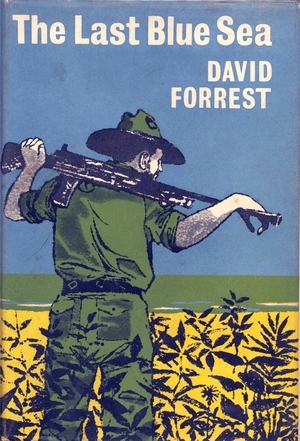
He wrote two novels. His debut novel, published in 1959, was The last blue sea. It is set in New Guinea during World War 2. It focuses, in particular, on the difficulty the Australians faced in fighting in the heat and rain of New Guinea. Wikipedia shares that it has been called “the classic short novel of the New Guinea campaign.” It apparently won the first Mary Gilmore Prize. I wrote last year about his winning this award, but it wasn’t clear in my research that he was the first winner. Now I know.
However, the book which inspired this post, was …
His humorous novel
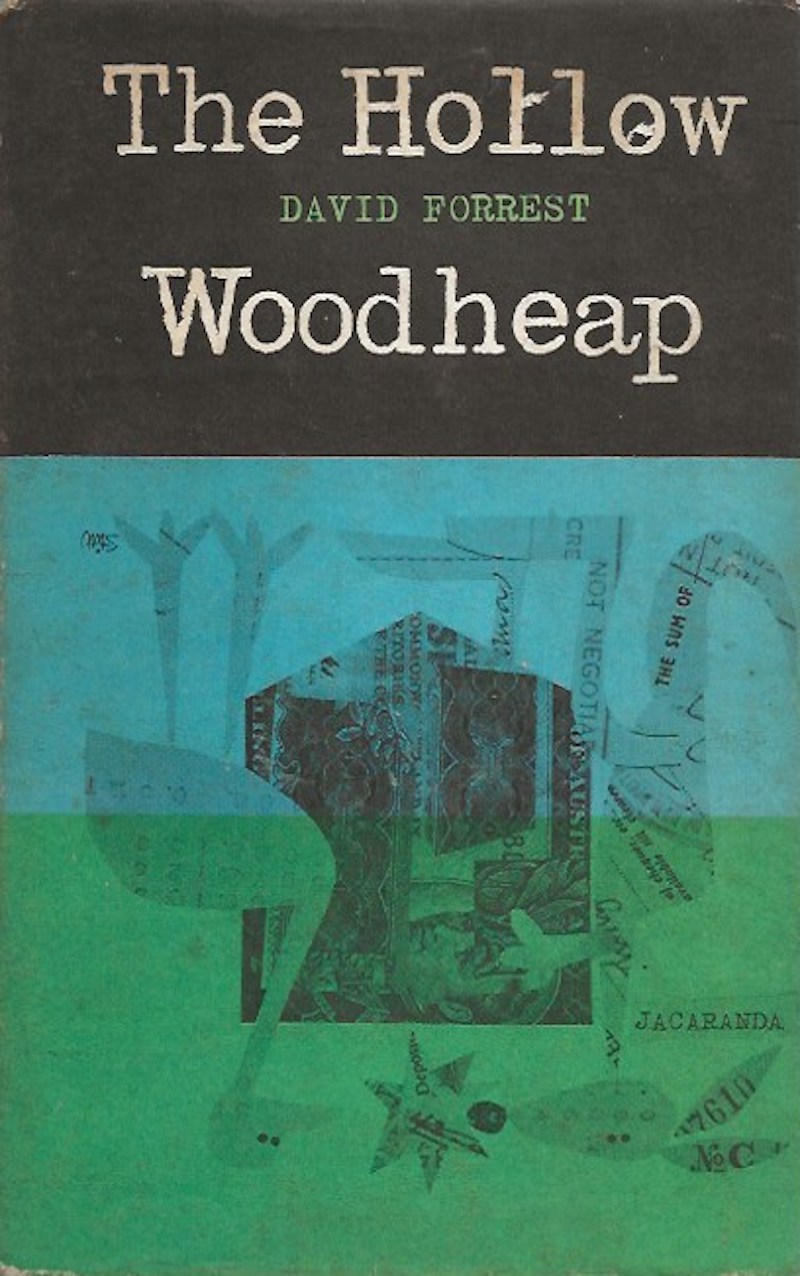
The Trove Treasure I found was in Sydney’s Tribune on 12 September 1962 and was written by someone signing as R.W. S/he started with:
Humorous novels are not particularly common in Australian literature, or for that matter in any other. This is all the more reason why we should be grateful for such a deliciously humorous work as David Forrest’s new novel, “The Hollow Woodheap”. Not since Lower’s famous “Here’s Luck” has the Australian reader’s sense of humour been so titillated.
It seems that Forrest took to heart the advice to “write what you know”, because his first novel was set during World War 2 in New Guinea, where he had served, and this novel, says R.W., “deals with life in the branch office of a bank in Brisbane” which is where he was working at the time. Critiquing the book, R.W. says that the “the plot is rather flimsy” with the humour deriving “mainly from the personalities and behaviour of the characters in their office environment”. Forrest “reveals a sense of the ridiculous and a capacity for irony, of which there is not the slightest trace in his war novel”. My question is, does the humour have a point? R.W. continues,
The new novel is not a work of profound social criticism, but in his lightly humorous way, the author makes many a sharp jibe at the snobbery and red tape of banking institutions, and at the soulless careerism which corrupts those who cannot resist the lure of money, power and status.
I found little else about the book, but I did find a review-rebuff in a Letter to the Editor in The Canberra Times (14 August 1962). Unfortunately, I could not find the actual review, but Maria Reah did not agree with some criticisms the reviewer had made. I’ll just share one paragraph from her letter:
It is true that most of the characters—the bank manager (The Keg), the bank inspector (The Drummer), the savings bank officer (St. Joseph the Bloody Worker), and the three models of managerial material (Mark One, Mark Two and Mark Three)—are caricatures, but Forrest is not the first creative artist to use caricature to good purpose. If these characters were developed more fully they would lose their value as symbols. For The Hollow Woodheap is more than an attempt to poke fun at “the establishment,” though it does this very successfully. It presents a novelist’s impression of Australian society. The sociology is impeccable, but unobtrusive. The young man who wrote the book is not angry enough to lose sight of either the patterning of social life or the lighter aspects of this patterning. His humour is never plodding, as it appears to your reviewer.
Finally, I’ll return to R.W. He hopes that Forrest will write more humorous novels. As it turns out, while he lived another thirty or so years, Forrest wrote no more novels, humorous or otherwise. Wikipedia , however, does say that he wrote a notable and humorous short story, “The Barambah mob” (1963), which has been often anthologised.
I could say more about Denholm/Forrest, but my point for this post is simply this little “treasure”. I agree with R.W. that good humorous novels are hard to find, but they add so much to our literary environment.
Do you have a favourite humorous novel, and would you share it with us?
 Whispering Gums
We admire but barely forgive Forrest for grabbing Lawson’s famous hollow woodheap anecdote and using it to name his novel, presumably as a metaphor for the bank, depriving the rest of us the opportunity. And of course I would love to share my favourite humourous novel but I’ve yet to write it :0(
Haha, Throsby, good answer. Have you read it? I assume, like you it’s a metaphor for the bank. I have to admit that I don’t know (or remember) Lawson’s hollow wood heap anecdote. Can I find it somewhere?
In The Drover’s Wife ~
“Yesterday she bargained with a stray blackfellow to bring her some wood… On her return she was so astonished to see a good heap of wood by the chimney, and she gave him an extra fig of tobacco, and praised him for not being lazy. He thanked her, and left with head erect and chest well out. He was the last of his tribe and a King; but he had built that wood-heap hollow.”
Oh thanks Throsby. I was hoping you weren’t go to say this story since it’s the one I’ve read the most! How could I have forgotten it!
I have only just now come to realize that I do not even know of a humorous novel – unless T.H. White’s “The Once and Future King” can be thus categorized …
There are eight novels to which I am heavily addicted that could be described as crime novels in which humour is delightfully utilized – eight of the nine written by my favourite (award-winning) author of all times, whose unexpected death some years back did away with all possibility of meeting him (and gushing like an ancient schoolgirl …)
Thanks MR … I have never read The once and future king. You can gasp now!
Whenever I think of humorous Australian novels, I think of Nino Culotta’s They’re a weird mob. I think there are more recent writers like, maybe Nick Earls?
Are you meaning Peter Temple? You can name him you know … I did like hime too though I’ve only read two of his books. I don’t remember a lot of humour but I’ll believe you.
There’s a new Aussie crime writer, Benjamin Stevenson, whose novels are humorous I think. I’ve given two to my son but I’m not sure he’s read them in his busy life!
These are the novels which spring to my mind (yes, I’m home. For a week or so I hope). Miles Franklin’s Old Blastus of Bandicoot was my father’s favourite. Which leads to the similarly themed Steele Rudd On Our Selection etc, which I think are more pathos than comedy, but did give rise to (radio serial) Dad ‘n Dave. My favourite is surely Marie Munkara’s darkly satiric A Most Peculiar Act.
Probably should also mention Lawson’s The Loaded Dog.
Yes Bill, I agree that Marie Munkara is a great example of a modern Australian funny/satiric writer. I have still to read A most peculiar act, but I did love Every secret thing.
Your other examples are good older examples, though I haven’t read Old Blastus of Bandicoot yet.
Few humorous novels? David Lodge wrote several feet worth of them: Changing Places, Small World, and perhaps Souls and Bodies (in the UK How Far Can You Go?) to name the ones that I have read. Malcolm Bradbury wrote Rates of Exchange and Stepping Westward (The History Man and Eating People Is Wrong may or may not count). Charles James Portis wrote a number, of which I have read only Norwood. Flann O’Brien’s At Swim Two Birds is very funny; The Third Policemen is very funny also, but doesn’t seem to fit what I think of as a humorous novel.
I suppose that some of the difficulty is in pinning down the definition. Does bite disqualify a novel? If so, then the ones I have expressed doubt about aren’t humorous novels.
Thanks George. I know of most of those and have read some, but none are Australian, which was this critic/reviewer’s point, which makes me wonder. Most of Lodge’s best known ones were written a decade or so after this 1962 novel. Have you read any of his 1960s ones?
But, good question re definition. I think it has to be an eye-of-the-beholder situation. I think that if it makes your laugh it’s humorous but – hmm – is it a humorous novel? Wikipedia uses the Collins Dictionary to say that “Comic novels are often defined by the author’s literary choice to make the thrust of the work—in its narration or plot—funny or satirical in orientation, regardless of the putative seriousness of the topics addressed”. They suggest that humour IN a novel does not make it a comic novel. The comedy needs to be “the framework and baseline of the story, rather than an occasional or recurring motif”. I think that makes sense to me? How does that fit with your thinking on the matter? For me, novels with bite would have to make me laugh out loud (like Bill’s suggestion of Australia’s Marie Munkara, I think.)
One of my uncles adored C. J. Dennis for his humour if you will allow verse novels and poetry into your selection.
Why not? The writer of the piece may not have considered them, Brona, but we can make out own rules here don’t you reckon?
I don’t know any Australian comic fiction but two favourite comic novels of mine would be John Kennedy Toole’s A Condfederacy Of Dunces and Ivan Goncharov’s Oblomov.
Thanks Ian… Two I haven’t read but good ones to name here. I’d particularly love to red The confederacy of dunces.
Both of my choices have a sort of sadness about them that goes well with the comedy>
I think that’s often the most powerful comedy isn’t it?
I thought Lantana Lane was absolutely hilarious in so many ways. I tend to find older novels funnier because they’re disconnected from modern technology, which means people get into all kinds of shenanigans to entertain themselves.
On the other hand, I’m currently reading an American novel called Kaiju Preservation Society, which is science fiction and very modern, but really funny. I think it’s because I relate to the characters too well, such as the guy with the Master’s degree in Lit who ends up a food delivery person (like Uber Eats) because it pays more than adjuncting. Basically, he’s wittier than you would expect for “just” a food delivery person, so the dialogue is rapid-fire funny. The novel doesn’t use much technology in the early parts, so it is possible to have a modern novel that is quite hilarious.
Oh thanks Melanie. I haven’t read Lantana Lane. I’d like to, and now you’ve added another reason for me to.
I love your thoughts about why older novels might be funnier, though I can’t help thinking that it’s surely possible to make the hnology funny too? Maybe it just needs more time for people to see the funny side?
I like the sound of your current read too, even though it’s science fiction! Haha. It sounds like the sort of science fiction I can like.
I think in older novels people have to rely on their imagination, which is a wonderful thing. If you think about the first Anne of Green Gables, so much of what young girls love about it is the writing group she develops with her friends, and later they act out the stories. It all started with forming a club in the woods. And I’ve read Lantana Lane two times now. There is something in there with the humor that reminds me of people in the Appalachia region. Just laid back, funny, witty, but still simple. Nothing needs to be complicated.
The Kaiju Preservation Society is a book in which they can explain the science to people who don’t know science, so it’s made for a lovely sci-fi read.
That’s an interesting point about relying on their imagination. You mean the characters in the novels? In that in past-times people had less “things” to distract them so they had to make their own? At first – for some reason – I read your comment as referring to readers of older novels needing to use their imagination because the world is so different! Then I re-read your comment and realised what you were saying.
I am going to check how easily available Lantana Lane is and if it seems easy to get am going to push it for my reading group as it might be just the thing for our next classic!
Yes, I think we got on the same page. People like Anne Shirley and the children in Lantana Lane — so, older novels, not older readers. 🙂
Phew!!
Off topic but in the spirit of Monday Musings I’ve just bought (for just 50p!) a 1954 miscellany called The Sunburnt Country which is a collection of pieces about Australian people landscape and culture. It has a preface for Gilbert Murray the very famous classicist and contains articles by Australian writers living in UK. Some interesting looking pieces- look forward to reading Eric Partridge on Australian English.
I first thought this book a bit of a rare find but its Wikipedia entry tells me it was a big seller in the 1950s. I’m wondering if this is a book you’ve heard of.
Oh thanks Ian… That sounds like a Treasure Trove!! Couldn’t resist that. No, I hadn’t heard of this book but it sounds as though it would provide a fascinating insight into how much things have – or haven’t – changed. I was born in the 50s so it’s an era I know a little. How (where) did you find it?
In a charity shop. I wouldn’t have bought it but for noticing some well known names listed as contributors : Murray, Partridge and others. Not really done more than dip into the book but there is an insistence on Australia’s continuing links with the “mother country” and Gilbert Murray’s acknowledgement of the need to reckon with the country’s crimes towards Aboriginal Australians. I will read some chapters of this book.
Thanks Ian. That insistence on links to the “mother country” is not surprising for the time but great to see acknowledgment of the need to reckon with our dark history. I have to admit that I know Partridge but Murray less so (though I think he was renowned for Classics so this interests me). What is your interest in him?
I read The Once and Future King a few years back (it was a long-time shelf sitter) and was surprised to find it so entertaining and enjoyable (not because I’d heard anything negative, but only it had been neglected for so long that I didn’t really have any expectations and had just read another shelf-sitter that I didn’t enjoy half as much). I’m not sure I’d consider it actually humourous though, not in the same way that some of Thomas King’s stories are (which we’ve talked about before) or, for a lighter touch (but, still, sad things happen), the American writer Fannie Flagg.
Oh thanks Marcie for all this. I’ll keep The once and future king in my back pocket possibilities.
And yes, thanks for Fannie Flagg – black humour perhaps? I’ve only read her Fried green tomatoes … though, so am not a good judge.
Ohhh, yes, if one was thinking of that book first, I wouldn’t say humour. Maybe a note of whimsy or playfulness at most? Other than that hearty dose of, um, irony? lol (Hmmm, I guess the modern storyline is funny though. I always think of the scene with Kathy Bates, in the film, wrapped in saran wrap when her husband comes home from work.) Daisy Fay and the Miracle Man is much funnier (the coming-of-age voice) and the other books of hers I’ve read have comic moments.
Once I recommended David Sedaris’ Holidays on Ice to a co-worker, to listen to when they had a long drive for a vacation, but they stopped listening partway through because it was too sad. lol I mean, he’s an elf in a Christmas display at the mall, and that IS funny sometimes, but it’s also tragic (other aspects of the story). That part felt heavier for them, I guess.
Yes, I think those are better words for that book, as I recollect. I should suss her out.
Your comment on Sedaris reminds me of how much more personal and cultural comedy seems to be compared with tragedy which seems more universal – which is a fascinating topic in itself. I have heard of Sedaris. I think my son loves him and we share a sense of humour so I should suss him out too.