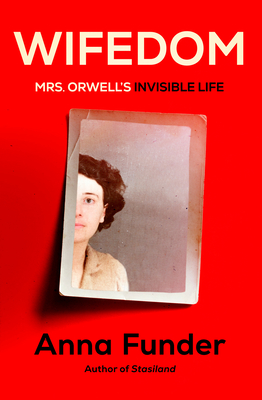
Anna Funder’s Wifedom: Mrs Orwell’s invisible life is a book with a mission, a mission that is implied in its full title. That mission is to examine the notion of “wifedom”, and the way patriarchy works to construct it, through the example of the invisible – or, as Funder also calls it, erased – life of George Orwell’s wife, Eileen O’Shaughnessy.
To do this, she wrangles Eileen out of the shadows of history to produce an intelligent, funny, warm-hearted, loyal and hard-working woman who, observed novelist Lettice Cooper, loved George “deeply, but with a tender amusement”. It’s an engrossing story, well-told. However, it’s a challenging read too.
Funder explains early in the book that her interest in Eileen came from reading something Orwell wrote about women and wives – after Eileen had died. It’s astonishingly misogynistic, and made her wonder who Eileen was and what she might have thought. Funder set about reading six Orwell biographies written between 1972 and 2003, but she found them unhelpful when it came to Eileen. Indeed, she says, they gave so little that they “started to seem like fictions of omission”. Funder then, logically, went to these biographers’ sources. She found some more bits and pieces about Eileen, but it wasn’t enough. All she had was “a life in facts, a woman in pieces”, so she “considered writing a novel – a counterfiction to the one in the biographies”. But, she was fascinated “by the sly ways” in which Eileen had been hidden, and she felt a novel couldn’t effectively explore this. Then she “found the letters”.
These were six letters that Eileen had written to her good friend Norah from just after her marriage in 1936 until 1944, but they had not been discovered until 2005. These letters gave her Eileen’s voice – and this voice was “electrifying”. Funder believed she could no longer write a novel. She writes,
I wanted to make her live, and at the same time to reveal the wicked magic trick that had erased her, and that still holds sway today. I thought of it as writing a fiction of inclusion.
“it’s hard … for history to find you”
This is where the book gets tricky, because, while I found Wifedom a fascinating read, it raised questions too, and they are intrinsic to what Funder is trying to achieve, and how she goes about achieving it. The book is divided into five parts, with the first part titled “Wifedom, A Counterfiction”. What does this mean? She doesn’t immediately explain what I have described above. Instead, she opens her book on a scene in which she imagines Eileen writing a letter to Norah – and she includes excerpts from that letter. This throws us readers in at the deep end. As we get into the book, we come to recognise these imagined sections, because they are identified by indentation, and opening and closing graphical symbols, but at the beginning it’s a bit mystifying, albeit an engaging way to capture our interest.
Early in the read, then, it becomes apparent that Wifedom comprises a complex mixture of processes and forms. The imagined sections are interspersed throughout the book between more traditional biographical writing about Eileen and George’s life. And interspersed between these are reflections from Funder’s own life, because one of her points is that the patriarchy, the “patri-magic”, which erased Eileen’s life from George’s biography, still exists and is evident in her own life as a wife and mother, despite her supportive husband and “egalitarian” marriage. I’m not going to focus on this aspect of the book, though, because it seems to fade away somewhat as Eileen and George’s story picks up, and is not, anyhow, where I want to go in this post.
Instead, I want to tease out the process. Early on Funder writes that
Looking for Eileen involved the pleasure of reading Orwell on how power works. Finding her held the possibility of revealing how it works on women: how a woman can be buried first by domesticity and then by history.
This is not particularly new. Anyone interested in feminism is aware of how women have been lost in (and thus to) history. However, Funder’s book is enlightening in this regard. She does an excellent job of interrogating how it can happen. It happens when biographers ignore or play down the role of women in their subjects’ lives. Through cross-matching her sources she finds example after example of Eileen’s contributions being downplayed or omitted. She shows how the use of passive voice and terms like “wife” rather than Eileen’s name work to make her disappear. (Orwell does it himself in Homage to Catalonia.) She finds examples where biographers, disconcerted by some of George’s behaviour, excuse it (how often are men excused!), or, uncertain about evidence, will rephrase it. For example, Funder writes that Eileen
noted his extraordinary political simplicity – which seems to have worried one of the biographers, who rewrote her words to give him an ‘extraordinary political sympathy’.
Eileen’s words come from a 1938 letter to Marjorie Dakin. The biographer is Crick. (Another of the textual clues to readers in this book is that Eileen’s words are conveyed in italics, while the words of others are enclosed in quotation marks.)
But here’s the challenge – interpretation. Funder writes early in her book that,
As serendipity would have it, in 2020 Sylvia Topp published Eileen: The Making of George Orwell, which contained much material I hadn’t found, and was thrilled to read, though we interpret it differently, and so build differing portraits of Eileen.
She does not explain what she means here, but in the very thorough Notes at the end of the book, Funder elaborates on Topp’s approach to Eileen. Put simply, Topp, Funder says, sees Eileen as one of those celebrated people’s partners who devoted their lives “joyfully to assisting the talented partners in all their various needs knowing all along that they would be under-appreciated, and often ignored, and yet never faltering in their dedication, or in their willingness to submerge their own personal talents into their partners’ success.” Topp, then, sees Eileen as a “helpmeet of genius” while Funder is interested, as she writes in these Notes, “in examining what it took, perhaps, to be in that marriage, and that dream”.
So, what we have here is interpretation. Topp had the same sources that Funder did. Indeed, she added some to Funder’s arsenal. But, she interprets them differently. As a feminist, I easily aligned with Funder’s interpretation, but as I read I also had this little niggle that Funder was interpreting her sources – from the perspective of her times, values and gender – just as other biographers had before her.
Wifedom was my reading group’s April book. Our conversation focused mainly on the biographical content – on Eileen’s life, on George Orwell and his books, and on the impact of patriarchy on Eileen. We were horrified by the life led by Eileen, as Funder tells it – and the facts seem inarguable. Their relationship appeared to us to have been so one-sided. Eileen did all the domestic work, and it was hard work given the primitive rural cottage that they called home. She was, often, the main breadwinner, and she did his typing, as well as offering editorial comment. She was necessary to him. Meanwhile, he focused on his writing and, we gathered, chasing other women. And yet, Eileen stayed with George. Why, we wondered?
We didn’t delve into the interpretation issue, albeit I would have loved to, but I needed more time to collect my thoughts. We did, however, discuss why we thought Eileen stayed with George which, I guess, was us interpreting what we’d read! Various ideas were put forward, including that Eileen might have been a “rescuer”, or that she knew she was unlikely to have been published herself (in a patriarchal world) and so channelled her energies through George, or, simply, that she loved him and, much like Topp argued, willingly helped him in any way she could.
So, there you have it! History, biography, it’s all a matter of the facts you have, and the way you see them. I don’t mean to devalue the biographer’s art by that statement, but simply to recognise that even the most formal, most rigorously documented biography will, necessarily, be affected by the biographer and their times. For this reason, I found Wifedom an absorbing and provocative read, though perhaps only partly in the way Funder intended.
Anna Funder
Wifedom: Mrs Orwell’s invisible life
Hamish Hamilton, 2023
511pp.
ISBN: 9781760143787
 Whispering Gums
Thank you for this review. I’m currently listening to Wifedom on audio so hadn’t realised that Eileen’s words were in italics (how could I?). I think your final observation is spot on – Truth is subjective in that each of us experiences truth in our own way. There can be many versions of truth and this is what Funder would have found in her research. It’s an engrossing read.
Oh that’s interesting libbycat. This is certainly the sort of book, I realise now, that would lose quite a bit in terms of nuance, in the audio version. One of the things I generally find hard about audio versions is character names. How are they spelt. I just don’t always know, and somehow the visual appearance of the word helps me remember it.
Thanks for understanding my final point! It’s easy to get carried away with your own version/interpretation. I think Funder does recognise this to a degree but I’m not sure she makes it clear enough that hers is also a version. But, see what you think when you get to the end.
I’m looking forward to reading it – and to examining the structure. Hopefully the combination of Anna Funder’s reputation and the subject matter interest, she will have paved the way for publishers to accept other author’s departing from a more standard approach.
Thanks Gwendoline. I think they have already? I’ve read a few biographies that are not your traditional style. I suspect, though, that publishers are most likely to be open to writers like Funder and subject matter like Orwell’s wife that they know will attract interest and sales? Still, every example like this, as you say, will pave the way for acceptance of change?
I wrote a manuscript that was alternate chapters of fact and faction (or autofiction). The marketing arm of publishers rejected on the basis that booksellers wouldn’t know whether to put it in the biography/memoir or fiction section. BUT! I did not have the “hook” this combination of author and topic have.
I’ve pulled it apart now and it is two work-in-progress manuscripts: one fact, one fiction.
And, as soon as I did that … along came Wifedom. LOL
Oh, I can feel your pain but I suppose I can also understand where the publishers are coming from. Readers are a fickle lot.
BTW I think George Orwell was in the situation of having to accept or reject ms for a short time, and he couldn’t do the rejections.
Anyhow I wish you good luck with your writing. I can’t imagine taking on such a project. I admire anyone who does.
I look back on my naive debut self with a touch of whimsy – but it is so much better knowing what I know now.
And actually, this exchange reminded me of something I wrote a couple of years ago. I’m taking the liberty of linking here, but please delete if I have crossed a line…https://garrulousgwendoline.wordpress.com/2022/05/08/garrulous-gwendoline-on-writing/
We never stop learning do we. Of course I don’t delete your link… And I look forward to reading it later as I am multi-tasking right now.
Brilliant analysis of the book and of your response to it.
Thanks very much Carmel. It took me a while to write this one.
Brilliant review, Sue.
I read Wifedom last year but never got around to reviewing it. I found it completely engrossing and raced through it in record time, but I also found it problematic. In fictionalising aspects of Eileen’s life, I found it muddied the waters slightly. Why not just write it as a straight biography?
Also, as you point out, I sometimes felt that Funder was bringing a modern mindset to Eileen’s life and the social conditions under which she had to live.
And while I understand that the use of the passive voice serves to eradicate Eileen from Orwell’s biographies, all academics write in the passive voice regardless of the subject/topic. (God knows I’ve spent the best part of a year turning passive sentences into active ones in dozens of academic reports!)
Finally, Orwell’s own failure to mention Eileen in his writings may not be because he disregarded her contribution but that he wanted to protect her from the public eye. (I never mention my partner or show his photo in social media, for instance, because he’s asked me to safeguard his privacy.)
As you say, history/biography is all about how we interpret facts and choose to present them.
Thanks kimbofo. I thought it was such an engrossing read on so many levels but that did include thinking about what she was doing and what I thought about it.
Your points and questions, and alternative interpretations, align with the sorts of things I was wondering about. I know what you mean about passive voice. It’s taken me a long time to train myself out of it, so I love all the work you are doing! But, I do think that when biographers are writing about what people to do it’s not un-academic to use active voice: George went… etc? So why not for Eileen?
I must say that I took nearly a week to write this post. I wrote bits, moved bits around, deleted bits, then last night, as I was trying to sleep, it suddenly came to me exactly how to say what I was thinking! So, I’m glad you appreciated it.
Excellent review, very thoughtful nuance. Thank you.
Thanks very much Sean … and I will get to yours soon!
I’m now reading Topp’s bio on Eileen – hoping to do a comparison of the 2 plus an Orwell bio by Taylor by the end of the year #longtermproject
Oh I’ll be interested to hear what you think Brona.
While I found [your] Wifedom [review] an absorbing and provocative read.
Thanks MR … I can always rely on you to boost my ego!
I am no liar; and in your case, no exaggerator.
In MY case, “no exaggerator”! You always make me smile MR.
I didn’t read it but heard several interviews with the author about it. I have a problem with fictionalised biographies but I understand the issues raised are quite important. Sometimes I wish there wasn’t so much media coverage of certain books because then I know so much about the book I pass it by.
Thanks Pam … this isn’t a fictionalised biography exactly but there are imagined sections. She does source much of what she says but it’s a bit tedious to go back and forward so I didn’t but looked at a lot of the Notes/sourcing at the end.
Intense media coverage is a two-edged sword isn’t it. It does have that effect on me sometimes too.
I don’t know much about the writing of biography, but I do know what I like to read and why. When I read a biography, especially of a person who has been hard to unearth from the archives/attic/some great-grandchild’s box of letters, I prefer that the author tell me what we know about the material (where it was found, direct quotes) and give context (and explain how the biographer knows the context) and then hypothesize what things were like for the subject and explain why. When the writer tries to recreate scenes from the subject’s life, I take to them just as well as I do when I watch forensic TV shows and they do a dramatic replay of a crime — that, is not well at all because I’m acutely aware that I’m watching fiction!
I like that too Melanie. In fact for most biographies I’m very interested in the journey. And, I think that by taking us on their journey, biographers help us understand where they are coming from and their perspective on the subject, which is a good thing and doesn’t at all, for me, undermine the worth of what they are doing.
I don’t mind if they recreate scenes, really, as long as I know what they are doing. I found those sections of Funder’s book engaging because they are so well sign-posted that it’s clear what she is doing, and she does source as much of it as possible in the Notes at the back. Though, to be 100% sure I would need to read each of these sections with the Notes side-by-side!
I remember reading a book a man wrote about his relative who died almost in obscurity because she was an amputee, which made the family feel ashamed. The number of times he wrote about getting closer to who she was only to hit a dead end was riveting.
That sounds like just the sort of book i like reading Melanie. The persistence of researchers when they hit dead-ends is fascinating to read about.
And I wanted to “like” every one of these comments but that didn’t seem to be an option. What an interesting discussion you sparked with this post!
Thanks Gwendoline… Sometimes you can tell when this might happen but not always. Wifedom has been out for a while now so I wasn’t sure if people would be still interested so I’m pleased to have this discussion. It helps us all I think?
This is such a fascinating piece, Sue. A little like Libbycat, I listened to this on audio, but it was an abridged version for Radio 4, extensively filleted to fit into their Book of the Week slot, which runs to around 70 mins in total. I found the sections about Eileen more interesting than Funder’s reflections on her own life, but (as you can imagine) it was a little tricky to distinguish between the factual and imagined elements of Eileen’s story. Still, I may get pick up a physical copy at some point to get a better feel. (I was left with the feeling that Eileen has sacrificed so much for George – her career, her health, even her life…)
Thanks Jacqui. an abridged audio version would give you the gist of the information but this is such a complex book that it would be hard to assess exactly what it’s all about from that sort of version however I think what you did get is one of the main messages that Funder was trying to convey. The other was why we knew so little about what she did. It sounds like that part of the story didn’t come through.
What a layered exploration of related materials; I would warm to the complexities in the back of the book too!
Why am I not surprised? We are alike in that Marcie!
Obviously, this is a book I will have to read. I remember years ago reading Crick’s Orrwell biography which, if my memory can be trusted, emphasised Eileen’s role in the lightness of touch in the writing of Animal Farm. She seems to have been an enormously important first reader of that little masterpiece.
Yes Ian. Her role in Animal Farm – including suggesting writing it as an animal fable and discussing it step by step – is discussed in the book.
I thought this was great review too. I loved this book so much, although I came to it with quite some skepticism given the scathing reviews it copped in some of the international press. In my view, Funder neatly managed to balance on the fact/fiction tightrope. The fictional parts were clearly flagged, and her examination of the sources left plenty of room for readers to come to their own conclusions (whether or not they agreed with Funder). Best of all, it’s just oh so beautifully written.
Oh I hadn’t known of scathing international reviews Michelle but I was aware that there were mixed reactions. Overall, I found it a great read too. I think it is a bit moot how much space she left for readers to interpret themselves as she comes on strong. I don’t think we still know what Eileen really felt but we have a much better understanding of her role. Funder’s use of all those letters from and comments by those who knew her is so interesting. It makes me wonder how does a biographer know where to stop in terms of sources and understaning WHO those sources are. How trustworthy are they? Who’d be a biographer!!! Haha!
Brilliant review, Sue. I read Wifedom when it was first released, and happened to see Funder speak about it at the Melbourne launch. Like you, many thoughts about what it is a complex piece of writing. One thing I have continued to ponder is Funder’s own experience, inserted in the story – on reflection, it felt a little convenient – did she love Orwell that much? If I was having an existential crisis, would I sit down and absorb myself in one author…?
Thanks Kate … did you review it? I’ll have a look in the morning. I felt that she wanted to make some points about the continuing effect of patriarchy on women (and women creators, in particular) but it might have been one ball in the air too many. It probably needs a second read to do it full justice.