As I research for my 1924 Monday Musings series, I am coming across articles that don’t neatly fit into 1924-dedicated posts but that I want to document. The most recent one concerned the Lothian Book Publishing Company. It was about a specific initiative, which I will discuss at the end of this post, but I was intrigued to find out more about the publisher itself.
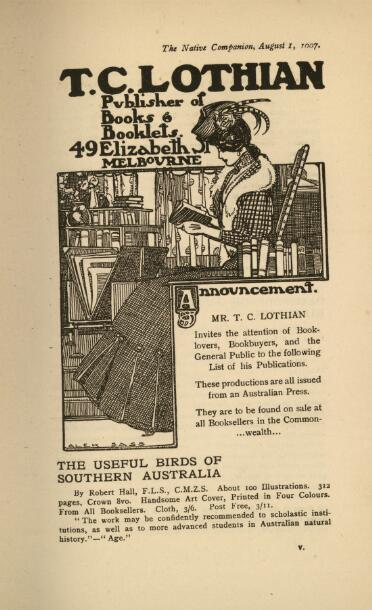
AustLit tells us that, while now an imprint of Hachette Australia, Lothian has a long history, starting well over a century ago, in 1888 in fact, when it was founded by John Inglis Lothian. Then it was a Melbourne-based book distribution company, but it started publishing in December 1905 under John’s son, Thomas Carlyle Lothian. During its first three years, it produced 40 books and four periodicals. AustLit then jumps to the interwar years (the 1920s and 30s) and says that it “was particularly notable” for publishing Australian poets, such as Bernard O’Dowd and John Shaw Neilson. Lothian also represented Penguin Books in Australia until the end of the Second World War. Cecily Close, in her article on Thomas Carlyle in the ADB, provides more information, and adds other authors to their list, like Miles Franklin and Ida Outhwaite.
The company was active, and by 1945, it had offices around Australia and in Auckland, and had literary agents in London and New York. It remained a family-run affair, with Thomas Carlyle Lothian being followed by his son Louis Lothian, and then Louis’ son Peter Lothian.
Austlit says that the company moved into children’s publishing in 1982, which has remained a big part of its activity since. Then the take-overs started. In December 2005, the Time Warner Book Group acquired Lothian and formed the Time Warner Book Group (Australia), with Lothian Books becoming an imprint of Time Warner. Very soon after, in February 2006, Hachette Livre acquired the global Time Warner business, with Lothian Books now becaming an imprint of Hachette Livre Australia. Lothian Books’ CEO Peter Lothian retired in July 2006.
The focus on children’s books has continued with Hachette Australia expanding its children’s publishing, and branding its children’s books with the Lothian imprint. AustLit says that as part of the new arrangement, some adult publishing would continue, as a ’boutique’ list of Australiana titles, both already published and to be commissioned, but I’m not sure that this eventuated, or, if it did, that it lasted. Hachette Australia’s website does not clearly differentiate its imprints.
Lothian stories
It was a story about Lothian that inspired this post, but while researching it, I found another intriguing story, so I’m closing with two little anecdotes about Lothian.
Lothian and Henry Lawson
The State Library of Victoria’s La Trobe Journal carries an article by John Arnold about the relationship between Lothian founder, Thomas, and Henry Lawson. You can read the article yourself as the story is not a short one but, essentially, it started in 1907 when, on a business trip to Sydney, Thomas Lothian signed a contract with Henry Lawson to publish two collections of his writing, one of prose and one poetry. The contract was signed in James Tyrrell’s bookshop in Castlereagh Street, Sydney.
I won’t go into the details but it was a standard Lothian printed contract. The author would receive a 10% royalty for each title. Lawson was to deliver the completed manuscript of both titles to the publisher, two weeks after the signing of the contract, and Lothian was to publish the two books no later than three months from receipt of manuscript. The contract “declared that the author was the proprietor of the copyright of the material proposed to be published and it gave the publisher the world serial, translation and dramatic rights to the material in question”.
This is not what happened, and Arnold writes that “this commercial agreement … was in a short time revised, revised again, then broken, leading to false promises, abuse of copyright, and a falling out between author and publisher. The proposed books were not to appear for six and a half years”.
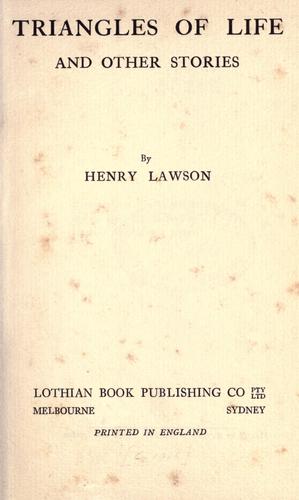
It was a tortuous process, due largely to Lawson’s “erratic behaviour” but also affected by Lothian’s busy and ambitious workload. Arnold concludes his article with:
Despite his unrewarding and frustrating dealings with Henry Lawson, Lothian was still willing to chip in when the Lawson hat was sent round after the author’s death. In 1928 he became a Life Member of the Footscray-based Henry Lawson Memorial Society, and in 1931, as one of Lawson’s publishers, wrote a one-page testimonial to be read at the society’s annual meeting.
The handsome certificate with which Lothian was presented by the Henry Lawson Society in 1938 stated that Life Membership was awarded for ‘Unselfish and Generous Services rendered to this Society and Australian Literature generally’ …
Lothian and Nettie Palmer
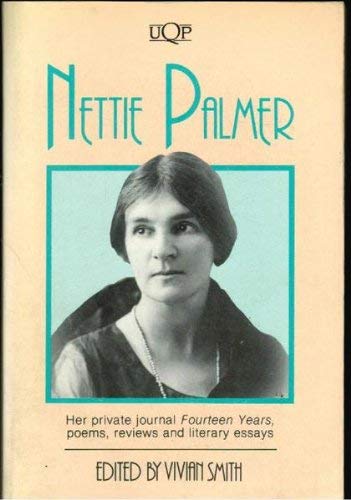
Finally we get to the article that inspired this post, the announcement in The Argus of 8 May 1924 that Nettie Palmer had won a “prize of £25 offered by the Lothian Book Publishing Company for the best critical essay dealing with Australian literature since 1900”. Her essay was titled “Australian literature in the Twentieth Century” and was to be published in June. On 18 July, The Albury Banner and Wodonga Express, reports on this work, now titled Modern Australian literature, describing it as ‘an interesting “measuring up” of Australian literary work from 1900 to 1923’. Vivian Smith, editor of UQP’s Nettie Palmer anthology, which includes this work, says the piece “is significant for what it reveals of the expectations and hopes of the time”, and also that
Nettie, like Vance, was concerned for the relationship between a national literature and the national experience behind it, but both explored this relationship in a tentative and programmatic way and had no readymade formula to account for it.
Nettie has appeared here several times, and will again, but I’ll leave her here for now. (Except, I’ll share that the Goulburn Evening Penny Post (23 October 1924) reported that she gave her prize money to the “Blinded Soldiers”.)
My initial idea was to write a post about this Lothian Prize, but I’m not sure it continued. However, I’ve written posts about publishers before, and Lothian seemed perfect for another.
 Whispering Gums
How lovely that Nettie gave her prize money to blinded soldiers! £25 would have been quite a lot of money back then! : )
Yes I thought so, I liolalee, and worth sharing. Thanks for commenting.
The publishing world is awfully representative of how companies swallow each other up, isn’t it ? Seems to me that here in Oz tracing one back to its source is as lengthy a process as anywhere else in the world. Why is this, ST ? What is it about publishing that makes so many of them so transient ? Do they misread the need for whatever niche they start out choosing ? Does the reading public show initial enthusiasm for every new publisher and then get bored ? There aren’t many that last through generations ..
I don’t know MR, but it’s probably a range of reasons, starting with, in Australia, the smallness of our market which can make it difficult. This requires really careful management, and a lot of hard work, which can be exhausting. I think reasons can include wider economic circumstances at the time, decisions made by the CEO (particularly with Independent publishers), appealing offers from a larger company, changes in government policy.
I wouldn’t think it was much to do with the public getting bored with a new publisher. I suspect most readers take very little notice of who publishes the books they like to read?
I think for example that the economic circumstances of the mid to late 805 were a big part of why McPhee Gribble merged with (co-publishing) and was then taken over by Penguin.
I remember being disappointed by that.
Yes, it was very sad. Gribble went on to establish – help establish – Text, which seems to be going well. Different times? Lessons learnt? Different management? Combination of all probably.
I have Nettie’s book!
I had to search for it for ages before I found a copy.
It’s very small, only 59 pages, but it’s a treasure.
Oh lovely, Lisa. It’s interesting they published an essay … though I suppose it’s like those little essays commissioned and published over recent years by Black Inc (I think?) On resilience, On passion, etc.
I have this too but in the UQP anthology. It would be lovely to have on its own.
Quite apart from the content, the best thing about it is that the index of authors lists heaps of authors I’ve never heard of, though it omits Dorothea Mackellar who gets s mention on p.52, plus it has a list of ‘some of’ the authors that Lothian publishes. I don’t recognise many of them either.
How great … an indexed essay. I guess indexes though are always going to have errors but missing Mackellar is a big one!
Well, yes and no.
I read McKellar’s bio, and really, apart from That Poem, her work wasn’t up to much.
See Nettie’s thoughts https://anzlitlovers.com/2023/09/23/her-sunburnt-country-2023-by-deborah-fitzgerald/
Yes, I’ve read a few critiques of Mackellar’s works, and gathered the same. A one-hit wonder! But, regardless of that, she is a figure in Aus Lit so people will be interested in Palmer mentioning her, won’t they?
I looked up what I had written about Lawson previously and found “In this period, immediately before the Great War, Lawson had published a prose volume “The Rising of the Court” and a book of verses “Skyline Riders””, which sounds like they might be his two Lothian books. He was pretty ill by this time and Lothian was taking a calculated risk relying on him to come up with the material on time.
Sorry Bill, but I believe it was the two works published in 1913 that were Lothian. They were first published in England I think under the Standard Publishing imprint and then in 1916 under the Lothian. The Poetry one was For Australia and Other Poems (1913)and the short stories was Triangles of Life and Other Stories (1913).
My mistake! On Trove just now I found a mention of “The Rising of the Court” in 1910, published by Angus & Robertson
There was a lot going on around with him around then, Bill, so no apologies necessary.
That’s funny that Nettie Palmer won 25 pounds way back when. Today, a short story published in The New Yorker will get you around $7,500.
This seems to perfectly summarise how delightful a research binge can be, one sets out with a goal but then one things leads to another and another and…but it’s all to the good.
In AustLit, do you pronounce the first ‘t’? In the early online bookgroups I was part of a group dedicated to what some, there, called AussieLit, but maybe that’s not commonly used IRL?
You are perfectly right about research Marcie. Love it.
Re AustLit, no, I normally would pronounce it 0ZLIT (And spell it AusLit) but this is a particular project-cum-website. I don’t know how they pronounce it but if I said it I would probably say the ”t” to differentiate it from the generic description.
Ahhh, thank you. Just the details I craved.
Always glad to satisfy your cravings Marcie.