With 1923 nearly over, I’m running out of time to share more of the thoughts and ideas I found regarding Australian literature in 1923 from Trove. This post, I thought to share some of the ideas expressed about humour in Australian literature.
Humour wasn’t always specifically mentioned in 1923 as being a feature of Australian literature, but was mentioned enough to suggest that some, at least, appreciated its use.
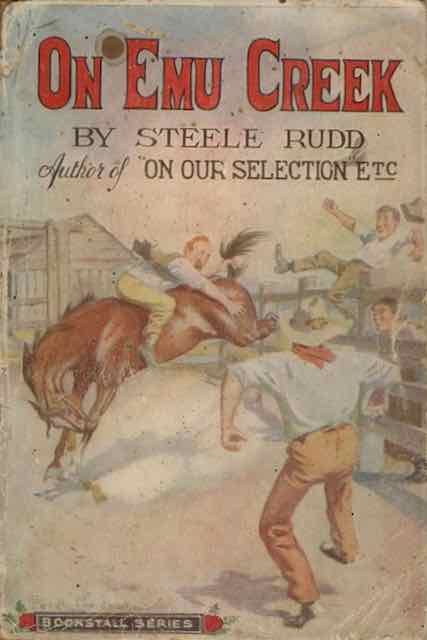
The most frequent mention I found concerned, Steele Rudd, famous for the Dad and Dave stories. He is praised for using humour to make interesting and enjoyable the truths he has to tell about Australian lives. The Queensland Times (2 May) introduced Rudd’s new book, On Emu Creek, and describes it as giving “full play to his whimsical humour, his knowledge of the rural dwellers, and his sympathy with their struggles”. Melbourne’s The Age (5 May) is more measured, but seems also to like the humour, describing it as “an agreeable story, without any affectation of style, and containing points of humor”.
Others, though, are a little less enamoured, with various reviewers qualifying their approval. One of these is J.Penn, writing in Adelaide’s The Register (19 May). There is some satire, he says,
But the main idea of nearly every chapter is someone being knocked over. It is difficult to think of any other humourist who would not seek to find humorous terms in which to describe intendedly humorous incidents. But Steele Rudd is firmly convinced that his readers will find sufficient fun in the mere fact of some one being humiliated or hurt, without the author’s having to worry to hunt for words.
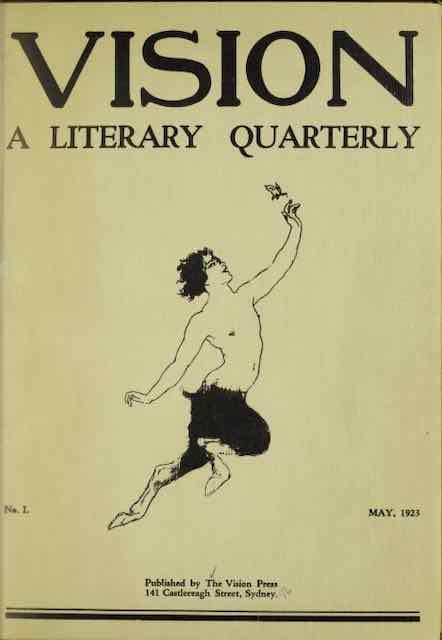
Ouch … This is not to say that J.Penn doesn’t like humour. He clearly likes satire. And, he critiques another 1923 literary endeavour for lacking “gaiety”. It was a literary magazine titled Vision: A Literary Quarterly, that was edited by Frank C Johnson (comic book and pulp magazine publisher), Jack Lindsay (writer and son of Norman Lindsay), and Kenneth Slessor (poet). The quarterly, which only lasted 4 issues, aimed, says AustLit, “to usher in an Australian renaissance to bolster the literary and artistic traditions rejected by European modernists”, but they also wanted to “invigorate an Australian culture they claimed was stifled by the regressive provincialism of publications such as the Bulletin“.
Anti-modernist in ethos, Vision, continues AustLit, was influenced by “Norman Lindsay’s principles of beauty, passion, youth, vitality, sexuality and courage” and “consistently provided readers with potentially offensive content”. Penn was thoughtful about the first issue:
It is a welcome guest, as giving outlet for a lot of good work which might not find a fair chance elsewhere. But it has three faults, one of outlook, two of detail. Contemplation of sex matters is not the only way to brighten life; yet they constitute quite four-fifths of this opening number.
Not only that, but, he says, ‘while it would seem difficult to be heavy, even “stodgy,” on matters of sex, that feat has been accomplished here’. Indeed, it has “no spark of gaiety”, which is exactly what Norman Lindsay, in the same issue, accuses James Joyce of. (Excuse the prepositional ending!) However, not all of Vision is like this:
The poetry in this volume, by Kenneth Slessor and others, has much of the desired element of gaiety; and a page of brief quotations from modern writers in other countries, with satirical footnotes, is delightful. There remain the pictures. These are as bright and gay as could be wished—a riot of triumphant nudity, in which Norman Lindsay in particular finds full opportunity.
Overall, he feels that “with some judicious editing, this endeavour to brighten Australia should have at any rate an artistic success”. (Also, he does like Jack Lindsay’s “valuable essay … on Australian poetry and nationalism, with a theory that we must get away from shearers and horses”.)
A very different magazine is one praised for its cheerfulness, Aussie. It ran from 1918 to 1931, and had various subtitles, The Cheerful Monthly, The National Monthly, and The Australian Soldiers’ Magazine. I had not heard of it before, but AustLit once again came to my rescue. Created for soldiers in Europe, most of its early contents came from them, and comprised, says AustLit, “jokes, anecdotes, poems and drawings” which reflected “the character (most likely censored) of the Australian soldier in World War One”. In 1920, it was revived as a civilian magazine, but “the humour … was maintained”. Now, though, its contributors were established writers and artists, like AG Stephens, Myra Morris, and Roderic Quinn. I found a review of a 1923 issue in The Armidale Chronicle (19 September). It is unfailingly positive, telling its readers that “every page of Aussie breathes cheerfulness, and there is not a joke, a picture, or a story that fails to portray some phase of Australasian humor”. I wish it described what it meant by “Australasian humor” but the word it uses most is “cheerfulness”. This perhaps makes sense, given AustLit’s assessment that “it maintained its position between political extremes, addressing the views of a predominantly middle-class audience”.
Humour is also mentioned reviews of books for children, such as The sunshine family, by Ethel Turner and her daughter Jean Curlewis. It is described in the Newcastle Morning Herald and Miners’ Advocate (14 December) as having “rare good humour”, but is that unusual for a book for children?
The descriptions of the 100 books chosen by AG Stevens for Canada, that I wrote about earlier this year, include several references to humour – in fiction, such as EG Dyson’s 1906 Factory ‘ands, with its “brilliant satirical humour”; in children’s books, like C Lloyd’s 1921 The house of just fancy, whose pictures “have quaint loving humour”; and in much of the poetry, including JP Bourke’s 1915 Off the bluebush, which contains “verses of sardonic humour”.
Humour is such a tricky thing – from the sort of situational humour in Rudd’s On Emu Creek, through the apparent “cheerfulness” of Aussie, to the more satirical humour liked by J.Penn – but unfortunately, most of the references I found don’t analyse it in much detail. I will keep an eye out as we go through the years.
Meanwhile, do you like humour in your reading? And if so, what do you like most?
Other posts in the series: 1. Bookstall Co (update); 2. Platypus Series; 3 & 4. Austra-Zealand’s best books and Canada (1) and (2); 5. Novels and their subjects; 6. A postal controversy
 Whispering Gums
Why does The Armidale Chronicle use American spelling ? – is that an American article in an Australian magazine ?
But more urgently, why do I find myself typing in a Gutenberg block ? I should like to be able to find humour in that, but I cannot: I use the Classic Editor.
WordPress is causing me a weekly increase of grumpiness. 😦
Re the American spelling, MR, it’s not just that paper. I have noticed it throughout the papers in Trove. The Macquarie Dictionary says this “In Australia, as in Britain, the most common spelling of these words is with -our, although -or is often used and certainly occurs consistently in a large number of magazines and newspapers.” My feeling is that over time newspapers have standardised their spelling to what we ”know” as Australian practice, to agreeing on a ”style”.
As for the comment block, I have no idea. I have done nothing. I converted to Gutenberg maybe 3 years ago. Certainly over 2. WP is a law unto itself. Don’t get me started on commenting.
OH, dear ST, I know it ain’t you. But I’m WordPress-grumpy, these days.
Bad noos about the spellin.
Ha ha, re the spelling! And, yes, I’m WP-grumpy too, and it seems nothing to do with block or classic!!
So it is ..?
All I can think is that it’s the programmers’ love of tinkering to make things better! It keeps them employed. Ha ha.
I’m certainly with that reviewer who didn’t like Steele Rudd. Not so much for the slapstick humour with people, but the descriptions of sickening cruelty against animals.
I’ve read a few comic novels by Norman Lindsay, though most of them came after this period that you’re writing about. But A Curate in Bohemia came out in 1913, and I enjoyed that (though whether I would now, I don’t know).
I like satire in my reading, but I like it subtle. There are exceptions, a recent one being Naked Ambition (2023), by Robert Gott.
!!
Oh! I see what MR means by her reference to ‘a block’. I couldn’t remember who wrote Naked Ambition so I looked it up on my blog, and copied and pasted the title rather than type it all out. And I see that it has brought the link with it into your comment.
I would rather it didn’t do that…
Thanks Lisa. I haven’t read any Rudd, and haven’t watched or listened to much (despite my job) Was the cruelty to animals, which of course I don’t like, that which was typical of the times?
I haven’t read any Lindsay either. I do tend to read realist or satirical novels more than comic ones. Always have. Not sure why, because one of my nicknames as a child was “giggling Gertie”! I love satire – subtle is great, but good satire as you clearly agree doesn’t HAVE to be subtle.
I wondered what she meant, how you can tell. But all I can say is that there is nothing I can do about it. I did switch to Gutenberg 2-3 years ago, but have not recently done anything to my blog. WP keeps fiddling. I’m having awful troubles commenting on blogs. I have to fully fill out the comment block with all my details EVERY time I comment on yours and Kate’s for example, but Bill’s knows me, and Brona’s (I think it’s hers) offers me the W Icon to click. I even have to sign into my OWN blog posts every time I comment (but I can click the EDIT button and edit without signing in.) I am replying to this via Notifcations not on my blog post. WP Staff have tried to help but their advice either doesn’t work or requires me to reduce my security settings which I won’t do.
I quoted an example of the cruelty on my blog: anzlitlovers.com/2009/06/07/on-our-selection-1899-by-steele-rudd/ and I referenced Black Beauty which was published as a plea for animal welfare 30 years before. So I think Rudd was well out of step.
Re the Block, I always use the Classic editor, and (so far) my comments look the same. But I know I’ll be forced to change one day.
The thing is, there are things you just can’t do in a block. You can’t put a border around an image (e.g. a book with a pale cover). You can’t edit the image via the edit button on a post, you have to go through Posts, and then open it in the Classic editor if you e.g. want to crop it or make it into a thumbnail…
Thank. I’ll Check that post out.
You can resize images in block editor. You click on the image, grab the handles, and resize to your heart’s content. They also have a pre-set thumbnail option which I did use but now I’m resting myself. I don’t know about borders as I’ve never thought about using them.
So, when you comment on other WP blogs, you are aways ” known”?
Known? So far.
I know you can resize that way, but that is not the same as having a thumbnail. I’ve always been conscious of the size of the images I use because (as you know because you’ve spent time outside the capital cities), internet speeds are terrible in some places (e.g. the Gold Coast, the Hunter Valley) so if images are too large, the page takes so long to load that it times out. If it is possible to do thumbnails with the block then it’s not intuitive because I couldn’t figure out how to do it and could not bothered spending time learning something I did not need when I had a perfectly good, IMO better, alternative.
I prefer thumbnails not just for that reason but for copyright reason.
Thumbnails are straightforward in block. Every block you are in has characteristics you can change. In the sidebar at the right are the POST (for publishing, categories, tags, etc) tab and BLOCK tab. In the image BLOCK tab are the size options. You can hide the sidebar if you don’t want clutter, but I like it there. I understand staying with Classic. BUT overall Block is fine once you understand it. I’m sure I don’t use all its functionality.
Yes, that’s another thing. If I use the edit button from a post, it defaults to the block editor. In the RHS menu I see Categories with a drop-down arrow. If it opens up (and a lot of the time it doesn’t, or takes forever) it rearranges my categories so they’re not in the order I want them, and they’re not even consistent. (I just opened two at random, one has FORM AND STYLE at the top, and the other has BOOK REVIEWS, neither of which are at the top of my drop-down menu.) Sure, I can search for a category, but I want to scroll through them to see what I want to choose.
I just don’t have the patience to be bothered with it…
Hmmm … I think I know what you mean. Normally, when I’m creating a new post those categories in the RHS are in alphabetical order by the top level. But when I’m editing, they put the categories I’ve chosen for that post at the top (in order of the top level as I recollect), and then the unused categories after that in the usual alphabetical order. Once I realised that that’s what they were doing, I was fine but at first I was mystified. I can understand the thinking but for those of us who like standard order and not something that changes due to context, it’s irritating.
Yup.
https://www.theguardian.com/books/2023/nov/27/the-big-idea-should-we-abolish-literary-genres
I draw that to your attention, ST, and would like your thoughts, please !!!
Thanks for this MR. I read it quickly as life is getting busy. My opinion on genres (or any categorisation) is that
1. they are useful broad guides; and
2. we should not get too hung up on/about them.
I think there is value in having some broad categories because people do have reading (or listening or viewing, or whatever) preferences, and being able to hone in on what you like quickly is going to keep you coming back for more. But, genres/categories can be given too much weight – and start to drive how we think about things, how we assess them, what we expect from them, how we value them – and for creators, how to create them. That’s when they become problematic – because they become an end in themselves, rather than a concept or principle to guide the creator and the consumer. Is this making sense?
Literary fiction has always been problematic I think because it’s not, really, a genre. A genre is a work that has a particular set of characteristics/that meets agreed conventions. Literary fiction by contract has no (or very few) conventions – perhaps that’s what defines it! The problem is the elitism that accompanies the idea of literary fiction, and the “value” put on that. I don’t know how to get around that, but I don’t think we should throw the baby out with the bathwater.
“They” can try abolishing genres but “they” will never succeed (to my mind) because people like to categorise (and find it useful). However, “they” can talk about abolishing genres because such talk gets us thinking and talking and engaged in what we like to read and why – and that is a good thing. I love talking about genre – in general, like this, and about specific genres – for this very reason.
I hope this has made sense. It’s late at night and I’ve written off the top of my head from a quick scan of the article. I might have missed the point.
What say you?
I say THANK-YOU !! All makes excellent sense.
Oh good … I was working my brain very hard last night!
I love self-deprecating humor, like Samantha Irby (author) and Christopher Titus (stand-up comedian). I would never associate the words “cheerful” and “humor,” so that is interesting! How would you describe Australian humor, the kind you see in everyday life?
Aussie humour is often self-deprecating, and with a lot of wordplay, double entendres, with a lot of irony/sarcasm. More British I think. What about around you?
And no, I thought the “cheerful” was interesting, but worth mentioning.
In America, most humor is just 1) conservatives trying to humiliate other people OR 2) saying how ridiculous conservatives are and hoping people laugh. Both forms of “comedy” are terrible. It’s a rare stand-up comic who can make me laugh anymore.
That’s a bit sad Melanie … humiliation is not a good type of humour is it.
Steele Rudd sounds rather like Stephen Leacock here in (the land currently called) Canada…except for the animal cruelty element that Lisa’s observed in Rudd. They’re of a similar vintage and seemingly both concerned with the portrayal of ordinary lives with a focus on amusement (which doesn’t always translate…but, how could it, many decades later, when humour is so tricky and personal to start with).
I’ve heard of him, but have never read him Marcie so could not have made that connection even if I tried. And ah yes, humour translating across space and/or time is such a tricky thing.