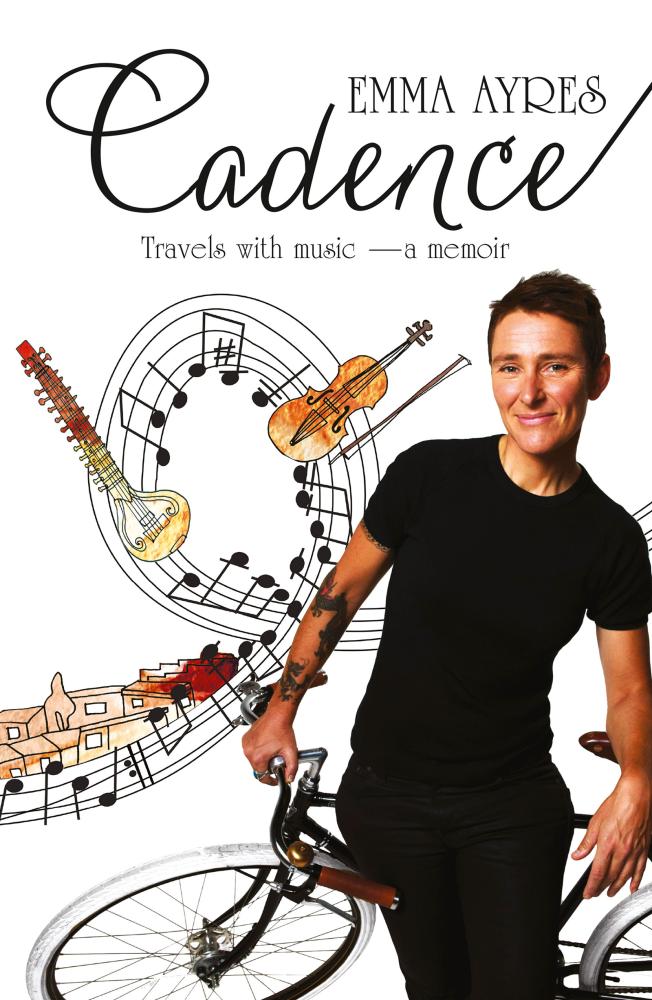
Ok, I admit it. This post’s link to Australian literature is tenuous, but there is a link, even though it’s not the subject of this post. The link is that the person who inspired this post, Ed Le Brocq, previously known as Emma Ayres, has written several books – memoirs, mostly – of which I’ve read and posted on one, Cadence. Since then, as Eddie/Ed Ayres and Ed Le Brocq (married name), he has published Danger music, Whole notes and Sound bites. None of these, however, have much to do with this post, though they all interest me.
Ed Le Brocq became known to many of us – starting back when he was Emma – as a radio announcer on our ABC Classic FM. She was hugely popular. Since then, she left radio, travelled some more, transitioned to Ed, and in 2019 returned to ABC Classic FM, doing the Weekend Breakfast show. I often listen in. This last weekend, he told a little story and asked us a question – and I thought, for a change of pace, that I would ask it of you too.
The story goes this way – but needs a little explanation first. As well as radio announcing, Ed Le Brocq performs music, and teaches it – the viola and cello. The story concerns a lesson he was conducting recently from his garage because his usual venue in a school wasn’t available. A mother walked by with her 7-year-old son and apparently the son was attracted to the music. He came into the garage, and asked, “What’s that you’re playing?” and, on being given the answer, said, “I want to play that too”. He will start lessons next year – on one of those two stringed instruments.
Ed was fascinated by the child’s recognition of something that he really wanted to do, and asked the radio audience whether they knew around that age what they wanted to do – and whether they’d done it. So:
Did you realise when you were around 7 years old (give or take a couple of years) what your interest or passion was, and is that what you ended up doing in some way or another?
It seems I did. When I was around 5, my father was President of the local Apex group (a service organisation roughly like Lions and Rotary). I was fascinated by his papers, and am reported as saying, “When you die, can I have your Apex stuff?” Jump a few years to when I was around 11, and I remember myself creating a little neighbourhood library, complete with Date Due notations in the back of my books. Around the age of 14, I encouraged my sister to help me write an encyclopaedia, starting with one article per letter (though we didn’t get far because adolescence hit!)
Is it any wonder that I ended up being a librarian-archivist – and that it was a career I loved?
Now, over to you …
 Whispering Gums
Great post! I wrote lots of stories aged 7 and decided I wanted to be a writer. A few years later I made a series of magazines. I ended up building a career in magazines, first as a journo, then as an editor! I am now a publications manager.
Pretty clear trajectory there, I’d say! This is all fascinating. I guess your parents weren’t surprised?
I could read before I started school, and was writing poems and stories by the age of seven. The sight of words on a page absolutely enthralled me, especially when I was the person writing them – the whole process seemed like magic to me. I rarely had my nose out of a book. I started a little local newspaper when I was about thirteen, after I was given a little portable typewriter, and later a school paper. So I think my career as a book editor and publisher was pretty much pre-ordained!
Haha, Teresa. It sounds like it. What all this is saying to me, as our grandson approaches 6, is to look closely at his passions because therein might lie the man (at least in terms of his life’s direction. Character is different.)
What a great topic. None of us will resist writing about ourselves!!
From an early age, like perhaps most boys (and tomboys), I would dissect my most expensive toys to see how they worked (even why, with a subsequent fondness for philosophy :). They commonly didn’t after that. Naturally I became a technician and spent a long career fixing things.
I was ten when my elder sister took me to her favourite second hand book shop, the famous Mann’s (long since Rice’s) in Newcastle. Except in my aunt’s Georgian time-capsule home I’d never seen so many books (we were ‘poor’ with but a children’s encyclopeadia as our library).
From around age twelve I would visit Mann’s after school, taking the bus into town, and browse the delights of those dark old overstocked bookshelves. By savings from my sixpence a week pocketmony, by the time school was over I had a library of my own – and a cataloguing system too, btw!! And have been collecting and cherishing old books since.
I do envy those of you (above and below in these comments) who began writing so young and had literary careers. It’s where I now wish to have worked.
How fascinating Thosby. I’m loving the stories. I love your how AND why! As a librarian-archivist dedicated to preserving things for the long haul, doing anything to them was an anathema to me. Imagine my horror when Mr Gums, who had been a child like you, decided to drill holes in the back of our new stereo system because he believed it was overheating. He was right. I learnt a big lesson that day about different skills.
I’m sorry though that you wish your career had been different, but I hope you also enjoyed what you did.
It’s OK, no regrets. Mr Gums was indeed right. I bought a spare stereo amplifier to backup mine, and it came from western NSW. It was the same model with one difference – the owner had drilled an extensive network of additional ventilation holes.
Haha Throsby … that makes me laugh! I’m glad Mr Gums wasn’t the only one.
What a wonderful post. Thank you. And I am sure there are going to be many fascinating responses.
When I was eight, the mother of a friend suicided. I was profoundly affected by the horror of this event. My mind in a dark whirl, I suddenly had a moment of luminous clarity. I thought: ‘I can’t do anything about this – but I can do something WITH it.’ The thought calmed my heart and mind. I had personally realised the power and purpose of storytelling, of writing.
In fact, it took me forty years to work out how to write the story. But in the meantime, I wrote many other stories.
The story in question is ‘Pomona Avenue’, and it is published in my collection The Essential Bird, Fourth Estate 2005.
Thanks Carmel. I hope there will be. What an awful thing to experience at that age – and your poor friend. How shocking for her, or him. I love your recognition that you could do something WITH it – and that it calmed your mind. There is nothing like feeling you can do something, is there.
When I was about 7 I had to write a ‘composition’ for homework, answering a series of questions, including ‘ What do you want to be when you grow up?’ I asked my mother, ‘What’s a job where you have to read a lot?’ She said, ‘A censor.’ So that’s what I wrote. But if she. And I had known what an editor was, that’s what I would have written. It’s work I loved from my first day on the job, and still love
Ha ha, Jonathan … I think we’ll make that a Yes!
That produced a loud laugh here :0) If you’d become a censor, there’s a lot of work in Florida (USA) right now!
And that produced another loud laugh!
Thanks for the post. I’m a big fan of Ed Le Broq and have been for years. No surprise to learn that I wrote stories from a young age. When I was eight, I won second prize in a Geelong Show writing competition. This was important because all of a sudden I was out there, and being rewarded for something I had only done at school.
Oh yes, me too Dorothy. And thanks for engaging with this. I had a feeling that most writers would have started writing at a young age, but I love that winning a prize at a young age for writing had a validating impact for you.
My word, you lot were ambitious from an early age!
I never knew what I wanted to do. The world was so full of possibilities, I could not choose.
Haha Lisa … I had a few temptations along the way but I kept returning to my first love.
It often fell to me, as a Year 6 teacher, to make the speech at the end of their final year of primary school, and from the time I went to a conference on the future led by Ian Lowe (set up Barry Jones was Minister for Science, how long ago was that!!) I used to make a point of saying that many of them would go on to have jobs that hadn’t been invented yet. It is even more true now than it was then.
It sure is. We were talking careers with friends recently and one said she’d never really loved her job. When I asked what she would have like to do, it was a job that want really around then – geographic information systems (that combined her love of geography and maths. She was a civil engineer in hydrology!
I’m in your camp, Lisa. I had no idea, and now, long retired at 76, I still could not choose if I had to, despite a last few decades settled into tech and IT. But before that, until the age of 40, I’d had a few dozen jobs of all sorts. That sounds like a good apprenticeship for a writer, I’d say. And I’ve still time to make use of them in that way. You won’t be surprised to know that the final 15 years of my working life was spent doing jobs that ‘hadn’t been invented’ when I was forty.
Indeed, that is a good apprenticeship for a writer… most of the LitBios I’ve read show that our best writers (i.e. the ones who get LitBios written about them) had many and varied jobs, meeting with people from all walks of life and backgrounds. Having lots of different jobs makes people adaptable too.
As a teacher, I met many who’d never had any other kind of job though I think it’s probably less common now that so many have to work to pay their way through university.
Having different jobs, travelling, engaging in a wide variety of activities, volunteering – all, I think, contribute to adaptability.
My recollection is that at seven I had four main ambitions: to be football player for the Cleveland Browns (I think I imagined myself on the offensive line); to be an astronaut; to be a fireman (we lived three doors down from a firehouse); and to be a scientist working in a laboratory (as my father did).
In the event, I grew up to be undersized for the modern National Football League (I am not a small man, but NFL players are really big), I hadn’t the eyesight to take the military pilot route to NASA, and somehow the other two ambitions fell away.
Haha George, those were some ambitions. I wonder if more boys had sporting ambitions than girls, and whether that has changed? Were you a reader at that age?
In those days, one didn’t hear much about women’s sports, unless in golf and tennis. Title IX, which gave a tremendous boost to women’s intercollegiate sports, was still ten years in the future.
Yes, I read a lot when I was seven. though at this point it would be hard to say what. I can remember some of the books I read in my childhood, but pinpointing the year is another matter.
No it’s not easy for me to remember back then. By the age of 8 or 9 I can be more clear, and there was a decent amount of Blyton, but not the well known ones.
I wanted to be a pilot! On the book front I know I read the usual stuff like Famous Five etc but at 8 years old I recall reading Alice in Wonderland, and I was enthralled enough to never stop reading for the rest of my life. Did Alice lead anywhere? I became a bookbinder apprentice at 16 though only because my dad insisted on a printing industry job “job for life, son” and have spent almost a lifetime in that industry. A tenuous early reading experience to a life in print, I suppose.
Fascinating fourtriplezed. Was your father in the printing industry? If not, why that industry? Sounds like a good industry to me, anyhow! How many of us would dare predict ‘job for life” these days!
Do you reread Alice every now and then?
My dad was a Letterpress Printer who did an apprenticeship in the UK in the mid 50’s. He took me to the old Government Printing Office in Brisbane in the mid 70s for a job interview, and I never looked back. It was an industry for life. I have no complaints as it took me to places I never even thought of as a young apprentice, training for example. I have only recently left the industry just to try something different in my last 3 or 4 years of working life.
As to Alice, I reread it back in 2016 and thought it superb. A book for both the child and the adult.
Ha, we had an OGPO (Old Government Printing Office) here in Canberra, but by the time I saw it, it was like an old warehouse where cultural institutions, like the National Library, stored overflow collection material.
I can imagine it was a good industry to be in, because things have changed a lot over the years. I always said that about my work. The “content” was the same but how we did it changed dramatically from when I started so there was always something to keep the brain engaged.
I watched massive change. Comps setting type to within a decade the prepress trades of decades, centuries even, being changed beyond recognition. My trade hand binding has all but disappeared, machine binding is still going strong though. Machine printing by Lithographic machines is still huge, don’t believe all that you read about the death of print due to digital. The last figures I caught was that by volume commercial traditional print in Australia is 80% with some places overseas as high as 95%. Digital has its limitations. The only area that has been hit hard by digital is Newspapers, and I have little feeling about their slow demise after dealing with some companies in a past life. Good subject this, and I would love to read a comprehensive bio, as it were, about it.
And also our love of books. They are still being printed by the bucket load, the chat about the demise of hard copies is premature.
I remember being 7, but I don’t remember wanting to be anything. By the time I was in 5th grade (age 10-11), I was staying indoors from recess to work on my manuscript. By manuscript I mean my own Scooby Doo parody. It’s over if the first times I can remember using a computer. Then in 6th grade (age 11-12) I did a report on what job I would have. I chose writer. My predicted daily schedule included items such as meet with editor and go over movie script of my book.
That was impressive understanding at 11, Melanie. Question is, were you writing at 7 even if you don’t remember wanting to be anything? Certainly it was around 11 that I could start articulating what I wanted to be, but it was evident before that I think.
Well…..I remember in music class we did some barn dance during which a little boy would pick a little girl to dance around the circle, and I heard rumor that this one boy thought I was “the hottest babe” for that dance. Next time we had music class, boom, he picked me, so rumor confirmed. Other than that, I don’t remember much about being 7. I rode on that “babe” comment for about a decade.
And why not!!! Why don’t we all still barn dance?
Well, I mean, I’d have to convince Nick first, and mostly he just does this dance he calls “crazy feet,” which is most decidedly NOT barn dancing.
Haha, Melanie. Doesn’t sound like it is! Mr Gums likes “ballroom” dancing so that’s not an issue for us,
Fascinating topic Sue and I love all the responses.
I have two stories, Mr Books & I have been cleaning out the cupboard this week where we stored all of his dad’s paperwork after he died. So he has been on my mind a lot again. When he was young during WWII all he wanted to be was a pilot (he had plane books Biggles books and playing cards with plane silhouettes) and all he ever wanted was to be a pilot. After a lifetime of other jobs he retired and got his small plane pilot’s licence at age 70. He flew for over a decade before his death, including the morning before his heart attack.
My story is much more typical. At age 9 (I know the age because it was the time my youngest sister was born) I couldn’t decide if I wanted to be a teacher or a librarian. One day I would have all my younger sisters arranged in chairs doing homework, the next I would be pulling my books off the shelf to catalogue them and alphabetise them – sometimes by author, sometimes by title, and sometime by date of acquisition just to mix things up.
As you know I was a teacher for 18 years, and have now spent the past 15 years managing an indie bookshop. Both dream careers have come to fruitition and I have loved them both 🙂
Thanks Brona, this is great. I was wondering if anyone would come up with “wanting to be teacher stories”, Love that you ended up doing the things you love.
Oh, Sue, I had a little library too! Not long ago, I found one of the tiny squares of numbered cardstock inside one of my old books, still tucked there for the “librarian’s” use. Seven and eight were difficult years for me; they sent me into retreat, into books, which is where I’ve mostly stayed. So I would tend to agree, at least, that it’s a formative time.
Haha, why am I not surprised. I’m sorry that they were hard years for you Marcie. I’m glad that you had the nous to see books as a place to retreat. Far better than some other options!