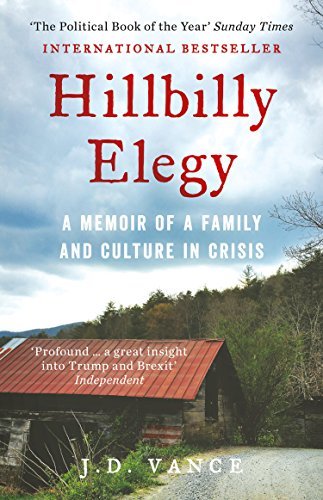
I did something recently that I haven’t done for a long time. I picked up a book from a remainder table. It was at the National Library bookshop, and I was waiting to meet a friend for lunch. The book was J.D. Vance’s memoir Hillbilly elegy: A memoir of a family and culture in crisis, and on its front cover was a review excerpt from the Independent, which said “profound … a great insight into Trump and Brexit”. I was intrigued, and embarrassed that I had not been aware of this “international bestseller” – unlike many of you I suspect.
So, I started reading while waiting for my friend and was engaged. On the first page of his Introduction, Vance tells us that the cover of the book says memoir, but he’s only thirty-one and has accomplished nothing great, nothing that would justify a complete stranger paying money to read about him. Then comes the point, he had written the book, he said, because he had achieved something quite ordinary. He had graduated school, then gone to university and Yale Law School, something that doesn’t happen to people like him, to white people who grow up poor in an Ohio Rust Belt steel town. This is the sort of socio-cultural story that interests me.
Then I hit a little block. I wrote about it to my American friend – we always share our reading – and she filled me in on Vance (born in 1984). Anti-Trump in 2016, he has since back-flipped and is now not only not anti, but actively, and visibly, pro-Trump. He is, in fact, as of 2023, a Republican Senator and Trump supporter. Hmm … well, I kept reading, though admittedly after a little pause. I’m glad I did because I learnt quite a lot – about American white working class culture, specifically Appalachian hillbilly culture, and how it can lead to the sort of thinking that can make something like Trump happen. But, the book was published in 2016, so it doesn’t necessarily explain what is happening today.
The memoir
As a memoir, Hillbilly elegy follows a typical misery (or poor-boy-done-good) memoir trajectory. Born into a dysfunctional family with an addict mother and a procession of “father” figures, Vance was headed for a life of similar struggle and little hope. He provides a colourful and warm-hearted but also clear-eyed picture of the Kentucky-based Appalachian hillbilly culture from which he’d come, and of those from it who migrated, as his family did, to the now declining factory towns of Ohio. Of all the American books I’ve read over the years, this was not a story I knew, and I found it fascinating – in both the parts that were unique and those that were universal to disadvantaged families (in western cultures anyhow), namely the poverty, the lack of opportunity, the lack, even, of awareness of what could be striven for (let alone how to do it). This lack of awareness and know-how are, in a way, the real kickers.
As is common in this genre, Vance survives with the help of others, most notably his maternal grandparents, Mamaw and Papaw to whom he dedicates his book. He credits Mamaw’s (and his mother’s, in fact) commitment to the importance of education, along with the help of others who recognised something in him, as being what got him through. It’s a common story in one sense, but the particulars of this one – to do with the hillbilly culture and his individual circumstances – make it worth reading.
At the end of the book, Vance acknowledges the help of various people in writing this book. These include someone called Charles Tyler who forced him “to hone in on a few core themes”. Those themes are evident from the beginning, and they stem from an interrogation of his cultural background, its derailment and how it operates to hold people back. It’s a believable story, and I enjoyed reading it, partly because he brings the place and the people to life and partly for the truths he shares, because there are truths there, truths that confirm some of my own sociological studies into disadvantage back in the 1970s.
The sociology
However, it’s also in the sociological analysis that I was most challenged. Vance describes in detail the problems his culture faces – the poverty and lack of opportunity, the drug addiction, the broken families, the violence, the complicated relationship to work – but the conclusions he draws are what’s interesting.
An example is his discussion of his culture’s understanding of success, which they put down to one of two factors: the luck of being born into wealthy families, or talent. As most hillbillies don’t come from the former, they ascribe success to being smart, meaning “hard work doesn’t matter as much as raw talent”. He analyses this a little, providing some nuance, but it seems that in his mind work ethic (or lack thereof) is an issue. He raises it first in his Introduction where he describes his experience of working on the floor of a tile distribution business and seeing poor work ethic firsthand. This and similar experiences (including seeing welfare gaming in operation) drove this book, which he says is about “a culture reacting to bad circumstances in the worst way possible … a culture that increasingly encourages social decay instead of counteracting it”.
My friend wrote during our discussion by correspondence that he seems to come more from the “pull yourself up by your bootstraps” mentality than one acknowledging the role of outside help, such as from the government. Vance does talk about all the help he received – indeed he says he wouldn’t be where he is now without it – but it was from family, friends, and mentors, meaning personally-based, not from the government. The message feels confused. He clearly appreciates how difficult it is for people who grew up like he did to get ahead on their own, but his analysis of the remedy feels narrowly simplistic:
Public policy can help but there is no government that can fix these problems for us.
and
I don’t know what the answer is precisely but I know it starts when we stop blaming Obama or Bush or faceless companies and ask ourselves what we can do to make things better.
These are valid points – to a point. Change does need to come from within, but that can rarely happen independently. Serious support is needed, and it needs to be systemic, and structural, from without as much as from within. Vance understands issues like lack of opportunity and ignorance. These things can’t be easily fixed from within. It doesn’t seem like Vance sees that (or, didn’t then, anyhow).
I wasn’t far into Hillbilly elegy when I was reminded of another poor-boy-done-good memoir, Rick Morton’s One hundred years of dirt (my review). However, while Vance has gone on to join his country’s ultra-right, Morton, who was also born in the mid-1980s, has gone in a very different direction. A journalist, his expertise is social justice, and he regularly calls government to account for its failings. His understanding of opportunity and social inequity feels more nuanced to me, but that may be because I agree with his way of thinking about these issues, and how they might be addressed. I could ask why these two men who came from such poverty-stricken backgrounds are so different in their thinking, but I’d only be conjecturing (albeit with some basis in fact) so let’s just leave that thought hanging.
I’m glad I read Hillbilly elegy. Vance cares deeply about his culture, and his stories of real people who are genuinely hurting engaged my heart, but he also provided insight into a way of thinking about these issues that I little understood.
J.D. Vance
Hillbilly elegy: A memoir of a family and culture in crisis
London: William Collins, 2016
264pp.
ISBN: 9780008220563
 Whispering Gums
This does sound a fascinating insight into a side of America that I can’t say I know much about–both in terms of life and culture but also outlook. Though I suspect there will be plenty to grapple with.
Thanks Mallika … it really was an interesting read, but challenging to write about because it was difficult at times to properly grasp his point. And I think that’s because he doesn’t really have the answers.
Honing in, eh ? – why am I not surprised ..?
Can’t even begin to have a ‘balanced’ view of this, ST.
But it is important to read the views of others, n’est-ce pas, MR? I don’t do enough of it, really, because it’s easy to become locked in one’s echo chamber. It’s scary though how differently we all can think about the same issue!
You are simply too reasonable, ma chère. I shall remain here in my anti-tRump echo chamber and listen !
And that’s fair enough to MR!
How well you have read the JD Vance book: Hillbilly Elegy. There were elements I saw in it along the lines you identified. I bought it when it was published expecting something along the lines of Joe Bageant’s two books – which I became aware of when Phillip Adams interviewed him around 2009, 2010: the first book: Deer Hunting with Jesus: Dispatches from America’s Class War (2007) and then Rainbow Pie: A Redneck Memoir (2010). He passed away aged about 65 in 2011. Do you know these two – far more satisfying than JD Vance.
Thanks Jim, but no I hadn’t until a couple of hours ago when I saw a mention of the Deer hunting book. But now you have intrigued me. I looked him up in Wikipedia, and apparently Australia’s Scribe published a book of his essays after his death.
Wikipedia also says that in Deer hunting he wrote about the ‘how the Democratic Party lost the political support of poor rural whites and and how the Republican Party has convinced them to “vote against their own economic self-interest”.’ This reminds me of the election here where it was said that the landlords voted in favour of their tenants, and the tenants voted for the good of the landlords.
Bageant sounds like an interesting person.
Well, I have read a bit of analysis about why people support Trump e.g. in The Lonely Century (by Noreena Hertz) and also less empathetic articles about it in the news media I consume…
but *chuckle* that is quite enough for me.
And fair enough Lisa.
I prefer Joe Bageant’s “Rainbow Pie” for the account of growing up in hillbilly environments. With some very interesting insights into that culture and a degree of wit, it is delightful reading. His book with my favourite of all titles – a big claim I know – is “Deer Hunting with Jesus” !
Thanks Campbell, the votes for Bageant are coming thick and fast. I’m truly intrigued.
I remember reading about this at the time and I’ve seen mention of it since and wondered if I’d missed the boat and it was out of date now. I will still pick up a copy if I see one, as it’s important to understand communities like the author’s, wherever in the world they are.
Thanks Liz … yes, that’s why I decided to read it, and to continue reading it when I understood more about the author’s context. It’s an interesting read on a few levels.
I read this when it first came out. I enjoyed it but if I remember he was from Indiana a very red state o not surprised he turned pro Trump. How interesting.
Thanks Pam. He’s from Ohio with family origins in Kentucky.
I stand corrected. I knew it was south of Michigan but thinking Indiana for some reason. I was close! 🤣
You were! Same difference?
Thank you for reviewing this book and I agree with you that it is sometimes difficult to grasp what point JD Vance was making. It seemed as if he attributes the poverty of the Appalachian hillbillies to their fatalistic attitudes, lack of work ethic, and helplessness. There may some truth in that, but does this Appalachian mentality apply to all struggling groups in the United States, and is it accurate in understanding the rise of the MAGA culture in the country. His book has been very popular among social conservatives because it validates their belief in minimal governmental support. Now that with his Trump endorsement JD Vance has become a senator, will he tell his constituents to stop whining, or will he make some effort to better their lives through living wages, childcare, healthcare, or battling of the fentanyl crisis?
Agree with all you say including your pertinent questions Carolyn. I struggled a bit with this review because I did feel his conclusions didn’t match the reality that he seemed to see but kept sliding away from drawing what seemed to me to be the obvious conclusions.
Thanks for engaging with me on this journey!
Have you read Bageant?
I tried to give the ideas in Vance’s book a fair shake when it first came out https://necromancyneverpays.wordpress.com/2016/11/13/liminal-lives-just-mercyhillbilly-elegy/
but now I think he’s full of shit and I’m furious that he got the majority of the unthinking Republican votes in Ohio to “represent” me in the U.S. Senate
Thanks Jeanne, I’ll come and read your post, but I can imagine doing exactly what you did. I’ve read a bit about him since my friend clued me into his trajectory since the book, something I hadn’t been aware of, not following individual states closely, and as I implied in my post I nearly gave up reading the book. But, it was interesting to see where he was then and rather gobsmacking to see how such an educated person can be so swayed into where he is now. That just makes the whole Trump thing even more mysterious to us outsiders.
My analysis is that Americans are thinking less and feeling more.
That makes sense Jeanne. The trouble is, it’s easier to feel isn’t it?
PS I don’t think you were the only one to try to give the book a fair shake.
oh no, I think a lot of people leaned over backwards trying to give it a fair shake
I read this just after Trump won the election, and remember it as being readable, interesting and bit baffling. His blind spots when it came to a social safety net were enormous. Basically his premise seemed to be ‘if I can succeed, anyone can.’ Which to my mind totally ignored all the systemic issues (the so-called US health system, for example).
Yes, thanks Michelle, that’s the problem, he ignores the systemic/structural issues. He is very clear about the help he received – and it wasn’t just one person – that helped him get to where he was, and yet doesn’t seem to realise that not everyone has so many people in their courts. In fact he sort of does, with an example he shares near the end, but still doesn’t then come to what we would see as the logical conclusion.
I am interested, Stefanie, so will read that. Love your “supporting blankity-blank”.
I was thinking quite a bit about how generous to be … and I guess my first issue was this was published in 2016 so probably mostly written in 2015 before all this really started to fall out, and the other was to try to put myself in his shoes and where he’d come from. It sounded pretty dire. He drew conclusions from his experiences that saddened me (like his response to the welfare gaming) but I have to understand it too and not come on with my privileged white middle-class (which order to put those in!) perspective. I constantly come up against this and it tempers my responses, perhaps too much sometimes!
Stefanie from A Stone in the River (https://www.astoneintheriver.net) commented on this post, and I replied twice, before reading her recommended article and after, but while finalising my second reply, both my reply AND her original comment went POOF and are nowhere to be seen, so I’ve retrieved Stefanie’s original comment from my email system:
I’m glad your friend clued you in about Vance since he has been discredited and is a far-right Trump supporting blankity-blank. Nothing wrong with the memoir part of the book, but I think you are being too kind about the rest of it (and I appreciate your generosity!). Even his social assessments have been criticized as being racist, sexist, and all kinds of wrong. If you’re curious, Politico has an interview with the Chair of Appalachian Studies at Berea College, Kentucky https://www.politico.com/news/magazine/2022/05/06/jd-vance-book-dangerous-00030374
My first reply, before I’d read the article, is above.
I really disliked this memoir because it’s his story, yes, but I felt he clearly crafted it with a message in mind: that being poor is often your own fault because anyone can change their circumstances with the right choices. However, did you notice how he completely skipped the part about HOW he got into a prestigious law school? He’s just suddenly there.
We’ll it’s interesting Melanie because he frequently admits to the help of others, and in his example at the end he talks of a young man from similar circumstances and wonders what help he had. So I felt he had some glimmers of the complexities behind being able to make choices but to my mind he draws the wrong conclusions about how to remedy this.
This may already be on your radar Sue, but I’m 3/4 of the way through Demon Copperhead, Kingsolver’s homage to David Caopperfield set in the Appalacian town of Jonesville, Lee County. An area she grew up in herself and has recently moved back to.
She covers the same topics as Vance and more, including how big coal, big tobacco, big pharma have all made this area the way it is. She has written an extraordinary story that is in no way derivative – and one I suspect will be my best book of 2023.
Oh thanks Brona. It’s on my reading group’s schedule suggestions but am not sure it Will get up. Your characterising it in relation to Vance increases my interest.
Did not know he wrote this, but had heard of it. As being Trumps’ official VP pick, will certainly be picking it up to read. Thanks for the review.