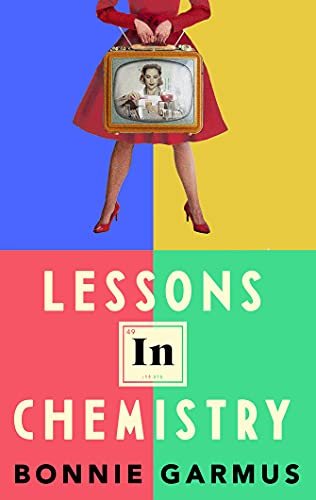
Bonnie Garmus’ debut novel Lessons in chemistry made a splash on best-of-2022 booklists last year, resulting in my reading group scheduling it this year. It is an enjoyable read, but the intriguing thing is that more than one reader I know couldn’t remember what it was about a few months after reading it. Each remembered enjoying it but could not recollect the details. Why is this? Why, in fact, are there some books that we read and enjoy but forget quickly, while others linger long after we’ve turned the last page? I will leave this for you to ponder. Meanwhile, I’ll get onto the book.
Most of you will know the basic story, but I’m going to document it anyhow – because, you know, I might forget it down the track. It is historical fiction set in the 1960s, and tells the story of female scientist, Elizabeth Zott, whose only ambition is to be a research chemist but whose career is constantly derailed by powerful men’s determination to keep women out of the laboratory. She ends up in the most unlikely job, the host of an afternoon cooking show which, despite her best efforts not to fit the female-TV-star mould, becomes a hit.
Everyone in my reading group thoroughly enjoyed the read, despite some reservations, to which I’ll return later. Our overall assessment was that, with its stereotyped, larger-than-life characters who don’t really change, it read like a fairytale, fantasy or, revenge comedy. But, we also recognised that it dealt with some relevant and serious topics, particularly regarding the inequitable treatment of women – in science, and in life. So, here is the question: given my earlier comment regarding readers forgetting its details not long after reading it, how effective is its light, comedic approach to making the message stick? Humour is a tricky thing. We love reading it, but does it move us to take its target seriously?
Like all writing, some humour is more effective than others. Satire, for example, with its characteristic clever, ironic wit engages my brain and, in doing so, can help the message go down. Lessons in chemistry has some of these elements, but it felt more situational and laugh-out-loud than satiric. This is what makes it so enjoyable, but such humour can sometimes bury the message. Time will tell for me!
And now, let’s look at its humour. Some of my favourite scenes came from the cooking show which Elizabeth Zott uses to teach her housewife audience chemistry, but more than that, to empower them. In one show, she describes different chemical bonds, one being the hydrogen bond:
“I call this the ‘love at first sight’ bond because both parties are drawn to each other based solely on visual information: you like his smile, he likes your hair. But then you talk and discover he’s a closet Nazi and thinks women complain too much. Poof. Just like that the delicate bond is broken. That’s the hydrogen bond for you ladies — a chemical reminder that if things are too good to be true, they probably are.”
“See?” a woman in Santa Monica demanded as she turned to her sullen seventeen-year-old daughter, the girl’s eyeliner so thick, it looked as if planes could land there. “What did I tell you? Your bond with that boy is hydrogen only. When are you going to wake up and smell the ions?”
Her poor producer Walter Pine, whose boss is demanding sexy clothes and cocktails with the cooking, tries in vain to rein her in.
Rowing is another topic that recurs through the novel. Obstetrician Dr Mason wants to get single-mother Elizabeth back in the boat when her baby, Mad, is just one year old. He discovers that she has a keen, helpful neighbour, and suggests that she ask this neighbour to help out:
“At four thirty in the morning?”
“This is what is so unsung about rowing,” Dr. Mason said, turning to leave. “It happens at a time when no one’s really that busy.”
That made me splutter my coffee – as did so many other observations throughout the book. It is a chuckle-inducing read, replete with funny one-liners and surprising similes alongside its array of set pieces.
But, as I said, my group did have some reservations, though they varied. One, for example, didn’t like the anthropomorphism involving the dog, Six-Thirty, while others of us appreciated his astute commentary on his human companions. Another felt it read a bit like a catalogue of issues – suicide, rape, domestic abuse, single-parenthood, and plagiarism, among others. And a couple of us found it somewhat anachronistic. I usually give historical fiction authors a lot of leeway in this regard, but the novel felt imbued with a strong 21st century sensibility. For example, Elizabeth Zott’s young daughter responds to minister Wakeley’s question about her age with “I’m not allowed to give out private information.” Most of us remember the 1960s, but we don’t remember this sort of idea being promulgated. It was just “don’t talk to strangers”.
“Chemistry is change” (Elizabeth)
Garmus was 65 when the book was published, making her a late-bloomer in terms of a novelistic career. However, it also means that she has a lot of life experience to share. She – through Elizabeth – believes that science has much to offer human beings. Elizabeth is infuriated that “too many brilliant minds are kept from scientific research thanks to ignorant biases like gender and race”. She believes that science can be empowering – “when women understand chemistry, they understand how things work”. Indeed, for her science encompasses
the real rules that govern the physical world. When women understand these basic concepts, they can begin to see the false limits that have been created for them.
Beyond this, however, is the over-riding philosophy that life, like chemistry, is all about change. Through the book Elizabeth has to cope with a range of challenges, some of them serious, and some, in fact, tragic. It is her faith in science – plus the support of some decent people, it has to be said – that see her through.
Lessons in chemistry is not a perfect book, but it is great fun to read and it has a big heart. I can forgive it its little failings for these.
Brona (Brona’s books) and kimbofo (Reading Matters) both enjoyed this book too.
Bonnie Garmus
Lessons in chemistry
Transworld, 2022
391pp.
ISBN: 9781473594531
 Whispering Gums
I find high profile launches often off putting so had resisted this one. but then Garmus came to do an event with a local indie bookshop so I went out of curiosity. She was a wonderful speaker, full of anecdotes about the impetus for the novel. So I ended up buying it though have yet to read it. The anthropomorphic dogs might give me an issue but for now I’ll keep an open mind.
yes, some books I enjoy but instantly forget – like the Long Song by Andrea Levy. When I came to include it in a recent list post I actually had to look up my review to remind me what the plot was about
Ha ha Karen, your comment about Long Song reminds me of my recent decluttering activities where any book that I came across in my read shelves that I didn’t remember at all having read had to go. The books I kept were those that meant something to me even though many of them I will never read again.
I think it’s worth reading Lessons in chemistry, particularly since you’ve got it, because it really is an entertaining read. Not perfect but she has a wonderful way with storytelling, is able to set up scenes that are entertaining, and has so many laugh out loud comments and descriptions. I’ll watch for your review, once I have time to watch for anything!
Thanks for commenting – so nice to hear from you particularly given how remiss I’ve been.
I’ve been just as remiss! Too many other things competing for attention at the same time and it was blogging/commenting that had to take a back seat.
I rarely keep books now once I’ve read them – they have to be exceptional.
I completely understand Karen …
I have a friend who passes nearly all her books on after she’s read them but I’m not quite there yet!
I really enjoyed this, but yes, definitely saw it as a feminist fairy tale. I didn’t mind the dog, to my great surprise, but I was a bit taken aback by the violence – not the sexual assault, as I mistakenly led another blogger to believe, but the bit with the pencil and the description of an accident. I seem to remember others being given pause by that, esp as it was marketed as very light and frothy. My review is here if you didn’t see it at the time (I had a copy from NetGalley so read it a while ago and when there wasn’t so much hype). https://librofulltime.wordpress.com/2022/05/03/book-review-bonnie-garmus-lessons-in-chemistry/ I’d say it would definitely be a good book group read.
Thanks Liz, I’ll check your review. I didn’t want to talk about the violence specifically beyond mentioning abuse, rape, and tragedy. I reckon that gives the sense that it’s not all frothy – and, after all, fairy tales aren’t violence free are they?
Oh yes, you gave a very good idea of it; it was the marketing that made it seem lighter than it was, and I saw early marketing, too. I just found those two points maybe too sharply defined and they were being talked about a lot when I read and reviewed. Of course you’re right about fair tales, too! And who hasn’t wanted to do what she did, as well!
Thanks … I didn’t see the early marketing for it but then I don’t generally take a lot of notice of book marketing, particularly of books published elsewhere. I can imagine how it went though – you can see it in the cover.
I wanted to read and enjoy this book SO BAD because it sounds like my cup of tea and it’s so popular, but unfortunately, I could not get into it when I tried it. Could’ve been due to all the chaos going on in my life at the time, or could’ve been the fact I tried to read it via Kindle (I hate ebooks so much!!!!) so I should probably give it another chance.
I had to look up the definition of anthropomorphism. Interesting!!!
Your review was really well written and nice to read. You gave me a better look “inside the book” without giving anything away. I think being prepared for the type of humor used in the book is major as I find very few humorous things to actually be funny. lol
Thanks Jinjer. I read it by eBook! (Oops, I forgot to put my usual publication details at the end – will remedy that). I don’t like e-Books either, but I have decided that I need to get used to them as I can’t just keep acquiring books, and I don’t like borrowing them from the library because 1) I write marginalia, and 2) I can’t necessarily get what I want when I want.
It may be to do with where you were at at the time. That can have a big impact. Or it may just not be the humour for you. Mr Gums finds fewer things funny than I do, so I understand where you are coming from.
PS I love that you said that I gave you “a better look “inside the book” without giving anything away”. That’s exactly what I want to achieve, really.
It’s what you’ve been achieving all along, you NONG !!!
I’ve told you so a thousand times.
Sighhh ..
[grin]
It’s good that you review books about the overall quality of which you’re not totally convinced (I’m unsure of that preposition, myself !): it leaves room for us to .. ahh .. consider.
Thanks M-R. I know some of my blog readers think I only rave about books, but I don’t really think that’s true. However, I rarely read books that I don’t enjoy in some way. Also, I’m ecumenical in my tastes, and am not a harsh critic.
As for that proposition – damned if you do it that way, damned if you don’t I think!
Most members of my book club have raved about this but one or two didn’t like it. Sounds like a good holiday read for me, Sue.
Your comments about memorable reading resonate for me. I’ve decided the measure of a good book is that it stays with me – especially given how much I read. A good criteria for culling.
That’s the criteria for literature that emerged with the classes I taught as a teacher-librarian. The kids loved those endless Treehouse books and the smuttiness of Jennings et al, but they were quite clear that the books that were “literature” were the books that you remember all your life.
Sensible kids, eh, Lisa? I guess that’s why Alice, Pooh, Mowgli, et al last on and on.
It would be a great holiday read Angela – for most people – I think, but I can understand why some would not like it.
And yes, exactly, a good criterion for culling, and one I’ve been using over the last couple of months. Trouble is, I’ve remembered too many (or, just enough of too many, to weed out as many as I should!!)
I haven’t been sure about this book (Kim’s review convinced me to reconsider).
What you’ve said about the staying power of books is interesting – same thing happens for me. I figure if I can’t remember what I enjoyed about a book, then it’s not a keeper.
I probably wouldn’t have read it if my reading group hadn’t scheduled it Kate – it wasn’t one of my recommendations – but that’s the joy of my reading group because although this wasn’t a perfect book it really was a fun read and I’m glad to have read it. The cooking show episodes, for example, and the whole afternoon TV thing, were a hoot.
Thanks for the link to mine. I really enjoyed this book but like your book group member I really detested the anthropomorphised dog and I didn’t much like the precocious, super-intelligent child either. It wore its agenda/s a little too heavily and was written with a modern mindset, but it’s an entertaining read nevertheless.
As to whether it’s a memorable read, I’m not sure as I only finished it last week so it’s pretty fresh in my memory. I think the circumstances in which you read a book, where you are, what you’re doing in other areas of your life etc often determine if a book is memorable… I tend to remember the ones I read on certain holidays, for instance, and I know exactly what books I was reading when I was going through a long drawn-out redundancy process in 2010.
I guess we dog people don’t mind anthropomorphised dogs, particularly in fairy stories, kimbofo! Mad was very precocious, but again, I didn’t read this book as realistic so I enjoyed her – plus Daughter Gums, though not as precocious as that, did have a wise head on her shoulders so Mad was not completely out of the realms of possibility for me.
Good point re other factors besides the book itself affecting whether you remember it. I remember reading several in Maupin’s Tales from the City series over a long weekend, in the mid 90s. I have no idea how I managed to carve that time given the kids were young. Maybe it was school holidays and they were with my parents? Anyhow, it was bliss and I don’t think I’ve had a time like that again since. Still, I think I let those books go in my declutter – with a lump in my throat.
How much we remember of a book several months or years after reading it is an interesting way to evaluate a book. My reading group in SoCal discussed this book a couple of months ago but many members had already read the book more than a year ago. Knowing that members read books far in advance, I found a summary of the story and read it aloud to everyone before we started the discussion. It was shocking the details and even main parts of the storyline that we’d forgotten. Of course, it could be that our senior brains are not what they once were, but while nobody remembered the convoluted plot of the story, everyone remembered the frustrating and often violent injustices the main character suffered for just being a female wanting a career in science. Did we recall enough to make it a significant book? I’m not sure.
Thanks for sharing these insights Carolyn. Of course, it was your comment about this in a letter, plus a comment from a reading group friend who’d read it months ago, that inspired my intro to this post.
I don’t think you need blame your senior brains!
As for whether it’s a significant book, yes, I’m not sure either, but it was so fun to read, wasn’t it?
I could say I’ve never heard of it, but perhaps I should check first to see if I commented on Brona or Kim’s reviews. Let’s just say it didn’t stick.
Garmus is a few years younger than I am, which means she graduated and began working (in advertising) in the 1970s. I wonder why she chose to set her novel in the 1960s; and why fight a dragon that has already been slain?
Thanks Bill, that’s a question I often ask about historical fiction. I guess the dragon has been slain to a degree, but complete gender equity isn’t here yet. There’s probably also value in reminding us of how it was, to ensure we keep moving forward because we know – just look at abortion rights in the USA – how easily things can slip back.
I read it a year ago and it sticks with me because of the ending, with the long-lost mother coming out of the woodwork and saving the day. Hurray! The current popularity of this heart-wringing trope in novels is wearing thin for us in the adoption community with lived experience, and the dialogue used was straight out of reports from what Australia now terms the Forced Adoption Era (which was as prevalent in the US).
I realise that is a very personal perspective and gripe, and most will not put much store in it. Nevertheless, it does tap into the wider discussion as to who has the right to story, e.g. the controversy over American Dirt, or “white” Australians writing Indigenous stories.
Thanks Gwendoline. The ending was another thing that I didn’t really like (which brought a bit of a gasp from most of my reading group). I guess if you read it as a fairy tale then it’s OK, but I prefer endings to be a little less neat. I hadn’t though thought of it in the terms you describe, as I don’t have that experience.
This who has the right to tell stories issues is a bit problematic. I get it in one sense – particularly with situations like First Nations people and others whose stories have been oppressed – but taken to its logical conclusion it suggests that I could only write about an older, white Australian woman living in Canberra. It can become very limiting on the imagination, n’est-ce pas? So, I remain open to the idea that authors should be able to write, respectfully, outside their own experience, but they need to be ready for questions too.
I agree with your views on who can write what – subject to the author doing their homework. No doubt you’ve noted the emergence of sensitivity readers.
My friend and fellow writer Christine Sykes (also at one-time an older white Australian woman living in Canberra), took advice from previous indigenous colleagues when addressing some points in her memoir Gough & Me, and it added information and improved those sections no end.
Similarly, when she wished to have an adoption angle in her novel Tap Cats of the Sunshine Coast and proposed giving far too much weight to the funds promised by Julia Gillard as a “fix” in dialogue between characters, rather than test our friendship by explaining she was off-course, I put her in touch with a relevant counselling organisation. Where she had been seeing the situation through a public service lens, without being aware that the funds never flowed through, her attention was drawn to the emotional minefield she may have accidentally stepped into. Again, the final outcome was more on point.
I am woefully behind on all things blogging (again) but unlike you I have no method to getting around to all my regular blogging haunts. My approach so far is haphazard, like spotting an alert for a link to one of my posts! I thought I might catch up this long weekend in NSW but family life has very happily got in the way.
I read this book 3 months ago now and mostly remember it for the fact that it was the perfect read when I was feeling unwell with a nasty sinus infection and had a couple of days lying on the lounge!
And here I am a week later responding, Brona, showing just how behind I am too. I’m struggling to post twice a week at the moment, and keeping up with other blogs is just very hit-and-miss.
The way you remember the book seems to be largely the point I was making – people remember enjoying it but not a lot else. I can imagine it was a perfect read for when you were unwell.
Very interesting review! I haven’t read Lessons in Chemistry yet but I like your thought-provoking q re books you remember vs those soon forgotten. On the subject of humorous novels about women’s roles (here, in medicine), I would highly recommend At Least You Have Your Health, by Madi Sinha. It weaves together some interesting themes while creating Wodehouse-like situations from a large group of characters. I hope you like it. Humour is so subjective though! Regards, Elizabeth
Thanks Elizabeth for the recommendation – and I’m really sorry I didn’t reply earlier. Humour is subjective I agree, but I can usually see the funny side. I will make a note.
I think I know what would make me forget a humorous book: if the book consists mainly of zingers, of those one liners that nearly make you spit out your coffee, it’s forgettable, and that’s why I highlight these kinds of passages. But, if they make an entirely funny scenario, I will cherish that for longer than my mother’s phone number. I think that is why Lantana Lane is so funny; the author recreates series of hilarious situations AND has zingers.
I wonder why this author didn’t set the book today. It’s not like women are having much better luck in the STEM field, and the mommy YouTube channels are incredibly popular, as are Netflix original baking shows. She could have easily transported the whole thing to 2023 and made the same point but kept the 21st century attitude that seems to be coming through. I think this book sounds lovely, so I’ll see if I can get a copy.
Oh wow, my library has FOUR copies (audio, physical, large print, and e-book) and all four are checked out! Hooray for Bonnie Garmus!
Thanks Melanie … I usually ask that question about why did the author choose historical fiction but I had other fish to fry this time, and left that one alone. But, you make some fair points I think – I agree with you more than I agree with Bill. I don’t think the dragon has already been fully slain yet – but perhaps she felt that in that era the sexism was more cut and dried so easier to make comic.
Anyhow, I hope you read it and look forward if you do to your comments.
Right, I know Bill believes that historical fiction, in a way, erases history and becomes propaganda, but in this case it just sounds like the author is too familiar with current times, and who can blame her? I’ve reached the point where I forget that when I went to college the first time, there were no smartphones because they didn’t exist.
I didn’t know the author was so old…maybe this would be a good follow-up to Babel, which irritated me a little because the author was clearly so young!
I don’t know Babel Jeanne so I can’t comment, but I’d be interested to hear what you thought.
Pingback: Sunday Lowdown #128 – Grab the Lapels
I must confess I’m probably one of the few who find this book off-putting. I tried it once listening to the audiobook, and had to quit about half way. After some months I made my second attempt, feeling i should at least listen to it all if I’m to make my criticism legit. Well here I am–never thought I’d voice my discontent here in your blog, WG. While I can appreciate the author’s acerbic attacks on the misogyny and inequality of the time, I find the heroine, EZ, to be a voice of hubris, talking down to her other characters, including her TV viewers, and I’m afraid by implication, her readers. What really disturbs me is the author’s taking on the “science vs. religion” debate and wrapping up the conclusion by a few verbal challenges and declaring victory of one and trampling on the other without reservation, and especially without presenting another intelligent voice to offer counter-arguments for debates on this age-old discourse, one that cannot be superficially dealt with, sounds extremely reductive and judgmental, ironically, from a free thinking scientist. What a haughty statement to declare that scientists who believe in God are being intellectually dishonest? How naive and simplistic this sounds. So, coincidental that you’ve this book posted as I just finished the audiobook last night. According to the EZ spirit of intellectual honesty, I feel I must present my ripples upon finishing the book. 🙂
Thanks for airing your discontent here Arti. I am glad that you did. I did think this issue would come up in my reading group because the discussion of religion in books is something that one member in particular usually has something to say about. I would like to have thought about it some more, but my time is so pressured at the moment and there were other things that interested me, that I didn’t spend a lot of time thinking about those discussions in detail. It’s interesting that she did take on this issue – why did she? As my group did feel, she tackled perhaps too many issues.
In my experience there are scientists who can make religion with their profession, and others who see them and incompatible, so Elizabeth’s POV didn’t seen unreasonable to me, but your question about why Garmus wanted to discuss the issue is worth asking.
BTW, it’s coming out as an Apple TV series, but I didn’t include it in my list of upcoming books to screen (my current post) as I have reservations about it’s ‘voice’. But then again, maybe Brie Larson will add some humanity and humility to the character. Maybe you’d like to check out my list. On another note, have you read those popular beach reads, like Beach Reads, Book Lovers etc. by Emily Henry? That could be a new wave of contemporary Nora Ephron-esque rom-com’s.
Thanks Arti, I will check out your post.
No I haven’t read those books though I’m pretty sure my daughter and my son’s partner have. I don’t really read beach reads as I have so much else I want to read.
I’m not a fan either. Just saying cause it looks like the rom-com as a genre might be having a comeback. Anyway, I can totally appreciate your having so much else you want to read. 😉
One more thing: have you seen the new Korean movie Past Lives? Comes with high acclaims. I’ll watch it next week.
No, I haven’t. I’m very behind in movies at the moment as my downsizing is all-consuming! But I’ll look out for it.
All the best with your move. I’m trying to delay that as late as possible… I can see how much a task and challenge that is. 😐
It is pretty horrendous but we are over the worst now – into the final stretch – until Plan B which will be in a decade or so’s time we think. My only advice is to do it sooner rather than later… but we all have our own timelines and pressures don’t we.
I did a major clearance of our whole basement last year (took me two months) as my son’s family (with two toddler grandkids) came from Toronto to visit and wanted to stay there. So I’d some horrendous experience as well… not with them, but the stuff accumulated over the decades. While many of my friends have moved to condo apartments from single family homes, there are those who are determined to stay as long as they can for the freedom and space. So, will see how it develops. All the best with your plan and endeavour! I’m sure you feel much ‘lighter’ which I envy. 😉