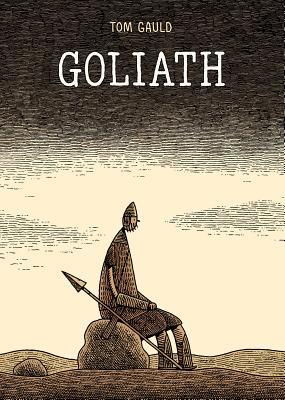
Tom Gauld, Goliath (#BookReview)

It’s probably just me, but I hadn’t heard of Tom Gauld until a member of my little volunteer indexing team sent me a link to some of his “cultural” cartoons in The Guardian. I was immediately enchanted. And then, he lent me one of Gauld’s graphic novels, the above-named Goliath. Being primarily a textual person, I am not a big graphic novel reader, but our son became keen on them in his teens, so I have some familiarity and have read a handful.

Now I’ve added Goliath to that elite bunch. It’s the sort of graphic novel I enjoy – spare, drily witty, a bit melancholic. It is also, as you will have assumed, a retelling of the biblical David and Goliath story. Like many modern retellings, Goliath is told from a different perspective, that of Goliath himself, who is seen as a pawn in the game of war. In a wry touch, Goliath is your quintessential gentle giant. When, out of the blue, he is approached to be measured for some armour, he says to the armour-maker, “Are you sure this isn’t a mistake? I mainly do admin”. As one who doesn’t mind a bit of admin, I’m with Goliath.

Gauld has published well over 20 books, starting back in 2001, but according to Wikipedia he is best known for Goliath (first published in 2012) and Mooncop (2016). I notice that his latest, published just this year, is Revenge of the librarians. Now, that’s one I’d love to read!

Anyhow, back to Goliath. Although he’d rather do admin work, destiny has other plans for him as we know – and so, he finds himself, under the Philistine king’s orders, waiting in a valley, armoured and armed up, issuing, morning and night, a challenge to the Israelites:

I am Goliath of Gath,
Champion of
the Philistines.

I challenge you:

Choose a man,
Let him come to me
that we may fight.

If he be able
to kill me
then we shall be your servants.

But if I kill him
then you shall be
our servants.

Poor Goliath. “I’m not a champion”, he says. In fact, he continues, “I’m the fifth worst swordsman in my platoon … I do paperwork. I’m a very good administrator.” But, in classic political spin, he’s told that there won’t be any fighting. He just has to “look like a champion” and “the enemy will cower”. We all know how that turned out … along came David (albeit in this version, after a very very long time of waiting for poor Goliath).

The reviews on the back cover sum it up beautifully. The New York Times says that Gauld uses “simple, clever images to explore the larger, more complicated issues of war and heroism”, while London’s The Times says, and I particularly like this, that “Goliath is a master class in reduction … a celebration of the Christian underdog becomes a subtle meditation on the power of spin and the absurdity of war”. The rest of the back cover review excerpts are similarly spot on.
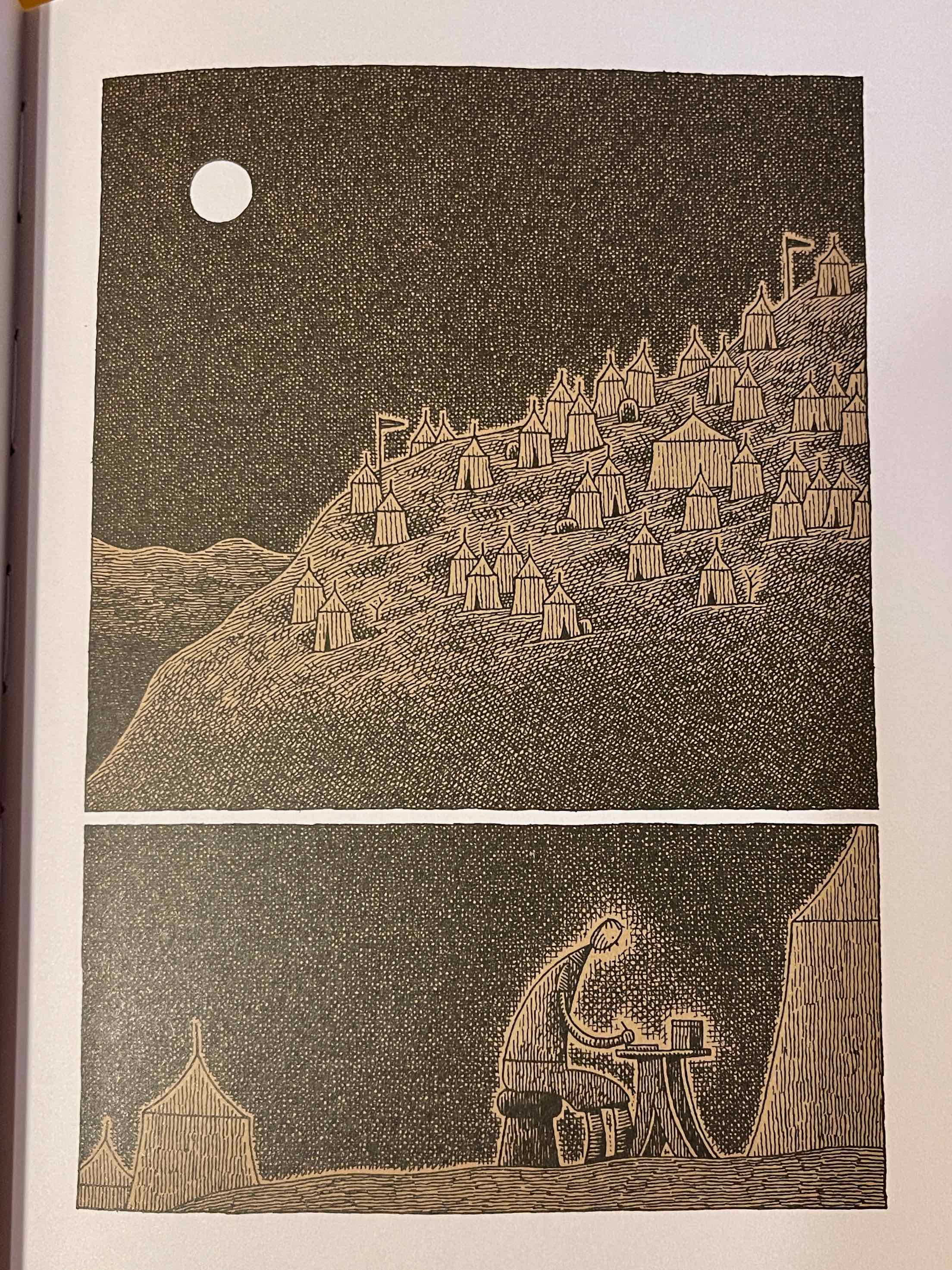
Small reproduction, allowed for review purposes.

So, did I enjoy it? Yes, I did. I liked the spareness of the art and the text. The first five textless pages set the scene – that is, they show Goliath going about his day quietly, peacefully, doing his paperwork, having a stretch at his desk, and trudging down the hill on which the encampment is located to get a drink. One of my challenges with graphic novels is taking in the images and the text, without letting one distract me from the other, but in Goliath the spareness of both made this easy. Making it easy to comprehend, though, is not the main reason for the spareness! It also reduces the story to its essence, encouraging us to engage with Goliath and what he is experiencing.

I also liked the humanity of Goliath and the small boy whose job it is to support him. As they traipse to see the captain, the small boy carries Goliath’s oversize shield. “Are you OK with that?”, asks Goliath. “Sort of” replies the boy. These two, we clearly see, are pawns in the game, potential “collateral damage” as it were, though of course the Philistine leaders believe they have the winning hand.

I also liked the subtle humour, which you have hopefully picked up already. And, of course, I appreciated the anti-war message conveyed through a twist which shows the ostensibly powerful giant as the manipulated underdog – just by changing the perspective. Something we all need to do, eh? See and feel things from another side. Recommended.

Tom Gauld
Goliath
Montreal: Drawn and Quarterly, 2017 (orig. ed. 2012)
[96]pp.
ISBN: 978770462991
Monday musings on Australian literature: Community novels

Recently, I came across a blogger discussing what she described as “community novels”. The blogger is Liz Dexter at Adventures in reading, running and working from home, and the book she was discussing was an English novel, Small miracles by Anne Booth. It got me thinking, because I love community.

Community, however, is a word with multiple meanings and applications, but Liz’s concept of “community novel” is one which has “a range of other characters, each with their own story that intertwines with the whole”. These characters, if I understand Liz’s blog correctly, can belong to communities that can range from those as “compressed” as a nunnery to those more open like a seaside town. The point is that the characters are all connected by their community, and the novel incorporates the stories of several members of that community.

Of course, I searched the internet for community novels, and found our own Annette Marfording (who has appeared on my blog). Back in 2016 she discussed the topic on her blog in a post titled 10 Great Novels on Community. Annette writes:

Using a community in fiction has several advantages: a community almost invariably provides a hotbed of conflict between its members, and it is conflict that drives a story. Communities also provide the opportunity for the author to begin the story with a new person joining the community, which can serve as the springboard or inciting incident for the story. Furthermore, community allows authors to display their skill at conveying a strong sense of the place where the writing is set. 

So, a significant feature for her are the dramatic opportunities offered by having a new person join a community. To this I would add the opportunities offered by someone returning to a community, which seems a common trope these days. Anyhow, Marfording goes on to list ten “great” Australian community-based novels – at the time of writing – noting that they tend to be set in “small rural or coastal towns, but it would, of course, also be possible, albeit more difficult, to build such communities in a city suburb”. (Check her post for her thoughtful list.)

Both Liz and Annette point to the factors that make “community novels” interesting. The small community, for one, which means readers can quickly come to know and feel engaged with it. The opportunity for conflict and difference – and hopefully resolution at the end – is another. In my internet search I found reference to a book published in 2014 by J. Hillis Miller. Titled Communities in fiction, its subject is described on Amazon as

the question of how communities or noncommunities are represented in fictional works. Such fictional communities help the reader understand real communities, including those in which the reader lives. As against the presumption that the trajectory in literature from Victorian to modern to postmodern is the story of a gradual loss of belief in the possibility of community, this book demonstrates that communities have always been presented in fiction as precarious and fractured.

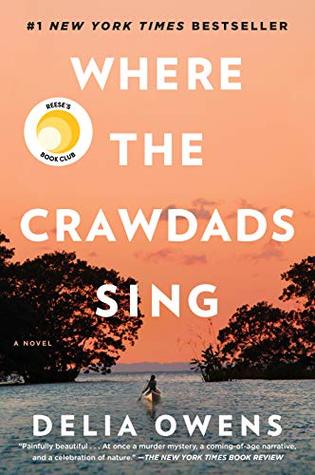
I’ll leave the trajectory issue to the academics, but I’d be interested in your perspective on whether communities in fiction are always presented as “precarious and fractured”. For me, it depends on the definition of “precarious and fractured”. If “precarious” means “likely to fall or collapse” (Oxford Languages), I’d argue that many fictional communities might be fractured, that is, “damaged” or “broken”, but are not necessarily going to succumb. Take a recent American case, for example, Where the crawdads sing (my review). That community was never going to fall or disappear, but it sure was fractured.

I also found another interesting article* on JSTOR, from 1988, which I scanned. It’s about a genre the writer, Sandra Zagarell, calls “narrative of community”, which she describes as “committed to rendering the local life of a community to readers who lived in a world the authors thought fragmented, rationalised, individualised”. Zagarell and others argue that these novels see community as important to survival in an increasingly individualistic – or, some say – capitalistic world. Zagarell comments at the end of her article on the progress of this genre into modern times, writing that

Embracing increasingly heterogeneous visions of the collective life, narrative of community is expanding the story of human connection and continuity.

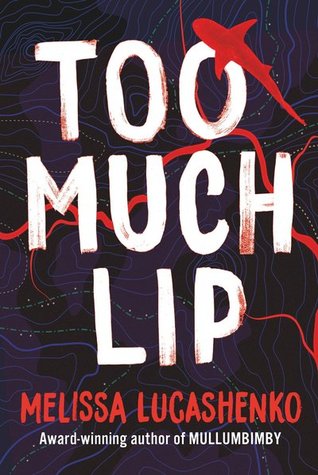
Melissa Lucashenko, Too Much Lip

Notably, she sees this happening particularly in the writing of African-American authors like Toni Morrison and Alice Walker. Interesting. We can surely see some of this in First Nations Australian literature. In Melissa Lucashenko’s Too much lip (my review) Kerrie returns to her community because her grandfather is dying but she decides to stay to fight for Granny Ava’s island. This is, in fact, a precarious community. It’s respected leader, Uncle Richard, says near the end that

We had to grow hard just to survive … But the hardness that saved us, it’s gonna kill us if it goes on much longer.

This is a community learning how to live in modern rural Australia. It’s a similar story in Nardi Simpson’s Song of the crocodile (my review) which is also about a community being torn apart, and about the resilience of a culture that is, philosophically, community-based.

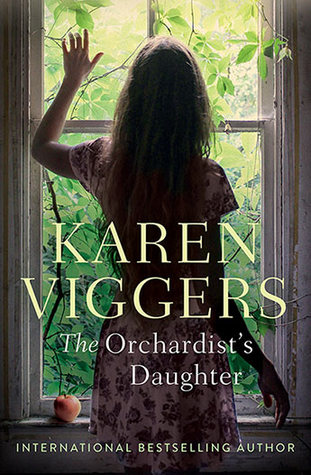
Karen Viggers, The orchardist's daughter

Besides these and other First Nations novels, I’ve read other several community-set novels in recent years, such as Malcom Knox’s coastal Bluebird (my review) and Karen Viggers’ rural The orchardist’s daughter (my review). Both are set in vividly delineated communities and explore the tensions, prejudices, greed and/or corruption that can tear communities apart, while paradoxically also conveying the potential in community for the opposite.

I opened this post by saying I love community, which means I also love novels set in communities, so my question of course is …

Do you like “community novels” and if so, what do you like about them and would you like to share some favourites?

* Sandra A. Zagarell, “Narrative of Community: The Identification of a Genre” in Signs, 13 (3) Spring, 1988: 498-527

Six degrees of separation, FROM Notes on a scandal TO …

It might be spring but it’s not a particularly appealing one here, with so much grey and rain, which is unusual for my corner of the world. But, Daylight Savings starts this weekend, which is always a plus, and the spring blossoms and bulbs are out which cheer up the grey. What also cheers up the grey is that it’s Six Degrees time again, which is a time of reconnecting with bloggers I don’t always catch up with over the month. As always, if you don’t know how it works, please check meme host Kate’s blog – booksaremyfavouriteandbest.

The first rule is that Kate sets our starting book, and in September it is another book I haven’t read, though I did see the movie, Zoë Heller’s Notes on a scandal. It was also published under another title, What was she thinking? If I’d realised that before – I only discovered it when I was searching for the book cover – I might have started my chain with the idea of different titles, but I didn’t and so I’m not!

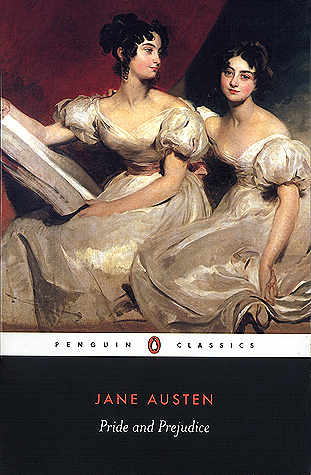
As I said above, I have not read the book but have seen the movie, which stars Cate Blanchett and Judi Dench, so I’ve decided to go with a book that was adapted to a film in which Judi Dench played a role. There are of course many many such books in her long career but I couldn’t resist the opportunity to include a Jane Austen novel again. Judi Dench played Lady Catherine de Bourgh in the 2005 Pride and prejudice (a post on the novel), so that’s what I’m linking to.

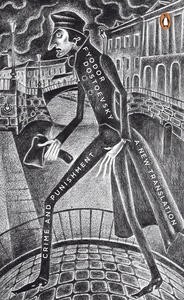
Fyodor Dostoevsky, Crime and punishment

Next up is a simple link, another book with a three-word-title with “and” in the middle. I think I’ve done this sort of link before, but no matter, it works and my time is limited. The books is Fyodor Dostoevsky’s Crime and punishment (my review).

In Crime and punchishment, our antihero protagonist,  Raskolnikov, is sentenced to Siberia for eight years. Diego Marani’s protagonist in his The last of Vostyachs (my review) is Ivan, who is the eponymous last of the Vostyachs, an ancient Siberian shamanic tribe – hence my link!

Vincenzo Cerami, A very normal man

My next link is a more usual one, the nationality of the author. Diego Marani is Italian, and so is Vincenzo Cerami, whose novella, A very normal man (my post) has remained in my mind ever since. Perhaps because ….

… its protagonist was a civil or public servant, as I was (though in libraries/archives rather than a government department.) This public-servant subject matter, and the fact that it’s set in Canberra, is partly why my next book also remains memorable for me, Sara Dowse’s West Block (my review). It also happens to be an excellent read, and a novel with a slightly different structure that I found enjoyable to think about as I read. However, that’s not what I’m linking on next.

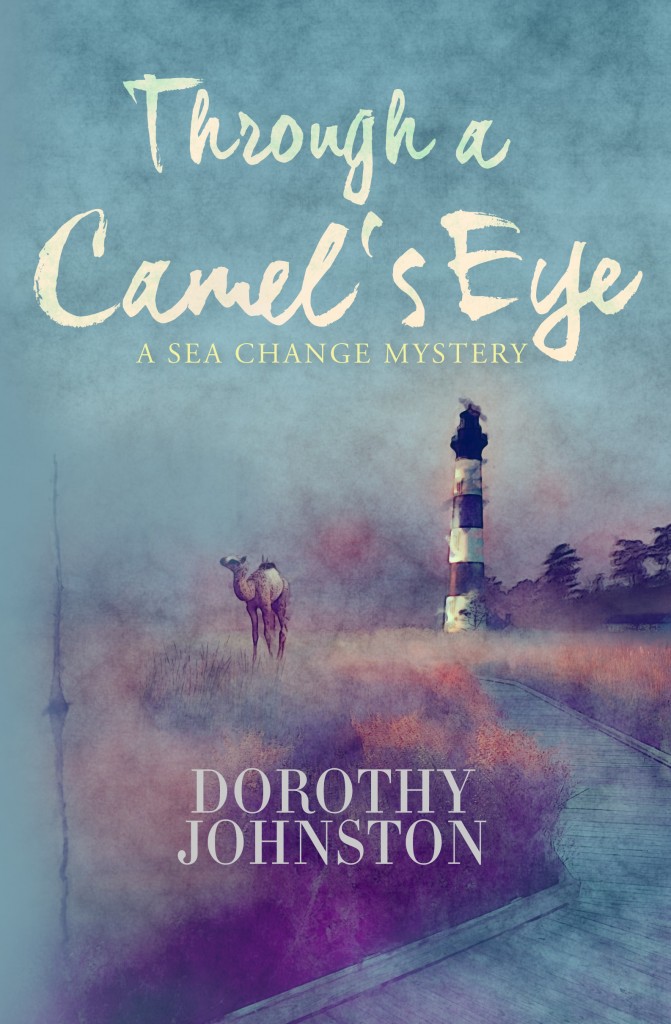
Dorothy Johnston, Through a camel's eye

My final link is on publisher. Both Dowse’s book and Dorothy Johnston’s Through a camel’s eye (my review) were published by a small and, I gather, highly personal publishing company For Pity Sake Publishing. I wanted to mention this because I did once meet the publisher, Jen McDonald, and found her a lovely, warm person. Tragically, however, she died this year, way too young. Sara Dowse has written a beautiful tribute on her blog. (I should add that I could also have linked Johnston to Dowse through their joint membership of Canberra’s Seven Writers group).

This month, we’ve traveled from England through Russia to Italy and across to Australia. We’ve stayed mainly in the 20th and 21st centuries but have also popped into the nineteenth century. Oh, and we’ve read a few translated novels. This month the gender split is 50:50.

Now, the usual: Have you read or seen Notes on a scandal? And, regardless, what would you link to?