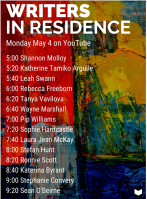
 With information coming from every which way, I’m not sure how I heard about the Writers in Residence online festival. Organised by The Writers Bloc and inspired by Isol-Aid, its aim was to “ask some of Australia’s most exciting emerging writers to read from their new books” and share “what they’ve been reading in isolation”.
It ran from 5pm to 9.40pm on Monday, and involved 14 writers, each on for 20 minutes. All interviews were conducted by Geoff Orton, an English and Geography teacher and a founder of Writers Bloc. The format was that each writer provided some background to their book, did a 10-minute reading from the book, and shared some isolation reading.
I only managed to hear 6 properly, as 5-9.40pm is a pretty difficult time-frame, but I enjoyed what I heard. It looked like there were 50 to 75 people viewing throughout the evening. Here are the writers I watched …
5pm: Shannon Molloy
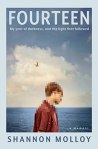 Molloy’s book, simply titled Fourteen, was published in March. It is an autobiographical coming-of-age memoir about being a gay teen. It is set in Yeppoon, in regional Queensland, in 2000. Molloy admitted that his story is harrowing, but believes it also has a strong message of hope. He wants kids “to know there is an end in sight”.
The excerpt he read described the annual coral spawn, which he sees as “the best metaphor for Yeppoon”. I understood this to mean that Yeppon is “pretty” but is also “a bit off”. (Apparently coral spawns give off a smell.) He described how he “became a pastime for bored kids”. “I was there to taunt, to abuse, to bash”, he said.
To write his book, he drew on memories, talked with his mother and siblings, and listened to bad pop music from the era! Pop music, he said, was a way of accessing the outside world, of escaping.
5.20pm Katherine Tamiko Arguile
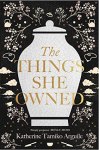 Arguile’s debut novel, The things she owned, was published in late April. Describing herself as “from all over the place”, Arguile, was introduced by Orton as a Japanese-British-Australian artist and journalist. She explained the title of her book. The things are objects which the protagonist, Erika, inherited from her mother, Michiko. Erika is half-Japanese like Arguile, and the novel draws from her own experience. However, as she stressed, The things she owned is a novel, and Michiko is nothing like her own mother.
The novel is about Erika coming to terms with the death of her mother, which she gradually comes to accept by discovering the stories associated with the things her mother owned. Apparently, the book was the creative component of a thesis for a course at the University of Adelaide. Her research was about “grief and objects”, which is a topic other viewers, like myself, would love to have explored more.
Arguile noted that the things in the book are things she herself owns. These non-fictional objects anchored both her and the story, she said.
Orton commented on the role of the ocean in the book. Arguile replied that it hadn’t been something she’d planned but she’d realised later its strong presence. She referred to the Jungian understanding of water as “something unseen, something that lies underneath the conscious mind”. Makes perfect sense for a book about grief.
5.40pm Leah Swann
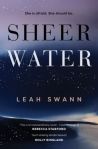 Swann’s novel Sheerwater, which was published in March, is garnering a lot of reviews for the Australian Women Writers Challenge. (I’ve reviewed her short story collection, Bearings). The novel starts with a mother driving with her two young sons. They witness a light plane accident, to which the mother goes to see if she can help. When she returns to her car, the boys are nowhere to be found.
Journalist and speechwriter Swann said the idea had come to her during a road trip some time ago, but that, as the mother of young children at the time, she wasn’t prepared “to go there”. Understandable! When she did decide to do it, she found it easy to write the first draft. She just kept writing, seeing where it would take her. The first draft was 130,000 words, with the final book, four or five drafts later, being around 70,000 words. Like Arguile, she doesn’t plan her books. What she loves about writing is discovering things.
I did note her lockdown reading: Meg Mundell’s We are here (Affirm Press), which she described as “beautiful essays by people who have experienced homelessness”; and Meg Mason’s Sorrow and bliss, whose publication has been delayed until September, because of COVID-19 I believe.
7pm Pip Williams
 The dictionary of lost words, published in late March, is Pip Williams’ debut novel, though she has written other books. She was one of the reasons I was keen to register for this event as I gave this book to my mother for Easter. She, a retired lexicographer, loved it.
If you’ve heard of the book (see Lisa’s review), you won’t be surprised to hear that she was inspired by Simon Winchester’s The surgeon of Crowthorne. Williams said that she saw that the OED (Oxford English dictionary) was a completely male endeavour, that the lexicographers, contributors, and workers were mostly men, and most of the literature they referred to was by men. It made her wonder whether “words mean different things to men and women, and if they do what does that mean for the OED?”
She talked a little about the OED, and her research (which included reading a lot of the OED). After her reading, Orton asked whether she’d found any “hilarious” words. She had, of course, but decided to share some interesting ones. For example, “teen” used to mean “vexed”, “irritate”, and “teenful” meant “causing trouble or sorrow”. Has this played a role in our word “teenager”, she wondered! She discussed the word “bondmaid”, which went missing from the dictionary, and she shared the word “anythingarian”which describes a person with no belief in anything. Perhaps I, a self-described wishy-washy person, is an “anythingarian”!
Her lockdown reading included another Affirm Press novel, Rachael Mead’s upcoming novel The application of pressure.
7.20pm Sophie Hardcastle
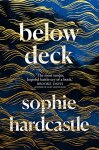 Artist and writer Hardcastle’s novel Below deck, was published in March and is her first novel for adults. It is divided into four parts, with the last being set in Antarctica. Hardcastle had had, she said, an artist’s residency in Antarctica. She wanted to write a work that explored “climate change and our relationship with the natural world.” She thought that a story of the body being violated could work as a metaphor for the environment being violated. The rest of the conversation, however, didn’t really discuss this aspect further.
Asked, whether the story changed as she was writing it, she said that the bones of the story stayed the same, but because it’s a book about trauma, about the way the body remembers trauma, this did come out more during the writing. She wanted, also, to explore, the myths around rape culture. Orton briefly mentioned synesthesia, which both Hardcastle and her protagonist have, but there was no time to discuss this.
Hardcastle’s lockdown reading included Maggie Nelson’s Bluets and Jenny Offill’s Weather (which reminded her of Max Porter, she said.)
7.40pm Laura Jean McKay
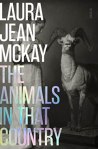 McKay’s novel, Animals in that country, was published in late March. It’s another I had bought as an Easter gift, because, not only did it seem appropriate for the times, given it involves a flu pandemic, but it sounded innovative and feminist. Right up Daughter Gums alley! The novel does have talking animals, including a dingo called Sue! McKay had spent time in a Northern Territory wildlife park as part of a writer-in-residence program, and got to know some dingos here. Sue was apparently inspired by an actual dingo.
McKay read from the part of her book where the human protagonist first hears the animals talking, which happens just as a flu is whipping through the country. At the time she was writing it, she feared her idea was a bit too speculative, but as her publication date drew nearer, well, she realised not so much!
McKay’s lockdown reading included Ling Ma’s Severance (which is about a pandemic) and Ronnie Scott’s The adversary.
A well-conceived COVID-19 event. The writers I saw were thoroughly engaging, and Orton managed the technology with aplomb. Will these sorts of events continue post COVID-19?
Writers in Residence: An Online Festival
4 may 2020, 5:00 PM – 9:40 PM
ZOOM Online, organised by Writers Bloc
 It is not the richest award – though $8000 this year for the winner and $1000 for each runner-up is not bad either – but it carries a good deal of kudos. It has also done well over its 24 years in
  If you look at the Wikipedia link in the paragraph above, you’ll see that the number of awards made each year varies. In 1997, ten awards were made, but most commonly it seems that around three to four are announced.
  While SMH’s Best Young Australian Novelists is one of the best known emerging writers awards, there are others. Many, like this one, are age-related, such as The Australian Vogel Literary Award which was won this year by Katherine Kruimink, A treacherous country. But not all are. The
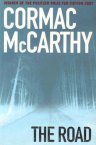 Now to May’s starting book, the 2007 Pulitzer Prize winning novel by America’s Cormac McCarthy – The road. If you haven’t read it, let me tell you that it’s a mesmerising, post-apocalyptic dystopian novel. I loved it, partly because its writing is so spare (see
 Another, very different road trip underpins Australian writer Eve Langley’s The pea-pickers (
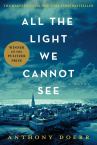 While road trips aren’t the backbone of my next book, American writer Anthony Doerr’s Pulitzer prize-winning novel All the light we cannot see (
 Staying in war-time but moving to a different sort of road, I am taking us to the Thai-Burma railroad as told by Australian writer Richard Flanagan in his Booker Prize-winning novel, The narrow road to the deep north (
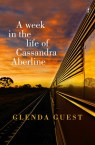 Having mentioned railroads, I’ll stay with them and link to Australian writer Glenda Guest’s A week in the life of Cassandra Aberline (
 Choosing my final book proved a challenge: I had many to choose from, many I wanted to highlight. In the end I decided to stay in Australia, and go a bit lighthearted. The book is English writer Louis de Berniere’s Western Australia-set Red dog (
 Whispering Gums