Six degrees of separation, FROM Like water for chocolate TO …

I’ve decided to change my blog titling practice for my Six Degrees meme, from including the end book to not! I’ve decided it’s more fun to read the post following the connections until the end, rather than knowing the end book at the beginning? Let me know what you think. But now, the formalities. Six Degrees of Separation is a meme currently run by Kate (booksaremyfavouriteandbest). To find out more about it please click the link on her blog-name. It’s a fun meme.
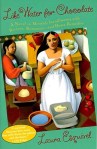
Laura Esquivel, Like water for chocolateNow, the book Kate chose for October is one I’ve actually read, unlike many of her other choices, but it was long before I started blogging. It’s Laura Esquivel’s Like water for chocolate. Unfortunately, I no longer have my beautiful hardback copy, having lent it to someone and never got it back, as happens sometimes in our reading lives. As always, I’ve read all the books in my chain, though not all since I started this blog.
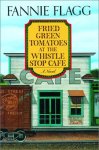
Fannie Flagg, Fried green tomatoesI had fun choosing my first book. Should I go with chocolate in the title (like Chocolat), or Mexican authors (like Valeria Luiselli), or magic realism (like Gabriel Garcia Marquez), all of which or whom I’ve read? Nope! The subtitle of Esquivel’s book is “a novel in monthly installments (sic) with recipes, romance and home remedies”, so I’ve chosen another book that (like Chocolat in fact) also glorifies food and eating, Fannie Flagg’s Fried green tomatoes at the Whistle Stop Cafe. I read it before blogging, so no review to link to I’m afraid.
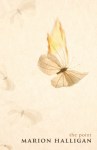
Marion Halligan, The pointFood plays a shocking role at the end of Flagg’s warm Deep-South-set comedy, but I’ve decided not to go there. Instead, I’m linking on the cafe idea, and have chosen another book that I read before blogging, Marion Halligan’s The point, about a beautiful, top-class, but fictional, glass restaurant in my city, the capital of Australia. I did say I wasn’t going to follow Flagg’s shocking end, but I need to admit that there’s a murder in this book so it’s not all champagne and caviar! It deals with haves and have-nots, with insiders and outsiders (for which the glass motif works well, of course.)
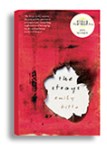
Emily BItto, The strays, book coverAnd now, I’m going to get to books I’ve read since blogging. Another book which deals with insiders and outsiders is Emily Bitto’s The strays (my review). Its narrator is an outsider who is welcomed into a Victorian artists’ community as the friend of the founding artists’ children. She has her life, her expectations, her dreams turned around, until things go awry. How much it was all to her benefit is a question we ponder at the end, and that is also a relevant question for my next book …
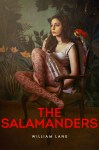
William Lane, The salamandersWilliam Lane’s The salamanders (my review) which has its origins in an artists’ colony though the book is set sometime after that colony had disbanded. However, it too explores the impact on the children of the artists. It’s a very different book to Bitto’s, however, delving into bigger issues relating to the land. Salamanders, and lizards in general, feature, both to represent the antiquity of the Australian continent and also, I think, resilience.
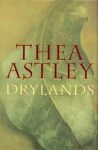
Thea Astley, DrylandsRegardless of the intent, this motif reminded me of the bar, cheekily called the Legless Lizard, in Thea Astley’s Drylands (my review)! It’s set in the dying town of Drylands and presents a bleak picture of Australia. Here is the quote I used in my review, describing Drylands as

a God-forgotten tree-stump of a town halfway to nowhere whose population (two hundred and seventy-four) was tucked for leisure either in the bar of the Legless Lizard or in front of television screens, videos, Internet adult movies or PlayStation games for the kiddies.

[…]

No one was reading anymore.
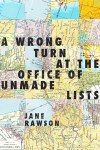
Drylands could be called dystopian, albeit one set in the present not the future. And that made me think of Jane Rawson’s A wrong turn at the Office of Unmade Lists (my review). There’s no doubt about its definition as a dystopian novel, dealing as it does with the devastating effects of climate change. Coincidentally, it also has several scenes in a bar!

Well, we haven’t travelled far once leaving the Americas – besides returning there briefly in Rawson’s book – but we have spent quite a bit of time in kitchens and bars. What does that tell you about me?

Have you read Like water for chocolate? And whether or not you have, what would you link to? 
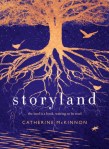
Catherine McKinnon, Storyland (#BookReview)

Catherine McKinnon, StorylandIt is still somewhat controversial for non-indigenous Australian authors to include indigenous characters and concerns in their fiction, as Catherine McKinnon does in Storyland. But there are good arguments for their doing so. One is that not including indigenous characters continues the dispossession that started with white settlement. Another is that such fiction brings indigenous characters and stories to people who may not read indigenous authors, which is surely a good thing?

However, such writing requires sensitivity, or empathy, on the part of non-indigenous writers. Indigenous author, Jeanine Leane says that this can only be achieved by social and cultural immersion (which can include informed reading of indigenous writing). McKinnon addresses this in a couple of ways. In her author’s note, she refers to discussing “stories and ownership” with local Illawarra region poet and elder, Aunty Barbara Nicholson, which resulted, for example, in her telling a brutal story from the convict perpetrator’s point of view rather than from the indigenous victim’s. She also acknowledges Nicholson “for reading, local knowledge and generous advice both early on in the process and nearing completion”. But now let’s get to the reason for all this …

Storyland is set in the Illawarra region south of Sydney, and tells the story of the Australian continent, post-white settlement, from 1796 to 2717. It has a nine-part narrative arc that takes us through five characters and six time periods: Will Martin 1796, Hawker 1822, Lola 1900, Bel 1998, and Nada 2033 and 2717. These form the first five parts of the novel. The final four parts return through Bel, Lola, Hawker, finishing with Will Martin, each picking up its character’s story where it had been left first time around. Got it? Two of these characters – Will and Hawker – are based on historical figures, while the rest are fictional.

… a tricksy plot

Will’s employer, the explorer George Bass, says early on that “the land is a book, waiting to be read”, and this, essentially, is what the book’s about. Will is a 15-year-old who sailed with Flinders and Bass in 1796 on their search for a river south of Sydney. On their trip they meet “Indians” whom they fear might be cannibals. We leave them at a nervous moment in their encounter to move to 1822 where we meet the convict Hawker. He’s a hard man, who believes you need “a mind like flint and a gristly intent”. He has his eye on a young indigenous woman, but also on improving his future. From him, we jump again, this time to 1900 and young hardworking dairy-farmer Lola who lives with her half-sister and brother Mary and Abe, both of whom have indigenous blood. There is racism afoot, with a neighbouring farmer suspicious of Abe’s friendship with his teenage daughter Jewell. We leave this story, with Jewell having gone missing, to meet Bel in 1998.

Bel, the youngest of our protagonists at 10 years old, spends her summer rafting with two neighbourhood boys on a lagoon that features in each of the stories. They befriend a couple, Ned and his indigenous girlfriend Kristie. Bel is a naive narrator, but adult readers quickly see the violence at the centre of this relationship. Meanwhile, down the road lives the slightly younger Nada, who is the pinnacle of our chronological arc, featuring in 2033 and 2717. In 2033, climate change has created havoc in the land, and a dystopia is playing out …

Country and connection

I hope this doesn’t sound too confusing – or fragmented – because in fact Storyland is a very accessible book. Superficially, it seems disjointed, but McKinnon connects the stories through links that gradually register as the narrative progresses. For example, the transitions between each story all feature birds, such as this one from Hawker to Lola:

The women are disappearing into the forest. And then they are gone. Lost in the dark trees. An owl

Lola
1900

calling boo-book, boo-book.

(My html skills aren’t up to replicating the layout I’m afraid.) Other links include the aforementioned lagoon, a creek, a cave which most characters reference, a big old fig tree and an ancient stone-axe. None of these are forced, or feel out of place. Instead these places and objects naturally connect the stories, despite their very different narratives, to provide a continuity that transcends the people to focus on the land itself – because, ultimately, this is a story about the land and our ongoing relationship with it.

McKinnon, the author bio says, has been a theatre director and playwright, as well as a prose writer. This is evident in the voices (all first person) and dialogue which beautifully capture the rhythms, vocabulary and grammar of the different characters and their times. Will Martin talks of “Indians”, Hawker talks of “forest”, while turn-of-the-century farmer Lola uses structures like “Jewell and me carry buckets of skimmed milk” and “When he were done”. Ten-year-old Bel is language-proficient, with a good vocabulary, but she sees things through a ten-year-old’s eyes, such as this on the abused Kristie, who “has her big black sunglasses on” and “looks funny, her lips look bigger or something”.  (In a delightful in-joke, her father Jonathan is writing his PhD on unreliable narrators).

The real star of the novel, though, is the land. McKinnon traces its trajectory from an almost pristine state at the dawn of colonisation through being farmed by Hawker and Lola to climate-change-caused destruction in 2033 followed much later by a mysterious post-apocalyptic world. She similarly traces our relationship with indigenous people from early caution, uncertainty and tentative goodwill, through 19th century brutality and ongoing dispossession, to the continuing racism and exploitation of the twentieth century.

The question to ask here is why did McKinnon structure the story the way she did, starting and ending with 1796? Here is Will at the end, exploring a beach on his own:

The white sand curves around the land; the dunes in the late night are dark mountains and valleys; the forest behind is thick and green to the sky. This is a wild place. Too wild for civilisation. It is a place for adventure.

And “the water is fresh” to drink! Is McKinnon, by ending with this more idyllic picture of the land, suggesting that there’s still hope? This is how it was, this is what could happen. Does it have to? Can we yet turn it around? Well, yes, perhaps. As Uncle Ray says to Bel, “it’s our job to look after all this land around here. If we don’t, bad things can happen.”

“To dare is to do”, George Bass tells Will, and this is what McKinnon has done in Storyland. She has combined historical, contemporary and speculative fiction to tell us a story about our land – and our relationship with it and with the people who know it best. This land, these mountains, creeks, lagoons and trees, were here first, Uncle Ray says, and this makes us “part of their history, not the other way around.” The message is clear.

Storyland is a beautiful book physically – in cover, design and construction – as well as being a moving and relevant read. I dare you to read it today.

Bloggers Lisa (ANZlitLovers) and Bill (The Australian Legend) liked this book too.

aww2017 badgeCatherine McKinnon
Storyland
Sydney: Fourth Estate, 2017
382pp.
ISBN: 9781460752326

(Review copy courtesy HarperCollins Publishers)

Monday musings on Australian literature: Queensland Writers Centre

Today’s Monday Musings is the fourth in my little series on our writers centres, and it’s to Queensland I’m turning this time, partly because next month GenreCon will be held at the State Library of Queensland. But, more on that later in the post. First, I’ll introduce the Centre.

The Queensland Writers Centre was founded in 1990, as a membership organisation, with “the aim of nurturing Queensland literature and building a community of writers”. On its About page, they say:

… we love stories. We love the writers who tell the stories and the readers who give them life. We love the way they help us to understand and connect with those around us and gain a greater understanding of ourselves.

QWC … supports, celebrates and showcases Queensland writers and writing in all its forms. We work with our members and partners to promote a vibrant and diverse writing community across Queensland.

Like all writers centres they offer a wide range of programs, including workshops, seminars and online courses, magazine and newsletter, mentorship and manuscript assessment program (aka The Writer’s Surgery), and fellowships and prizes. Here though, as in previous posts, I’ll highlight a few programs that particularly caught my attention.

(I was going to start with their Regional Events, which seemed worth promoting, but when I clicked on the Regional Events link, I was taken to an Events page for July to December 2017, which seems to have only one event outside Brisbane, “Thriller Writing with James Phelan” in Townsville. That was a little disappointing, but I know these Centres run on minimal funding, and servicing a physically large state would be a challenge.)

Events

In fact, following from the paragraph above, the About page lists a number of activities under What we do which all link to the Events page. These activities are:

  • Regional Events
  • In Conversation Events
  • Salons and Reading Events

Over the second half of 2017, their events include, in addition to the above mentioned James Phelan on Thriller Writing:

  • a panel (“in conversation”) with Jane Harper (whose book The dry has been one of this year’s big publishing successes) and Matthew Condon;
  • a seminar on writing about music and musicians;
  • a four-part course for beginners on developing narratives;
  • workshops for intermediate and established writers, such as one on public speaking and another on editing (given by Melina Marchetta); and
  • workshops on other topics such as speechwriting, writing romance fiction, writing media releases.

A diverse program don’t you think?

if:book Australia (The Future of the Book)

This is a QWC initiative which:

explores new forms of digital literature and investigates the changing relationship between writer and reader.

It’s not, as you might think, about eBooks. The medium is not the point. Instead it’s about the interaction or relationships forged between writing and reading, and looks at such topics as “the purpose of the book”, “new forms” that can expand how stories “are discovered and shared”, interactions between old and new technologies, and “what changes when we change the book”. The program extends beyond Queensland, and links internationally with programs in the USA and UK.

If this sounds a bit mystifying, the following examples of their projects should help:

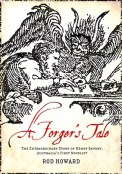
Rod Howard, A forger's tale

Rod Howard’s book on Henry Savery

  • the tweets of Henry Savery (probably Australia’s first novelist, about whom I wrote a couple of years ago) in the Rumours of Death project: a live Twitter feed by Christopher Currie, undertaken during the 2105 Brisbane Writers Festival. You can read the tweets at the link above. (Such as, “I will be most interested to see how the Australian literary landscape has changed since I founded it some 184 years ago. “)
  • lost in track changes: the title provides a hint. Five writers (Cate Kennedy, Ryan O’Neill, Krissy Kneen, Robert Hoge and Fiona Capp) were asked “to create a short piece of memoir, a vignette” each of which was then “passed onto another author within the group” who then had to transform the piece into something else, with if:book tracking the changes! You can download the ebook version from the link above.
  • Writing Black: new Indigenous writing from Australia: an interactive book using the iBooks platform, edited by Ellen van Neerven, and including writing, photography, audiovisual, and twitter fiction, from such creators as Bruce Pascoe, Tony Birch, Tara June Winch, Kerry Reed-Gilbert, Sylvia Nakachi, Siv Parker and Marie Munkara (several of whom I’ve reviewed here, in traditional formats!) You can download Writing Black from iBooks.
  • Memory makes us: ever thought of writing as performance? Well, this is it, but it’s “distinct from other performative aspects of literature: this isn’t a reading of a prepared work, nor is it freestyle poetry. It’s improvisation not with speech but with text and the tools of contemporary writing: keyboard and cut-and-paste.” This “event” has involved several North American and Australian writers, including Paddy O’Reilly, Marie Munkara, Angela Meyer and Maxine Beneba Clarke (all of whom you’ll find on my blog). if:books says that “For most readers, Memory Makes Us is a web site. For festival visitors, it’s a live event. We have also taken it to print. But none of these individual ‘formats’ capture the whole project.”

I love all this – I mean, I love the exploration. I can’t imagine these forms will replace traditional reading but, like most new media, some might stick around as an alternative form. In the meantime, the process must surely help both creators and readers/consumers break “normal” patterns, and that can only be good for literature.

GenreCon

I wrote about GenreCon in 2013. It’s actually called AWM GenreCon, AWM being the Australian Writer’s Marketplace which I understand is managed by the Queensland Writers Centre. GenreCon is a three-day biennial conference comprising panels, talks and workshops with Australian and international genre fiction writers, editors and agents – across all genres. It also offers one-on-one pitching sessions.

This year’s conference runs from 1oth to 12th November, at the State Library of Queensland. The “special guest” is Australian Garth Nix, and one of the international guests is Fiji-born New Zealand writer Nalini Singh. (I had to laugh because the brief bio names her books but not her genre, which apparently we should know. Unfortunately I don’t! Oh dear. Ah, Wikipedia tells me she writes paranormal romance.) Other Australian speakers include debut author and Noongar woman Claire Coleman, award-winning crime writer Emma Viskic, and award-winning fantasy author Angela Slatter, all of whose names I do know I’m happy to say.

… and that’s about it for another clearly active and inspiring Writers Centre.