Monday musings on Australian literature: Novels set in Canberra

The time will come, I’m sure, when I start repeating myself in my Monday Musings posts. This week’s post comes perilously close. I’ve written before about Canberra’s centenary publications (The invisible thread and the Meanjin Canberra issue), and I’ve written about Capital women and men poets, and women and men novelists*, but I haven’t specifically written about books set in Canberra. So today, Canberra Day, that’s what I’m going to do. Canberra Day, for those of you who don’t know, celebrates the official naming of Canberra on 12 March, 1913.

Canberra, as you’ll know if you’ve been reading my blog, boasts many writers (past and present). However, those writers have often not written about or set their novels in Canberra – and, sometimes, writers who don’t come from here, have. Consequently, this post’s focus is the works, not their creators’ origin. As always, I’m presenting a small selection – and the books will be presented in chronological order of their setting (as best as I can determine that).

  • M Barnard Eldershaw’s Plaque with laurel (1937) is believed to be the first novel set in Canberra. Unfortunately, I’ve not read this book but historian Patricia Clarke wrote about it in the Sydney Morning Herald in 2012, the 75th anniversary of its publication. A satirical novel about Australia’s literary scene, it is about a writers’ conference held in “inscrutable” Canberra and is apparently not at all complimentary about what was then barely a city. One character apparently describes living there (here) as “just awful”. Clarke sees it as an “invaluable historical record of Canberra in the 1930s”. I really must read it, and try not to let my patriotic blood boil!
  • Frank Moorhouse’s Cold light (2012, my review) spans around two and half decades, from 1950 to 1973. The last book in the Edith trilogy, it completes the story of Edith’s career which started in Europe in the League of Nations and ended in Canberra during some of the city’s most formative decades. These were the years when, for example, Lake Burley Griffin was created after much dispute. One of Edith’s first jobs when she arrives in Canberra is to work as a town planner, and Moorhouse gorgeously chronicles the discussions and controversies that raged at the time about Canberra as a place to live and work. I loved Edith’s desire to see Canberra as a “social laboratory”, which would “try out all sorts of ideas for good living”, and as a “place for citizens to ask questions”. I think Edith would love to see today’s Canberra!
  • Andrew Croome’s Document Z (2008, my review) is set in the mid-1950s and tells the story of Canberra’s most famous spies, the Petrovs. Croome describes the Canberra of those days, the suburbs and shops of the inner South, with an authenticity that suggests thorough research. Like Moorhouse’s novel it’s a good example of historical fiction, which I see as a work that combines an interesting story with well-researched depiction of the times in which it is set.
  • Sara Dowse’s West block: the hidden world of Canberra’s mandarins (1983) is set in the 1970s in West Block which is one of Canberra’s early buildings housing public service functions, and was, for some time, the home of the Prime Minister’s Department. This book is about the machinations of the bureaucracy, about the public servants who work behind the ministers to create and manage the policies the ministers want. My reading group loved it when we read it in the 1980s, because it rang true to the world we knew.
  • Fog sculture, National Gallery of Australia

    Fujiko Nakaya’s Fog sculpture rising over Dadang Christanto’s Heads from the North

    Dorothy Johnston’s The house at no. 10 (2005, my review) is set in the early 1990s, on the cusp of the legalisation of the sex industry in Canberra. This Canberra is the Canberra of suburbs and neighbours, of love and betrayal. It could almost be set in any city, except that Johnston knows Canberra and uses its particular history and features – such as the lake to divide the two aspects of the main character’s life as a mother and sex-worker – to ground the work in a particular place and time while also exploring universal themes.

  • Marion Halligan’s The fog garden (2001) is set around the time it was written. It is her novel about coming to terms with the loss of a much-loved partner. It’s also a clever book about the art of fiction – about finding the truth in the nexus between fact and fiction. It has an autobiographical element, but “Clare is not me” she says. The title is metaphorical, describing the “fog” that comes with grief, but also drawing from the wonderful fog garden at Canberra’s National Gallery. This is just one of several books that Halligan has set in Canberra.
  • Kel Robertson’s Smoke and mirrors (2010) became, by popular vote, the ACT’s book in the 2012 National Year of Reading collection of eight books designed to “articulate the Australian experience – remote, regional, suburban and metropolitan”. I haven’t read this, though Mr Gums has, but I was intrigued that a crime novel was chosen by Canberrans to represent us. Then again, perhaps it’s alright, as the murders being investigated take place at a writers’ retreat! (Maybe Robertson had read Plaque with laurel!) Also, the murders are political, relating to an about-to-be-published memoir of a government minister that is suspected to reveal CIA involvement in Gough Whitlam’s dismissal in 1975.

Have you noticed how many of the novels have politics at their core? That’s not surprising, given the sort of city we are, but I also noticed that most of the novels are fully or mainly set south of the lake (or where the lake ended up being). This is interesting, particularly given the CBD is north of the lake, but maybe it reflects my first point – parliament house, the centre of politics, is located in the south!

For a more extensive list of novels set in Canberra, check out the blog Dinner at Caphs, which documents blogger Dani’s year of reading and reviewing Canberra-set novels.

* I should probably use the adjectives “female” and “male” here, and I did in the title of one of those posts, but for some reason it just doesn’t sound right to me.
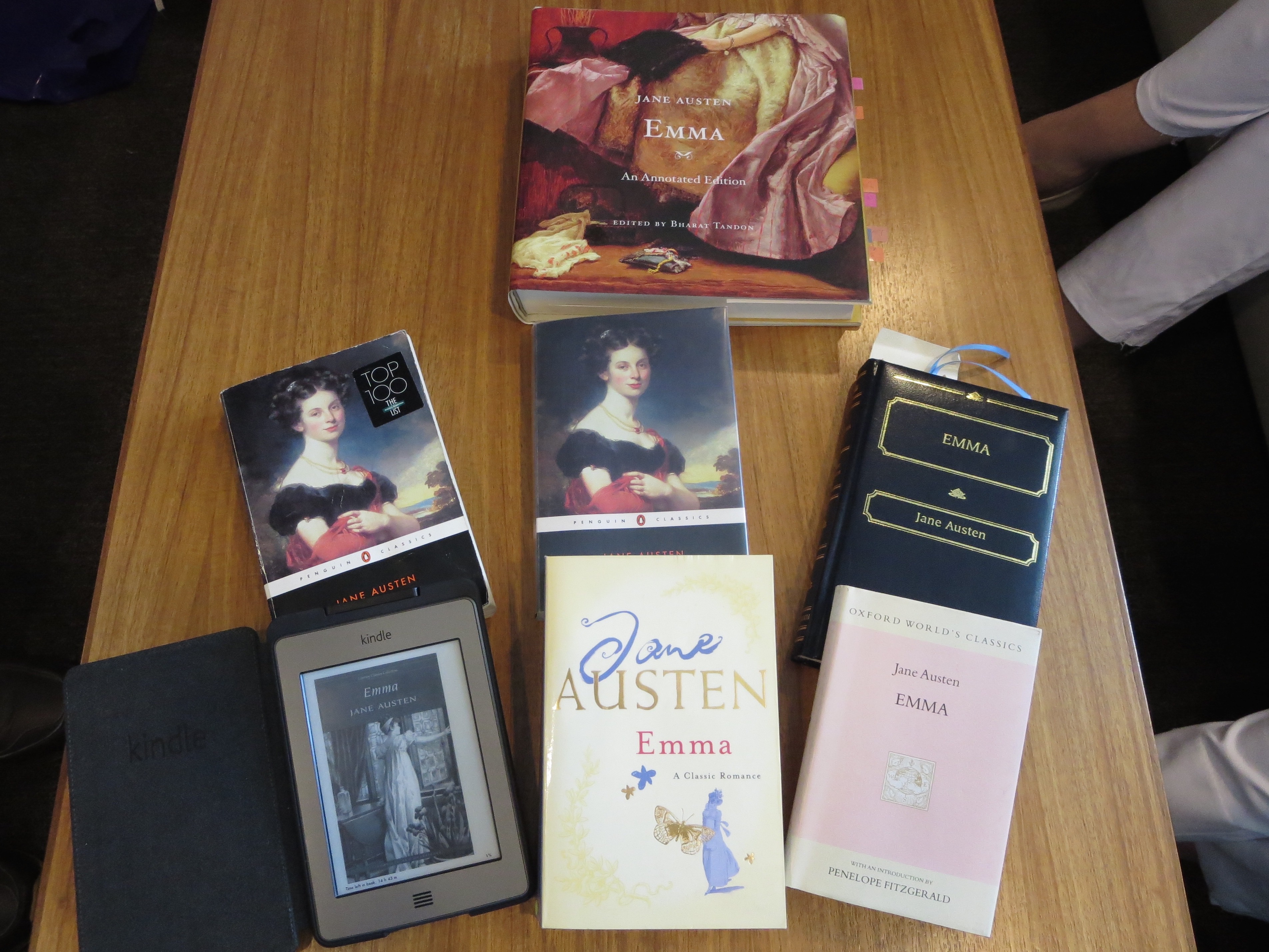
Jane Austen, Emma Vol 1 (Review, or perhaps just thoughts)

EmmaCovers

Every now and then my local Jane Austen group does a slow read of one of Austen’s novels. With 2015 being the 200th anniversary of the publication of Emma, we decided it was the logical choice for our next slow read. I love this activity because what happens when I re-read an Austen novel – particularly when I take part in a slow read – is that I “see” something new in the novel, something new to me that is, because it’s hard to think that anyone could come up with something totally new about Austen.

So, last time I re-read Emma, the thing that stood out for me was how beautifully plotted it is. There isn’t a word or action that doesn’t imply or lead to something telling, even if we don’t know it at the time. This read, with the plotting firmly in my brain, I’m finding that the aspect is flying a little under the radar. Instead, I’m noticing how often the word “friend” or notion of “friendship” is appearing. The novel, in fact, starts with Emma losing her ex-governess-then-companion Miss Taylor to marriage. They’ll remain friends but … so Emma, alone in a big house with her fussy, demanding, albeit gentle father, develops a friendship with Harriet, “the natural daughter of Somebody … [who] had no visible friends but what had been acquired at Highbury”.

This, though, is not the only friendship involving Emma to appear in Volume 1. Mr John Knightley, Emma’s brother-in-law, advises Emma “as a friend” that Mr Elton’s attentions are more than friendly, but Emma believes that she and Mr Elton “are very good friends, and nothing more”. Emma and her long-standing friend and neighbour, Mr Knightley, decide to “be friends again” after one of their quarrels. Meanwhile, we, like Mr Knightley, wonder whether Emma’s friendship is helpful to Harriet or not.

In the third paragraph of the novel, Austen suggests what she sees friendship to entail:

Sixteen years had Miss Taylor been in Mr. Woodhouse’s family, less as a governess than as a friend, very fond of both daughters, but particularly of Emma.  Between them it was more the intimacy of sisters.  Even before Miss Taylor had ceased to hold the nominal office of governess, the mildness of her temper had hardly allowed her to impose any restraint; and the shadow of authority being now long passed away, they had been living together as friend and friend, very mutually attached, and Emma doing just what she liked; esteeming Miss Taylor’s judgment, but directed chiefly by her own.

I’m talking about the words “and Emma doing just what she liked”. Miss Taylor/Mrs Weston, as Mr Knightley says to her later, had been a good companion to Emma but had also been better at submitting her will to Emma than in giving Emma the “complete education” he thinks she needed. Mr Knightley’s view of friendship encompasses providing honest, wise advice. He’s therefore severely angry with Emma when she encourages Harriet not to accept Robert Martin’s proposal:

 You have been no friend to Harriet Smith, Emma.

There are other friendships in the novel that don’t directly involve Emma, some with and between neighbours, and some within families. Her father, Mr Woodhouse, may be “no companion” for Emma, but we learn in Chapter 3 that he “liked very much to have his friends come and see him”. One of those visiting friends is Miss Bates who feels fortunate to be “surrounded with blessings in such an excellent mother and so many good neighbours and friends”. And one of these “good neighbours and friends” is Mr Knightley who supplies the low-income Bates’ women with apples and other produce from his estate. Emma’s friend Harriet, herself, has friends who invite her to visit, the Martin family who manage a farm on Mr Knightley’s estate. See what’s happening? An intricate set-up of all sorts of friendships. Austen must be on about something.

Emma more than any of Austen’s six novels paints a fairly in-depth picture of a diverse community. There are the Westons, Mrs and Miss Bates, and their niece Jane Fairfax, Mr Knightley and his estate, Mr Elton the minister and his wife, Mrs Goddard and other members of her school, the new-money Coles, and various other members of the community who appear briefly, including the poor and gypsies. This is a more complete “Country Village” than we find in the other novels, even though her focus here is still her favourite, that is, “3 or 4 families” (Letter to her niece, Anna, 9 September 1814). It’s not surprising, then, that with such a wide and diverse group that friendship would feature more significantly. I look forward to watching and thinking about how she develops this concept over the next two volumes. Watch this space …

Monday musings on Australian literature: Pitch days

When I was researching last Monday’s post on development programs for writers, I came across several references to publisher “pitch” days. As someone who isn’t writing a book, and who has no plans to, the concept of a “pitch” day was something that hadn’t made a big impact on me, though of course I knew what it meant.

If you are a writer who’s tried to get a book published, you know there are various ways of going about it. One is to find an agent who will tout/pitch your book to publishers. Another is to win a prize that involves publication – not that there are many of those! Yet another is to send your manuscript, unsolicited, to a publisher and hope they will read it. We’ve all heard stories about what happens then. They end up in a pile, and more often than not don’t get read. What authors want, of course, is some sort of guarantee their work will be read. This is where “pitch” days come in.

So what, exactly, is a pitch day? Most publishers have always accepted unsolicited donations, albeit with varying degrees of enthusiasm, but their pitch days offer two specific things: the publisher clearly identifies what they are looking for, what the writer needs to submit, and how; and they (mostly) offer some sort of guarantee that the work will be read and the time-frame within which this will happen. These pitch days are a fairly new thing, I believe, and stem partly from the possibilities offered by digital publishing.

Here are some of the programs I’ve come across, and that I believe are currently operating:

  • Allen & Unwin’s The Friday Pitch has been running for 6 years or more, and is open to writers for adults, young adults and children. They ask writers to “email a short synopsis or outline of your chapters and contents, and the first chapter of your work and related illustrations if relevant” on any Friday. They say that “if we like what we read … we will get back to you within a fortnight”. They don’t say, but I think imply, that they will read everything. They also say that Friday Pitch has discovered some bestselling authors, including Fleur McDonald, Helen Brown, and Mary Groves, though I must say that I don’t know these authors myself.
  • HarperCollins’ The Wednesday Post started in 2013. Writers can send fiction and nonfiction submissions each Wednesday, for print and digital publication, and digital-only publication. They say they will respond to authors within three weeks if they are interested. According to Writing WA, HarperCollins wants to find “new adult and YA titles and is particularly interested in ‘exceptional contemporary women’s fiction'” from new and established writers.
  • Pan Macmillan’s Manuscript Monday is a “new” initiative (though I don’t know when they wrote that statement). This process only occurs monthly on the first Monday of the month. They “accept submissions between 10am and 4pm that are sent electronically” and comply with the guidelines available via the link above. They say they will read every submission within three months of receipt, but won’t provide reasons for their decision nor give any feedback. And you can’t ring or contact them to chase up your submission. I think this includes pitches for Momentum, which is PanMacmillan’s “digital first imprint”.
  • Penguin’s Monthly Catch was created because Penguin “is keen and excited to read new work from Australian authors”! This program operates over the first 7 days (that is from the 1st to the 7th, regardless of days of the week) of every month. Only electronic submissions are accepted, and only works for adults. They say they’ll read every manuscript, and will get back to successful authors within three months. They do not provide feedback.

These are just a few of the programs out there. There are, for example, some genre-specific ones, such as for Romance writers. And some conferences run pitch-to-the-publisher programs, such as GenreCon and the Perth Writers Festival.

What these publishers won’t accept is fairly consistent. Poetry, plays, and educational works are frequently identified as not wanted. Some exclude works for children and young adults, while others will accept these. Authors need to check each publisher’s guidelines to make sure.

If you are interested in reading more about pitching, you might like to read the experience of two authors: Patrick Lenton who was published by Pan Macmillan’s digital arm, Momentum, and the above-mentioned Fleur McDonald who was published by Allen & Unwin. I also enjoyed reading this blog post on the “art of pitching to publishers”.

As always, I’d love to hear if any readers here have used “pitch days” … or have any stories about being published.