Monday musings on Australian literature: National Biography Award

I have mentioned the National Biography Award before, but have never dedicated a post to it. Since this Monday musings coincides with the announcement of the 2014 award, I thought it would be a good time to write a little about this award.

The National Biography Award was initially endowed by Geoffrey Cains, with support a little later by Michael Crouch, and is managed by the State Library of NSW. Its aim, says its website, is “to encourage the highest standards of writing in the fields of biography and autobiography, and to promote public interest in these genres”.  As of 2013, the winner receives $25,000, with each shortlisted book receiving $1,000. I like the fact that more and more awards are providing a monetary prize for the shortlisted works. Associated with the award, since 2003, has been an annual lecture on the subject of life-writing. The list of lectures, and papers if available, can be found on the State Library of NSW’s website.

The shortlist for 2014 was:
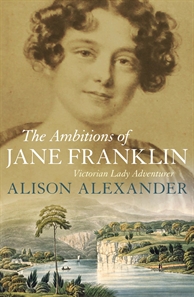
    Alison Alexander, The ambitions of Jane Franklin
    Courtesy: Allen & Unwin
    • Alison Alexander’s The ambitions of Jane Franklin (Allen & Unwin). This one intrigues me as Lady Jane Franklin, about whom I’ve written before, was one of those amazing 19th century woman who came to my attention through contemporary novels, including Richard Flanagan’s Wanting and Andrea Barrett’s The voyage of the Narwhal, and a book of poetry titled Jane, Lady Franklin by Tasmanian Adrienne Eberhard. The biography is subtitled, Victorian lady adventurer. I don’t know Alexander, but she is apparently a Tasmanian historian.
    • Steve Bisley’s Stillways: A memoir (HarperCollins Publishers). Steve Bisley is an Australian actor and this book, the website says, is “a classic memoir of an Australian childhood in the sixties”. That in itself gives it some appeal to me.
    • Janet Butler’s Kitty’s war (University of Queensland Press). This one is on my TBR. It is based on the war diaries of World War 1 army nurse Sister Kit McNaughton. In 2013 it won the NSW Premier’s Prize for Australia. Butler works in the History department at La Trobe University.
    • John Cantwell & Greg Bearup’s Exit Wounds: One Australian’s War on Terror(Melbourne University Publishing). Cantwell was a Major-General in the army who served in Iraq and Afghanistan, and ended up with post traumatic stress disorder (PTSD). He has written this with Walkley Award winning journalist, Greg Bearup.
    • Sheila Fitzpatrick’s A Spy in the Archives (Melbourne University Publishing). Historian Sheila Fitzpatrick lived in the Russia during the Cold War, while researching for her doctoral thesis. She apparently felt at home in Russia, but, as a foreigner, was always seen by Soviet authorities as potentially a spy. The book explores this part of her life. Fitzpatrick is regarded as an expert in the field of Soviet/modern Russian history.
    • Gideon Haigh’s On Warne (Penguin Australia). Australians will know immediately the subject of this biography, the flamboyant, controversial but highly-talented cricketer Shane Warne. Gideon Haigh is a journalist who has written several well-regarded and award-winning books on sport, media and the automotive industry (among other topics).

    All books I’d willingly read … though Alexander’s and Butler’s would be my top priority.

    And the winner is: Alison Alexander’s The ambitions of Jane Franklin! Now I really do want to read this book … It was a little tricky to find who won via a normal Google search several hours after the announcement, so I turned to Twitter and there it was (of course). Will it be reported on Australian television news tonight? I wonder!

    Anyhow, once I knew the winner, I was able to search on that and found a Sydney Morning Herald article which quotes chair of the judging panel (and a previous winner), Jacqueline Kent, as praising the book for its detailed portrayal of a “highly intelligent, vital and strong-minded woman” She said that “This is a biography that drew on a huge amount of research but is also very light on its feet”. Apparently Franklin, according to the Herald, had left behind “8 million words in journals and correspondence”. Alexander is reported as saying that the biography would have been impossible without a “Find” key to search documents. Isn’t modern technology grand – though the “find” function can’t completely replace in-depth reading during which you can find all those wonderful serendipitous details that make research such fun.
    The meeting of art and literature, at the Singapore Art Museum

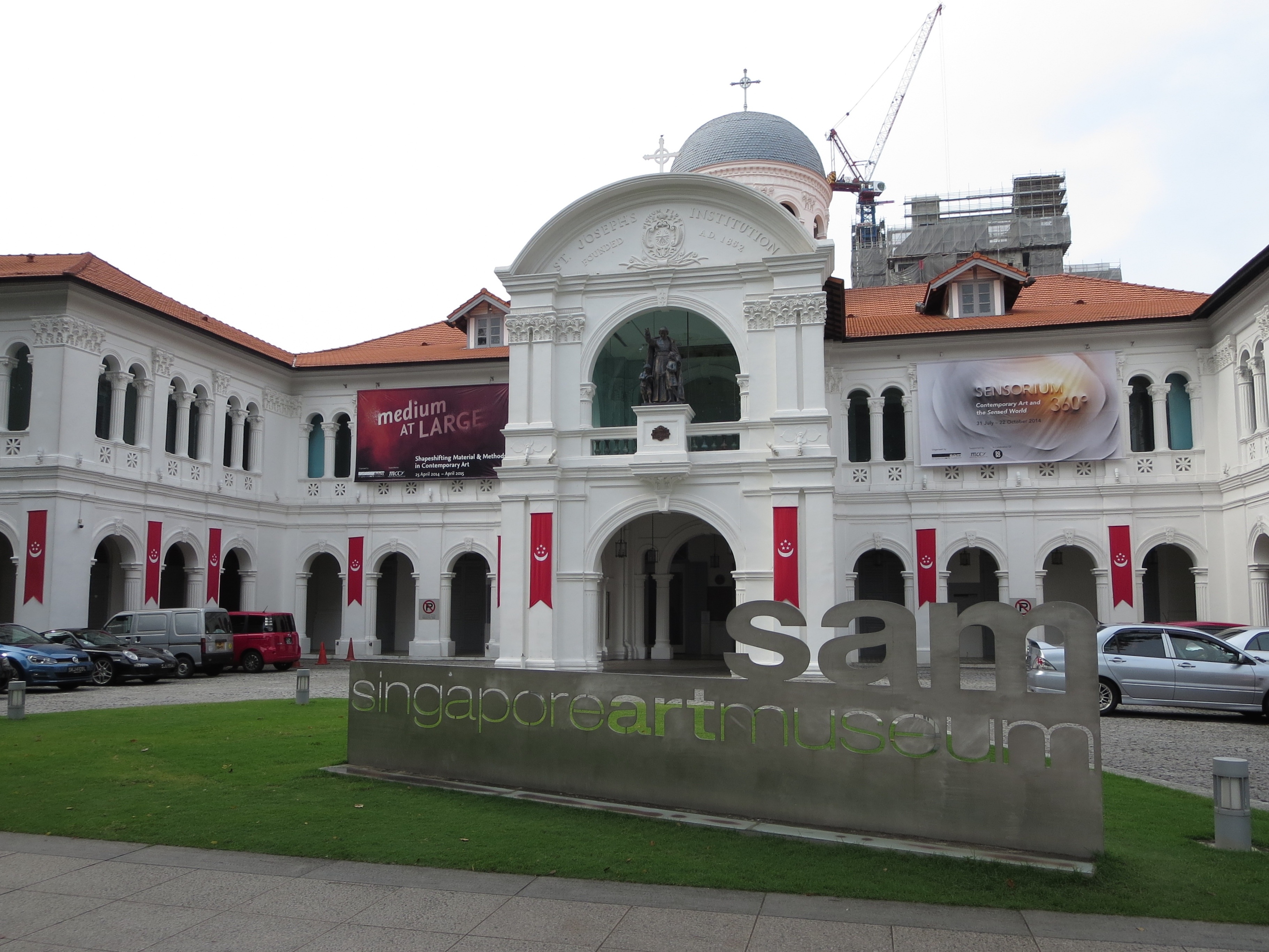
    SAM ExteriorMr Gums and I have had a busy few months, with, unusually for us, two overseas trips in less than four months. Both were family-inspired: Canada in April-May to visit our daughter, and then last week Koh Samui to help Mr Gums’ sister and husband celebrate their 40th anniversary. We decided to spend a few days en route to Samui in Singapore. What an interesting place it is. Although, technically, a new country which will celebrate its 50th anniversary next year, it has a much longer history, dating back to the second century. What we know as “modern” Singapore, though, began when the British, via Sir Stamford Raffles, established a trading post on the island in 1819. We didn’t see anywhere near enough but we tasted its variety –  including my topic for this post, the Singapore Art Museum (SAM).

    SAM is housed in a gracious old 19th century missionary school building – the St Joseph’s Institution run by La Salle Brothers.  The building was constructed in stages, from 1855 to completion in the early twentieth century. It was acquired for the museum in 1992. SAM describes itself as having “one of the world’s largest public collections of modern and contemporary Southeast Asian artworks, with a growing component in international contemporary art”.

    The current major exhibition, which will run for a year, is Medium at Large: Shapeshifting materials and methods on contemporary art. SAM explains that it

    explores the idea of medium in contemporary art, probing some of the most fundamental and pressing questions of art – its making, and also our experience, encounter and understanding of it.

    It’s the sort of exhibition I enjoy – modern, confronting and/or provocative, with useful interpretive signage. Of course, I enjoy the famous, classic galleries like the Louvre or Prado, just as I like to read classic novels, but I also enjoy seeing what contemporary artists are doing and thinking. I loved the concept behind this exhibition. In our increasingly fluid, interactive, interdisciplinary world, a focus on how art is made and how re relate to it, seems very relevant.

    The exhibition comprises 32 artworks and apparently draws mainly from the museum’s permanent collection, but it also “includes loans and commissions from Singaporean, Southeast Asia, and Asian artists”. We are seeing more Asian artists here in Australia, but it’s exciting to visit Asian galleries where we can see art and artists less familiar to western gallery-goers. And so, we saw two portraits made using live bullets on sandpaper (by Filipino artist Alvin Zafra), and a sculpture made with human hair (Dutch-born Indonesian artist Mella Jaarsma’s Shaggy). We saw works that play with medium and form, such as an oil painting overlaid with a video projection (Indian artist Ranbir Kaleka’s He was a good man), a distressingly mesmerising video of a woman dancing on butter captured also in still photographs (Indonesian artist Melati Suryodarmo’s Exegie – Butter Dance), and another video in which a taut rope springs and snaps through architectural spaces (Singaporean Chen Sai Hua Kuan’s Space Drawing 5). Our minds were challenged by a video installation called The Cloud of Unknowing (by another Singaporean Ho Tzu Nyen) in which various residents in an apartment complex experience some sort of epiphany or understanding of something mystical. Some of the works, including this last one, have been exhibited at the Venice Biennale.

    RenatoOraro's Bookwork: NIV Compact Thinline Bible (page 403)

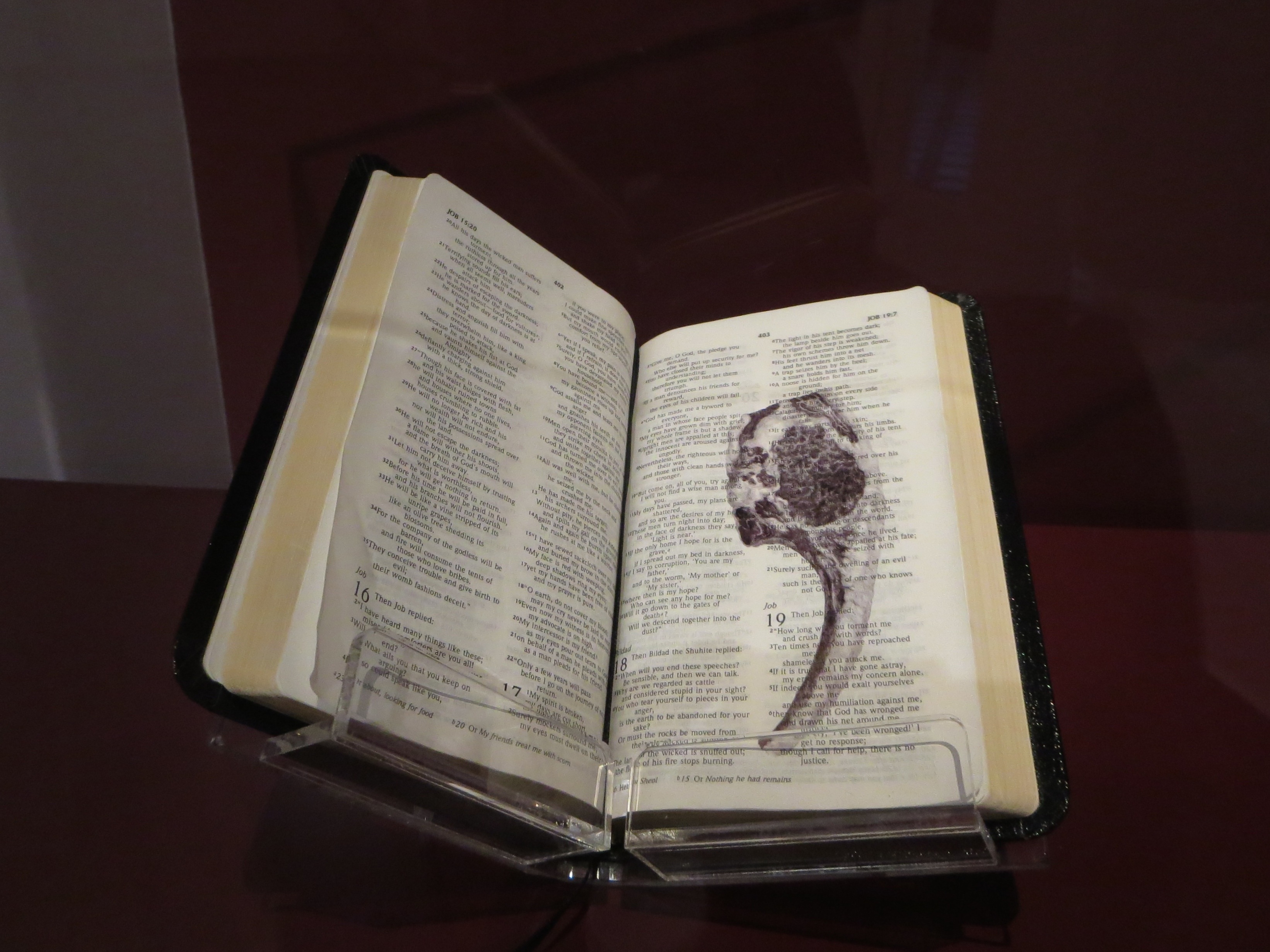
    Renato Orara’s Bookwork: NIV Compact Thinline Bible (page 403)

    But, since this is primarily a litblog, I’ll finish with two works that incorporate books. The first one is, in fact, the first work that confronted us in the exhibition, Filipino Renato Orara’s* Bookwork: NIV Compact Thinline Bible (page 403). It comprises a lamb cutlet, finely drawn in ballpoint pen on a page of the Bible, a page from Job. Since Job is primarily about how humans can comprehend why an all-powerful God lets good people suffer, the piece raises all sorts of questions about “the lamb of God”, about sacrifice. The label suggests other tensions too, such as between word and image, between open/public (when the book is open) and hidden/private (when the book is closed), and, through imposing what is essentially a chop on the Bible, between the sacred and profane. I would add another tension – that between wonder at the delicacy of the execution of the image and feeling “gross” from seeing a lump of fatty meat on the Bible. A surprising work that stays with you.

    Part of Titarubi's Shadow of surrender (2013)

    Part of Titarubi’s Shadow of surrender (2013)

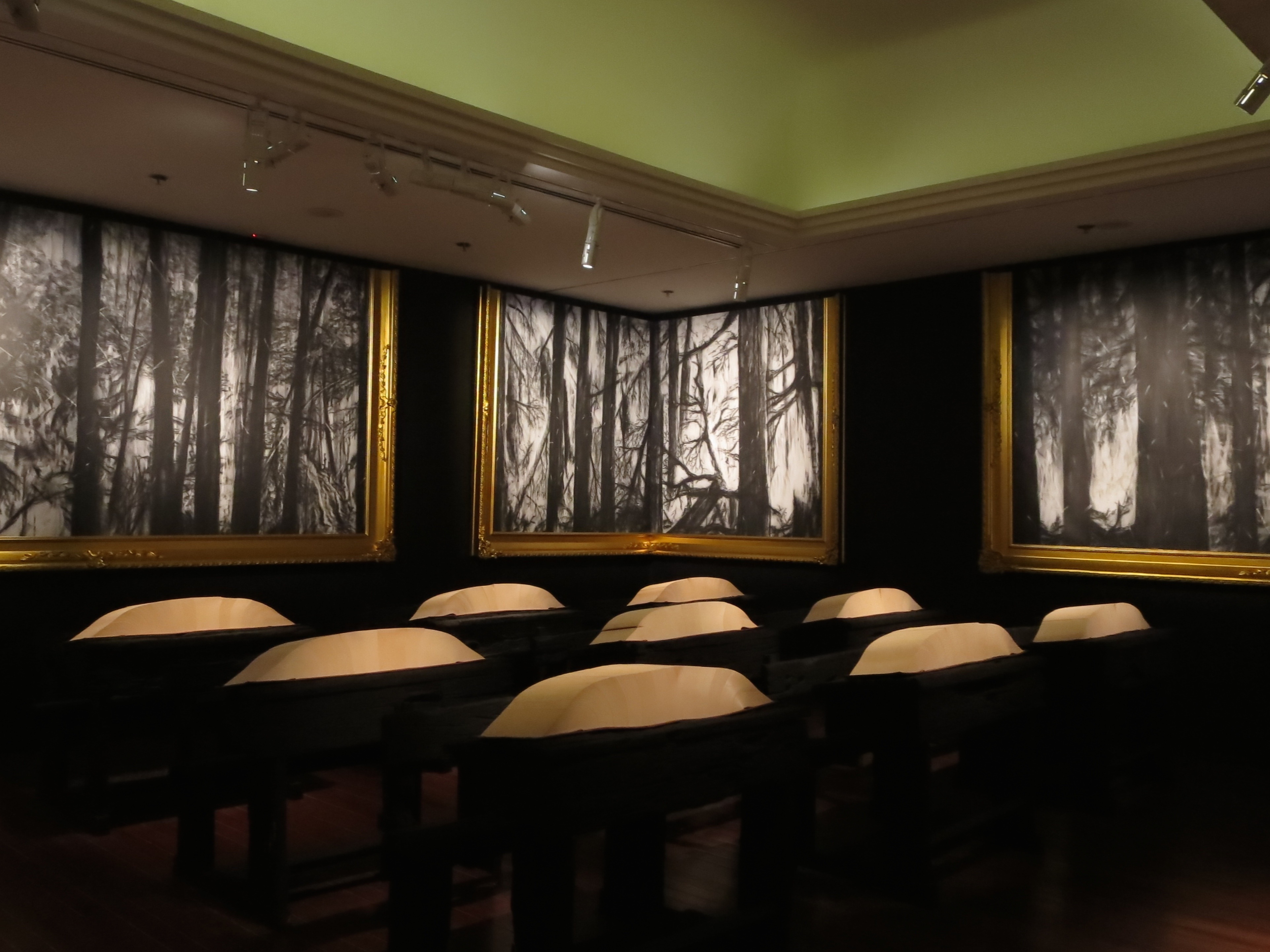
    The other work, Titarubi’s Shadow of surrender, comprises multiple components in a large space. I could not quite fit it all into my photo but it contains large, open, blank books on benches, with chairs, and with big charcoal drawings of trees on the walls. It was commissioned for the Indonesian pavilion at the 2013 Venice Biennale. It’s a complex work, with additional layers of meaning contained in the knowledge that the wood used in the furniture comes from colonial-era railroad tracks. The pieces are burnt, which apparently references the charcoal the artist’s mother cooked with, but which also links to the charcoal tree drawings. And, of course, trees provide the paper and wood used for books and furniture, suggesting a cycle of life theme too. The label refers to the fact that the books are empty implying a “tabula rasa” and the idea that it is time to re-write history or re-learn lessons, and thus develop anew leaving past colonial constructs.  An article about the Biennale on Titarubi’s website says that in this work he links “sakti” (‘divine energy”) “to both education and the environment, to knowledge and the natural world”. Another powerful and emotive piece, as you can see.

    SAM was our last “sight” in Singapore and rounded off our visit very nicely!

    * While researching where Orara was from, I discovered an article about artists using ballpoint pens. It starts with: “Accessible and affordable, the ballpoint pen has become the medium of choice for artists to make obsessive abstractions, extreme drawings, and playful riffs on venerated ink traditions”.