Monday musings on Australian literature: Specialist literary festivals

Are you a reader of crime or science fiction or fantasy? Or, perhaps of poetry? A few weeks ago I wrote a post on regional literary festivals in Australia. I focused then on festivals for general and/or literary fiction. But, if you have specialist reading inclinations, there are also likely to be festivals for you. And so today I thought I’d post a selection – just to whet your appetite.

While I was researching that last post, I came across a couple of websites: literary festivals.com.au, which lists Australian festivals, andVampires in the Sunburnt Country, which publishes a literary festival calendar for Australia. They are worth checking out if you want to know whether a festival is coming to a town near you – or, better still, your own town.

As last time, I’ll list a randomly selected few – representing a variety of specialty and location – in the order of their establishment, starting with the oldest.

  • Australian National Science Fiction Convention. Established in 1952, and run each year in different cities by different groups. This year’s festival will be held in Melbourne and run by a group called Continuum.  Arthur C Clarke was a guest at the fourth convention held in 1955.
  • Romance Writers of Australia Conference. Running now for 23 years, this is a big affair. It’s a 4-day event and will be held in Sydney this year, but moves around a bit I believe. It is, really, more conference for practitioners than festival for readers, but with “350 published and aspiring romance writers, editors, agents and other industry professionals” attending, I figured it’s worth mentioning. Romance is, clearly, serious business. And, anyhow, the conference will include a Literacy High Tea, which they describe as a networking event “for librarians, booksellers, authors and readers” that will also be a fundraiser the Australian Literacy and Numeracy Foundation.
  • StoryArts Festival Ipswich. Established in 1995, and originally called the Ipswich Festival of Children’s Literature. It takes place biennially and is organised primarily by the Ipswich Teacher-Librarian Network (in Queensland). Good for them. Their aim is broad: “to increase an awareness of the value of the arts in relation to writing and illustration and help build and maintain increased audiences for children’s literature. We plan to inspire young people to buy and read more books and gain an appreciation of the processes involved in writing and illustrating. We also aim to enthuse teachers and parents about the value of stories and encourage them to promote literature to young people.”
  • Perth Poetry Festival. Established in 2005 as the WA Spring Poetry Festival, and now run by WA Poets Inc. It is one of many poetry festivals held around Australia, including some dedicated to bush poetry and other poetry forms, which suggests that poetry is alive and well(ish) even if poets can’t make a living from their art!
  • Jane Austen Festival Australia. Established in 2008 in Canberra, this is a 4-day Regency Festival which explores the world of Jane Austen. It includes a wide variety of activities and events including dancing, archery, historical costume making, a Jane Austen book club and lectures on literary and historical subjects. The 2014 conference included a half-day symposium on Mansfield Park.
  • Reality Bites. Established in 2008, and run by the Sunshine Hinterland Writers’ Centre (in Queensland). (It may alternate with another festival titled Reality Writes, but the website doesn’t yet have its “About” page functional). It describes itself as “Australia’s premier literary nonfiction festival” and takes place on the last weekend in October each year. It sounds right up my alley but is rather far away.
  • Death in July Festival. Established in 2014 – yes, this is its first year. In my last post I only selected festivals that had some longevity behind them but, Ballarat Writers Inc, which is organising this festival with Sisters in Crime, tweeted me about it. I reckon that deserves a guernsey. It celebrates women’s crime writing and will be held in Ballarat, Victoria, in July. Guests at this first festival will include Angela Savage whose The dying beach I reviewed earlier this year.

As you can see, most of these are pretty recent – though there are some longstanding ones. I haven’t included any play/theatre festivals but there are several of those too. It does seem that literary festivals of all sorts are popular at present – not only in cities but also in regional towns, which clearly hope that festivals will be part of their survival in our economically tough world.

Have you attended any speciality literary festivals? If so, what specialty has taken your fancy!
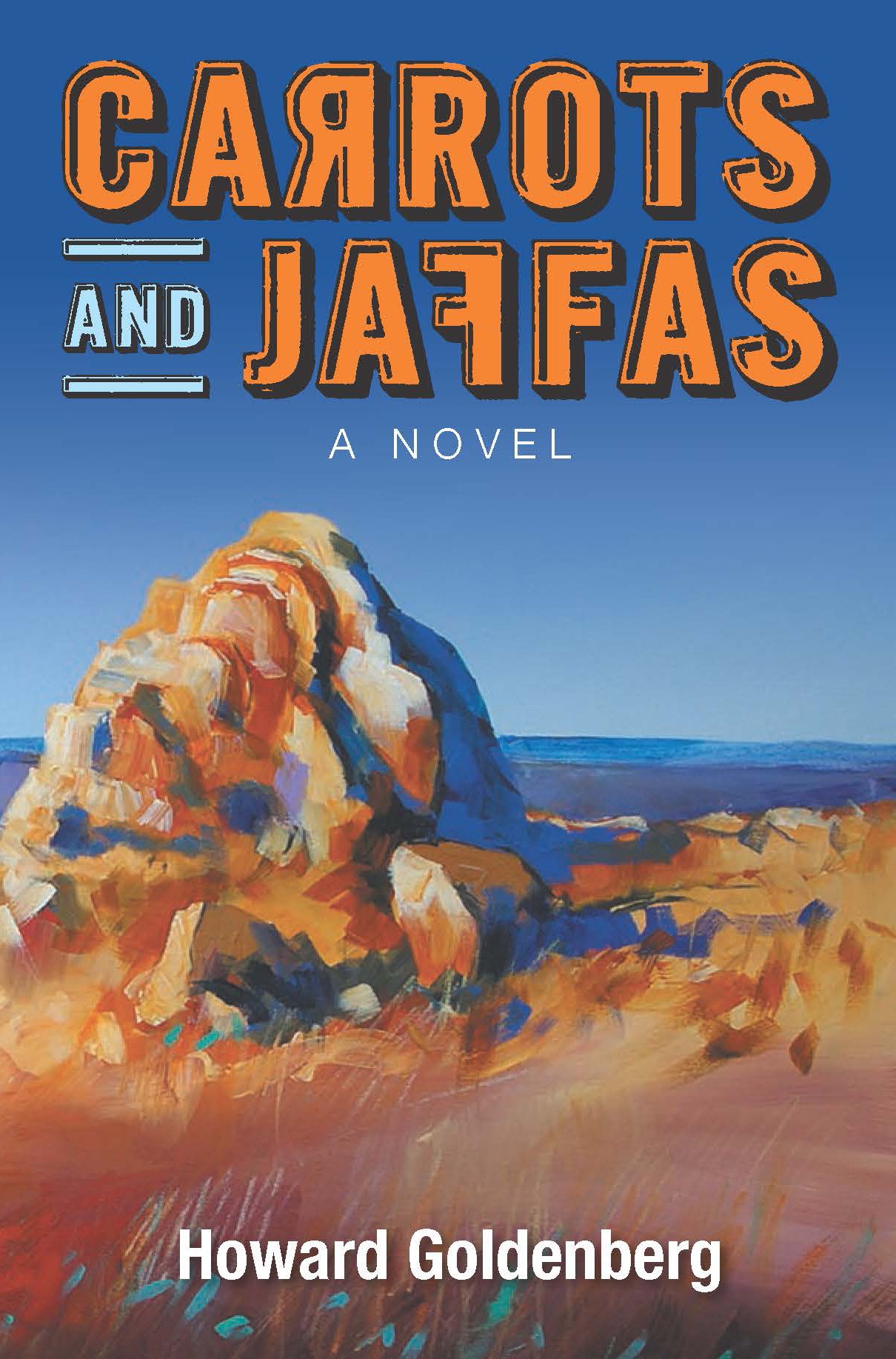
 

Howard Goldenberg, Carrots and Jaffas (Review)

Howard Goldenberg, Carrots and Jaffas

Courtesy: Hybrid Publishers

Howard Goldenberg, we are told in “About the Author” at the back of his debut novel Carrots and Jaffas, is the sole practitioner of a literary genre – the rhyming medical referral letter! Wouldn’t I love to see some of those! Anyhow, you’ve probably guessed now that Goldenberg is a doctor, and you’d be right. But he’s a doctor with some very specific experience. Earlier this year I wrote about white writers writing on indigenous subjects. It resulted in quite a discussion. While the overall opinion was that there should be no taboos in subject matter for writers, we agreed that such writing is most effective when done from a standpoint of knowledge (and, it goes without saying, sensitivity). Howard Goldenberg, whose novel Carrots and Jaffas I’ve just completed, has such knowledge*, as he has and still does practise for part of his time in outback Aboriginal communities. Beats me how he could also find time to write a novel, but like all passionate writers, he has!

I hadn’t heard of Howard Goldenberg before, but apparently he was featured in one of the sessions at this year’s inaugural Melbourne Jewish Writers festival, about which (the festival, not Goldenberg) Lisa (ANZLitLovers) and Jenny (Seraglio) have posted on their blogs. Goldenberg writes on his blog of his session with Martin Flanagan. He says that Flanagan “led a conversation about the book, about my choice to turn from serious non-fiction to the novel, about stolen children – the ultimate wound, about twinness, about the problems and pitfalls of the whitefella writing about blackfellas.” Oh, wouldn’t I have loved to have been there!

This novel, Carrots and Jaffas, is pretty ambitious. It covers a lot of ground, asking us to make the right connections between different experiences of suffering and loss. It uses parallel stories and a frequently shifting narrative perspective to do this. It has the odd awkward moment – a coincidence pushed a little far, an irony that doesn’t quite ring true, an earnestness that gets in the way – but these are minor in a story that totally got me in from the first page. Goldenberg has written two works of non-fiction – a memoir about his father, My father’s compass, and a book of stories about his experiences as a doctor in outback Aboriginal communities, Raft. These non-fiction works have clearly honed his narrative skills.

The main action of the novel occurs around 2004, with the setting split between suburban Melbourne and the Flinders Ranges in South Australia, in Adnyamathanha country. The plot starts with the abduction of 9 year-old Jaffas, one of identical twins, by an ex-drug addict, ex-con, who plans to deliver him to an old indigenous woman, Greta, who had two sons stolen from her in the 1960s. Clean now, but with a brain damaged by PCP, he (Jimmy aka Wilbur) sees himself as Golem or the Redeemer. He is going to right a wrong. He planned to take the two boys but it goes wrong and he ends up with just Jaffas, leaving behind a distraught Carrots. The story then flashes back to the story of how Carrots and Jaffas came to be, to the meeting and subsequent marriage of their parents, Bernard, an IT specialist who had lost his father when young, and Luisa, an immigrant from Buenes Aires who, we gradually learn, had suffered significant trauma and loss in her youth. Later, we meet Doc who works in the Flinders Ranges, but who has experienced a loss of his own, a sibling through divorce.

From here the story alternates between Carrots at home, and Jaffas in the outback in a neighbouring state. As Carrots starts to fall apart, Jaffas, who was threatened with the death of his twin if he tells, is introduced to indigenous culture. He is not happy, is biding his time for an opportunity to go home, but in the meantime, over a period of a couple of months, he starts to hear different stories about life – indigenous ones from Greta and scientific ones from Doc – and learns another way of living. I will leave the story at this point … except to say that there is drama alongside reflection. It’s quite a page turner, in its quiet way!

There is humour here, despite the serious subject matter. I particularly loved the chapter on the kindergarten fancy dress parade. It brought back such memories. Even in this lighthearted scene, though, there’s seriousness. One child is particularly diminutive, and Goldenberg writes:

No one in his class considered him abnormal. But already behind him, forever past, were the years of parity with his classmates. This would be his last year of unselfconsciousness, the last year before he entered the big school, where bigger kids would be free with unkind comparisons. Luisa gazed at him, concerned; she realised the child did not suffer from dwarfism – not yet.

Oh, the power of labels!

The characters are engaging, each clearly individualised – from Luisa’s bible-learnt English and understandable fearfulness to Greta’s confident, nurturing nature, from Bernard’s practical approach to life to the Doc’s passionate if somewhat eccentric one.

There are many losses explored in this novel – parents “lose” children, and children their parents, siblings lose siblings – and they are mostly needless, human-induced. Goldenberg examines what happens to the soul, the spirit, when it experiences such pain. Not everyone responds in the same way – some start to disintegrate, some go into problem-solving mode, others respond with increased generosity of spirit – but all suffer.

Carrots writes letters that he clearly can’t send to the abducted Jaffas. In one of them he writes “I am not me without you”. They are of course twins, but most people, Goldenberg shows, are irrevocably changed when they experience loss. For all this, the novel is redemptive. I’d love to know how indigenous people respond to the novel but, for me, it’s a novel written with love from the heart. I enjoyed it.

Howard Goldenberg
Carrots and Jaffas
Melbourne: Hybrid Publishers, 2014
242pp.
ISBN: 9781925000122

(Review copy courtesy Hybrid Publishers)

* Read, for example, his powerful, heartfelt blog post on the current Budget recommendations regarding co-payment for medical treatment.

Barbara Baynton, Bush church (Review)

awwchallenge2014“Bush church” is my sixth and last* story from Barbara Baynton’s Bush studies, and it presented a rather pleasant change in tone from most of the others in the book. I’m sorry in a way that I read these stories quite out-of-order. “Bush church” is the fifth story in the collection, appearing after “Billy Skywonkie” and before the very grim “The chosen vessel”. It would work well in this position I think.

Like “Billy Skywonkie”, “Bush Church” contains a lot of dialogue in the vernacular of that particular place and time, making it somewhat of a challenge to read. However, I didn’t find it off-puttingly so. This may be because I’ve developed a bit of an ear for it (and you do have to use your ear when reading it) or perhaps because there is less dialogue. The story concerns a motley group of graziers and selectors gathered together at a grazier’s property to attend a church service delivered by a travelling parson. It becomes clear early on that attending a church service is a very rare occurrence in this neck of the woods. There are couples not married, children not christened, and people, indeed, who have never been to a church service.

It is, in many ways, a comic piece. But, here’s where I should take back that word “pleasant” in my first sentence because, while it doesn’t have the violence that several of the other stories have, the comedy is bitter. Baynton’s people here, as in her other stories, are not the noble sufferers we meet in Henry Lawson’s “The drover’s wife” or those two stories by Mary Grant Bruce that I recently reviewed. They are, with few exceptions, jealous, self-centred and/or mean-spirited.

The story, divided into two parts, starts with the parson on a horse en route to the grazier’s property. It’s not a good horse. The story opens:

The hospitality of the bush never extends to the loan of a good horse to an inexperienced rider.

The implication, of course, is that the bush is hospitable. You know, country hospitality and all that! However, as the story progresses we see little if any evidence of bush hospitality. Early in the story, our unnamed parson, is joined by “flash” Ned, who is desperate for a smoke, but gets none from the non-smoking parson, nor from “hairy Paddy Woods of eighteen withering summers” whom they meet along the way.

Perhaps because of this or just because he’s who he is, Ned decides, mischievously, that the parson is there as an Inspector, and spreads this news to all and sundry, so that they start hunting for:

land receipts, marriage lines, letters from Government Departments, registered cattle brands, sheep ear-marks, and every other equipment that protects the poor cockey from a spiteful and revengeful Government, whose sole aim was “ter ketch ’em winkin'” and then forfeit the selection. All of these documents Ned inspected upside down or otherwise, and pronounced with unlegal directness that “a squint et them ‘ud fix ‘im if thet’s wot ‘e’s smellin’ after”. He told them to bring them next day. Those of the men who had swapped horses with passing drovers, without the exchange of receipts, were busy all afternoon trumping up witnesses.

No wonder Ned, who, we also discover, is a wife-beater, “was no favourite” among his neighbours!

This is where the first part ends. The second part comprises the church service which takes place on the grazier’s verandah. The attendees, we are told, are “ten adults and eighteen children”. Baynton provides us with colourful descriptions of these people as they arrive, and then the service starts:

For a few minutes the adults listened and watched intently, but the gentle voice of the parson, and his nervous manner, soon convinced them that they had nothing to fear from him. Ned had been “poking’ borak” at them again; they added it to the long score they owed him.

Not surprisingly, with a couple of exceptions, they all gradually lose interest. The adults bicker, while the children find the food the hostess had prepared for a post-service lunch for the parson, herself and her husband. Her hospitality was not extending any further, but she’s one-upped by the children and one of the mothers! When the service is over, she has a problem to solve!

This is not a story with a strong plot, but is, rather, a slice of life, presented with a good deal of humour peppered with bite and irony. Susan Sheridan, in her introduction to my edition, suggests that Baynton’s writing belongs to the naturalist tradition of writers like Zola and Gorky. Naturalism, she says, is a style that “was crafted to express the view that the uncontrollable forces of the natural world had their equivalents in human nature, and that the values of civilisation were a mere crust over an underlying struggle to death among various life forms”. In this style, she suggests, violence and cruelty are expressed in a detached way. That doesn’t mean, I think, that we readers react in a detached way. Rather, the detached tone adds to our feeling of horror.

Barbara Baynton, I’ve decided, was a very interesting woman. I plan to do a Monday Musing on her soon to share a little more about who she was.

Barbara Baynton
“Bush church” in Bush studies
Sydney University Press, 2009
ISBN: 9781820898953
Available online: in Bush studies at Project Gutenberg.

*For my previous reviews of stories in this book, click the appropriate title: A dreamerScrammy ‘and, Squeaker’s mate, The chosen vessel, and Billy Skywonkie.

Monday musings on Australian literature: ABR’s first laureate

While I was gallivanting in the northern hemisphere in April, ABR (the Australian Book Review) announced its first ever laureate. I missed it at the time, but heard of it soon after my return, and am now sharing it with you. For most Aussie readers, though, it’s probably a bit old hat!

ABR’s concept of a laureate is somewhat different to, say, Britain’s poet laureate who is called upon to produce poetry for special occasions. ABR’s idea, says editor Peter Rose, is “to highlight the work of our greatest writers”. However, the laureate will have one job, and that is to nominate (and possibly mentor) a “laureate’s fellow”, a younger writer who will receive $5000 to support “a work of poetry, fiction, memoir or criticism” that will be published in ABR.

So, who is ABR’s first laureate? Rose said that deciding the first laureate was easy – David Malouf. With David Malouf turning 80 this year, it seemed obvious, he said, to mark his many achievements. Makes good sense to me, particularly given the breadth and depth of those achievements. But, I’ve already written about Malouf turning 80, so won’t repeat what I said then.

However, to commemorate Malouf’s laureateship (is that a word?), ABC Radio’s Mark Colvin conducted a brief interview with Malouf for PM  Colvin asked him a few well-targeted questions concerning the development of Australian literature. Malouf was his usual thoughtful, measured self – and made his usual sense. He talked of the change in Australian literature from the 1980s to now, suggesting that in the 1980s and 90s, defining our identity, our Australian-ness “was a big thing … I think writers themselves had a more self-conscious notion of their Australian-ness and what the particular subject matter of Australia might be. I think that moment has more or less passed”. In response to Colvin’s question regarding why that might be, he said:

I think the question of Australian identity has become much more open and flexible and more complex. I think younger writers don’t necessarily think of themselves as being Australian writers; they really want to be global writers or international writers. But you know, like all writers, the thing that they are aware of is that you’re a writer for yourself. It’s something very, very personal.

And I think we’ve reached the kind of sophistication when we think about Australian-ness to understand, which I think is absolutely true, that for anybody who is writing and has grown up in Australia with Australian language and Australian education and Australian interests, your Australian-ness is something you can pretty well take for granted. You don’t have to work on it.

I think he he’s right – and it is probably part of the natural maturation of a nation. It’s perhaps a bit like moving from adolescence to adulthood in that we are becoming comfortable in our own skins. This is not to say that we won’t continue to write about some of the issues that define us, issues like our indigenous/colonial/settler history, or our physical distance from much of the world (which might be mitigated somewhat by technology but not completely – the kilometres are still there). But it does suggest that we are less likely to fuss about who we are, to feel that we have to explain or justify ourselves. Books like Malouf’s own Ransom (my review) is a perfect example – an Australian writing about classical Greeks (as he did earlier about ancient Romans in An imaginary life).

If Malouf is right and we do, and can, take our Australian-ness for granted, what does this mean for our interpretation of the Miles Franklin Award’s stipulation that the winner must be about “Australian Life in any of its phases”? How do we interpret that in 21st century Australia? In other words, what does an “indigenous literature” (Franklin’s words) look like in a mature nation?

Anyhow, the other main question Colvin asked him concerned the difficulty of being a writer today and the future of the novel. Malouf said that, while there may be some questions regarding the impact of new formats like reading on a screen,

my belief would be that there will always be readers because I think reading is for some people something they can’t do without. It’s a bread and butter matter, it’s an addiction. And I think those people will go on reading. I think they’ve always been a fairly small number; I think they’ve always been pretty much the same number.

So I’m optimistic really about the survival of the novel and the survival of the reader.

His final point – and it’s a writer’s point – was that “the question really would be about what happens to publishing rather than what happens to writing.” Once a writer, always a writer, obviously!


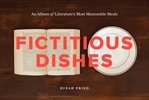
Dinah Fried, Fictitious dishes (Review)

Dinah Fried, Fictitious dishes

Courtesy: HarperCollins Australia

Regular readers here know that I recently spent a few weeks in North America – mostly in Toronto, bookended by a few days in Southern California. We spent our last day with a friend I “met” many years ago through online reading groups. We actually met Trudy for the first time in 2008, so this was our second meeting. She is a fun, generous person, and upon our arrival at her pretty cottage, she proceeded to shower us with gifts targeting our interests and activities. One of these was Dinah Fried’s Fictitious dishes which she chose because of our “sophisticated palate and enthusiastic approach to dining” – as well as, of course, my love of reading. I’m not so sure about the sophisticated bit, but we do love our food!

Dinah Fried’s book, subtitled “an album of literature’s most memorable meals”, is one of those delightful little books for readers to get their teeth into. (Ha!) As you read it you think, of course, about your favourite meals and foods in books. (You know what I’ll be asking you at the end of this post, then, don’t you?). In her introduction, Fried mentions some of her favourites, starting with one of my own, Heidi (by Johanna Spyri). Fried mentions the golden cheesy toast that Heidi’s grandfather serves her in their home in the mountains, but I also remember the white bread rolls that so astonished Heidi when she lived in the town with Clara. Who doesn’t like cheese on toast and perfect bread rolls!

The book contains an eclectic and sometimes surprising collection of “fictitious dishes” in both adult and children’s books that range from European classics like Kafka’s Metamorphosis to modern American Pulitzer prize winners like Cormac McCarthy’s The road. This latter, involving a can of pears, reminded me of the cans of peaches* in Adam Johnson’s The orphan master’s son (my review). In other words, the book can send you off on little journeys of your own! There are 50 or so dishes, and each is presented as a two-page spread. On the left is the title of the book, the quote, and some tidbits of information inspired by the book and/or the food items chosen. On the right is Fried’s photo of the food, lovingly prepared and carefully laid out. In her introduction, she talks briefly about food preparation and the work involved in sourcing just the right props. It is good fun looking at the photos and thinking about her design choices. She is, after all, a designer, a graduate from the Rhode Island School of Design. As with any book of this ilk, some designs worked better for me than others, but I enjoyed looking at them all.

Most intriguing to me, though, were the little pieces of information. They include:

  • the history of various food items, like freeze-dried potatoes, for Beverly Cleary’s Beezus and Ramona;
  • notes about the books, such as prizes won or an interesting point about their publication; and
  • comments on the authors, such as their inspiration for the work or their relationship to the food.

There’s no real pattern to these. Some books have four or five points, and others only two, but they are fun to read. She does provide a list of references at the back, along with a list of the books chosen and the editions she used for the quotes. I do have one bone to pick with her (oh dear!), and that’s regarding her comment on, you’ve probably guessed it, Jane Austen! Food appears quite frequently in Austen’s novels, and particularly in Emma, which features a hypochondriacal father keen to ensure everyone eats as plainly and boringly as he does. It also features a picnic, a strawberry gathering party (from which Fried takes her quote), and balls and dinners. My quibble relates to Fried’s comment that “Despite proposals, Austen never married, setting her apart from many of her novels’ characters, who are husband hunters”. To describe Austen’s heroines so baldly as “husband hunters” badly misses Austen’s point. Her heroines were prepared not to marry (as Austen didn’t) if they couldn’t marry for love. Austen knew the importance of money to women’s security, but her heroines also wanted to love and respect the man they married.

But now, to the fun bit. One of my favourite bookish references to food comes from Virginia Woolf’s A room of one’s own. I’m sure you know to what I refer! However, as Fried’s book is devoted to fiction, I’ll share one of my favourite fictitious dishes (one that wasn’t included by Fried). It comes from Gene Stratton Porter’s A girl of the Limberlost and refers to a brown leather lunchbox:

It did open, and inside was a space for sandwiches, a little porcelain box for cold meat or fried chicken, another for salad, a glass with a lid which screwed on, held by a ring in a corner, for custard or jelly, a flask for tea or milk, a beautiful little knife , fork and spoon fastened in holders, and a place for a napkin.

Not only did I adore the idea of this gorgeous little box, but the love and generosity behind it in the story speaks to the most important thing about food in our lives – the making of and sharing it with those we love. Now, over to you … what are your favourite fictitious dishes?

Dinah Fried
Fictitious dishes: An album of literature’s most memorable meals
New York: Harper Design, 2014
126pp.
9780062279835

* They play an important role in the lives of the main characters, but to explain it would be to spoil!