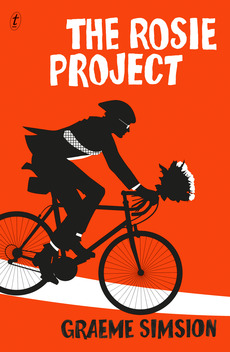
Bookcover (Courtesy: Text Publishing)
While I go to films fairly regularly, I rarely think of adapting books to film when I am reading. However, I was only a few pages into Graeme Simsion’s The Rosie project when it occurred to me that it was perfect film material. The feeling got stronger – and then around a third of the way through the novel I decided to look at the publicity sheet Text Publishing sent with the book. I usually read these sheets after reading the book. Guess what? The Rosie project started as a screenplay and has won a Writers’ Guild Award for Best Romantic Comedy.
This brings me to the other thing that crossed my mind as I read it: how to categorise it. I’ve now read two books in a row that are a little outside my usual fare. Like the previous one, Anita Heiss’s Paris dreaming, The Rosie project is a romance, but it’s not chicklit and I’m not sure it fits the romance genre as a whole either. You see, the protagonist – as the cover may have told you – is a man, one Professor Don Tillman. As I understand it, romance novels tends to involve a female protagonist and the trials and tribulations she meets en route to true love. Movies have a genre called “romcom” but I’m not sure that term is used for novels. It is, however, the most appropriate description for this novel – because it’s a romance and it’s funny.
Now, I’d better give you a brief outline of the plot. It opens with Don Tillman, a genetics professor, about to give a public lecture on Asperger Syndrome as a favour for his friend Gene (ha!), a psychology professor. In the second paragraph, you start to suspect that Don himself has Asperger’s:
The timing was extremely annoying. The preparation could be time-shared with lunch consumption, but on the designated evening I had scheduled ninety-four minutes to clean my bathroom.
Ninety-FOUR minutes!? The novel continues in this vein with Don admitting to being socially inept, to being routine-driven and focused on efficiency over all else, and so on. He knows all this about himself, but never in the novel is he named as having Asperger Syndrome so I won’t either. However, this description of him provides a good introduction to the novel’s basic premise. Don, nearing 40, wants a wife but, not surprisingly given the way he approaches the world, he hasn’t had much success. He starts the Wife Project and creates a 16-page questionnaire designed to help him eliminate unlikely candidates before he wastes time on getting to know them. In comes 30-year-old Rosie, whom he thinks Gene has sent to him as a candidate. But Rosie, he quickly realises, would fail his questionnaire on the first page. She smokes, works in a bar (and so, he presumes, would fall below the required IQ), is not punctual, dresses unconventionally – you get the picture. Yet, there’s something about Rosie … so, pretty soon, Don offers to help her find who her father is, and thus begins the Father Project, which rather puts on hold the Wife Project.
From here, the novel runs pretty much to a romcom formula. The light tone tells you that it is likely to turn out the way you expect but despite this, the novel engages. This is because, although the plot is formulaic, the characters aren’t. Don is an unlikely hero. He’s aware of his difference and, as the novel progresses, starts to think about whether he can change himself to become more acceptable to people. It’s, dare I say it, poignant – but it’s not saccharine. Don and Rosie are too themselves for that. The novel also has some truly laugh-out-loud scenes. Comedy which involves ridiculing difference can be uncomfortable but again the tone saves it – it’s light and it’s warm. We like Don and our laughter is not so much at his behaviour as at the absurdity of the situations he sometimes finds himself in. I loved, for example, his description of his special treatment by airlines:
As we drank champagne in the lounge, I explained that I had earned special privileges by being particularly vigilant and observant of rules and procedures on previous flights, and by making a substantial number of helpful suggestions regarding check-in procedures, flight scheduling, pilot training and ways in which security systems might be subverted. I was no longer expected to offer advice, having contributed ‘enough for a lifetime of flying’.
I enjoyed the book. It is a warm, but not stuffily earnest, book about accepting and celebrating difference, about negotiating relationships that accommodate different ways of being. It would make a great film.
Lisa at ANZLitLovers also found it fun.
Graeme Simsion
The Rosie project
Melbourne: Text Publishing, 2013
329pp.
ISBN: 9781922079770
(Review copy supplied by Text Publishing)
 Whispering Gums