Wish You Were Here (Movie Review)

Regular readers here know how I love a novella. It occurred to me that feature films that are shorter than 90 mins could be seen as the cinematic equivalent of novellas. At 89 minutes, the recent Australian movie, Wish You Were Here, reminds me a little of a novella. The story is focused, with no digressions into side stories. In other words, the minor characters are there only to serve the purpose of the main story, and not to have lives or stories of their own. And, like a good novella, it doesn’t slow down in the middle but engages you at the beginning and keeps you involved – and guessing – right to the closing credits.

The basic plot concerns a young woman, Steph, and her new boyfriend, Jeremy, deciding to holiday in Cambodia where he has business (hmmm…) dealings. Steph asks her sister Alice, who is pregnant with her third baby, to come along with husband Dave. Initially resistant, Dave is convinced by Alice to have this final fling before their family expands again.  At the end of the week, Jeremy goes missing and the other three return to Sydney, but there are clearly secrets. Some characters, we suspect, know more than they are letting on. Gradually, through current action and flashbacks, the story comes out, with devastating consequences along the way for those involved.

The film has been billed by some as a “psychological thriller” but I wouldn’t call it that. It didn’t keep me on the edge of my seat, but there is mystery, tension and drama.  The production company, Aquarius Films, describes it as a “psychological drama/mystery”. That’s more like it.

As you’d expect, given its plot-line, the film does play to some familiar stereotypes, that of middle-class white Australians enjoying cheap holidays in SE Asia, complete with alcohol and party drugs, and a hint of that darker story of drug smuggling hovering in the background. These are not, however, the story’s target, so the stereotypes work as background or introduction rather than as the main fare. The main target or theme relates to the decisions you make, the things they set in motion, and how you handle things once started. From these spring those bigger universals of love, commitment and forgiveness. In the film, the first critical decision is that of going to Cambodia, and it is followed by some stupid and terrible decisions and actions taken while there. These set in motion behaviours and further decisions that threaten to pull apart what was nicely and economically established at the beginning to be a stable and happy marriage. But, I won’t be more explicit than this to avoid spoilers.

Instead I’ll talk a little about the production. Dave (Joel Edgerton) and Alice (Felicity Price), the two main characters, are convincing and sympathetic (even when you want to give them a shake!) – and their two very young children played by Isabelle Austin-Boyd and Otto Page are stunningly natural. I was intrigued to notice that Felicity Price also co-wrote the script with debut director and husband, Kieran Darcy-Smith.

Stylistically speaking, the film uses techniques that seem popular now: fast cutting, a handheld camera look, and shifting focus. The fast cutting approach worked well to convey the colour and action of a SE Asian holiday. It also helped build up the tension as the implications of what happened started to tell on and derail the characters and their relationships. You do have to concentrate, however, to make sure you don’t miss a step in the narrative sequence or a clue to what is going on. I’m not quite so enamoured, though, of the shifting focus – just as I wasn’t in The Hunter. I was rarely convinced that it made a difference to the impact of the scenes in which it’s used – but maybe that’s just me.

Wish You Were Here was premiered at Sundance this year which is, in itself, a recommendation. And while it didn’t, for me, have quite the punch of Animal Kingdom (which came out of the same Blue Tongue Films stable), its considered exploration of the ramifications of making morally poor (and poor moral!) decisions make it a challenging and engrossing movie. Good novella, this film!

Monday musings on Australian literature: The other David Campbell and the sin of misattribution

Much to my chagrin, the “other” poet named David Campbell drew to my attention recently to the fact that I had twice, in my blog, (mis)attributed a poem he’d written to the wrong David Campbell. The poem is “The Last Red Gum” and I first wrote about it in my post on The magnificent River Red Gums and then again, because it seemed relevant, in my post on Richard Allen and Kimbal Baker’s book Australia’s remarkable trees.

The David Campbell to whom I thought I was referring is the one who lived much of his life in my neck of the woods, that is, in the Australian Capital Territory and neighbouring areas of New South Wales. He did write a lot about nature and the landscape. In fact, his Wikipedia article (to which I’ve linked his name at the beginning of this paragraph) includes quotes from two poems about trees – “In summer’s tree” and “Snow gums”. It’s not surprising really that, at first glance, I thought I knew who I was quoting. This David Campbell wrote many volumes of poetry, edited anthologies and won some of our top poetry awards. He died in 1979.

However, the “other” David Campbell is very much alive – and just as well, because he was able to ensure I righted my wrong. He lives in Victoria and is a member of the Federation of Australian Writers. He too has won several poetry awards and has published volumes of poetry. While he also writes in free verse, his first love he says is bush poetry. As a lover of Banjo Paterson, I can relate to that. This Campbell is keen, he writes on his website, “to promote traditional poetry, particularly in terms of the assistance that a mastery of rhythm and rhyme gives to any form of writing”. He argues that this form of poetry “is accessible to all”. Like the first David Campbell, he has also written short stories (and appeared in Black Inc’s Best Australian stories, 2005).

In 2011, Campbell won the Bronze Swagman award for his poem about dementia, called Wasteland. You can read it on the ABC’s Western Queensland website. It’s a simple, accessible and moving poem.

And so, I apologise to this later David Campbell and hope he doesn’t mind if I quote another verse from “The Last Red Gum”, because I do like this poem and its environmental message:

Dead gums in Lake Mulwala

Dead gums in Lake Mulwala, on a late autumn afternoon

At Mulwala and Chowilla there are remnants of our kind
in a place where verdant floodplains used to be.
Now a ghostly red gum graveyard is the only thing you’ll find
and a desert is the only sight you’ll see
(from “The Last Red Gum”)

Oh, and I haven’t even mentioned “another” Australian David Campbell, the singer and son of rocker Jimmy Barnes! It clearly pays to be careful in your research – something I with my librarian-archivist background should have been well aware of!

Have you ever been guilty of misattribution – and how did you handle it?

Delicious descriptions from Down Under: Willa Cather’s landscape

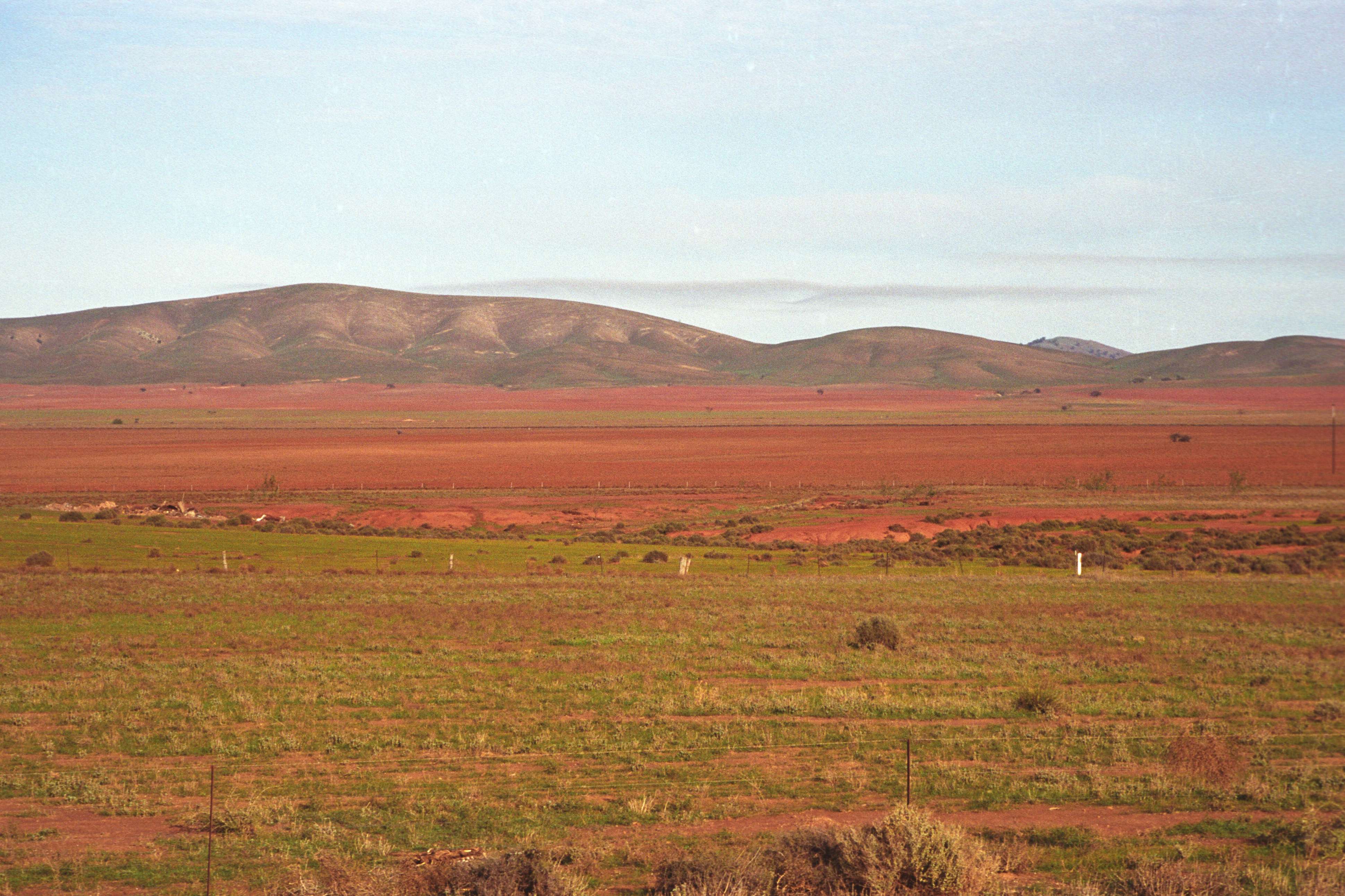
In my review earlier this week I mentioned that Willa Cather‘s description of pioneer life in My Ántonia could apply pretty closely to Australia, but I didn’t say that her description of the landscape could too. Again, the details are different, but the sense is the same. The expansive blue skies and the preponderance of yellows and reds in a vast landscape are all very familiar to Australians. The book is full of gorgeous descriptions featuring the sun and sky, and with the colours of red, rosy, and yellow dominating.

Here is Jim in Book 1 describing a landscape that is still new to him:

I wanted to walk straight on through the red grass and over the edge of the world, which could not be very far away. The light air about me told me that the world ended here: only the ground and sun and sky were left, and if one went a little farther there would be only sun and sky, and one would float off into them, like the tawny hawks which sailed over our heads making slow shadows on the grass.

Outback Australia, near Burra, SA

Outback Australia, near Burra, SA

And here he is in the 5th and final book some 30 or so years later:

Out there I felt at home again. Overhead the sky was that indescribable blue of autumn; bright and shadowless, hard as enamel. To the south I could see the dun-shaded river bluffs that used to look so big to me, and all about stretched drying cornfields, of the pale-gold colour, I remembered so well. Russian thistles were blowing across the uplands and piling against the wire fences like barricades. Along the cattle-paths the plumes of goldenrod were already fading into sun-warmed velvet, grey with gold threads in it.

If I think wheat instead of corn, and spinifex and wattles instead of Russian thistles and goldenrod, I could be reading about Australia. Not that I need to apply my reading to Australia, of course, but in this particular book it struck me again what similarities there are between the two New Worlds of Australia and America. For both our countries, Jim’s description that “there was nothing but land: not a country at all, but the material out of which countries are made” rings true.

Willa Cather, My Antonia (Review of eNotated edition)

Portrait Willa Cather 1936

I am a Willa Cather fan, and have read some of her novels and short stories, so was intrigued when eNotated Classics offered me an eNotated version of Cather’s My Ántonia for review. eNotated? That sounded like something worth exploring so, although I’ve read the novel before, I decided to read it again. I wasn’t sorry. It’s still a wonderful read.

My aim here is not so much to review the book, though I won’t be able to resist saying a little, but to explore this eNotated edition that I read on my Kindle. I understand from the website that eNotated Classics produces books for the Kindle, the Nook and iBooks. The company’s aim is to take “advantage of eBook technology to extend and enrich books in a way that increases understanding, engagement and reading pleasure”. Did they achieve this aim for me? That is the question!

I’d say yes and no – and will explain by discussing what I see as the three main components of the eNotated version.

eNotation links

These are underlined text (words or phrases) that you click for added information, which can be dictionary-style definitions, brief encyclopaedic-like descriptions, or interpretations. The eNotations can also be read as a group by clicking a single link at the beginning and end of each chapter, and they appear at the end of the book. In fact, the novel finished at the 77% mark in the book, with the last 23% comprising the eNotations and other material.

I was disappointed that many of the eNotation links contained the same information that the Kindle dictionary contains. Since the latter is faster to access by simply moving the cursor to the word to be looked up, those eNotations were rather superfluous. However, perhaps this depends on the dictionary the e-reader accesses, making the experience different with different e-readers.

There were a few of the more interpretive style and I appreciated those. One concerned the relevance of the play Camille which the narrator Jim sees with Lena. This sort of notation can be useful to students who may not, for example, know the play.

A useful feature is their identification system, which comprises a bracketed number at the end of each paragraph and each eNotation, making them easy to cite and to find. The number is obvious as you read, but you soon get used to it.

Theme indications

Now this one bothered me somewhat. See what you think: here are the first lines of the novel as they are presented in this eNotated version:

Last summer I happened to be crossing the plains of Iowa (TIME) in a season of intense heat, and it was my good fortune to have for a traveling companion James Quayle Burden – Jim Burden as we still call him in the West.

Throughout the novel sentences or phrases are treated like this – formatted in italics followed by (TIME), (NARRATOR) or (ELEGIAC). The “How to read this book” section at the beginning of the book explains that these italicised passages are cited in the relevant theme essay – Time, Narrator or Elegiac – at the end.  These are not really “themes” in the literary analysis sense: “Time” is a theme but “Narrator” relates to voice, and “Elegiac” relates to tone. I did find these a little intrusive and wonder whether they would have been better handled as links to the essay they occur in without the bracketed upper case word to show the way.

Additional information

At the end of the book are several items designed to add value. Most of these are not unique to e-Books. They are the eNotations (which you can click on to go back to the text), the three theme essays, a History of Nebraska, a Willa Cather Timeline, a Key Event Timeline, a Bibliography and Images. These are all useful value-adds. I liked the fact that the 12 images can be enlarged, something I can’t do with maps and images in the travel guide I bought last year. It was fascinating to see an image of a Dugout house in Nebraska, though photo credits next to the captions would have been good.

I’m not a Cather expert, but I found the Theme essays interesting – and expect they’d help both students and general readers. The bibliography is short and looks useful, though the most recent citation is dated 1987 which seems a little old. The novel might be a classic, but scholarship continues …

And now to the book itself

How do I love this book? Let me count the ways! I love its meditation on the past, on how the past intrudes into the present. Jim Burden is, really, “burdened” by his past. He meets Antonia when he is a 10-year-old orphan arriving in Nebraska to live with his grandparents, and she a 14-year-old Bohemian immigrant arriving with her family to settle there.  They end up on neighbouring farms and become friends when her father asks Jim to teach Antonia how to speak English. The novel then follows the next 30 or so years of their lives – the first four “books” cover 10 years from the novel’s opening, while the last “book” jumps to 20 years later. Jim, the narrator, keeps an eye on what happens to “my” Antonia over the years, but the book is as much about him and his inability to move on from the past. He says near the end:

In the course of twenty crowded years one parts with many illusions. I did not wish to lose the early ones. Some memories are realities, and are better than anything that can ever happen to one again.

 I love its language and tone. It’s delicious to read. I’d probably describe it as “melancholic” or “meditative” but I wouldn’t argue with Bedell’s “elegiac”. Here is an early description as Jim arrives in Nebraska from the greener, more lush Virginia:

Between that earth and that sky I felt erased, blotted out. I did not say my prayers that night: here, I felt, what would be would be.

Lovely, simple, spare writing.

And I love Cather’s description of pioneer life, and pioneer characters. Much of what she writes could easily apply to 19th century Australia. The landscape is different – but is similarly bare and harsh – and the ethic mix is different – but the experiences and hardship are universal. It’s a life and environment in which character is writ large – and Cather draws her characters beautifully. Even the minor ones – such as farm hands Jake and Otto who disappear early in the novel – are vivid. Here is Jim on Ántonia, late in the novel:

She lent herself to immemorial human attitudes which we recognize by instinct as universal and true. I had not been mistaken. She was a battered woman now, not a lovely girl; but she still had that something which fires the imagination, could still stop one’s breath for a moment by a look or gesture that somehow revealed the meaning in common things.

This is one of those novels that stays with you and I’d recommend it to anyone. Would I recommend this eNotated edition? Yes. It’s a good attempt to take advantage of the eBook format and, while there are features that didn’t  work perfectly for me, at USD5.99, it’s hard to beat.

Willa Cather
The eNotated My Ántonia
eNotated by Barbara Bedell
eNotated Classics, V1.00 12/1/2011 (based on 1918 edition)
Kindle edition
ISBN: 9780982744864

(Review copy supplied by eNotatedClassics.com)