Monday musings on Australian literature: Noongar/Nyungar, and the importance of place

Conceptions of home and understanding of place are the central issues in Noongar author Kim Scott‘s Miles Franklin award winning novel, That deadman dance, which I reviewed last year. From the opening pages of the novel Scott explores notions of home, as the white settlers confront the indigenous inhabitants of the land they are trying to colonise.

Here is the main indigenous character, Bobby:

And then Bobby found a sheet of granite, and a small rock hole covered with a thin stone slab and filled with water.  He crouched to it, touched the stone, and sensed home. Something in the wind, in plants and land he’d at least heard of, and increasing signs of home. There were paths, and he knew where there’d be food […] Bobby closed his eyes, felt the wind tugging at his hair and rushing in the whorls of his ears. Breathed this particular air. Ngayn Wabalanginy moort, nitjak ngan kaarlak … Home (pp. 235, 238)

And here is the main would-be pastoralist settler, Chaine:

With no boat Chaine felt his loneliness … It was land he’d hoped for – pastoral country, with good water and close to a sheltered anchorage. But he had tried and been disappointed. It deflated him. (p. 239)

These occur during a long trek which Chaine and Bobby make when Chaine’s boat hits a reef and founders. Chaine thinks Flinders’ journal will provide the guidance he needs while Bobby, in country unfamiliar to him, relies on his understanding of the land’s clues. “This way, we go this way, follow the creek away from this spring and this estuary”, says Bobby, while Chaine insists “they keep to the coast … so he could catch sight of the sea every now and then”.
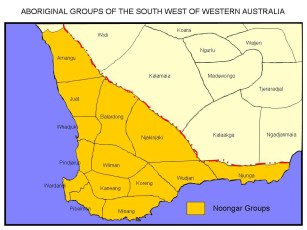
noongar1

Courtesy John D Croft, English Wikipedia, using CC-BY-SA-3.0, via Wikimedia Commons

All this is to introduce a fascinating seminar I attended today, at the Australian Institute of Aboriginal and Torres Strait Islander Studies. It was given by Associate Professor Len Collard, a Nyungar* scholar researching Nyungar place names, using an ARC research grant. The English title of his talk was “I am creating the knowledge of Country place names: from the past to now and into the future”.  His aim is to document Nyungar place names in Western Australia’s southwest on the basis that naming place confirms or establishes “ownership”. The project aims at

  • supporting reconciliation,
  • encouraging environmental understanding,
  • helping tourism ventures, and
  • “closing the gap of Australianness” by creating a common understanding of local indigenous geography.

You’ve probably noticed the alternative spellings I’ve been using to name the people of this area. Alternative spellings are a significant challenge for both indigenous and non-indigenous people studying indigenous culture.  Collard made an interesting point regarding variant spellings. He says that a common reason given is that  the Nyungar (like many indigenous people) encompass several language groups and that the different spellings could therefore have come from different pronunciations, putting, in a sense, the onus of problematic spelling at the feet of the indigenous people. However, he suggests there is another possibility. His project is based on post-colonial historical records produced throughout the 19th and 20th centuries by settlers from a wider variety of countries – England, Ireland, Holland, France, and so on. The different spellings, he suggests, could be due to the way these recorders transcribed, using their own linguistic knowledge, the word/s they heard.

Early in his talk he talked of the “history of constructing the negative” in which indigenous people have been reduced to the role of sidekick in post-colonial Australia. The reason for variant spellings could be read as an example of this. Another is the attitude to indigenous trackers. Their knowledge, Collard said, was critical to the survival of the colony and yet, as Scott shows in his novel, this knowledge was either used ungraciously or, at worst, ignored.

I thoroughly enjoyed the talk, not only for its specific content but also for the way his scholarship intersects with contemporary indigenous literature. Home, land, place … they are important to all of us … recognising and respecting that is a good place to start. I’ll conclude with Bobby near the end of the novel:

On time we share kangaroo wallaby tammar quokka yongar wetj woylie boodi wetj koording kamak kaip … Too many. But now not like that, and sheep and bullock everywhere and too many strangers wanna take things for themselves and leave nothing […] And now we strangers in our special places.


Delicious descriptions from Down under: Julian Barnes on ageing and memory

This is the second Delicious Description I have written about ageing. It probably won’t be the last because, being a woman of a certain age, I am starting to connect with authors who explore the impact of ageing. I loved Barnes’ description of failing memory in his The sense of an ending (which I recently reviewed):

When you start forgetting things – I don’t mean Alzheimer’s, just the predictable consequences of ageing – there are different ways to react. You can sit there and try to force your memory into giving up the name of that acquaintance, flower, train station, astronaut … Or you admit failure and take practical steps with reference books and the internet. Or you can just let it go – forget about remembering – and then sometimes you find that the mislaid fact surfaces an hour or a day later, often in those long waking nights that age imposes. Well, we all learn this, those of us who forget things.

They say you should write about things you know about. It sure feels like Julian Barnes knows about this!

Julian Barnes, The sense of an ending (Review)

I should have known I wouldn’t be the first to think of it, but during my reading Julian Barnes‘ Booker Prize winning novel, The sense of an ending, I was suddenly reminded of TS Eliot‘s The love song of J. Alfred Prufrock. It was the melancholic tone, the sense of life having passed one by, that did it:

What did I know of life, I who had lived so carefully? Who had neither won nor lost, but just let life happen to him?

Doesn’t that remind you of “I have measured out my life with coffee spoons”? I don’t usually read reviews before I write my own, but I wondered if my thought had come to anyone else. Of course it had. I googled “julian barnes sense of an ending prufrock” and up came several hits. Oh well, I thought, at least I’m not going to sound totally foolish. There is safety in numbers, after all, which brings me back to Tony, the novel’s protagonist, who says, at another point in the novel:

I’m not odd enough not to have done the things I’ve ended up doing with my life.

I admit to having a certain fellow feeling with Tony, a self-confessed “average” person who’s led an average life “of some achievements and some disappointments”. But, enough self-revelation, let’s get on with the review.

I’ll start by saying that this book is right up my alley. Firstly, it’s a novella and regular readers here know how I love a good novella. Secondly, it’s a good novella, by which I mean it’s tightly constructed and sparely written. And thirdly, plot is not the main point; character and life are Barnes’ focus.

Nonetheless, while there’s not a strong plot, there is of course a story, and it concerns the aforesaid Tony. He’s the first person narrator and is a reliably unreliable one. He tells us this on the second page, while at the same giving away the novel’s essential form:

But school is where it all began, so I need to return to a few incidents that have grown into anecdotes, to some approximate memories which time has deformed into certainty. If I can’t be sure of the actual events any more, I can at least be true to the impressions those facts left. That’s the best I can manage.

This tight little para tells us a few things about what’s to come. The word “deformed” combined with the idea that he “can’t be sure of the actual events” tells us to beware, that imperfect (for whatever reason) memory is at play. The mention of returning “to a few incidents” describes the basic structure of the novel, as it does indeed focus on and tease out the ramifications of a “few incidents”.  And the reference to school hints that there might be something of the bildungsroman about it.

I still haven’t told you anything about the story, though, have I? It’s divided into two parts. In Part One, Tony is in his teens and twenties and focuses on his three male friends and his first serious girlfriend, Veronica. This part is less than 60 pages and, as Tony promises at the beginning, primarily comprises a few scenes from his life, linked by some running commentary. There are classroom scenes and a particularly memorable one involving his first  (and only) weekend visit to his girlfriend’s home. We come back to this scene in the second part. I loved how, after spending some 50 pages on his youth, Tony wraps up around 40 years of his adult life in two pages. Impressive writing.

In Part Two, Tony is confronted again with some of the major incidents from his youth and is forced to reconsider his sense of self. The most important of these incidents concerns the suicide of one of his friends … and gradually we get a whiff of a mystery, albeit one just hovering around the edges. This is because the mystery is not the main point.

Tony, in this part, is bequeathed, out of the blue, the diary of the friend who had committed suicide 40 years previously. Now, Tony believes that it is the witnesses to your life, those you spent time with, who “corroborate” who you are. As these people drop away, there is, he says “less corroboration, and therefore less certainty to what you are or have been”. He therefore sees this diary as potentially significant:

The diary was evidence; it was – it might be – corroboration. It might disrupt the banal reiterations of memory. It might jump start something – though I had no idea what.

The bequest does “jump start something” but to what purpose is the moot point. An issue that occupies Tony is that of change. “Does character develop over time?” he asks and then continues, in one of those little postmodern touches we’ve become used to, “In novels of course it does, otherwise there wouldn’t be much of a story”. You said it, Tony/Julian, we are tempted to respond, except that by this time Tony had so captured my attention that the minimal story was neither here nor there.

And this is where I’ll leave the story … and return to an issue I raised earlier in the post, that regarding its being something of a bildungsroman. It’s not a traditional coming-of-age novel because only the first part of the novel chronicles his development as a young man. But, something is jump started for Tony in his 60s that forces him to rethink who he had been and who he had become. Memory, he says, can lock you into

the same loops, the same facts and the same emotions. I press the button marked Adrian or Veronica, the tape runs and the usual stuff spins out. The events reconfirm the emotions – resentment,  sense of injustice, relief – and vice versa. There seems no way of accessing anything else; the case is closed.

Occasionally, however, something happens to break the loop, as it does for Tony. He is suddenly confronted with new (or, different) memories which bring new emotions. He looks at “the chain of responsibility” and sees “my initial there”. He learns that the things he’d thought fixed or certain can be dissolved, that memory cannot be relied upon and can, in fact, come back to bite you. Time and memory, Barnes shows us, are malleable, suggesting, to me at least, that perhaps we never really do come of age.

Julian Barnes
The sense of an ending
London: Vintage, 2011
150pp.
ISBN: 9780099564973

Monday musings on Australian literature: World Book and Copyright Day, Australian-style

World Book Day!

World Book Day! (Photo credit: Nimages DR, via Wikipedia, using CC-BY-NC-ND 2.0)

World Book Day 2012 was more than half over before I realised it existed. That could be my fault of course. I may have had my head so deep in my last blog post and my current book that I missed all the publicity …

Are you aware of World Book Day?  April 23 was established by UNESCO as World Book Day in 1995 to promote reading, publishing and copyright. Why April 23rd*? Because in 1616, Cervantes, Shakespeare and Inca Garcilaso de la Vega all died. April 23rd is also the date of birth or death of other authors such as Maurice Druon, Halldor Laxness, Vladimir Nabokov, Josep Pla and Manuel Mejía Vallejo. And, while she may not be in the same class as these luminaries, the Australian creator of Mary Poppins, P.L. Travers died on April 23 (in 1996).

Anyhow, upon discovering that today is World Book Day, I hit Google to see what I was missing. Not much it seems. I discovered, for example, that the Department of Education in Western Australia thought that March 1* was World Book Day. Hmm … yes it was, but in the United Kingdom. Several others thought the same. The English, it seems, are doing such a great job of promoting their celebration of World Book Day that they have confused we Antipodeans!

So what is World Book Day all about? Here is a description from UNESCO:

It is observed by millions of people in over 100 countries, in hundreds of voluntary organizations, schools, public bodies, professional groups and private businesses.  … World Book and Copyright Day has won over a considerable number of people from every continent and all cultural backgrounds to the cause of books and copyright. It has enabled them to discover, make the most of and explore in greater depth a multitude of aspects of the publishing world: books as vectors of values and knowledge, and depositories of the intangible heritage; books as windows onto the diversity of cultures and as tools for dialogue; books as sources of material wealth and copyright-protected works of creative artists. All of these aspects have been the subject of numerous awareness-raising and promotional initiatives that have had a genuine impact. There must nevertheless be no let-up in these efforts.

Oh dear … Australia could perhaps lift its game a little.  After some careful searching of the National Year of Reading 2012 website, I finally found a link to the World Book Night (which says that it will be celebrated in the UK, Ireland, Germany and the USA). I found no press releases or reports on World Book Day activities involving our first Children’s Laureates. And Google didn’t turn up anything from booksellers or publishers.

However, my favourite radio station, ABC Radio National, knew it was today … and posted so on Facebook! To commemorate it, they asked their Facebook fans what they were reading and got 12 responses (by early evening, anyhow). And BookTown Australia has a web page on World Book Day. They suggest “that the enthusiastic focus on Book Week later in the year and … the proximity to ANZAC Day (April 25)” are reasons for minimal observance in Australia. They would like this to change:

One aim of BookTown Australia is to give World Book Day a context to be celebrated in Australia and link it to the international community of booktowns. Using World Book Day as the commencement of the One Town – One Book community reading programs is seen as viable means of doing so, especially as the reading program can then culminate in August to coincide with Children’s Book Week. On World Book Day (April 23) in Australia in years to come, any community – village, town suburb or city – can be a “booktown” on that day, simply by declaring its participation in the reading program with the announcement of their chosen book.

This was probably written in 2002 and there’s nothing on the site to suggest that anything significant has eventuated. And yet, the day does seem like a great opportunity to make a bit of a splash – to promote our writers, to encourage reading, to stimulate discussion about copyright and books in the new digital environment.

The theme for the 2012 World Book Day is Books and Translation. At first glance this is not, really, a comfortable fit for we Australian readers who live in an anglo-centric island nation. And yet, it could be an opportunity to draw attention to the diversity in our population and how reading translated literature can help us learn about and understand our non-English speaking compatriots.

I’m afraid I’ve rambled a bit today (more than usual, anyhow!) because I’m a little flummoxed. Does anyone have any experience of World Book Day – in Australia or elsewhere? Are we so over-run with UN-designated World Days and International Years that they’ve just become too much noise?

* Apparently, while most countries keep to the April 23 date, there are some that don’t, including the United Kingdom. This year they celebrated it on March 1. I was intrigued to discover that the Bodleian Libraries in Oxford dedicated their celebration of World Book Day this year to Jane Austen. They had a display, a reception, and two talks, one of which was on a sequel (not PD James’s though)!

PD James, Death comes to Pemberley (Review, sorta)

How do you review or evaluate a Jane Austen “sequel”*? Do we expect, want even, the author to channel Austen? I suspect the answer is as varied as are the readers of sequels, and it probably depends on why we read Austen. Those who are mostly interested in the stories and what happens to the characters are likely to have a completely different perspective from those who love Austen’s language and her very particular wry, sly eye on humanity. I fall into the latter group and this is why I am not drawn to sequels. I want to read Austen for Austen, and other writers for their style and worldview.

I have just read PD JamesDeath comes to Pemberley. I’d describe it as a traditional sequel, with a difference. That is, it picks up the story of Elizabeth and Darcy some six years after their wedding, but it is a crime novel, which adds an extra complication for the reviewer, because not only is there the issue of Jane Austen’s story and characters to consider, but there’s a shift in genre. This, I’ll admit right now, puts me at a double disadvantage: I don’t read Jane Austen sequels and I don’t read crime novels. So why did I read this book? Two reasons really. It was given to me by a friend and my local Jane Austen group decided to discuss it as part of this year’s focus on Pride and prejudice.

I’m glad I read it, mainly because I’ve been wanting to try a “sequel” for some time to understand what they are all about – and a sequel by a writer of PD James’ reputation seemed like a good one to try. However, I can’t say I really enjoyed it. It was, however a quick read – and I did find it intriguing to ponder what sequel readers look for.

Before I discuss that, I’d better say something about the plot, though that’s hard without giving too much away. The story proper starts on the night before a big annual ball. Elizabeth, Darcy, Colonel Fitzwilliam (now Viscount Hartlep), Georgiana and the Bingleys are all at Pemberley getting ready, when a carriage careens into view carrying, we soon discover, an hysterical Lydia claiming that her husband, Wickham, has been shot. Darcy, Colonel Fitzwilliam and a new character and suitor to Georgiana, Alveston, set off into the woods to find out if indeed this has been the case. The novel then, as crime novels tend to do, follows the story of a murder through inquest, trial and resolution. It’s an interesting enough plot, and one whose resolution I didn’t guess. But then, as I’ve already said, I’m not a crime reader.

But now, rather than review the book in my usual way, I’m going to talk about it specifically in terms of its “sequelness”. (Is that an ok neologism?). So here goes…

Characterisation

If there’s one thing a sequel should do, I think, it’s to be true to the characters. No matter what new situation they are placed in, they need to still be them. Unfortunately, in this novel, Elizabeth and Darcy do not come across as Jane Austen’s creations. Darcy spends most of the novel – which, remember, occurs six years after the wedding – bothering about his decision to marry Elizabeth and how it returned Wickham to his world. He’s not sorry about marrying Elizabeth but he mulls and mulls and mulls yet again about the implications feeling, for example, “that he had lost some respect in his cousin’s [Col Fitzwilliam] eyes because he had placed his desire for a woman above the responsibilities of family and class”. That’s not our Darcy!

Similarly, it’s a rather subdued Elizabeth we see. Sure, she’s older but she is still in her 20s. And sure, she’s now the mistress of Pemberley, but that doesn’t mean the young woman who stood up to Lady Catherine, unlike “sensible” girls who recognise their need of a husband, now has to be quiet and, yes, dull. Why doesn’t she tell Darcy of some clues and suspicions that may be relevant to the murder?

Would Charlotte Lucas really harbour resentment towards Elizabeth? James suggests she does:

… but it was unlikely that Charlotte had either forgotten or forgiven her friend’s first response to the news [that she’d accepted Mr Collins].

Style

I’m not sure that a sequel must ape Austen’s style … which is just as well because James doesn’t really. The problem is that I think she tried. She’s clearly a good writer, but it probably would have been better for her to stick to what she does best. There were moments of wit and humour, but much was ponderous. Here is Georgiana’s suitor speaking to Darcy:

Forgive me, sir, but I feel I must speak. You discuss what Miss Darcy should do as if she were a child. We have entered the nineteenth century; we do not need to be a disciple of Mrs Wollstonecraft to feel that women should not be denied a voice in matters that concern them. It is some centuries since we accepted that a woman has a soul. Is it not time that we accepted that she also has a mind?

This is way too didactic and preachy for Austen, particularly for a non-Mr-Collins-like character. The dialogue, overall, lacks Austen’s light touch – and is often stilted without capturing the formality of the period.

There were times too when I felt she was more Dickens than Austen. Some of her characters’ names are pure Dickens, such as Hardcastle, Pegworthy and Belcher.

However, I understand that James is known for her settings – something that Austen did not focus much on – and her descriptions of place are generally evocative and effective.

Observations

Along with her style, it’s the way Austen hones in on human behaviour and describes it with brevity and wit  that keeps me coming back to her. James was clearly keen to match Austen in this area and occasionally made me smile, as with this description:

… had exacerbated a disagreement common in marriages wherein an older husband believes that money should be used to make more of it, and a young and pretty wife is firmly of the view that it exists to be spent; how otherwise, as she frequently pointed out, would anyone know that you had it?

And this comment by the imperious Lady Catherine:

I have never approved of protracted dying. It is an affectation in the aristocracy; in the lower classes it is merely an excuse for avoiding work.

These little commentaries were like beacons in the forest … and showed me that, despite the misses in the novel, James does “get” Austen.

Genre

Then there’s the genre shifting. This is both a crime novel and historical fiction. I can’t speak much for the crime aspect except to say I thought it was well plotted and kept me guessing. I didn’t work out whodunnit, but when it came, the clues generally made sense. James also incorporated some Gothic elements – nature awry, dark woods and possible ghosts – something that Austen didn’t write, though she did spoof readers of Gothic fiction in her Northanger Abbey.

The historical fiction aspect was mixed for me. James had clearly researched the period thoroughly and I enjoyed learning about the practice of law, in particular. However, there were times when it felt that she just had to impart some information, whether or not it was essential to the story. Interesting enough, but it got in the way of her story.

Unlike Austen, who is often criticised for not writing about current events, James makes regular references to the Napoleonic war – and to English nationalism. This is fine. I don’t think a sequel has to limit itself to Austen’s subject matter.

I’d love to write more, but have already taken up way too much of your precious reading time. I’ve probably panned the novel more than I originally intended to. This is because it’s not the book for me – but it’s by no means a “bad” book. If you like Austen sequels, you’ll probably like it. If you like crime novels or are a fan of PD James, you could very well like it. But if you like Austen for her Austen-ness, then, like me, you’d probably rather read Pride and prejudice  – again. Horses for courses, as they say.

Death comes to Pemberley
London: Faber and Faber, 2011
310pp
ISBN: 9780571283583

*  Sequel in this Jane Austen context are books written by other writers based in some way on Austen’s novels. They can be “real” sequels (or prequels) in that they take an existing novel and tell us what happened next (or before); they can be retellings of a particular novel; or they can take another approach, such as tell the story of, or from the point of view of, another character.

Delicious descriptions from Down Under: Chris Flynn (or Billy) on yoga

It’s been a couple of months since my last Delicious descriptions – life has been particularly busy – but I can’t resist stopping for a moment to share this one. It comes during one of my favourite set pieces in Chris Flynn’s A tiger in Eden which I reviewed a couple of days ago. This piece tells of a 10-day Buddhist retreat that the protagonist, Billy, attends. It’s one of those retreats where you remain silent for 10 days, meditate, do yoga, eat vegetarian food, and so on. Since I have taken up yoga (again) over the last few years, his description tickled me:

Golden Bow yoga pose
Golden Bow (Courtesy: OCAL, via clker.com)

Some of the moves were hard even though I was fit as f*ck sure I couldn’t do them, stretching dead far till you thought your tendons would snap I was sweating so I was. I always thought the yoga was a load of aul hippy shite, no one told me it was a workout. After a couple of days I was dead into it though and practising in my cell sure I could near get my legs behind my head flexible as f*ck it turns out, who knew sure I could always find work as a stripper if nothing else worked out.

This little excerpt gives you another look at Billy’s voice and how Flynn has gone about achieving it. I liked the sound of it in my head as I read (notwithstanding the liberal use of expletives!)

Chris Flynn, A tiger in Eden (Review)

Flynn Tiger in Eden
Courtesy: Text Publishing

Are all people redeemable, regardless of what they’ve done? This is the question that confronts us in Chris Flynn’s debut novel, A tiger in Eden. I wondered, as I was reading this book, what inspired Flynn to write – in first person – about a man who was a violent thug during the Troubles in Northern Ireland and how he managed to achieve such an authentic voice. I don’t read reviews before I read books, and I didn’t read the press release which came with the book until I’d finished it, but when I did I discovered that Flynn was born in Belfast during the period he writes about. “I was born into the war and knew nothing else growing up”, he says.

He has seen horror, he says. He has had guns pointed at him, and he has heard “stories of torture and cruelty so nightmarish I would not recount them to someone who had grown up outside of Northern Ireland. You don’t want that in your head”. This, however, is the world of Flynn’s protagonist, the thug-on-the-run, Billy Montgomery, whose head is full of violent memories and whose hands are stained with blood. “Sometimes”, he says, “I reckon the worst thing that can happen to a person is surviving”.

I don’t want to say too much about the story because it’s a slim book with a small cast of characters and a pretty straightforward plot. To say too much would give it away. It’s set in Thailand in the mid 1990s. The aforesaid thug Billy, who is not short of a penny due to his criminal past, is hiding out. But, here’s the interesting thing. Billy is a sympathetic character, despite the violence we know he’s done (though we don’t know the full extent until near the end) and even despite the violence we see him enact in the first half of the novel. He’s sympathetic because we realise early on that he’s trying to work through something, that he’s carrying some terrible baggage he wants to shake off.

It’s the mark of a good writer to be able to make an unappealing character sympathetic. And Billy is pretty unappealing. Not only is there his violent past, but his attitude to women is (or, at least has been) appalling, as has been his attitude to Catholics and various other “lesser”, to him, members of society. But, this book is really about the education of young Billy and so, through the love of a couple of good women (which is, yes, a little corny) and some other meaningful encounters, a Buddhist retreat, and reading, Billy starts to think about his life and, consequently, starts to confront his demons.

One of the things that makes Billy work is his voice. The novel is told first person in the vernacular of his ilk. This means there’s liberal use of swear words*, minimal punctuation, and the grammar is, shall we say, idiosyncratic. The result is a voice that sounds authentic – and, in this case, reliable. The only thing stopping Billy from telling the truth at times is the pain it would release.

Billy is, of course, the tiger in Eden, a potential threat to good people everywhere, but just to give it some added real and metaphoric punch, Flynn has our Billy confronting and staring down an actual tiger, an escapee from a zoo (just like Billy really). However, whilst I say Billy is “the” tiger in Eden, he is not the “only” tiger in Eden. Flynn shows Thailand to be a place spoilt if not corrupted by sex-tourists and cashed-up back-packers who abuse the locals one way or another. Here is Billy after realising that a genuine friends-only outing with a local Thai girl threatens her reputation:

The aul sex tourism had changed things for all these people, I could see that now ‘cos normal life no longer existed. It was kind of like how the Troubles had changed things back home, once you go down that road, sure there’s nothing going back, everything gets changed forever and not for the better. I felt ashamed so I did.

In other words, while Flynn’s main story is men like Billy, he manages to make a few other points along the way.

At the beginning of this post I said that the book confronts us with the question of redemption, and so it does, but that’s not so much what Billy is seeking. He does not specifically ask to be “saved”. He simply wants to be able – psychologically and actually – to put the past behind him and “make something” of his life. This is not a perfect book. It’s somewhat predictable and the supporting characters are not well fleshed out, but Billy is a character that will engage you and make you see the world from another angle. And isn’t that what reading is all about?

Chris Flynn
A tiger in Eden
Melbourne: Text Publishing, 2012
217pp.
ISBN: 9781921922039

(Review copy supplied by Text Publishing)

* So it’s not the book for you if that offends.

Monday musings on Australian literature: What value literary awards?

If you are an Australian reader, you have probably heard that the new Premier of Queensland, Campbell Newman, has abolished the Queensland Premier’s Literary Awards. This was a shock as it had not been flagged during the election. His reason? To save some $250,000, as part of the Liberal National Party’s promised cost-cutting drive!

It was a wry moment for me when I heard the news, because only a few days before the announcement, I had pondered in my post about Adelaide Festival Awards for Literature whether, with the Festival becoming an annual event, South Australia would finally have an annual literary award, like most other Australian states.

Queensland’s literary awards program has been running since 1999 and is (hmm, was) one of the most comprehensive literary awards programs in Australia. It offers (offered) prizes in fourteen or fifteen categories, which included unpublished manuscripts, non-fiction, poetry, short stories, unpublished indigenous writers and fiction. Many of our significant writers have benefited from these awards, including Helen Garner, Alexis Wright, Tim Winton, Thea Astley, Nam Le, David Malouf, Judith Beveridge, Peter Carey, and Les Murray.

Australians will know that many of these award winners are not Queenslanders and their winning books were not necessarily about Queensland. Does this matter? All (I think) of Australia’s state-based awards are not state-limited in their criteria. I think that’s a good thing, though I can see arguments for limiting them to their states just as we have awards for women, for young writers, for indigenous writers, for unpublished works. What I don’t think is a good thing is to do away with awards. Awards for creative endeavours are always fraught. There are no objective standards to judge artistic creations by. But, this doesn’t mean they don’t have value – for the winners, for the short- and longlisted authors, and for the industry as a whole.

There are supporters of the decision. One is blogger Mark Fletcher who argues that these awards are “vanity projects” for Premiers and that “there are more significant funding opportunities for the arts in Queensland than the award: the end of the award does not mean the end of arts funding in Queensland”. Opponents, on the other hand, fear that this is the thin end of the wedge and that more cuts to arts funding are coming. Time will tell …

The topic has already been discussed on Australian blogs. Here are just a very few:

  • Angela Meyer of LiteraryMinded talks of the value of the prize to writers, publishers and booksellers
  • crikey.com calls it a sad announcement
  • Jeff Sparrow in Overland argues that this may be the harbinger of more cuts as more conservative governments gain power in Australia. He suggests that “There’s an urgent need for a new defence of literature, arguments that are neither philistine populism nor patronizing elitism but instead make the case why writing should matter to ordinary people. It’s something we’ve traditionally been very bad at. We need to get much better, very quickly.”
  • Lisa Hills of ANZLitLovers advises that the awards will be made with or without prize money and provides the link for submissions.
  • skepticlawyer describes plans by authors Matthew Condon and Krissy Kneen to continue the awards, probably using the law of trusts – and provides a link to their Facebook page for the awards.

I think that’s enough. You get the drift I’m sure. But, I wonder, what do you think about Literary Awards. Are they worth defending? What do awards mean to you, as a reader?

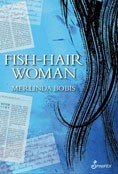
Merlinda Bobis, Fish-hair woman (Review)

Merlinda Bobis Fish-hair woman

Courtesy: Spinifex Press

How do you classify a book like Fish-hair woman by Filipino-Australian writer, Merlinda Bobis? Darned if I know, but I’ll have a go. It’s part war story, murder mystery, political thriller, romance, and historical epic. It draws on the magical realist tradition of writers like Isabel Allende, but overarching all this, it is a book about stories – about the stories we cleave to ourselves and the stories we tell others, the stories that convey the truth and the ones that hide it, the stories that change with time and those that never change.

But enough preamble, let’s get to the action. The book is set in the Philippines, with the core story taking place in a village called Iraya in 1987. It is a time of civil unrest: government soldiers fight communist insurgents (the historical New People’s Army), with privately-controlled armies added to the mix. The villagers are caught in the middle, struggling to survive under

violence dressed as salvation. What hopeful word, the sibilants a gentle hush: salvacion. The soldiers and the rebels spoke of this same cause, even as they remained in opposite camps and our village festered in between.

The central characters are Estrella, the fish-hair woman who uses her 12-metres-long hair like a net to retrieve the dead from the river (“trawl another victim of our senseless war”); her older “sister”, Pilar, who joins the communist insurgents; and Tony, the Australian journalist whom both had loved. These relationships are complicated by the fact that Estrella, whose mother died at the birth, is the illegitimate daughter of the most powerful man in the village, Mayor Kiko Estraderos (aka Doctor Alvarado), the man who runs the private army.

While the main action occurs in 1987, the time-frame moves between 1977, 1987 and 1997, with the story being mostly told from the perspective of 1997. By this time Pilar and Tony are among the dead or disappeared and Tony’s 19-year-old son Luke has been lured to the Philippines, on the pretext that his father is alive, by Kiko who wishes to “sanitise history and facilitate his return to politics”.

It’s a multi-layered story of political unrest, complicated village loyalties, and familial and romantic love. It is told in first person and third person, with changing points of view.  Sometimes we see through Estrella’s eyes, sometimes Luke’s, sometimes an omnipotent narrator’s or another character’s, and occasionally through newspaper clippings. Woven through it are recurring images and smells – the sweet lemongrass tainted by the corpse-laden river, the fireflies that light the dead so they can be found, and Estrella’s long hair that magically grows each time she senses violence and pain.

Australian Women Writers Challenge 2012 Badge

Australian Women Writers Challenge (Design: Book’dout – Shelleyrae)

This is one of those books that requires you to go with the flow. Its structure mimics the way we layer stories, the way we weave history and myth, stories and memories, so that at any one time we may or may not know where we are or who we are. Estrella, the fish-hair woman, and Stella, Doctor Kiko’s daughter, for example, are different facets of the same person, each with different stories.

There are simpler characters, too. One is Pay Inyo, the village gravedigger. He reminded me a little of the grandfather in Lianke’s Dream of Ding Village. He’s the peaceful man, the wise one who urges a humane path, who says it’s about perspective, “about how and from where you look … how far … and what you will to see”. But even he is unsure about the story:

But who is the hero in this story? Pay Inyo is not sure anymore, nor is he sure about what the story is in the first place. There are too many stories weaving into each other, only to unweave themselves at each telling, so that each story can claim prominence. Stories are such jealous things. The past and the present, ay, what wayward strands.

There were times, as I read, when I thought that Bobis may have created a few too many “wayward strands”. Some stories may not have been critical to tell, but her voice is so compelling and the language so expressive that I didn’t really begrudge her these, because by then I was well and truly along for the ride.

This is a novel set during war and yet it is not really about war. It is about people, “those whom we love and hate”, about how we use and manipulate stories to “save” or ” kill”, and, as Pay Inyo would like us to see, about collective grieving, collective responsibility:

This is the wake of the world: each of us standing around a pool that we have collected for centuries. We are looking in with our little pails … We try to find only what is ours. We wring our hands. Ay, how to go home with only my undiluted pail of grief? To wash my rice with or my babies, to drink? But the water is my dead kin, an enemy, a beloved, a stranger, a friend, someone who loved me or broke my heart. How to tell them apart? How to cleave water from water?

For all the sadness and brutality in this book, it has a big heart. And its message is clear. We are all in this together. How much better if we see it sooner rather than later.

Merlinda Bobis
Fish-hair woman
North Melbourne: Spinifex Press, 2011
303pp
ISBN: 1876756977

(Review copy supplied by Spinifex Press)

Vale Jerome

In living there is always
the terror
of being stung

of something
coming for you
on the unavoidable wave

(from “Bluebottles” by Dorothy Porter in her collection The bee hut)

I have not posted since last week’s Monday musings, and there will be no Monday musings this week, but I will resume in a day or so. In the meantime, my heart is just a little too sore for reading and reviewing.

Last week, the 26 year-old son of good friends died, just over three years after being diagnosed with cancer. It goes without saying that he was too young. He had so much to give and so much to live for.

I have bothered and worried about whether to write this post. After all this is not my story – I am just one of the bit-players on the side – but in the end I decided that for we who like to write, writing is cathartic, and so here I am. But I am not going to tell the story. It is for those closer to tell. I simply wish to say that no matter how much you prepare for a death like this, it is still devastating when it comes.

I will leave you with Jerome’s own words written in January this year in his raw, honest, beautiful blog:

What is wrong with this world. How is it that so few spend their lives doing things they love and so many do [what] they hate for something they do not need. I want to shout to the masses but [s]o few would listen. I would not have listened.

This is it. Do it now. You will not be here again.

And with Dorothy Porter, because … well, you’ll see why:

talking
and climbing
with this
glimmering
young man
who was talking to me
about death
how
a good dose of death
if you truly drink it
is a gift

a gift
a fresh cold
slap
a fresh dark
creek
you’ll never sleep-walk
through your life
again

(from “The snow line”, also in The bee hut)

Thank you Jerome for sharing your pain, ideas and hard-earned wisdom so generously and openly over the last year. I am proud to have known you.