The Hunter (movie)

The Hunter. Daniel Nettheim. Porchlight Films, 2011

Tasmanian Tiger (lithograph)

Lithograph of the Tasmania Tiger, after H. C. Richter's illustration in The Mammals of Australia (Gould) (Public Domain, via Wikipedia)

A guilty confession. I hadn’t heard of or read Julia’s Leigh’s apparently highly acclaimed novel, The Hunter, before this recent Australian movie was made. I’m not quite sure why that is. Maybe it was just child-rearing busy-ness at the time of its publication. Anyhow, the film is now out and I saw it this weekend. It was produced – but not directed – by the same people who made the excellent Animal Kingdom, and its cast includes Willem Dafoe (as “the hunter”), Sam Neill and Frances O’Connor. All actors I am always happy to see. And it was set in our beautiful southern island state, Tasmania.

The basic plot is straightforward. Martin (Dafoe) is a mercenary sent by a biotech company to find and kill a Tasmanian Tiger in order to bring back the necessary biological specimens for, it appears, biological warfare purposes. Now, if you know your Tasmanian history, you’ll know that the Tasmanian Tiger has been officially extinct since 1936 – but, like the Loch Ness Monster, there are always reports of sightings. The story, of course, has complications. The company organises for Dafoe to stay with a widow (well, her husband has been missing for a year) and her two young children who live on the edge of the bush … and from there the mystery thickens somewhat. What did happen to her husband?

The movie tos-and-fros between Dafoe “hunting” in the bush and spending time in the large log house with Sally (O’Connor) and her young daughter and son. Dafoe, established in the opening scene as a task-oriented person who likes cleanliness and order, a loner, arrives at Sally’s cabin to find the children running free, the house dirty and disordered, and the mother out-to-it (from, we soon learn, prescription drugs) in bed. He finds nowhere else in town: the logging-oriented townsfolk mistake him for a “greenie” and are therefore not willing to accommodate him, so he settles into Sally’s house, fixing it up to suit his needs. While doing so, he starts to engage with the two children and then the mother, which doesn’t endear him to Jack (Sam Neill).

This is billed as a thriller, and there certainly is tension. Can he find a Tasmanian Tiger? And do we want him to? What happened to Sally’s husband? Is Jack hiding something? Does Bike (Sally’s son who doesn’t speak) know something? The film doesn’t quite have the sophisticated moral and emotional complexity of Animal Kingdom. It is more a film of archetypes: the hunter who becomes the hunted, the silent child who knows something, the withdrawn grieving wife, and so on. The tension is enhanced by the remote, forbidding landscape, and the cinematography used to convey it. The colours are cold blues and greens, the lighting dark. There is also the sense of menace suggested first by the loggers but then by something less definite, more mysterious. Is it animal or human?

This is a difficult film to review. I enjoyed the movie, but had some reservations. The performances are excellent, particularly the taciturn but expressive Dafoe, and the two children. The pacing is slow, and yet it’s not too long. The cinematography is captivating overall, though I didn’t always like the unsubtle way parts of a scene would move in and out of focus. The soundtrack – the natural sounds in the bush, and Martin’s classics set against Sally’s Springsteen in the domestic scenes – is effective. The plot is perhaps its main problem. The initial set-up – that of expecting to find an extinct animal – needs a major suspension of disbelief, which was not a problem on its own, but the plot is then so tightly managed it was a little difficult in the end to know exactly who had been implicated in what. And this leads, I think, to a confusion of themes.  The logger-environmentalist conflict is introduced but never really developed. Was it there for necessary background*, or for its red herring purposes? There’s a bevy of themes concerning nature and extinct animals versus man, science and corporate greed. These are all touched upon and developed to some degree, but not as strongly as they could be. The overriding theme though is probably Martin’s emotional journey – from an isolated, self-contained man at the beginning to … well, I don’t want to give away the plot, but his character’s development was, though somewhat predictable in that archetypal way, nicely and movingly done.

Having seen the film, I’d rather like to read the book – to see how I would interpret the characters, plot and themes. In the meantime, I would recommend the film … it may not be perfect but it has plenty to recommend it and is well worth the price of a ticket.

* For more on why this could be so, see my review of Into the woods.

What do Di Gribble and Steve Jobs have in common?

MabBookPro

My current beloved MacBook Pro - aging but still fine

You probably think it’s strange to put these two luminaries together – one a lesser-known Australian publisher and entrepreneur and the other an international icon in personal computing. But the thing is, you see, that besides the fact that they both died this week – from cancer – Gribble and Jobs both entered my life in the mid 1980s. And their impact was significant. I have consequently decided to add my cyberspace tribute to these two people.

Di Gribble first. With Hilary McPhee, Di Gribble established a significant small Australian publishing house, McPhee Gribble. That was in 1975, but the real impact for me was about a decade later when I returned to reading Australian literature with a renewed enthusiasm – and it was through imprints like McPhee Gribble that Aussie literature was encouraged and promoted. McPhee Gribble were, in fact, the first to publish Helen Garner, Murray Bail and Tim Winton, all of whom I have reviewed here. Wonderful Australian writers, and we’ll surely be seeing tributes from them in the coming days and weeks. The company was sold to Penguin in 1989, with Gribble and McPhee going onto other things – but remaining in the Australian literature fold. Gribble’s post-McPhee Gribble ventures included the publishing company Text Media (later also sold, and still going strong as Text Publishing) and the independent digital media publishing company Crikey. She was, as they say, a goer – and we, in Australia at least, will miss her.

(You may also like to read Lisa’s tribute at ANZLitLovers)

And now Steve Jobs. Our first personal computer was one home-built by Mr Gums in the late 1970s. It was a great little computer – and as a librarian I was of course drawn by its possibilities, particularly for information management and retrieval. Our first database was one to manage our wine cellar! An excellent joint project to test the possibilities. This computer was, however, not particularly user-friendly. Mr Gums, the engineer, was well into DOS command lines but the computer didn’t easily engage we laypeople. Then along came Jobs, and Mr Gums, always on the lookout for improved technologies, saw the new world of personal computers coming. So, in 1985, we bought one of the first Macintosh models available in Australia – and I was hooked. The mouse, the GUI  interface with its WYSIWYG style, the continual improvements, not to mention the gorgeous designs (I even loved my often-maligned little clamshell laptop) have kept me in the orchard. Apple products are just so delicious! As most of my friends know, it is hard to separate me from my Mac (not to mention other Apple products, such as my latest gadget, the iPad2). Thanks Steve, we’ll miss you too.

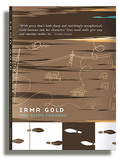
Irma Gold, Two steps forward

Irma Gold's Two steps forward Bookcover

Irma Gold's Two steps forward (Courtesy: Affirm Press)

Irma Gold’s* Two steps forward is, apparently, the last release in Affirm Press’s Long Story Short series. I have reviewed two others previously – Gretchen Shirm’s Having cried wolf and Leah Swann’s Bearings – but, before talking about this book, I must say how much I love the books themselves. I am starting to read eBooks. I recognise they are likely to be the future and they do offer advantages over print books. They take up less space, for a start. You can change font size to suit your eyes. And, eReaders have inbuilt dictionaries which can be useful when you are reading while out and about (or are just too plain lazy to get off your seat to find the dictionary). But, this doesn’t mean I don’t like print books – especially lovely ones to look at and hold like this Affirm Press series. I like their slightly smaller size and their simple, clear, modern design. The three I’ve read also have very stylish monochromatic covers. There’s little, in fact, not to like about them.

Now, though, the book. This is one of those short story collections, like Swann’s Bearings, that has its own title rather than one drawn from one of the stories within. I like that – and the title of this book, Two steps forward, is a particularly clever one, because of course it immediately calls forth the complete saying “two steps forward one step back”. This concept works well for the stories in Gold’s book.

Irma Gold is a writer and editor. She has been published in various journals, such as Meanjin and Island, but this is her first published collection. Well done her, because it’s an engrossing collection. Gold’s writing is clear and warm, and she demonstrates in this collection an ability to handle a range of voices and points of view. There are 12 stories in the book: five are told 1st person, two 2nd person, and the other five 3rd person. Her protagonists are mostly women, but there are a few male voices too. The stories could be described as “scenes from a life” (well, lives, really). Her characters include a single mother hoping for love (“The art of courting”), an empathetic woman working in a refugee detention centre (“Refuge”), a father experiencing his first access visit, after two years, with his 8-year-old daughter (“Tangerine”), an emotionally-neglected teen girl living in a caravan park (“Sounds of friendship”), an old homeless man (“Great pisses of Paris”), and so on. The characters are authentic. You know who they are, what they feel, and what they are confronting:

You notice how thin your lips have become, how the flash of greasy fuchsia looks almost crude. You pull at the loose skin on your neck, and the spongy puffs around your eyes filled with lines, the skeleton veins of a dead leaf. (“The art of courting”)

I want to touch him, but the space between us is fractured. (“Refuge”)

I compose sentences in my head, but none of them work. (“Kicking dirt”)

Says they can’t afford to waste cash on stuff they don’t need, though apparently alcohol is essential. (“Sounds of friendship”)

There’s a painful vulnerability to her characters, as they confront their particular challenges, such as visiting a terminally ill friend (“The visit”), facing a miscarriage (“The third child”), or trying to reconnect with a young daughter (“Tangerine”). Their lives are finely observed, so much so, in fact, that you feel you’ve been there – even if you haven’t. Their triumphs, when they have them, are hard won.

I also liked Gold’s use of imagery. It’s apt, evocative, and is not overdone or pushed too far – which suggests careful writing, good editing, or both:

 A day leaking away with a spill of apricot. Air stung with lavender. (“The art of courting”)

… and Abby catches the cold-barrelled words Mick fires at her mother. (“Sounds of friendship”)

But it was all icing slathered over stale cake. (“The anatomy of happiness”)

The tone doesn’t vary much, but this doesn’t spoil the experience. The stories, overall, have a somewhat melancholic air, as the characters struggle to keep a forwards momentum in their lives ahead of a backwards one. And, there are touches of humour (mostly wry) and some occasional irony (such as a reference to our anthem’s “boundless plains to share” in “Refuge”) that provide relief.

Endings are always hard … at least that’s what E. M. Forster told us in Aspects of the novel … but Irma Gold has handled them well. Keeping with the title, most of her stories have more hope than not – but none are fully resolved. Like life really.

Irma Gold
Two steps forward
Mulgrave, Vic: Affirm Press, 2011
(Series: Long Story Shorts, 6)
192pp.
ISBN: 9780980790474
Also available in eBook format

(Review copy courtesy Affirm Press)

* I was tickled to note in her Acknowledgements that Gold spent some time at Varuna Writers’ Centre.

Monday musings on Australian literature: Australian literary couples

Elizabeth Barrett Browning and Robert Browning

Elizabeth Barrett and Robert Browning (Unknown date and photographer, Public Domain, via Wikipedia)

Are you fascinated, like I am, by literary couples? It seems so romantic to share one’s calling with another … even if the reality is not always as idyllic or as successful as it sounds. We’ve all heard of Robert and Elizabeth Barrett Browning, Ted Hughes and Sylvia Plath, Virginia and Leonard Woolf, to name just a few famous couples. I’m guessing, though, that not many have heard of our Australian couples, but we do have them – and so this week I’m sharing five (from the past) with you.

Vance (1885-1959) and Nettie Palmer (1885-1964)

While Vance and Nettie Palmer are not particularly well-known now (at least to the best of my knowledge), they were extremely significant in their heyday, the 1920s-1950s, as writers, as proponents of Australian literature and as mentors for younger writers. Nettie in particular corresponded with and supported many women writers, including Marjorie Barnard (1897-1987) and Flora Eldershaw (1897-1956). They were literary critics and essayists. Vance was also a novelist (I read his The passage many moons ago) and dramatist, while Nettie was also a poet. They were political – egalitarian, anti-Fascist, and tarred, as were many back then, with the “Communist” brush! Their relationship seems to have been a productive and supportive one.

George Johnston (1912-1970) and Charmian Clift (1923-1969)

This is one of those troubled pairings, and it ended in the suicide of Charmian when she was not quite 46. They met in Australia, lived together in England and Greece (where they tried to live on their writing), before returning to Australia with their three children in 1964. Johnston wrote the highly successful My brother Jack, which some see as a contender for the Great Australian Novel and which is the first in a semi-autobiographical trilogy. Charmian wrote two successful autobiographies, Mermaid singing and Peel me a lotus. Both wrote much more across a wide spectrum: novels, essays and other journalistic pieces, short stories, and so on. Theirs was, in the end, one of the more self-destructive rather than mutually supportive relationships. Sad.

Ruth Park (1917-2010) and D’Arcy Niland (1917-1967)

Ruth Park (born in New Zealand) and D’Arcy Niland were more than a literary couple. They created a literary family, with two of their five children, twin daughters Deborah and Kilmeny, becoming successful children’s book writers and illustrators. I have written about Ruth Park before. She and D’Arcy worked as free-lance writers and shared a concern in their writings for the battlers in Australia. They worked hard to survive on their writing, turning their hands to a wide range of forms and genres, including novels, short stories, plays and journalistic pieces. They were, like the Palmers, a successful and happy couple until D’Arcy’s early death.

Rosemary Dobson (b. 1920) and Alec Bolton (1926-1996)

Rosemary and Alec were a little different from the other couples I’ve chosen to discuss here, but I’ve chosen them because they lived in my city, and I (ta-da) met and worked for a few years in the office next door to Alec. Rosemary Dobson is a significant Australian poet who associated with other major Australian poets like A. D. Hope and David Campbell. She has published around 14 volumes of poetry, edited anthologies, and translated poetry from French and Russian. Her husband was not so much a writer as a publisher. According to the AustLit* website he “was a creative force in Australian publishing for almost half a century. After his war service he worked as an editor for Angus & Robertson and Ure Smith before establishing the publishing program at the National Library of Australia”. He established one of those wonderful small presses, Brindabella Press, in 1972 while still working at the Library, and then continued working on it after his retirement. It was a labour of love, and among the authors he published was, of course, his wife!

Dorothy Porter (1954-2008) and Andrea Goldsmith (b. 1950)

Dorothy Porter, whose last book The bee hut I have reviewed here, is (was) another Australian poet. She lived with her partner, the novelist Andrea Goldsmith, for 17 years before she died through cancer in 2008. Goldsmith, whose latest novel The reunion I’ve also reviewed here, said in an interview after Porter’s death that “I’ve always loved Dot’s work – indeed I fell for the poetry before I fell for the poet”. Porter, who also wrote several verse novels, was more prolific than Goldsmith, but both produced well-regarded work during the course of their relationship. Another productive and successful pairing.

Some time ago I read an article about literary couples and the challenges they face: financial (supporting themselves from writing), space (finding room for each to write), and the big one, jealousy or competitiveness. I’m impressed that, despite such issues, four of the five couples I’ve described seem to have been remarkably successful – and this is beautifully exemplified by Ruth Park’s words at the end of her autobiography, Fence around the cuckoo:

We lived together for twenty-five years less five weeks. We had many fiery disagreements but no quarrels, a great deal of shared and companionable literary work, and much love and constancy. Most of all I like to remember the laughter.

After sharing five children and a rather insecure career, that’s pretty impressive.

I’d love to hear about other literary couples – Australian or otherwise, past or present – that you have come across.

* I have not provided a link to this site since most of its content is available by subscription only.