Monday musings on Australian literature: Some novels about the second world war

As I am still immersed in things paternal – and as my father served in the second world war – I thought that this week I’d take the easy way out again and list some of my favourite Australian novels about that war. Although I call myself a pacifist, I don’t shy away from war novels. The main reason is because in war we see humanity under duress and, through that, we see the best and worst of human behaviour. I love how the best war novels throw up the “truths” that I love to find in literature.

I’m going to list just 5 – though I’ve read more than that – in the order that I’ve read them. I’ve chosen these 5 not necessarily because I think they are the best (though I have enjoyed them all) but for the different perspectives they offer on the experience of war. (Note: the dates after the titles are not the dates I read them but when they were first published! Just so you know!)

Nevil Shute‘s A town like Alice (1950)

Nevil Shute was one of my favourite authors when I was a teen though when I read him now I see that he’s not as good a writer as my other teen passion, Jane Austen! Nonetheless, he was a good storyteller and many of his novels were adapted for film, including A town like Alice. It’s primarily a post-war romance, but the two characters, English rose Jean and rough diamond Aussie Joe meet when they are prisoners of war in Malaya, a story which is told in flashback. It’s a pretty stereotypical romance but the war, the English-Australian cross cultural story, and the Australian outback setting captured my teen heart.

Arnold Zable‘s Cafe Scheherezade (2001)

Café Scheherazade is set in, and based on, the real cafe of the same name. It was, from its establishment in 1958 to its demise in 2008, a significant meeting place for Jewish refugees who came to Melbourne post war. The novel tells the stories of the Cafe’s patrons – their lives in Europe, and how and why they came to Australia. It taught me something I hadn’t known before – that many Jewish refugees came to Australia via Shanghai. Zable’s prose is beautiful, and though the stories, as you can imagine, contain much tragedy, the final message comprises those universals of courage, endurance, love and even laughter.

Markus Zusak’s The book thief (2005)

Zusak’s The book thief is one of those rare books that pulls off telling a terrible story with humour. Its subject is an ordinary German family which fosters a young girl, and then hides, to their great risk, a young Jewish man. It’s a deadly serious book about bravery and cowardice, about kindness and cruelty – and yet it has, much of the time anyhow, a rather whimsical tone.

Hans Bergner’s Between sky and sea (1946)
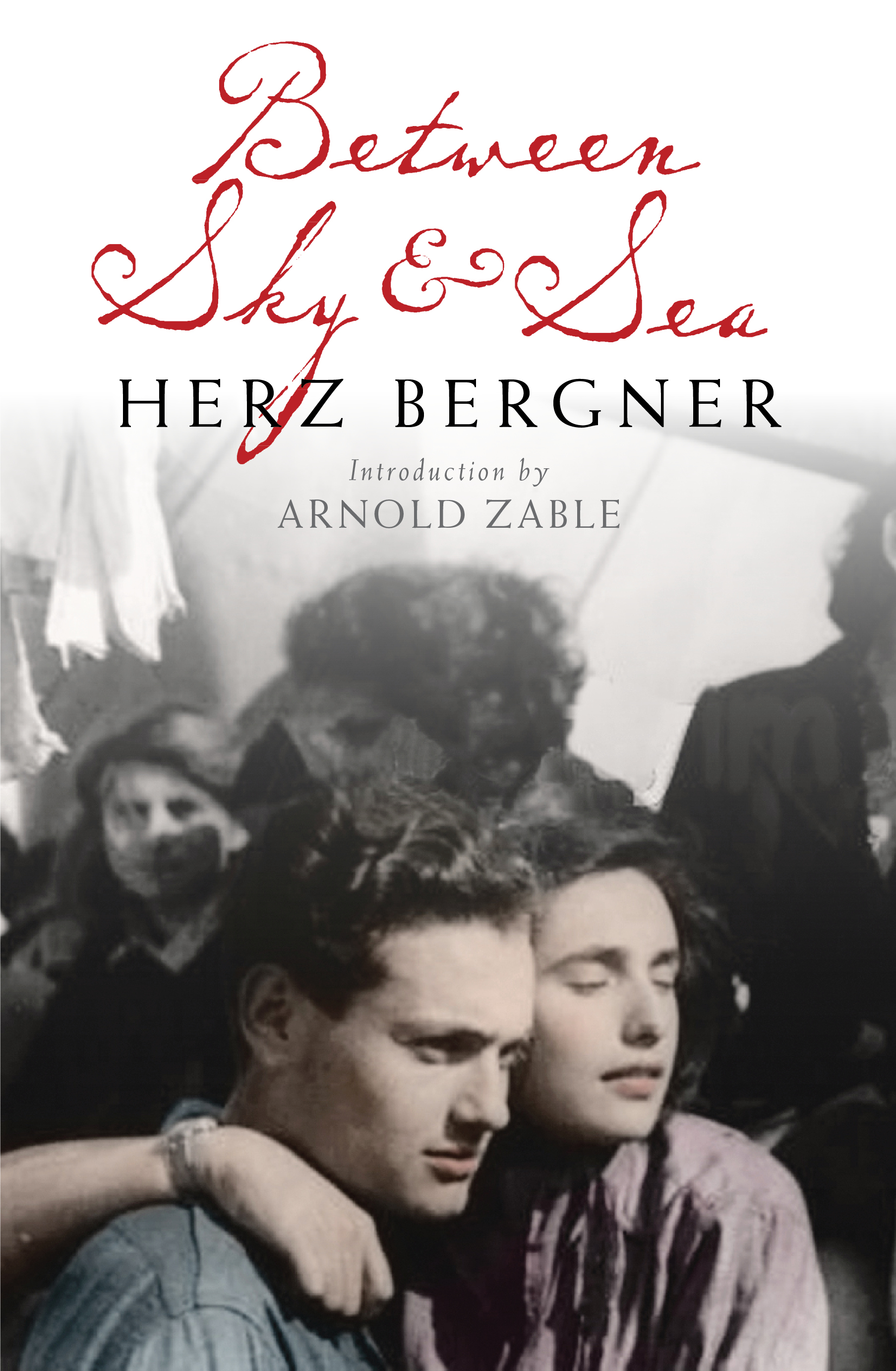
Hans Bergner, Between sea and sky

Bergner tells the opposite story to that told by Zusak. His characters are Jewish refugees fleeing Nazi occupied Poland on a boat – but no-one will let them land, no-one will take them in, the way the Hubermanns took in Leisl and Max in The book thief. It explores the impact of this, as the reality becomes clear to the boat’s occupants. It’s a pretty devastating story.

Alan Gould‘s The lakewoman (2010)

I started with a romance and I’m ending with a romance, but that’s where the similarity between the two books ends. Shute’s book has a pretty traditional trajectory – boy meets girl, boy loses girl, boy gets girl, more or less – against the backdrop of the war and early post war period. Gould’s story is far more complex – more realistic about life and character, with a touch of the mystical thrown in. Gould argues that his is not really a war novel because it’s not about the war. To a large degree that’s true, but in a sense it’s true of many books set in war. War is the setting, but the themes are often something bigger (universals about human behaviour) and smaller (about how particular people behave under stress). One of the issues Gould explores is how the promise of a person’s life can be thrown, not only by the things that happen to them but by the decisions they make as a result. And in war, a lot of things can happen to a person!

I’ve limited myself to 5 so am sure to have missed some favourites of yours. I’d love to hear whether you read war novels, Australian or otherwise and, if so, what your favourites are. If you don’t read them, you can tell us that too!

How’s this for a description of reading?

I was going to make this post another Delicious Descriptions, but decided it needed a more direct heading. It’s another quote from Kim Scott‘s That deadman dance and has been used by several reviewers of the book. But I think it needs a post of its own:

When Bobby Wabalaginy told the story, perhaps more than his own lifetime later, nearly all of his listeners knew of books and the language in them. But not, as we do, that you can dive deep into a book and not know just how deep until you return gasping to the surface, and are surprised at yourself, your new and so very sensitive skin. As if you’re someone else altogether, some new self trying on new words.

… and new ideas, emotions, ways of being, eh?

What say you to this? Do you you have a favourite description of reading?


Delicious descriptions from Down Under: Kim Scott on indigenous connection with the land

A short Delicious Description today from Kim Scott‘s That deadman dance, but an important one because it attempts to convey to we non-indigenous people just how closely indigenous people relate to their environment. It comes from the same expedition as my previous Delicious Descriptions post:

Sometimes Wooral addressed the bush as if he were walking through a crowd of diverse personalities, his tone variously playful, scolding, reverential, affectionate.

It was most confusing. Did he see something else?

Monday musings on Australian literature: Five fascinating fictional fathers

This week’s Monday musings has a personal, sentimental, genesis. Last Friday, my 91-year-old father underwent his third major abdominal surgery in 6 years. It’s a big ask for an older body but he’s hanging in there. My parents, not surprisingly I suppose, were instrumental in my becoming a reader. My mother introduced me to Jane Austen. My father would let me bring my “28 books” (why I thought there were 28 is lost in my childhood haze) to him in bed in the morning so he could read them aloud to me. It was also he who introduced me, through reading aloud again, to Banjo Paterson‘s ballads. I have a lot to thank my parents for – and my being a reader is one of them.

All this got me to thinking of fathers in literature, and particularly Australian literature. There are a lot of men – yes, really! – in Australian fiction, but how often, I wondered, is their role as fathers a feature of the writing? As it turns out, it’s more common than I thought, but I’ll just share five here.

Elizabeth Jolley‘s My father’s moon (1989)

My father’s moon is the first book in Jolley’s semi-autobiographical trilogy and, while it is really about Vera and her challenge to find a place in the adult world, the support provided by her father is critical in her life … and Jolley writes of it beautifully:

He always told me when I had to leave for school, every term when I wept because I did not want to leave, he told me that if I looked at the moon, wherever I was, I was seeing the same moon that he was looking at, ‘And because of this’, he said, ‘you must know that I am not very far away. You must never feel lonely,’ he said. He said the moon would never be extinguished. Sometimes, he said, it was not possible to see the moon, but it was always there. He said he liked to think of it as his.

Murray Bail‘s Eucalyptus (1998)

Eucalyptus is one of my favourite books. The writing is gorgeous and it explores fatherhood from a surprising angle – for a modern novel. It is in fact a rather traditional fairy story, with a modern twist. The father in Eucalyptus sets a task for his daughter’s wooers – they must be able to identify every eucalypt tree on the property in order to win her hand, but this modern father finds that managing his daughter’s future is not quite as easy as he thought. She might in fact want a say in it.

Joan London‘s The good parents (2008)

Joan London targets, among other things, the whole issue of parenthood by exploring three generations or so of parents and children. The central family is Jacob and Toni, with their two children, and Jacob is given reasonable “airplay” in his own right as he contemplates his missing daughter and his role as her parent, and along the way his relationship with his mother, Arlene. He wonders, as many parents do at some stage, whether the choices he made for his and his family’s life were the best ones for his children.

Steve Toltz‘s A fraction of the whole (2008)

The father-son relationship is the central idea of Steve Toltz’s big, loose, baggy monster of a novel as it explores Jasper’s rather typical desire to not be his father, the free-thinking-out-there Martin. After a rather wild ride in which Jasper learns many important things, he realises that he will never be his father, that he is the sum of more than one part.

David Malouf‘s Ransom (2010)

And then there’s Ransom, Malouf’s reimagining of Priam’s approach to Achilles to retrieve the body of his son Hector in order to give him a proper burial. The book has larger themes – about daring to dream, about humility, about the power of compassion, to name a couple – but at the heart of it is the love of a father for his son. Without that, there would be no book and we would have missed another beautiful read from Malouf.

This is a pretty quick introduction to some views on fathers in recent Australian literature, because my time right now is otherwise engaged – but I’d love to hear if you have favourite literary fathers. Who are they, and why do you like them?