Feng Shui, as most westerners probably know by now, is an important consideration in Chinese life. The correct placement of objects is critical to the well-being of those who live or come within the orbit of that object (which could be a bed in a bedroom, the house itself or, as in the case I raise today, a statue).
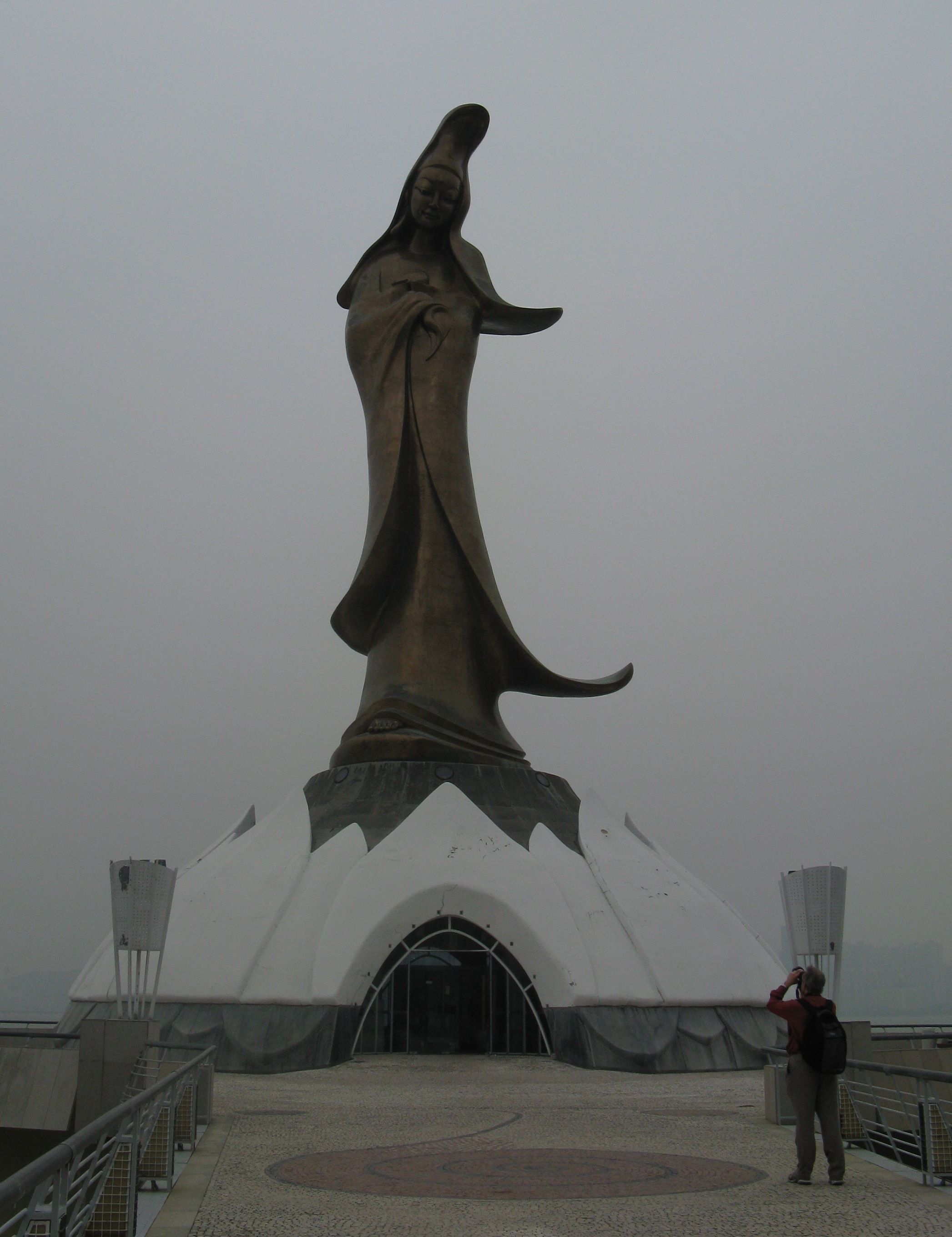
Guan Yin, Macau
Macau is the former Portuguese colony which was returned to China in 1999. It therefore has a fascinating blend of Chinese and European culture. I’m not going to go into long details about that now but thought I could convey some sense of it all through the example of the Guan Yin Chinese Goddess statue which stands by the Macau Harbour. She is, we were told, rather disliked by the Chinese of Macau. The reasons are:
- she faces the mountain with her back to the sea, which is the exact reverse of good feng shui (and where else would you need good feng shui but in the world’s gambling capital, eh?);
- she stands on a closed lotus flower but buddhas, bodhisattvas and other gods/goddesses are traditionally set on an open flower, which symbolises abundance and prosperity;
-

Chinese goddess? Or, Mary?
she looks more like Mary (that, is the Mother of Jesus) than a Chinese goddess; and, to add insult to injury,
-
she was created and built off-shore resulting in the megamillion dollars paid for her going off-shore.
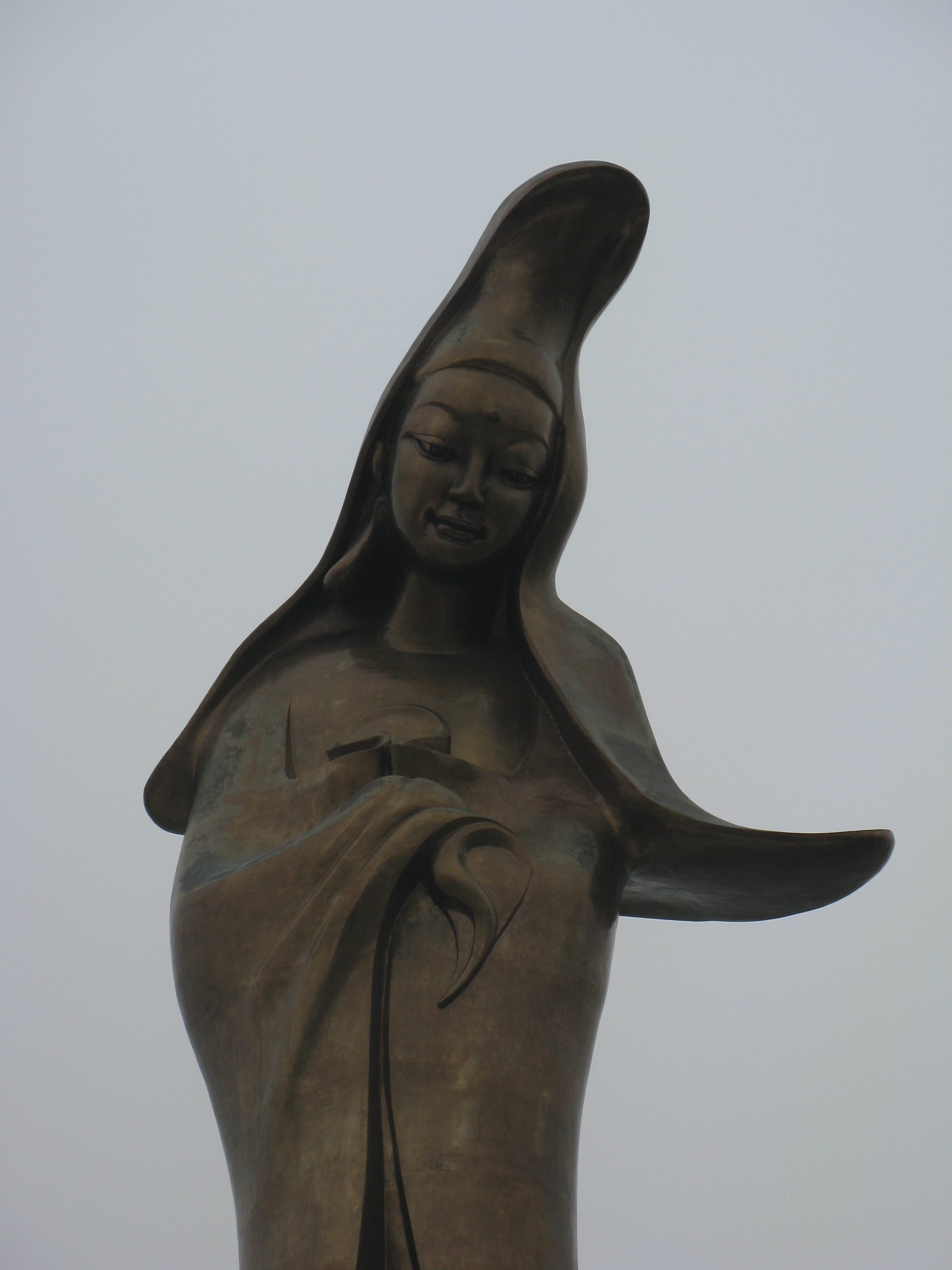
The things you learn when you travel. I have chosen this as my post to represent our week in Hong Kong/Macau because it reminded me of just how complex culture is and how important cultural knowledge is to our enjoyment and appreciation of the arts. It also demonstrates how easy it is to not quite get it right!
(Oh, and please excuse the photos. It was a grey old day in Macau so her gorgeous “bronzeness” was not well on display the day we saw her.)
 Whispering Gums
Fascinating! Macau is really the world’s gambling capital? I would’ve guessed that would be somewhere in the US. Also very interesting about her looking more like the Virgin Mary… funny how pervasive Western religion can be!
Well done you for posting during your trip, too – sore feet and all! 🙂
Why thanks, Hannah. Must say it was a struggle. Don’t know how you manage to do all your blogs on the little Netbook. As for Macau, it is a big gambling place and our guide said that, for example, last October Las Vegas made something like 4.8 million and Macau something like 5.4million putting Macau on top. And Macau is like Monaco in that there are no taxes because gambling covers all that. Meanwhile, back in HK, apparently the Jockey Club is the largest taxpayer here – it contributes about 13% of HK’s taxes. Gambling clearly pays!
I’ve become so used to it that normal big computer weird me out! And I’d tell all this baout gambling to the housemate, but for the fact that she’s in not-wanting-to-think-about-the-PhD mode at the moment!
P.S. I was trying to work on mine, but instead did a bit of creative writing. Should probably go to bed now though!
That’s an interesting post. Buddhists believe in reincarnation and that their deities will manifest in different guises at different times to help different people. Guan Yin is known in Tibet as Avalokitesvara Bodhisattva or Chenrezig. In this original guise, he is a man. It’s said he reincarnated as a woman in China since that form helped him to help more people there. His Holiness The 14th Dalai Lama is considered the current reincarnation of Chenrezig (see http://fng.sh/1b)
There are lots of writings by Buddhists and Hindus that say that Guan Yin, The Virgin Mary and Avalokitesvara are all the same holiness taking different forms to help different people. In fact one very famous book is Autobiography of a Yogi – http://amzn.to/csl4Gr – written by the first Indian Yogi to come to America. Pramahansa Yogananda talks about it frequently as well as where exactly did Jesus go during his time in the wilderness.
As for bad Feng Shui – do you think enlightened beings are subject to the same laws as us mere mortals? I guess we can only speculate but it was an interesting thought!
Thanks Angela for that elucidation on Guan Yin. I like what you say about holiness taking different forms. A lovely accommodating way to view it. As for your final question, I guess we can only speculate as you say … one could presume not but perhaps the point is how it is felt by the mere mortals? I’m no expert though!
You hit it right on the head with that! It’s about how mortals perceive the effect of it on the divine. Guan Yin is enlightened and having reached that state of non-duality the outside world does not bother the inside world. A famous Zen master called Hui Neng said of enlightenment:
“Since all is void, where can the dust alight?”
This is meaning that the mind is free of all worldly desires like grasping or aversion for an enlightened being. If one cares not for gain and is untroubled by loss, how can Feng Shui have any consequence? The statue is a reminder to the locals not to get sucked up in gambling if they wish to be beyond worldly problems. If the heart and mind is pure, one can face the worst situations and remain unaffected. Maybe it’s a bit like Jesus being crucified and rising? It seems in many cultures and places the thing divinity points to is that the only thing we should truly fear is losing our minds to the uncontrolled emotions that pour from the human heart.
Methinks the numbers are billions, not millions of dollars!
You’re probably right … I couldn’t quite remember. Is “mega” good enough to convey it’s a lot do you think?
What interesting comments you received on this post – far more about the topics than I knew. The David Mitchell Booker shortlist book has some scenes set in Macau – The Thousand Autumns of Jacob de Zoet
Sorry not very active at the moment. My computer time is being taken up with some real-world tasks at the moment.
Thanks Tom. It’s really nice that you found time to pop by, as I do understand your reduced activity at the moment. Must say that I had forgotten the Macau scenes in Jacob de Zoet…thanks for reminding me.
Beautiful statue even if her feng shui is all goofed up.Fascinating pieces of information. I am glad you had a good time in Hong Kong, at least it seems like you did!
Thanks Stefanie … and yes, we did have a good time. Intriguing place, and a lot to see and do.
Hello Whispering Gums, I came across your blog via the “freshly pressed” button and am very glad I did. Because your blog has a book focus and because you’ve recently been touring Hong Kong I thought you might enjoy reading Martin Booth’s Gweilo. It’s a memoir of his childhood growing up in Hong Kong in the early 1950s. It’s interesting and well written.
As well, perhaps you’d enjoy reading a short article I had published recently about my own trip to Macau. My editor forbade any mention of casinos or Portuguese culture and I was quite glad of that. To find it check out my blog (shelaghplunkett) and hit “The Real Macau” under the blog button. I hope you enjoy it.
Thanks Sheila for popping by. You know, I nearly bought Gweilo at Page One bookshop while I was in HK, but jsut bought Lee’s novel The piano teacher. I will seriously think about buying Gweilo though as yours is not the only recommendation. And I will check out your Macao article in the next couple of days.
Pingback: Success Stories « Vasilestoica's Blog
Pingback: Fng shui | Jbugdesigns