Salman Rushdie, The enchantress of Florence

The enchantress of Florence by Salman Rushdie

Cover image, used by permission of The Random House Group Ltd

Where to begin? Salman Rushdie’s latest novel, The enchantress of Florence is one of those books-writ-large: its canvas is broad, its structure a little complex and it has a large character set. In other words, you need your wits about you as you read this one.

This is only my third Rushdie. Like most keen readers I read and enjoyed Midnight’s children, with its inspired exploration of the partition of India. I also loved his cross-over children’s book Haroun and the sea of stories. It is a true laugh-out-loud book. In fact, as I started this book I had a flashback to Haroun, not so much because of the subject matter but the light rather satirical if not downright comedic tone. It is very funny at times, particularly in the beginning.
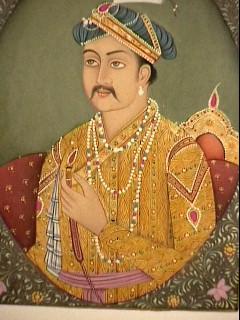
Akbar the Great

Akbar the Great (Courtesy: Wikipedia, Presumed public domain)

The novel is set in the 16th century and revolves around the visit of a young Italian, the so-called “Mogor dell’Amore” (Mughul of Love), to the Mughal emperor Akbar‘s court and his claim that he is a long lost relative of Akbar, born of an exiled Indian princess (Qara Köz) and a Florentine. The story moves between continents, with “Mogor’s” story about his origins in Medici Florence being told alongside that of Akbar’s court. The book is populated with a large number of historical figures – and at the end of it is an 8-page (my edition) bibliography of books and web-sites Rushdie used to research his story. They include social, political and cultural histories as well as fictional works such as Italo Calvino’s Italian folktales. One could wonder, at times, whether it’s a little over-researched, but perhaps that would be churlish.

The next question to ask is, What sort of novel is it? Is it historical fiction? Well yes. Is it a picaresque novel? Yes, a bit. Is it a romance? That too, a bit. Is it a comedy? Certainly. Is it a fable? Could be! What it is, under all this of course, is postmodern.

If I had to use one word to describe this book it would probably be paradoxical. On the second page of the story, the bullock cart driver who brings the stranger (our “Mogor”) to town, describes his passenger in these terms:

If he had a fault, it was that of ostentation, of seeking to be not only himself but a performance of himself as well, and, the driver thought, everyone around here is a little bit that way too, so maybe this man is not so foreign to us after all.

And thus the scene is set for a rather rollicking tale about people who either aren’t all – or don’t seem all – quite real, who play games with each other, who are perhaps more alike (“not so foreign”) than they are different, and who manipulate, fight, love and hate each other as they struggle to find (or understand or establish) their place in the world. In fact, at the end of the first chapter the sort of paradoxical story we are embarking on is made clear:

The visionary, revelatory dream-poetry of the quotidian had not yet been crushed by blinkered prosy fact.

In other words, as you read this book, keep your wits about you! And that is, I admit, what I found a little hard to do as stories, people, and ideas were thrown at me…and then taken back and thrown at me a different way. As I read books I tend to jot notes on the blank page/s you usually find at the end. My notes on this one are all over the place: Love, Power, Names and their mutability, Truth, Religion and Faith, Imagination and Reality, Stories, Nature of men and women, East versus West, and so on. The question now is, Do any of these tie together or form a coherent thought upon which to hang the book? I think there is, and it is to do with ideas surrounding imagination and reality. In Chapter 3, for example, we learn of Akbar’s love for Jodha, the woman he has conjured up for himself:

She was an imaginary wife, dreamed up by Akbar in the way that lonely children dream up imaginary friends…and the emperor was of the opinion that it was the real queens who were the phantoms and the nonexistent beloved who was real.

Their love is called “the love story of the age”, and the chapter talks about the border between “what was fanciful and what was real”. Love, and its power, is one of the driving forces of the novel, and, without giving anything away, the ending more or less unites the two ideas: the power of love, and the conjunction of imagination and reality.

But, truth be told, I’m having trouble writing about this book…and I think this is because, for me at least, it started off with a flourish but got bogged down, particularly when we moved from India to Florence. That said, it picked up again near the end. Here is Akbar in the last chapter:

Again, at once, he was mired in contradictions. He did not wish to be divine but he believed in the justice of his power, his absolute power, and, given that belief, this strange idea of the goodness of disobedience that had somehow slipped into his head was nothing less than seditious. He had power over men’s lives by right of conquest … But what, then … of this stranger idea. That discord, difference, disobedience, disagreement, irreverence, iconoclasm, impudence, even insolence might be the wellsprings of good. These thoughts were not fit for a king.

The word I used earlier in this review to describe this book was paradoxical and this is because almost every “truth” presented within its pages is met by an equal but opposite “truth”. And perhaps that is the biggest truth of all!

Salman Rushdie
The enchantress of Florence
London: Vintage, 2009
355pp.
ISBN: 9780099421924
Simon Armitage’s The odyssey

Mostly when we travel we listen to the radio or music, but on our recent trip we listened to a 3-CD dramatisation of Homer’s The odyssey. The set was lent to us; the dramatisation was done by poet Simon Armitage for BBC-4. As my friend who lent it to us said, you need to get used to the British accents telling an ancient Greek story in modern idiom, but once you get used to that…well, this is a pretty good way of familiarising yourself with (or reminding yourself of) Homer’s work.

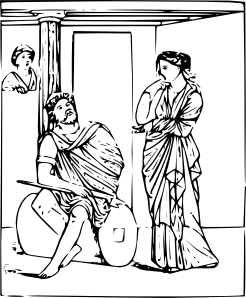
Odysseus and Penelope

Odysseus' return (Courtesy: OCAL @ clker.com)

The odyssey of course is Homer’s (ignoring here discussions of authorship) telling of Odysseus’ long journey home to Ithaca from the Battle of Troy. Armitage’s version begins with Zeus and Athena arguing over Odysseus’ fate and these two link the different phases of the story as we progress through them. This version essentially follows the sequence of the original but is pretty fast and furious, focusing mostly on the action and drama of the story…and that did, I must admit, get a little tedious for  a while around the middle of the production.

In other words, not much time is given for dwelling on the nuances or underlying themes…and there are many themes to explore in this work, including cunning and courage, fidelity and trust, the power of the Gods (in ancient Greek life), loyalty and greed. Some of the “truths” ring a little strange to our ears. Not only do we (most of us anyhow) no longer believe that our lives are at the mercy of the Gods, but there is also the old double standard: Penelope remained faithful while Odysseus had his flings. But other “truths” – the role of cunning, courage and loyalty in survival, and the vice of greed and gluttony, for instance – still work today, albeit in different settings.

I was intrigued though by Armitage’s allusions, such as the Bible’s “stranger in a strange land” (The Book of Exodus, King James’ version) and Shakespeare’s “screw your courage to the sticking-place” (Macbeth). But then, I guess literary allusions are as valid in adaptations as they are in original works?

There’s not much more I want to say about the adaptation: it’s fun, it’s well performed and it usefully and entertainingly recounts a classic tale. I’d recommend it on those counts.

The odyssey – Homer (Audio)
Adapted by Simon Armitage for full-cast dramatisation
BBC Audiobooks, 2004
3 hours running time

POSTSCRIPT: In the interests of maintaining synchronicities, a month or so ago I reviewed Arnold Zable’s Sea of many returns which focuses on Ithaca, and its literal and mythological contexts of “home”.

Hedonistic hiking

Dead Horse Gap, Kosciuszko National Park

Above the treeline, Dead Horse Gap, Kosciuszko National Park

“Hedonistic hiking” is the title of an article in a glossy little (“free at selected tourist outlets in Australia” but otherwise  $24.95pa) magazine I picked up in Melbourne a couple of months ago. The mag is called essentials magazine: culture, culinary, adventure. Can you tell me how the word “culinary” fits in there syntactically? The issue I picked up (free at some selected outlet obviously) was its – and I quote – “issue 15 mid-spring ‘Chrissy issue’ 2009” edition. What is that? Who is this magazine geared to? Anyhow, the article is essentially (ha!) a promo for gourmet hiking tours in Europe. It caught my eye though because it’s a term that could apply to our annual Thredbo sojourn. We are not campers – and we don’t eat gourmet food on our walks. Rather, we love to bushwalk and then go out and eat (well). Thredbo caters for this predilection of ours in a setting that is both beautiful and compact. We arrive, park our car, check into our lovely studio apartment with its view of the mountains, and then walk and eat to our heart’s delight.

But of course, there is more to this area than hedonism and hiking. Thredbo is in the Snowy Mountains of Australia, the mountains famous for AB Paterson’s “The Man from Snowy River” and Elyne Mitchell’s Silver Brumby series of books to name just two cultural icons from the region. Nearby is the town of Jindabyne, the setting for the rather gut-wrenching Australian film of the same name. It was loosely adapted from a Raymond Carver story titled “So much water so close to home”. As lovely as the mountains are, wireless connection here is iffy so I shall sign off, sit back and sip my Chardonnay while I enjoy the sun setting on Crackenback.

POSTSCRIPT: And there are nods to the cultural heritage here, such as Banjo Drive and the Silver Brumby Lodge in Thredbo, and the Man from Snowy River Hotel in Perisher. It’s rather subtle though – the hints are there but it’s not overdone. And there’s nothing wrong with that in a place that wears its commercial side rather lightly too.

On outdated books

Most readers at some time or other confront the issue of “datedness” in literature. This book is “dated”, we say. The funny thing is that what seems dated to one person is often not so to another. So, what do we mean when we say a book is dated?

The writer Fran Lebowitz is very clear about what she means by it. In a short documentary titled The divine Jane:  Reflections on Jane Austen that was produced last year for The Morgan Library and Museum’s exhibition A woman’s wit: Jane Austen’s life and legacy, she says:

Any artist who has that quality of timelessness has that quality because they tell the truth. Jane Austen’s perceptions don’t date because they are correct, and they will remain that way until human beings improve themselves intrinsically, and this will not happen.

She argues that those works which date do so because “their ideas are wrong” not because the details date. All details date she says. This has got me pondering. How often do we argue that a book is dated because of the “details” – because of their language, or lifestyles, or values?

Old books

Old books (Courtesy: OCAL @ clker.com)

It’s easy with non-fiction to identify datedness: look at this blog with its “hilariously outdated books of the week” posts. With non-fiction it really is mostly a case of the details – in some way – being wrong. The website, Education World, discusses outdated books and reports on one librarian’s “shelf of shame”. This librarian, and others, would rather have no books than outdated books. “Outdated books”, they say, “give children misinformation … we betray children when we put outdated information on our shelves”. “Outdated books keep stereotypes alive”, they say. All this is largely true, but – and here is the rub – they also say:

If you don’t have nice new books that kids want to read, they won’t read. We’re trying to get children to read more.

This feeds into other notions of being outdated, doesn’t it? Today’s children for example may not want to read my old version of The lion, the witch and the wardrobe because it “looks” old, it doesn’t accord with modern book design. They will however read a new edition, one that looks like books of their generation. I wonder if it was always thus? Once upon a time books were so precious, people read whatever version/edition that was available. But, perhaps, these people were readers anyhow, perhaps back then there were many who didn’t read and these are the people today’s librarians are trying to reach?

Enough digression, back to Lebowitz. I think about CJ Dennis’ The moods of Ginger Mick which I recently reviewed. I was initially not very keen to read it because it has, I admit it, always seemed old-fashioned, dated, to me. Its language is certainly dated – in the way that slang quickly becomes so – and the life it chronicles is certainly dated. Some of its values are too – its style of blokiness, its general attitude to race and gender – and yet despite all this it is I think also timeless. It’s timeless because it deals with humanity – with fear and bravery, with our misconceptions about each other based on superficial things (such as class) and our realisation that underneath these superficialities is what really makes a person worth knowing (such as loyalty and “grit”), with, in fact, our discovery of self. As Ginger Mick says in one of the poems:

Sometimes a bloke gits glimpses uv the truth.

Isn’t this why most of us read?

So, what do others think about datedness in literature? Is it enough to “tell the truth” as Lebowitz says – or can a truth-telling book be dated?

Top non-fiction of 2009

Is it cheating to do separate lists for fiction and non-fiction? Some people list their top books regardless of form or genre, while others created separate lists. I’m going to do the latter because – well, because I get to choose more books for a start. Actually, I didn’t read a lot of non-fiction this year so my top non-fiction titles will almost be all the non-fiction I read. As with my top fiction, I am listing them in the order I read them.

I didn’t nominate a top fiction for the year, but I’m going to here – and it is the one I read before I started blogging: Chloe Hooper’s The tall man and so I’ll do a little mini-review of it now.

Chloe Hooper’s The tall man

In a nutshell the book, which is best described as “true crime”,  chronicles the fallout that results from the death in custody on Palm Island of indigenous man Cameron Doomadgee, fallout which includes the autopsy report and ensuing riots, and the homicide trial of policeman Chris Hurley. Hooper explores the awful disconnect between people in the communities involved, between white and black, and within the white and black communities. She shows how women (particularly those on Palm Island) are caught in the middle. They believed the policeman killed Doomadgee but, when the riot occurred, they didn’t want the police gone because “who will protect us from the men”.

Throughout the book, Hooper manages to bring what is a very complex situation into rather clear focus…showing, not surprisingly, that in the end it’s the whites who have the power. For example, she attends a police rally organised to support Hurley and notes how they, the police, were fashioning themselves as victim. She comments that “measured against two hundred years of dispossession and abuse, the idea is fantastic, but no-one in that hall was thinking about historical relativities”! This point regarding “historical relativities” is well-made: this is not simply a case of white devil versus black angel, but we know where the real “victimhood” lies. The book also touches on the notion of power corrupting – or, questions at least how police officers are chosen and trained in the first place.

Hooper manages to walk a fine line. You know where her sympathies lie (particularly as the book progresses and she teases out the evidence) but she takes an analytical approach encouraging her readers to also do so. This begs comparison with Helen Garner who takes a far more heart-on-sleeve approach to her subjects in her books, The first stone and Joe Cinque’s consolation.

Finally, she makes an important point when she describes Hurley’s trial as “a false battleground”. Truth and justice – those universal concerns – do need to come out, but the trial is not going to solve the underlying problems. The tall man is a highly readable book about some significant concerns (for Australia at least)…and, in my mind, well deserves the awards it has won. I have only one quibble with it: I wish it had an index!

POSTSCRIPT: Thea Astley also dealt with troubles on Palm Island in her novel The multiple effects of rainshadow. It deals with the event which occurred on Palm Island in 1930 when the supervisor at the time ran amok and killed his children, something which Hooper refers to in the book when she provides a little rundown of Palm Island’s history.

Chloe Hooper
The tall man: Death and life on Palm Island
Camberwell: Penguin Books, 2008
276pp.
ISBN: 9780241015377