Bran Nue Dae

Broome

The gorgeous colours of Broome

You could hardly get two more different films than Warwick Thornton’s Samson and Delilah and Rachel Perkins’ Bran Nue Dae. Both are directed by indigenous Australians and both address indigenous Australian issues but, wow, how differently they do it. While Samson and Delilah is spare and almost without dialogue, Bran Nue Dae is exuberant and highly verbal. Of course it is, it’s a musical set in 1969.

There’s nothing I would rather be
Than to be an Aborigine
and watch you take my precious land away.

You have to see it to fully appreciate the contrast between the joyful (in fact cliched-musical-style) presentation of this song and the sting in its tail. Bran Nue Dae started life as a set of songs written by indigenous Australian musicians about growing up in Broome in the 1960s. Some time later, these musically eclectic songs were transformed into a musical that was a hit at the Festival of Perth in 1990. Rachel Perkins has apparently long wanted to adapt it for film. I have not seen the original play and so cannot comment on how the film compares with the original. Others can do that if they wish: I’m not always convinced that it is a worthwhile exercise to compare originals and their adaptations. Judge each work on its own terms is, I think, a better policy.

Briefly, the plot. Willy’s devout mother has scrimped and saved so he can go to boarding school in Perth and train to be a priest, but Willy (newcomer Rocky McKenzie) has met a girl (Jessica Mauboy), in his hometown of Broome, and is not so sure that priesthood is what he wants. Following conflict with the school’s priest (Geoffrey Rush), he heads back home from Perth, more or less under the wing of newly met Uncle Tadpole (Ernie Sigley). They obtain a ride with a hippie couple (Missy Higgins and Tom Budge), and the rest as they say is …. The encouraging thing about the film is that it celebrates our similarities (this is, after all, a coming-of-age story) while at the same time recognising significant differences (specifically the cultural dislocation experienced by indigenous people).

Comedy always seems to me to be a little tricky to review. There is such a fine line between being funny and being cringe-making. This film has the odd awkward or cringe-making moment – it verges on vaudeville and has its share of stereotypical if not downright cliched scenes. But these moments are few – and in fact they are, I’m sure, self-consciously there. Perkins wants us to make the connections between traditional musical comedy and her movie so that we can see its subversiveness – and it is subtly (or not so subtly) subversive. I found it genuinely funny – but with enough satire and moments of pathos (such as the references to deaths in custody) – that I got the message as well.

This film is at the other end of the black-white dialogue in Australia from Samson and Delilah. It is also starkly different from Rachel Perkins’ other musical (but definitely not comedy) film, One night the moon, which deals tragically with the refusal to engage in dialogue. It too is a spare film. These are both great must-see films, but it is also good to see humour being used in this important but mostly oh-so earnestly explored area.

And so, if you like to have a laugh – but with a little bite in it – go see Bran Nue Dae.

Geoff Page, The scarring

Geoff Page (born 1940) is a Canberra-based poet who has been active in the Australian poetry scene for many decades now. He was also, for nearly three decades, an English teacher. Page has published several volumes of poetry and at least three verse novels, of which The scarring is his first.

The scarring, which I read a few years ago but have been wanting to review here, is, I have to say, one of the most gut-wrenching works I have read. Page has set it in the landscape – rural northern New South Wales – of his childhood and says it was inspired by rumours he heard as a child (but it is not a “true” story). The story spans around seven decades from the 1910s to the 1980s, and chronicles the lives of a couple from their youth and courtship through to old age. As the blurb on the back cover says, “their separation through war sows the seeds of their eventual destruction”.

One of the things I love about the book is the way Page weaves so much of the social and political history of twentieth century Australia through the lives of this couple – war, the Great Depression, the boom of the 1950s, city versus country life and values, and of course gender inequity and the old double standard! The scene is set from the first line:

Breed em tough, the old man says.

Little do we know what lies beneath this seemingly innocuous opening – and I’m not about to give it away to you now. Let’s just say that Page deftly weaves the breeding motif through his tale of a young couple running a cattle property.

Here is an example of how history is told alongside life on the farm:

the new white stiffness of the sheets
where Sally will be his forever

‘Forever’ moves on two years more.
The set of skills they share between them
shoves them sideways from the news:
Sudetenland, then through to Munich,
Kristallnacht and into Prague.
It rattles in through bakelite
and once or twice on Cinesound
showing at the flicks in town,
that lifted arm and square moustache
relishing a massed salute.

And so the story moves on to its more or less inevitable – given the events that occur – conclusion. This is not flowery poetry. Page tends more to a spare style that is well suited to his setting and subject.  The poetry’s insistent rhythm draws you on, and Page’s use of repetition slowly but subtly builds up the tension. This is a novel that you’ll want to read in one sitting.

Page is, I think, a little too unsung … but then, isn’t that the case with most poets?

Geoff Page
The scarring
Alexandria: Hale & Iremonger, 1999
111pp.
ISBN: 0868066826

John Muir, A wind-storm in the forests

Giant Sequoia, Yosemite

Giant Sequoia, in the Sierras

Being rather partial to trees, I could not resist reading “A wind-storm in the forests” by Scottish-born American naturalist/enviromentalist John Muir (1838-1914) when it lobbed in by email today as this week’s Library of America story of the week. Anyone who has been to the stunning Yosemite – or visited the peaceful Muir Woods north of San Francisco – will have heard of John Muir.  Not only was he responsible for preserving many wilderness areas including of course Yosemite, but he founded the Sierra Club, an environmental organisation that remains today.

“A wind-storm in the forests” is more essay than story, but perhaps it is best described as a mood-piece: it uses a lot of musical imagery, not to mention sea imagery, religious imagery, and any other imagery that suits his purpose. And that purpose? To convey the grandeur and timelessness of the forests he loves and wants to protect. The story commences with a discussion of trees in the Sierra and how they variously respond to the wind, and then moves onto a description of a particular wind-storm during which he climbed a 100 ft Douglas Spruce to experience the storm first hand:

I kept my lofty perch for hours, frequently closing my eyes to enjoy the music by itself, or to feast quietly on the delicious fragrance that was streaming past.

Muir’s is a typically nineteenth century Romantic sensibility, and his prose is of the purple variety – but gorgeous for all that in its patriotic passion for the trees (“we are compelled to believe that they are the most beautiful on the face of the earth”) of the Sierras:

The waving of a forest of the giant Sequoias is indescribably impressive and sublime, but the pines seem to me to be the best interpreters of winds. They are mighty waving goldenrods, ever in tune, singing and writing wind-music all their long century lives.

AND

…the Silver Pines … wave like supple goldenrods chanting and bowing low as if in worship, while the whole mass of their long tremulous foliage was kindled into one continuous blaze of white sun-fire.

All eight pages or so are written in idolatrous prose like this. According to Wikipedia, Muir found writing hard, feeling that words were not really up to the task. Whether the problem is words or Muir himself, the prose is a little heavy-handed – and yet how wonderful it is to have the writings of such a man. We would, I think, have been the poorer without a written record of his passion.

POSTSCRIPT: Apologies to my Australian readers. I have no idea why, on Australia Day, I have chosen to write about American trees! I will, however, write one on a lovely book of Australian trees soon.

Vale Kate McGarrigle

Kate McGarrigle

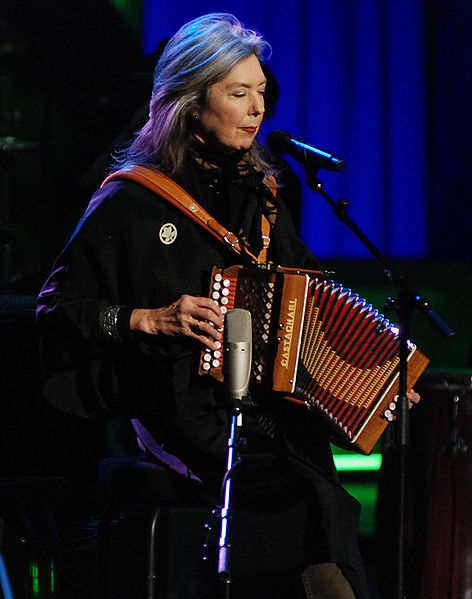
Kate McGarrigle, 2008 (Courtesy: Dfrancois, via Wikipedia, under CC-BY-3.0 Unported)

Last week I read on Cat Politics’ blog that Kate McGarrigle – one part of the Kate and Anna McGarrigle duo – had died just shy of her 64th birthday. How very sad. Like Cat Politics I discovered the McGarrigles in the 1970s, and over the years have acquired a few of their albums:

All wonderful. For those rare ones of you out there who don’t know them, they sing, write songs, and play instruments. Kate was married to musician Loudon Wainwright III (who wrote that silly fun song of my youth, “Dead skunk in the middle of the road”!) and is mother to musicians Rufus and Martha Wainwright. Oh, and they are Canadian.

And like that other wonderful contemporary Canadian singer-songwriter, Leonard Cohen, Kate and Anna are poets. I know that’s a bit simplistic – most songs can be seen as poetry (or at least as verse!) – but Kate and Anna’s words (with sometimes unusual rhythms) and music, in songs like “Heart like a wheel” (Anna) and “Talk to me of Mendocino” (Kate), have a plaintive beauty that resonates long after the song is over. Add to this their mesmerising voice tones and lovely harmonies and you have the whole package.

There are many obituaries out there and so I am not going to ramble on but, for those interested – and who haven’t seen it already – here is a link to Kate and Anna singing “Heart like a wheel” in 1990.

And let the sun set on the ocean
I will watch it from the shore
Let the sun rise over the redwoods
I’ll rise with it till I rise no more

(Talk to me of Mendocino, Kate McGarrigle)

Australia Post’s new set of Living Legends

Australian Legends of the Living Word, stamps

The six on the stamps (Courtesy: Australia Post)

Does the choice of writers for Australia Post’s Australian Legends of the Written Word look a little one-sided to you? Here is the list:

The Guardian books blog – Australian writers’ stamps send the wrong message – suggests so, and has a bit of a discussion going on the topic. I’m inclined to agree. I was trying to list the 6 recipients for my co-diners at lunch yesterday and, having remembered a few, started running through other possibilites. Helen Garner? No, I’m sure she wasn’t there. Alexis Wright? No. Kate Grenville perhaps? No. And so on … you get the drift. Personally, I’d have Bryce and Colleen outta there, and would have instead some of the names I’ve mentioned – or any of the many others I could think of. But then, this is “legends” and I suppose Bryce and Colleen have earned that right if only by dint of their recognition in the popular imagination of Australians who buy their books by the droves. Who am I to argue with that?

And just for a different approach to the topic, Australian ex-pat journalist and bookblogger in London, kimbofo at Reading Matters has asked her readers who they would choose for British authorial legends. You might like to think upon that too…

Don DeLillo, Midnight in Dostoevsky

Do reading synchronicities affect our comprehension? Well of course they do, since everything we do affects our comprehension to some degree doesn’t it? Anyhow, I have just read Don DeLillo’s short story, “Midnight in Dostoevsky” (you can read it here), and, as I read it, I couldn’t help bringing to mind Salman Rushdie’s The enchantress of Florence. Whether that’s valid or not is, I suppose, up to others to decide.

The plot concerns two college boys who spar, who indeed become disconcerted if they concur:

This was not supposed to happen – it unsettled us, it made the world flat – and we walked for a time in chagrined silence. Even in matters of pure physical reality, we depended on a friction between our basic faculties of sensation, his and mine, and we understood that the rest of the afternoon would be spent in the marking of differences.

At the beginning of the story the two boys see a man, and they start sparring about him. It starts with what sort of coat he is wearing but, over time, moves into less apparent things such as where he’s from. Interspersed with this are other scenes, including a few from their Logic class. Are you starting to get the connection with Rushdie? It’s the imagination-reality nexus I’m thinking about…the point where imagination and reality meet and merge.

Russian Ushanka Hat

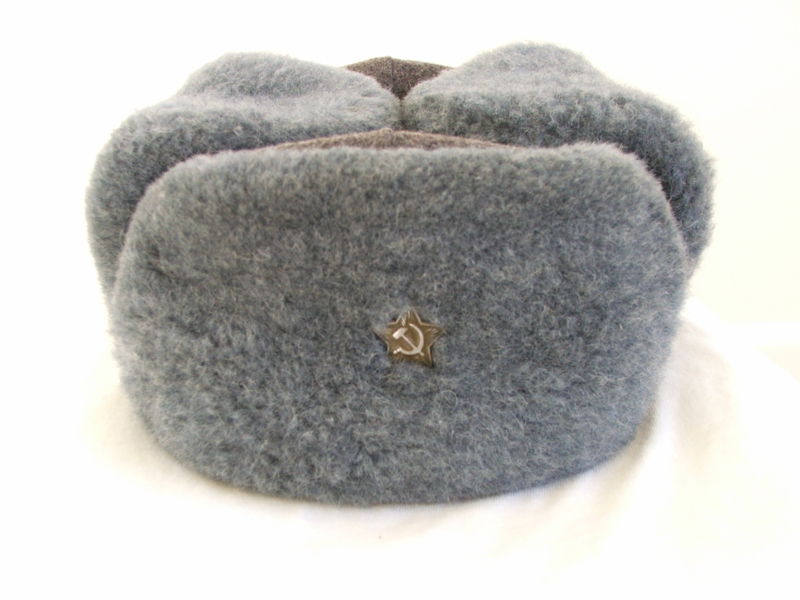
Russian Ushanka Hat (Courtesy: Eugene Zelenko, via Wikipedia, under CC-BY-SA-3.0)

It’s a gorgeously ironic tale, with the boys attending a very dry Logic class (in the evocatively named Cellblock) taught by the rather inscrutable Ilgauskas “who was instructing us in the principles of pure reason … he challenged our reason for being, what we thought, how we lived, the truth or falsity of what we believed to be true or false”. This class nicely counterpoints the flights of fancy the boys engage in when they are alone:

“Think of the hat he’d be wearing if he was wearing a hat,” I said.

“He’s not wearing a hat.”

“But if he was wearing a hat, what kind of hat?”

As I said, this is a story about imagination versus reality… The boys’ fascination with the man continues, as their imaginings become more and more intense (but never moves into actual fantasy the way Rushdie does in his novel).

“Feel the air. I say minus nine Celsius.”

“We’re not Celsius.” [narrator]

“But he is, where he’s from, that’s Celsius.”

That did make me laugh – fiction becoming, in a sense, reality for a while!

We then discover that Ilgauskas reads Dostoevsky (“day and night”) and so our narrator starts to read Dostoevsky too, finding it “magical” that the book which he leaves open at a page in the library is there the next day, open at the same page. In a great leap, he decides that the man is Russian, and that Ilgauskas is his son. His friend Todd says, “Does he have to be Russian to read Dostoevsky?”. Our narrator answers:

“That’s not the point. The point is that it all fits together. It’s a formulation, it’s artful, it’s structured.”

Wow, is this DeLillo’s fiction manifesto? I love it and I love the way this fiction manifesto also works for reason and logic, even though Ilgauskas says that “we  invented logic to beat back our creatural selves”. Creatural? A lovely bit of wordplay: one dictionary provides several meanings including “a living being” and “an imaginary or fantastical being”; another dictionary says “anything created” and “an animate or living being”. Now, that word packs a punch in this story!

The story continues, with the inevitable desire to check the reality of their fiction…but I won’t give any more away. Suffice it to say that this is one delightful and very intelligent story, well worth the read.

(Oh, and as for reading synchronicities? It’s quite possible that had I not just read the Rushdie, I might have come at the story from quite a different angle, such as looking at the relationship between the two boys – but I’ll never know now!)

Leslie Geddes-Brown, Books do furnish a room

Book stacks

Book stack - part of the TBR pile

There was no resisting this book – Books do furnish a room – when I saw it on a table in the National Library of Australia’s bookshop. It’s rare for me to buy a coffee-table book but … this is one gorgeous book. It is lavishly illustrated with images of books in pretty well every room or area of a house from bathroom to bedroom, from stairwell to kitchen. It’s enough to make a booklover drool.

But, what really sold it to me was that, amazingly, it even has an example that justifies my practice shown right: “Surprisingly” says Geddes-Brown, “it is found in a home belonging to a former editor of South African House & Garden … his excuse is that he had no bookshelves and just piled books against his bedroom wall”. Love it! He can visit my house any time.

In her introduction Geddes-Brown, former Deputy Editor of World of Interiors and Country Life magazines, writes:

So books do furnish a room – but not always very well. This book, with images from stylish houses, taken by world-famous photographers, intends to show how it can be done.

Hmm…I do find the text a little simplistic but, what the heck, after all it is really an adult’s picture book. And, it does contain the odd bit of practical advice – particularly for those who have not thought a lot about such things – such as about shelf size, location, and lighting. The book is divided into four sections – Living with books; Working with books; Designing for books; and Making the most of books – with each section having a short introduction followed by lots of well-captioned images to lust after.

And that’s about all I’m going to say, because this is a book to look at not talk about. I will just leave you with this:

… in their way, books are like pictures on the wall; they reveal whether you are a minimalist with all covers hidden under plain wrappers, a maximalist whose every room has a generously filled bookcase, or an anarchist whose preferred method of storage is an untidy heap.

Which one are you?

Leslie Geddes-Brown
Books do furnish a room
London: Merrell Publishers, 2009
158pp.
ISBN: 9781858944913

Hilary Mantel, Wolf Hall

An interesting question to ponder when thinking about Hilary Mantel’s Wolf Hall is the significance of the title. While the place Wolf Hall, the family seat of the Seymour family, does get a few mentions it does not really function as a location. Wolves, however, are one of the subtle motifs running through the novel. As its protagonist remembers late in the book:

…homo homini lupus, man is wolf to man.

Hilary Mantel, Wolf Hall

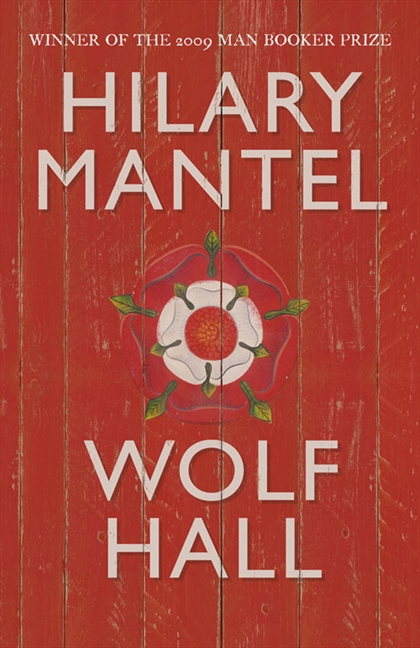
Cover image (Courtesy HarperCollins Publishers)

And, after reading the novel, it would be hard to refute this notion! Wolf Hall is set in England between 1500 and 1535, with most of the action taking place between 1527 and 1535. It deals primarily with the lead up to and first years of Henry VIII’s marriage to Anne Boleyn, but as seen through the eyes of Thomas Cromwell. Its plot centres on the machinations involved in dissolving Henry’s marriage to Katherine (Catherine) of Aragon, who had failed to produce a male heir, so he could legally marry Anne Boleyn; its real subject matter, though, is far wider than that. Its time period – the early years of the English Reformation – and its plot mean that it deals with the major issues of the time, including England’s separation from Rome, the translation of the Bible into English and the relaxing of rules regarding access to the Bible, the Act of Supremacy, and succession to the throne. Running through this are the jostlings for power, the skullduggery, and the betrayals (and suprising acts of loyalty) that are the hallmarks of the Tudor Court. Man was indeed wolf to man then (and I sometimes wonder how much has changed?).

This is an exquisite – though large! – novel. It won the 2009 Booker Prize: I can’t compare it with the others because I haven’t read them, but I did enjoy this immensely. In my recent review of The enchantress of Florence – and what fascinating synchronicity to read these two in sequence – I said that the one word I would use to describe it was “paradoxical”. The word I would use for Wolf Hall is “subtle”. It is subtle in so many ways – in its narrative style, its humour, its irony, its symbolism, its descriptions, its juxtapositions. Nothing here is heavy-handed or overdone.

But first, its narrative style. I was forewarned about Mantel’s use of “he” in this novel and perhaps this helped, because I rarely found it difficult or confusing. In fact, I rather liked the style. It’s a bit like a first-person novel told in third person – third person subjective (limited) point of view, I guess – and so the use of “he” reminds us that it is HIS perspective we are getting. Everything we know we know through him, through his thoughts and through his interactions with others. I found this approach intriguing – it gave immediacy and distance at the same time. And this brings me to the man himself.

Thomas Cromwell, for those who don’t know their English history, rose from very humble beginnings to being Henry’s trusted chief minister. He did this by dint of his character and the timely beneficial patronage of Cardinal Wolsey. He became street-smart in his youth but he also educated himself in the culture (literature and art) of the times. He could speak Latin, Italian and French. He was an accountant and lawyer.  He knew about trade. He was no slouch in the kitchen either. He was, indeed, a jack-of-all-trades. Here is a description early in the book (1527):

Thomas Cromwell is now a little over forty years old. He is a man of strong build, not tall. Various expressions are available to his face, and one is readable: an expression of stifled amusement … It is said he knows by heart the entire New Testamant in Latin … He is at home in courtroom or waterfront, bishop’s palace or inn yard. He can draft a contract, train a falcom, draw a map, stop a street fight, furnish a house and fix a jury…

A man, that is, not to be trifled with – and yet he is a man who develops a large and loving household full of loyal children, relatives and “wards”. Some of the loveliest sections of the book are set in his home, Austin Friars. He is also loyal – sticking by Wolsey, for example, in his decline – and firm, hard even, but not cruel.

However, I don’t want this review to be as long as the book and so shall move on. I loved Mantel’s descriptions – they are always short but highly evocative. Here is the Duke of Norfolk:

The duke is now approaching sixty years old but concedes nothing to the calendar. Flint-faced and keen-eyed, he is lean as a gnawed bone and cold as an axe-head;  his joints seem knitted together of supple chain links, and indeed he rattles a little as he moves, for his clothes conceal relics…

And here is another telling description (after charges against Wolsey have been written):

It is a wan morning, low unbroken cloud; the light filtering sparely through the glass, is the colour of tarnished pewter. How brightly coloured the king is, like the king in a new pack of cards: how small his flat blue eye.

Delicious aren’t they?

The novel ends at an intriguing point – but I won’t give that away here except to say that it does not conclude with the end of Cromwell’s life. That, we believe, is the subject of a sequel.

I would love to keep writing about the characters, the language, the way Mantel puts it all together – such as the way she drops hints then explores them later – but that could become boring. Better for you to read the book (if you haven’t already). Instead, I will end with what is probably the book’s overarching theme – that of “how the world works”, and that is through machinations behind the scenes:

The fate of peoples is made like this, two men in small rooms. Forget the coronations, the conclaves of cardinals, the pomp and processions. This is how the world changes: a counter pushed across a table, a pen stroke that alters the force of a phrase, a woman’s sigh as she passes and leaves on the air a trail of orange flower or rosewater…

It was ever thus, eh?

Hilary Mantel
Wolf Hall
London: Fourth Estate, 2009
653pp.
ISBN: 9870007292417

POSTSCRIPT: Steven, at A Momentary Taste of Being, posted a link to this fascinating article by Hilary Mantel on Thomas Cromwell. It is well worth a read.

Historical fiction…some brief thoughts

Hilary Mantel, Wolf Hall cover

Cover image (Courtesy: HarperCollins Australia)

I have never really thought of myself as a reader of historical fiction but of course I have read quite a bit of historical fiction, not because I seek it as a genre but because some of the, for want of a better word, literary fiction that comes my way is, also, historical fiction. Take last year’s Booker Prize winner, Hilary Mantel’s Wolf Hall, for example. (This is not my review of it, that will come next week)

A writer of The Guardian Books Blog wrote a little on the topic after the announcement suggesting that historical fiction has regained some “gravitas” in recent years but also recognised:

Writing in 1850, Alessandro Manzoni argued that novelists were different from historians because they give “not just the bare bones of history, but something richer, more complete. In a way you want him to put the flesh back on the skeleton that is history”. This is key, I think, to understanding fiction about the past.

However, the tension between the bones of fact and the fictional flesh can be problematic, as Leon Garfield argued: “Often you have to suppress what you actually know, and do it in a way that doesn’t seem as though you’re doing it, and you can only do that, I find, by being very subjective in your writing.” The historical novel writer is forced to acknowledge the innate fictionality of what they are doing and the way it suffuses everything, even the so-called “facts”.

Here in Australia we had a little furore over an historical novel, Kate Grenville’s The secret river, as I briefly referred to in an earlier post, and it was largely over her suggestion that novelists could add to our understanding of history. I think she understood very well “the tension between the bones of fact and the fictional flesh”: she knows that there are things that history can’t tell us and that there is a place for “imagining” how and why things actually happened, for trying to get in the heads of the people of the times. Sophisticated readers of fiction, I believe, can make this distinction, can understand that it is fiction they are reading while also recognising that this fiction may also contribute to their appreciation of the past.

I’ll probably come back to this again in future posts, but I thought I’d make an observation about how a couple of recent authors have handled presenting to their readers the historicity of their fiction. Salman Rushdie in The enchantress of Florence provides an 8-page bibliography at the end of the book demonstrating the extent of his research and giving his readers the option of following up anything they are interested in. (The fact that this book also includes magical/fantastical material as well doesn’t, I think, deny its historical aspect). Hilary Mantel doesn’t do this, but she provides an extensive list of characters and two family trees at the beginning of the novel. And like many authors of historical fiction she provides an Author’s Note to explain some of her sources and historical decisions. Kate Grenville, though, went one step further: she wrote a follow-up book, Searching for The secret river, which chronicled in detail her writing process for her book and how and why, in fact, she turned it from a biography of her ancestor into an historical novel with a fictional protagonist!

Coffee-time counsel

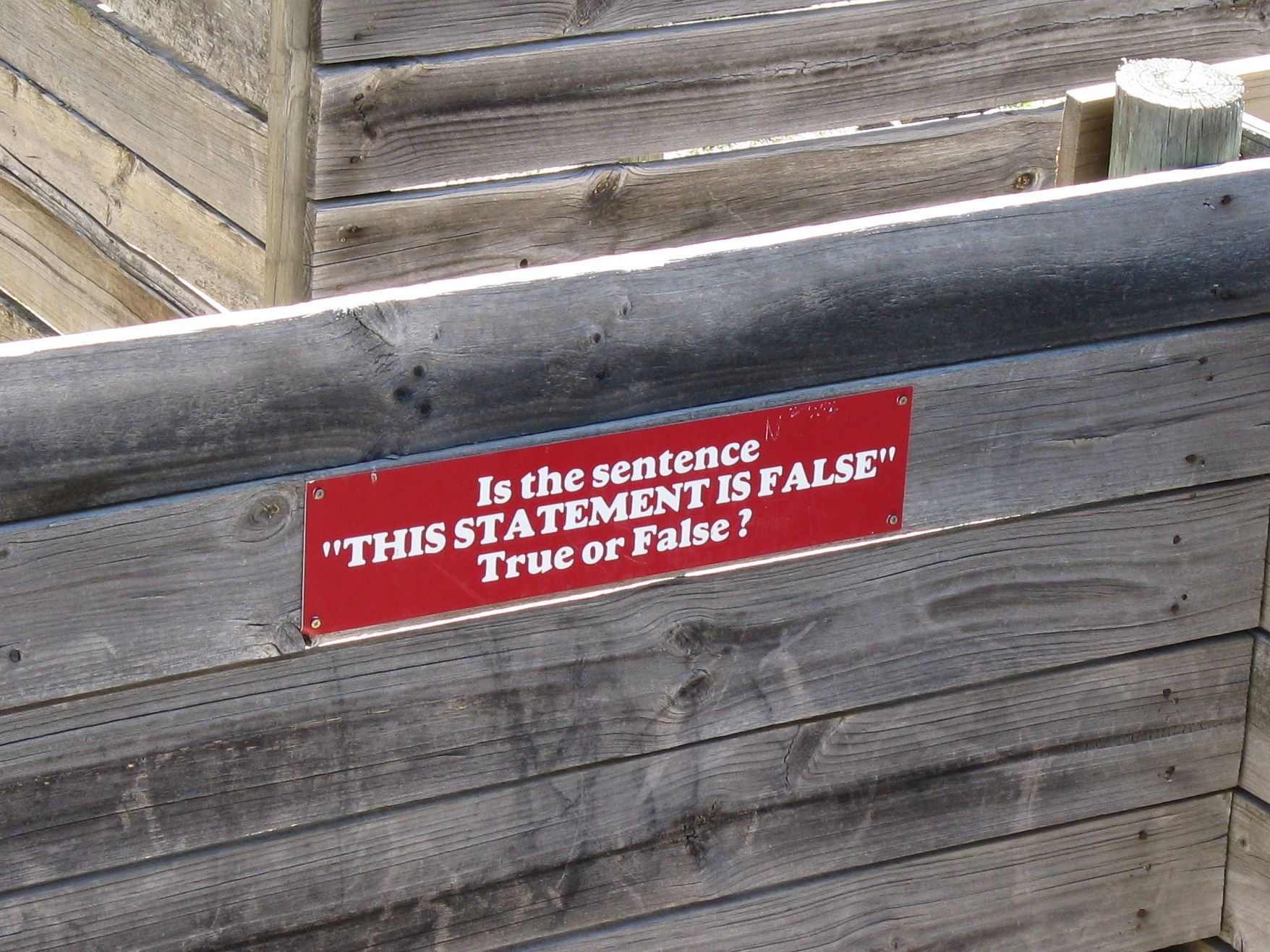
Crackenback Cottage Maze

Sign on part of maze

En route to our hedonistic hiking location we traditionally stop for lunch at the historic and delightfully rustic Crackenback Cottage and Restaurant. We’ve noticed over the years that they seem to like to tease their guests with words and ideas…and of course these particular guests are not averse to that!

My first example though comes not from the restaurant but from the maze on its doorstep (in the same complex): See right. Now, that’s a bit too deep for me at lunch time!

But, back to the restaurant. Some years ago, under previous owners, the restaurant’s paper napkins contained the fun little promotion:

There being no place, like this  place, near this place, this must be the place.

And then this year, with the current owners also clearly interested in entertaining their guests, our coffees came with a little quote tucked under the cup. Here are the two we received:

Use soft words and hard arguments. (English proverb).

Fair enough…but then…

Use your enemy’s hand to catch a snake. (Persian proverb)

Oh dear – not such lovely counsel from a pretty cafe! Anyhow, from what I am reading now about the English in Hilary Mantel’s Wolf Hall it would not have surprised me if the latter one had been ascribed to the English. Here is Mantel:

The English will never be forgiven [by the French at least] for the talent for  destruction they have always displayed when they get off their own island…

…and she goes on to chronicle the havoc wreaked by English armies not only against armies but civilians. But this is a long way from coffee-time and hedonistic hiking, and so I shall leave that for another day …