Is this starting to sound like a carol you know? Anyhow, I did say in a comment on my first Christmas book post that I had received another book for Christmas, The best Australian poems 2009 (edited by Robert Adamson). DKS’s comment about the value of this annual series to the cause of poetry made me think that I ought give it its own post.
I wouldn’t call myself a poetry expert, but I have mentioned poetry several times in this blog’s short life because I do enjoy reading it and wish, really, that I spent more time with it. Australian surgeon Mohamad Khadra, in his rivetting memoir, Making the cut, talks about the value of poetry, about how each day on his hospital teaching rounds he would begin by having his students recite a poem that might offer some entrée to understanding their patients’ states of mind. His view is that, as doctors deal daily with humanity, they, and by extension we, can learn from poets who have spent lifetimes making a study of humanity. Each chapter of his memoir commences with a poem.
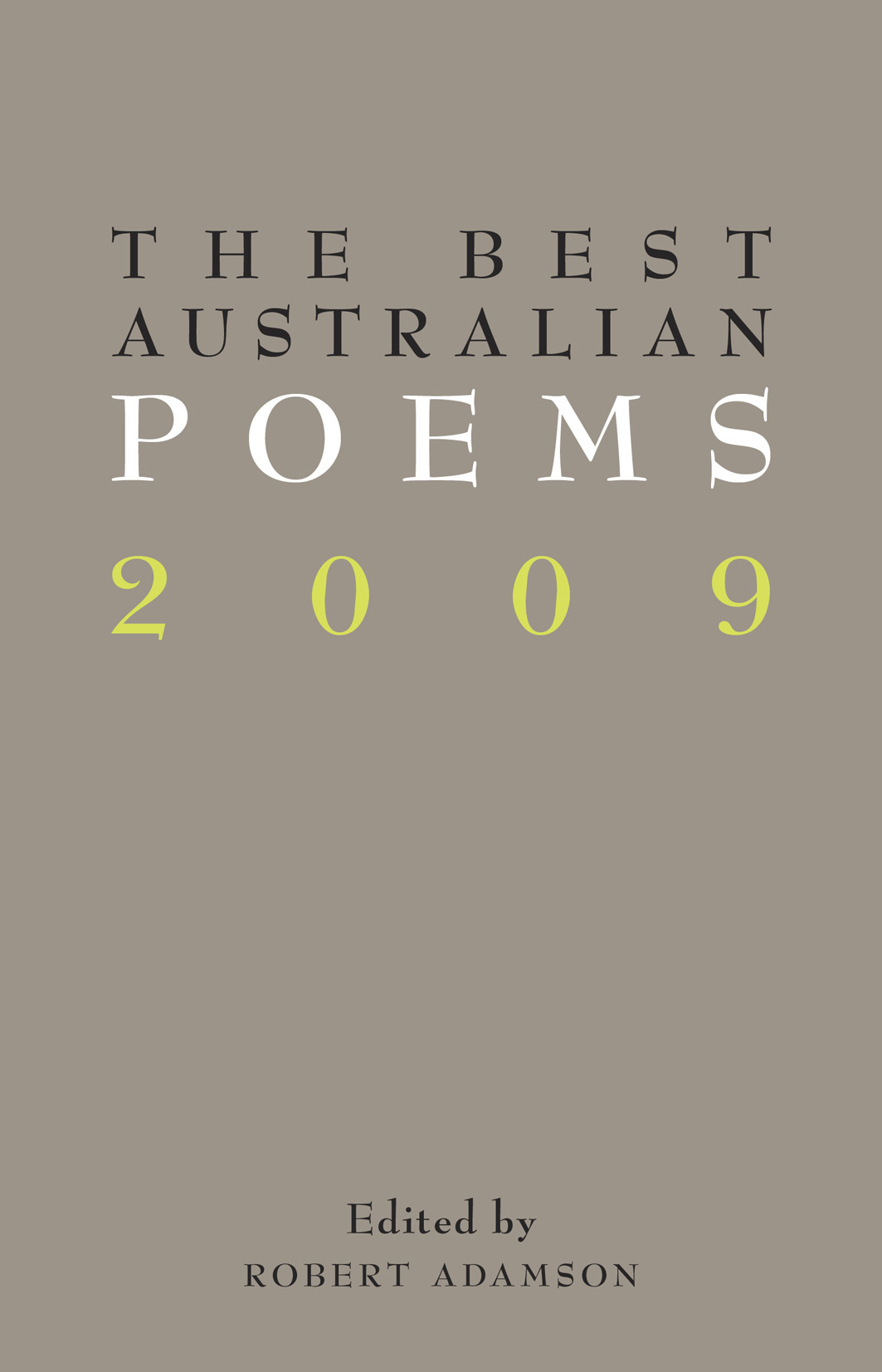
Cover image (Courtesy: Black Inc)
But I digress. Robert Adamson mentions three poets in the first paragraph of his introduction – Irish WB Yeats, English Gerard Manley Hopkins (one of my favourites) and Australian Meg Mooney – referring to use in their poems of birds and song. He says that there are many birds and lyrics in the anthology. I’m not quite sure why he singles out these two particular ideas in what is a general anthology – but maybe I’ll know by the time I’ve read all the poems?
To make the selection for this volume he “read all the poetry in the print publications as well as many of the electronic journals and even blogs that feature poems”. Isn’t it great seeing the blog world becoming an integral part of the publishing industry! He says about his selection that he “wanted to create a rhythm for the reader: shorter lyrics and some satirical poems, then hopefully a few love poems, poems of weather, landscape poems and, of course, bird poems.” Ah, the birds again…and then comes the explanation:
People ask me, why are so many bird poems being written and published? I have a theory : we miss having poets among us who can imagine that a soul can ‘clap its hands and sing, and louder sing’ [Yeats], that we need to acknowledge visitations by intense psychological presences, and that birds are the closest things we have, more or less, to angels.
Wow! I’m not quite sure how to respond to that.
The anthology commences with a lovely poem by Martin Harrison titled “Word” written for Dorothy Porter, after her death:
in which briefly suddenly one voice’s glimmer is lost
The anthology also includes a poem by Porter and, indeed, contains for the first time apparently more poems by women than men. The poems are listed alphabetically by poet – saves need of an index not to mention the problem of how to sequence the poems (and all those questions about how one poem’s proximity to another will affect its impact or meaning). He has also included a lot of new poets, more perhaps than in the past, as well as the tried and true. And that is how I like it (just as I like a “classical” music concert to mix it up a bit).
I think that’s about enough on a book I haven’t fully read, so I’ll just finish with some lines from Meg Mooney to whom Adamson referred in his opening paragraph:
The large, brown shapes of the wedgebills
their cheeky crests
disappear as I get closerlike they’re telling me
you can’t just look
and expect to see
in this country(from “Birdwatching during the Intervention“)
The best Australian poems 2009
Melbourne: Black Inc, 2009
239pp.
ISBN: 9781863954525
 Whispering Gums
Re. I’m not quite sure how to respond to that.
I’d respond by pointing out that the birds round my place spend their time crapping on the concrete and fornicating on the roof and I don’t think angels are supposed to do either of those things. I’m curious though, I wonder why he believes we want poets who think the soul should sing and clap its hands and acknowledge visitations by intense psychological presences. I don’t know enough about it to claim that we conclusively don’t (whoever ‘we’ are: people who read poetry I’m guessing) but I’d like to know how he knows, or why he thinks that most of us want this one thing in particular. Does he scan the poetic landscape and murmur to himself, “We have no Blake, we have no D.H. Lawrence, this is something I wish we had, and I have friends who say the same”? Has he been looking through poetry blogs and noticed a number of different people saying, “I wish poets would write more ecstatically”? I don’t detect a shortage of poets who advertise their inner states and feelings, but he specifies the intense visitation, so he must be thinking of something more, something mystic and transforming.
Speaking f’ myself, the last time I read a poem and thought, “Yes, that’s it, I want more like that,” it was an extract from Goran Sonnevi’s Mozart’s Third Brain, a combination of politics, memoir, anecdote, and world history, translated by Rika Lesser from Sonnevi’s native Swedish. It wasn’t until I read this, that I realised how many of the poems I’d come across recently were variations on, “I saw a teacup and felt an emotion,” or, “My dad died,” or, “I recall my childhood,” or, “Lo, a horse/dog/cat/sunbeam/pond.” It was a relief to escape into something – more ambitious? larger? more outward-looking? Something like that. (Maybe it’s this feeling of largeness that Adamson hopes to find in the ecstatics.)
Glad you responded. I was thinking as I wrote the post that I don’t know Adamson’s poetry though have heard of him of course. Maybe as you say it is “the feeling of largeness” that he’s (thinks we are) looking for. If he hadn’t added the line about angels I probably would have reacted differently. I’m trying to think what sort of poetry I like. I love Hopkins’ – and he certainly has some visitations (or wants visitations or….) but it’s the way his language flows off the tongue that grabs me…but then of course the meaning has to follow.
The last poem that truly grabbed me I think was Geoff Page’s verse novel The scarring. It is gut wrenching. I want to post on it one day, but I have to read it again first as it was several years ago that I read it. Before that I think the one that has grabbed me and stayed with me is Elizabeth Jolley’s (black as is her wont) Neighbour woman on a fencing wire, which I posted about a few months ago (https://whisperinggums.wordpress.com/2009/07/18/more-jolley/). I’ve read and heard more since then – and enjoyed them – but these two stick. They are much plainer in language than Hopkins but they have a tone – a grimness – that grips me. The tone say (though not, I hasten to add, the style) of some of TS Eliot’s work. As you can see, most of my poetry reading in latter years has been Australian!
And now you’ll really know I’m talking through my hat!
Hopkins is The Man. I haven’t read The Scarring. I was about to write, “I’ve got that Penguin Book of Australian Women’s Poetry,” but then I looked again and it’s the Oxford Book of Australian Women’s Verse I’ve got instead. No Jolley in here at all, not that poem, not anything else.
Talking about Hopkins and ecstasy, it occurs to me that while I’ve seen other poets write poems* that were evidently inspired by his swish-and-gulp enjambment, I don’t think I’ve seen any that did it ecstatically – nothing like that rapt, “Look look up at the skies! / Oh look -”
—
* Martha Zweig’s Overturn is the first one I can think of: http://bostonreview.net/BR33.1/zweig2.php (the other version I’ve seen had a line break after “cow -” which doesn’t appear here. I think the Boston Review might have misprinted it, because the break makes sense.
“Hi, power, who a hippo were, rough & river-
rocky horse & now (early spring & swollen) cow-
brown, with a will’s way over me upside-down.” )
I’d love to see a review from you of The Scarring. Too bad ANU never gives back exam essays, or we could have a good old laugh at what I managed to write about it in an hour!
This has also made me feel more disgruntled about my Pablo Neruda book that I shall never get back. Sigh.
We are besieged by seagulls, crows and magpies and its hard to write a decent poem about that little selection. Hopkins had it write with The Windhover, surely an all time favourite.
You have aquired an appealing volume there by the sound of it
DKS, that Zweig one is good and has that similar use exuberant evocative use of language as you say. Thanks for introducing me to her.
I love his God’s grandeur – with its visitations: “with Ah! bright wings”. And the distress of “Carrion comfort”
Tom, yes The windhover is wonderful – the words are magnificent really aren’t they. Continuing the bird theme, one of my favourites has always been ‘As kingfishers catch fire, dragonflies dráw fláme’ (Crying what I do is me: for that I came). And I pretty well know by heart “Spring and fall”. And the simplicity of Pied Beauty with its Glory be to God for dappled things!
You’re welcome. By coincidence, I was looking through a blog called The Page when I came across this link to a book review at the New York Times –
“In interviews, [Marie] Ponsot has mentioned her Catholic faith, and she pays homage to the Catholic [GM] Hopkins, who endeavored (as she does) to see in each plant, each animal, each sort of weather, a unique instance of Providence: “Loft him Halo him / Prize him high, pen in hand,” she tells Hopkins (“him” is God). But Hopkins was also a poet of anger and terror, frustration, mundanity, even despair: “No worst, there is none,” he wrote. “Pitched past pitch of grief.”
No poet must feel such anguish just to write well; but Ponsot’s own writing, like Ponsot’s version of Hopkins, can seem so self-consciously affirmative …”
That’s really lovely … never heard of her but she sounds well worth reading. I remember Hopkins’ distressed poems and that line quoted. Another favourite is “No I’ll not carrion comfort. Despair, not feast on thee” (probably got the punctuation and line scanning wrong but I’m sure you know what I’m talking about). Anyhow I will try to suss more of her out. Thanks for the link.