Monday musings on Australian literature: Vale Yasmine Gooneratne (1935-2024)

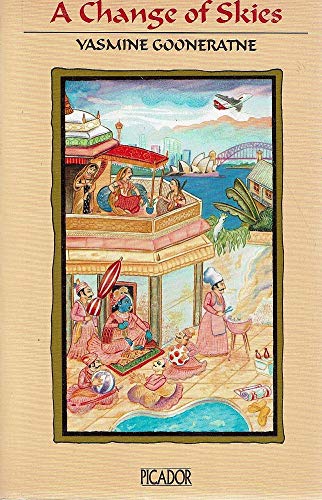
It was through the Jane Austen Society of Australia’s (JASA) newsletter, Practicalities, that I learned of the death of Yasmine Gooneratne, a woman with whom I have crossed paths – one way or another – three times. She was an academic at Macquarie University, where I did my undergraduate degree; she wrote a novel, A change of skies (1991), which my reading group discussed back in 1996; and, she was the patron of JASA (and you know how I love Jane).

You can find quite a lot about Yasmine Gooneratne on the Internet, if you are interested, so I’m just going to focus on a few points that struck me, and I hope will interest you.

“No nonsense”

A site called The Modern Novel provides a useful potted biography, so I will start with that. It says that she was born in Sri Lanka (then Ceylon) in 1935 as Yasmine Bandaranaike, which means she was “a member of the well-to-do Ceylonese family which included Sirimavo Bandaranaike, the first woman prime minister in the world”. She studied at the University of Ceylon and Cambridge University, and in 1962, she married the doctor and environmentalist Dr Brendan Gooneratne (who died in 2021). They emigrated to Australia in 1972, where she lived for 35 years, according to Wikipedia, before returning to Sri Lanka. It was here, in her home country, that she died on 18 February this year.

AustLit provides more detail, which includes that she was founding Director of Macquarie University’s Post-Colonial Literatures and Language Research Centre from 1989-1993, and that she was awarded an AO (Order of Australia) in 1990 “for her distinguished contribution to Sri Lankan and Australian literature”. She won (or was listed for) a number of awards in Australia and elsewhere.

Gooneratne wrote over twenty books, including novels, some poetry and short story collections, as well as many works of non-fiction, but she seems little known outside academic circles (and JASA). Indeed, my initial – and general – search for this post brought up many references to her but no news items on her death. I had to search a little more specifically for that. This was interesting given that, on the several internet sites I found, she is described as widely known. DBpedia* calls her a “Sri Lankan poet, short story writer, university professor and essayist” and says that “she is recognised in Sri Lanka, Australia and throughout Europe and the U.S.A., due to her substantial creative and critical publications in the field of English and post-colonial literature”.

When I did find something about her death, I was delighted to find an obituary written by her daughter Devika Brendon. Initially posted in the Sunday Times on 18 February 2024, it has been shared on many other sites including the blog I am quoting from. It provides a loving and personal tribute to her mother, but one which I suspect also rings true to the person Gooneratne was. Devika Brendon tells us that:

Yasmine Gooneratne as a private individual left clear instructions about what she wished regarding her funeral. Her directives show a great deal about her character and her values. ‘No public notices. No public viewing. No public funeral. No memorial lectures. No fuss. No feathers. No posturing. No performativeness. No photographers. No selfies. No celebrities. No nonsense.’

I have mentioned Gooneratne a few times on this blog, including in a brief Monday Musings post I wrote in 2013 on Migrant literature. It had been a long time since I’d read A change of skies (and it’s even longer now), but I wrote that the novel was about “educated middle class migrants – like herself I presume – who work to find a balance between fitting into the new culture while at the same time preserving their Sri Lankan identity”. If you want a better flavour of this work, check out this post written in 2012 by someone called Elen on a blog called the southasiabookblog. Elen says that Gooneratne’s “portrayal of the immigrant experience is as funny and poignantly ironic as Jhumpa Lahiri’s work on a similar topic is earnest”. I wish I could remember it that well, but I read it when I was immersed in parenting and my memory is general. This description of Gooneratne’s tone, however, sounds like the writing of an Austen-lover!

I will end with another paragraph written by her daughter because, not only does it tell us a lot about Gooneratne but, if you are an Austen fan, you will love the final line:

She had great contempt for hypocrisy and cruelty. She had a great sense of humour and a lively sense of fun. As she was a person of moral integrity, the repulsive conduct of people who prey upon the vulnerable saddened her, especially as she grew older. While always choosing to believe the best in people, she found herself unable to accept the lies that are spun by opportunists and predators on a daily basis. Her good opinion, once lost, was lost forever.

* DBpedia describes itself as “a crowd-sourced community effort to extract structured content from the information created in various Wikimedia projects”

Monday musings on Australian literature: Asian Australian writers

Brian Castro

Brian Castro (Public Domain, via Wikipedia)

Australia is an immigrant country, with the first immigrants, the original Aboriginal Australians, believed to have arrived 40-60,000 (there are arguments about this!) years ago via the Indonesian archipelago. They established what is now regarded as one of the longest surviving cultures on earth. Today, though, I’m going to write on some of our more recent immigrants – those from Asia. The first big wave of Asian immigrants came from China, during the Gold Rush in the mid 19th century. Since then people from all parts of Asia have, for various reasons, decided to call Australia home – and have enriched our culture immeasurably.

I’m not going to focus on the political issues regarding acceptance, promotion and encouragement of Asian Australian writers because, like any stories to do with immigration, it’s too complex for a quick post here. I hope that things are improving, but only the writers and communities themselves can really tell us that.

As has been my practice in these sorts of posts, I’m going to introduce 5 Asian Australian writers to get the discussion going. After that, I’d love you readers to share “immigrant” writers you know and love …

But first, a definition. My focus here will be on writers who emigrated from Asia, rather than those from subsequent generations. I will not therefore be discussing writers like Shaun Tan and Alice Pung.

Brian Castro (Hong Kong born in 1950, emigrated 1961)

Castro is one of the most prolific and most awarded writers among those I’m listing today. He came here as a child, and started writing short stories in 1970. He has, to date, published 9 novels, many of them winning major Australian literary awards. Lisa at ANZLitLovers suggests he is a contender for Australia’s next (should we ever have another one) Nobel Prize for Literature. In 1996, in the Australian Humanities Review, Castro said this about Australia and Asia:

The situation currently is that Australia needs Asia more than Asia needs it. While the West seems to have run out of ideas in the creative and cultural fields, relying on images of sex and violence, reviving old canons and dwindling to parody and satire in what can already be seen as one of the dead ends of postmodernism, the Asian region is alive with opportunities for a new hybridisation, a collective intermix and juxtaposition of styles and rituals which could change the focus and dynamics of Australian art, music and language.

Strong words – but they make you think! My sense is that Australia is now seeing (accepting?) some of this hybridisation that he speaks of – not only from Asia but also from our indigenous authors like Kim Scott and Alexis Wright. I wonder if Castro agrees?

Yasmine Gooneratne (Sri Lankan born, emigrated 1972)

Gooneratne is one of the first Asian Australian writers I read. I have chosen her for that reason and for some sentimental reasons: she holds a Personal Chair in English at my alma mater, Macquarie University, and she is the patron of the Jane Austen Society of Australia! Long ago I read her first, appropriately named, novel, Change of skies (1991). Like many first novels, it has an autobiographical element and explores the challenges of changing skies, of migrating to another place. It was shortlisted for the Commonwealth Writers Prize. She has, in the last decade, received a number of awards here and in the South Asia region for her contribution to literature.

Michelle de Kretser (Sri Lankan born, emigrated 1972)

Like Castro, de Kretser emigrated to Australia in her youth (when she was 14) and made quite a splash with her debut novel set during the French Revolution, The rose grower. Her second novel, The Hamilton case is set in Sri Lanka and represents she says her “considered” farewell to her country of birth. Her third novel, The lost dog, is set in her home-city (now) of Melbourne, but its main character migrated to Australia from Asia when he was 14 and struggles to find his identity. Her books are not self-consciously migrant but tend, nonetheless, to be informed by the experience of dislocation.

Nam Le (Vietnamese-born, emigrated 1979)

Nam Le is our youngest migrant in this list, arriving here when he was less than 1! His debut book, the short story collection, The boat (2008), won multiple awards and is remarkable for its diversity of content (setting and subject matter) and voice. I, like many others, am waiting to see what he produces next.

Ouyang Yu (Chinese born, emigrated 1991)

To my shame I hadn’t heard of Ouyang Yu until relatively recently, but I do have an excuse. He has only written three novels in English and two of them very recently: The eastern slope chronicle (2002), The English class (2010), and Loose: A Wild History (2011). He is, however, a prolific writer, of, apparently, 55 (yes, 55!) books of poetry, fiction, non-fiction, and translated works in English and Chinese. He’s translated Christina Stead, no less, and even Germaine Greer’s The female eunuch. If this is not contributing to cross-cultural understanding I don’t know what is.

I’ll close with some words from an interview with Michelle de Kretser in which she articulates rather nicely I think the experience of being a migrant (using the character Tom from The lost dog):

But I think that like a lot of people who come to Australia, Tom is trying to escape something. You know, people come here often because they’re trying to get away from war, or poverty or persecution — or merely from perhaps difficult family situations. And I think Tom coming here as a child simply delights in the kind of freedom and anonymity that Australia offers him, which is a classic experience of people moving countries, or indeed if you go back to the 18th century people moving from the city to the country; the city at once offers this kind of blissful possibility of inventing yourself anew, a kind of wonderful freedom from inherited ways of thinking and being identified and categorised. On the other hand that is also simultaneously — can be — a very lonely and disconcerting experience, again.