My inspiration for Monday Musings comes from various sources – my own interests, roving around Trove, news articles or stories I come across, or other bloggers. Today’s post was inspired by Lisa’s (ANZLitLovers) post on Gert Loveday’s novel, Writing is easy. Gert Loveday is a collective pseudonym for two sisters, Joan Kerr and Gabrielle Daly. I’ve written about literary couples here before – couples in literature like The Bloke and Doreen, and Australian literary couples like Vance and Nettie Palmer – but, while I did some work on writing duos in Wikipedia some years ago, I haven’t written about them here. Lisa put the challenge to me to do so – so, yes ma’am, here I am!
As I often do with posts like these, I’m going to list a few Aussie duos, roughly in chronological order of their writing:
M. Barnard Eldershaw
Marjorie Barnard and Flora Eldershaw are probably the best known writing duos in Australia. While both of them wrote individually, particularly Marjorie Barnard after Eldershaw’s death in 1957, they produced a significant body of work as a duo, starting with A house is built which won the Bulletin prize in 1928 (a prize they shared with Katharine Susannah Prichard’s Coonardoo). They went on to write four more novels, three histories, plays for stage and radio, a collection of short stories, and several collections of critical essays and lectures. There has been much discussion regarding how they worked together, with the suggestion that Barnard was more the creator, and Eldershaw more the editor, though I suspect the situation varied somewhat from book to book. However, Barnard did write, much later in 1974, that
Well, collaboration is like a bedroom secret; it all hinges on vanity and not having vanity. You must talk everything over before you put pen to paper […] I did most of the writing. Because I had more time and Flora’s forte was criticism […] I’d of ahead, writing with enthusiasm, and we’d talk it over afterwards and she would curb some of my exuberances; that’s what was the matter with “Tomorrow and tomorrow”. I wrote that alone.
It is, though, listed as one of their collaborative novels, but by then they were living in different cities.
They were, in addition, literary luminaries in the 1920s-1940s making a significant contribution to Australian cultural life. They supported and promoted Australian women writers, and argued for government support for writers. They also held “salons” in a flat they shared, at which both literary and sociopolitical issues were discussed.
Miles Franklin and Dymphna Cusack
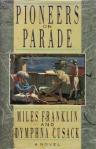 Miles Franklin and Dymphna Cusack mostly wrote solo, but they collaborated on two works, a novel, Pioneers on parade published in 1939, and a play in 1945 titled Call up your ghosts. Unlike Barnard and Eldershaw, they didn’t create a collective name. However, like them they were active in Australia’s literary scene, and were, for want of a better word, social reformers. Pioneers on parade satirised Australia’s 1938 sesquicentenary celebrations, mocking, so says the dust jacket of a later edition”established beliefs and institutions”.
The typical question we want to know of collaborators is how did it work? I checked Miles Franklin’s diaries to see if she said anything. Here she is on 9 May 1939:
Went to town at 3 to do shopping & get proofs at A & R … D.C. [Dymphna Cusack] came too. She is no help – lazy – thinks she is such a genius that she need not slog. Got home at six & read proofs until 10.
The things you can say in diaries! She did, however, work with Cusack again on Call up your ghosts, so it surely wasn’t all bad.
Dymphna Cusack and Florence James
I have reviewed Dymphna Cusack here twice – her novel Jungfrau and memoir A window in the dark. She wrote 12 novels, of which just two were collaborative, Pioneers on parade (1939) and her best known novel, Come in spinner. (1945). Her collaborator was journalist and literary agent Florence James, about whom I wrote early in this blog. Check it out if you’re interested in her take on the life of a freelance journalist in 1940. They wrote the novel while sharing a house in the Blue Mountains. Adapted much later for a successful television series, it beautifully evokes Sydney during World War 2, when American troops were in town and life was changing quickly.
Researching this post, I found a letter from Katharine Susannah Prichard to Miles Franklin (19 April 1951):
“Come in spinner’s” a delightful piece of work. Very well done, I think. With very real bits & pieces of Sydney & the happenings of those war days. The people all vital and true to type. It headed the list of best sellers here for 3 weeks … […]
I was so pleased that Dymphna had dedicated “Come in spinner” to you. Feels she owes you so much of literary style and intrepidity.
I also found in the same book – As good as a yarn with you – reference to the banning of a radio serialisation of the novel. Miles Franklin wrote (5 April 1954) to Cusack and James, then living in London:
It shows how far we still have to go or that the radio firm which did the serial is spurious. In no sense is procurement a main theme and God save us if mothers of girls can’t stand to hear what happens.
Morris Gleitzman and Paul Jennings
 And now for something completely different, two successful-in-their-own-right children’s authors collaborating on two series of children’s books, Wicked (1997) and Deadly (2000). Both series comprise 6 novels, and Jennings and Gleitzman wrote alternate chapters. A British online magazine for children’s books, Books for Keeps, interviewed Jennings and reported this:
The publishers adopted a high risk strategy for this venture [ie. Wicked]. Jennings and Gleitzman wrote alternative [sic] chapters, faxing them to each other and leaving the fantastic complications which end each episode for the other to sort out. The first books appeared well before they had any idea of how the final one would end.
‘It was fun getting the characters into terrible fixes knowing you didn’t have to worry about getting them out of it, but imagine what would have happened if we’d had a fight; it would have been a catastrophe.’
Gert Loveday
Gert Loveday have (or should it be has?) written five novels, the last being the aforementioned Writing is easy. I have it on my Kindle – in the TBR folder. Oh dear! It is apparently a funny book about writing workshops, which sounds highly appealing to me. Presumably our collaborators Joan and Gabrielle have experienced one of two in their day! Anyhow, I’m not going to write much about this duo, because one of my favourite bloggers, the US-based but Aussie lit fan Guy Savage, has interviewed them. Do check out the post. They talk about their process, how they resolve their differences, and, in wonderful irreverent tongue-in-cheek humour, they describe Gert:
Gert is Gert. We both have other writing identities in different forms, but we have a sense of Gert, or a Gertish way of looking at things. She looks like Elinor Bron, with wild white curly hair. We think she smokes (we would never do that) and she has an Irish wolfhound. She is at once much freer and more ruthless than we are. So she feels separate.
Must get back to my Kindle TBR clearly.
There seems to be such liveliness behind all these collaborations. I love the idea of active minds butting up against each other to produce something together.
Have you read any collaborative works? Does the collaborative factor affect how you think about them?
 Whispering Gums