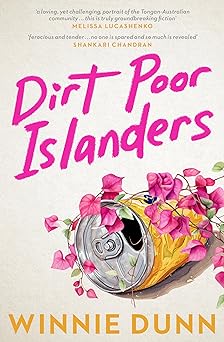
When my reading group chose our books for the second half of the year, the shortlist for the Miles Franklin Award had not yet been announced. However, wonderfully, the three books we chose from the longlist, all ended up on the shortlist. One of those was Winnie Dunn’s debut novel, Dirt poor Islanders. It is the first novel published by a Tongan Australian, and adds a welcome strand to the body of Australia’s second and third generation migrant literature.
Dirt poor Islanders spans around a year when its protagonist Meadow is approaching 12 years old. It can, therefore, also be read as a coming-of-age novel. It is a raw, earthy, honest and sometimes confronting read that exposes the challenges faced by Australian-born migrant generations, who are caught between two worlds.
This is not a new story. However, what is impressive here is that Dunn, in her first novel, has found her own strong and clear voice. It’s there in the way she gets right into the head of her protagonist Meadow, who is, admittedly, modelled on herself. It’s there in the way she interweaves English and Tongan language, capturing the vitality in her migrant community. It’s also there in her use of repetition, some of it onomatopoeic, to give her writing rhythm and create a tone that’s sometimes melancholic, sometimes humorous. Dunn also doesn’t spoon-feed her readers. She expects us to go with the flow and make the necessary connections. It’s not hard reading, but it does require attention.
“this way of seeing myself as half … and never enough” (Meadow)
So, who is Meadow? She’s a young girl who lost her birth mother at the age of 4. At the novel’s opening she is the eldest of six children in a blended family comprising three children from her birth mother, one from her step-mother, and two from this second marriage. Another is on the way. Her father is 30 years old. Meadow is grappling with what it means to grow up Tongan, particularly one who is hafekasi (half-Tongan half-White) and feeling caught between two worlds, neither of which fully accept her. She is desperate for a mother, and feels closest to her namesake, aunt Meadow, who lives in Mount Druitt with our Meadow’s paternal grandmother and another four aunts.
We follow Meadow through a tumultuous year. Early on, she spends most weekends at her Nana’s house surrounded by the five aunts, but when her father buys a new house in Plumpton, he wants Meadow, her sister Nettie and brother Jared, to call that home. With her birth mother gone, however, Meadow feels “stuck” and insecure. Aunt Meadow, also known as Lahi, is her “mother-aunt” and her rock. The narrative is built around the wedding of this Lahi, who, Meadow believes, is more interested in women. She fears for her boyish aunt, but she also fears for herself, that she will lose this mother figure to whom she clings with all her being.
Now, Meadow wants to be a writer, so she’s an observant girl, well able to express her feelings. She sees the messiness – literal and figurative – of Tongan lives, and she shares the lessons she is learning about being Tongan, not all of which are pretty. For example, “Tongan meant dirty” (p. 37), “being a joke” (p. 73) and “second best” (p. 102). But, there are positives too. “Togetherness was what it meant to be Tongan” (p. 40) and “being Tongan meant eating together and being grateful to eat together” (p. 118).
Dirt poor Islanders, then, depicts a migrant family living under stress. Big families and low-paying jobs with long hours mean a chaotic home. Meadow’s scalp is nit-infested, and her home, decorated with second-hand goods, much picked off roadsides, is cockroach-infested. Her parents work hard to keep the family sheltered and fed, but the mess overwhelms. Flipping between maturity and immaturity, Meadow sees all this – the hard work, the exhaustion, the love – but she struggles to find her place, to accept her Tongan heritage.
It all finally comes to a head, and her father organises for her to go to Tonga, because, he says, “it’s time for youse to know what being a Tongan truly means” (p. 239).
Migrant literature encompasses both memoir and fiction, with the latter mostly being autobiographical or autofiction. Dunn confirmed in her Conversations interview that much of the novel’s family background comes from her life, but the novel diverges from real life in its narrative arc and the resolution of Meadow’s inner turmoil. This answered the question I had as I was reading, which was why Dunn had chosen fiction, like Melina Marchetta did in Looking for Alibrandi, over memoir, like Alice Pung did in Unpolished gem. It’s a choice. What matters are the truths conveyed, not the facts, and Dirt poor Islanders feels truthful.
This truth is not all raw and confronting as I may have implied at the beginning. It is also warm and humorous. Meadow, who doesn’t like rich, fatty Tongan food tells us:
If it came out of a can covered in sugar and sodium, Tongans were eating it. But back then, all I wanted was food that came out of a window. (p. 37)
Preferably at Maccas! There are also funny scenes, many relating to the wedding which occupies the novel’s centre, and which is another nod – besides the title and epigraph – to the book that clearly inspired Dunn, Kevin Kwan’s Crazy rich Asians.
“no one could live as half of themselves” (Meadow)
However, Dunn’s book is fundamentally different from Kwan’s, whose aim, he said, was, to “introduce a contemporary Asia to a North American audience”. Dunn did want to introduce Tongan Australian culture – and counteract the image presented by Chris Lilley in Summer Heights High – but through Meadow, she also explores the excruciating difficulties children caught between cultures face. By the end of the novel Meadow comes to understand a little more the “messy truth” of being an Islander, and that:
No one could live as half of themselves. To live, I needed to embrace Brown, pālangi, noble, peasant, Tonga, Australia – Islander. (p. 275)
Dirt poor Islanders is both shocking and exciting to read, which is probably just what Dunn intended. I feel richer for it!
Winnie Dunn
Dirt poor Islanders
Sydney: Hachette Australia, 2024
293pp.
ISBN: 9780733649264
 Whispering Gums