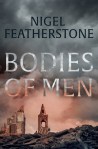
Nigel Featherstone, Bodies of men (#BookReview)

Nigel Featherstone, Bodies of menNigel Featherstone’s latest novel, Bodies of men, is a brave book – and not because it’s a World War 2 story about love between two soldiers at at time when such relationships were taboo, though there is that. No, I mean, because it’s a World War 2 story that was inspired by Featherstone’s three-month writer-in-residence stint at the Australian Defence Force Academy, in 2013. That’s not particularly brave, you are probably thinking, but wait, there’s more. What’s brave is that this novel, this story inspired by that residency, is about some darker sides of war – it’s about deserters, and violence from your own side, for a start … It’s certainly not about heroics, or, to be accurate, not the sort of heroics you’d expect. Courage, it shows, comes in many forms.

Here is what self-described pacifist Featherstone wrote in his blog two months into his residency:

I came here with the idea of exploring ‘masculinity in times of conflict’ …  Perhaps, like always, I’m being driven by that central question: what does it mean to be a good man, which, of course, is almost exactly the same as asking, what does it mean to be a good person?  But the military, especially the Australian kind of military, is all about men, isn’t it, the warrior, that iconic ‘digger’, that myth of our country, that brave saviour of everything we’re meant to stand for (whatever that is).

Those men who could do no wrong.  Except I don’t believe that for a second.

So, what did Featherstone actually write? It’s the story of two Australian soldiers from Sydney. William is from a conservative, well-to-do North Shore Sydney family, with a Member of Parliament father, while James comes from a poorer working class family, with a widowed mother who runs a shop but who’s also a socialist, a pacifist, and committed to helping homeless people. The boys had met and spent a few times together in their youth, but had lost touch for some years – until they find themselves in Egypt in 1941.

The novel opens with a reconnaissance that turns into an ambush. At an important moment, William, just off the boat, prevaricates, but James, there with a different military section, takes the initiative, and saves the day. The men vaguely recognise each other – “The officer”, thinks James, “does look familiar … but no it can’t be” – but have no opportunity to follow up, each returning immediately to their sections. From here the narrative, told third person from the alternating perspectives of William and James, follows the two men on their different paths. William, soon to be a lieutenant, is sent to manage a training camp in the desert. Believing he needs to redeem himself from that first experience of action, he sees this as an opportunity. He excels as a leader of men, finding the right balance between toughness and friendliness, but is dogged by his cold father’s voice, and worries about his ability to be the man his father expects. However, his mind is on that young man he glimpsed. Meanwhile, James goes AWOL on a military motorbike, which he crashes. Luckily, a family takes him in, a family which has its own tricky background and secrets, but James is just the right person to not rock their boat, so a warm relationship develops.

It’s not long before William works out a way of tracking James down. The story is told chronologically, but with frequent flashbacks which fill in that boyhood friendship. It was short, but intense. Both felt it, but William, in particular, struggled to understand it. It is therefore James, who, upon their renewed acquaintance, takes the lead – and the novel becomes, in part, a love story. Featherstone finds the right balance, here, conveying their tenderness and warmth, without sentimentality. We are never allowed to forget that this is war-time, and that both William and James are taking serious risks in their desire to be together.

However, this is not simply a boy-meets-boy, boy-loses-boy, boy-finds-boy again story. As mentioned above, Featherstone’s goal was to explore what it means to be a good man, against the backdrop of war. We do see some action, besides that opening scene, and there is an over-riding sense that something sinister could happen at any moment, but the main theme concerns men and their reactions to their circumstances – soldiers, men in hiding, men displaced, men in resistance. Each of these men provides the reader with a perspective on how men might choose to be. Courage and risk-taking, passion for a cause, recklessness, fear, commitment to helping others, tenderness and kindness – all of these come into play as the story progresses. And, as in all good novels, there are no simple answers. A love story this might be, but a genre romance or war-story it’s not.

How does Featherstone achieve this? Well, sometimes it’s hard to pinpoint these things, isn’t it? In a later post on his blog, Featherstone says that he wrote 38 drafts. You can tell this, and yet you can’t tell. You can tell, because you can feel the craft in the book. You can’t tell, because it also feels organic, not overworked. There’s skill in that. This skill includes the characterisation. William and James are sensitively fleshed out, well individuated, and grow through their experiences. But there are other characters too, including two strong women characters. James’ grounded, supportive mother is one, and open-minded Yetta, the woman who cares for James after his accident is another. It is she who articulates some of the novel’s main messages, including:

‘People must care for people. It’s not more complicated than that.’

There’s skill also in the narrative structure. The novel has a lightly episodic touch, with little breaks marked on the paper between “scenes”, but the story nonetheless flows. These breaks simply provide a way for the narrative to be progressed without unnecessary explication.

And, of course, there’s the writing. It’s spare, and yet perfectly evocative – of life at William’s desert camp, of the nervous busy-ness of war-time Alexandria where wells of quietness can also be found, and of William and James’ love. Here’s an example showing the edgy sort of tone Featherstone creates:

But now, something new: he was – he and James both were – sliding into the back seat of a car. They were being driven along one of Alexandria’s palm-lined boulevards; before long they were surrounded by blackness. William wound down his window and was about to yell, BUGGER THE WAR! – the night was getting away from him – but he managed to drag the words back down to where they belonged, in the pit of his gut.

Bodies of men, then, is a war novel that questions war. But, it is told with a generous touch that doesn’t undermine or betray those who choose to go. It’s a page-turner, underpinned by a fundamental understanding of humanity. It’s a very good read.

Nigel Featherstone
Bodies of men
Sydney: Hachette Australia, 2019
324pp.
ISBN: 9780733640704
 

Rudyard Kipling, The Janeites (#Commentary)

The topic for my local Jane Austen group’s March meeting was “Jane Austen in the trenches” which, I realise, sounds a bit anachronistic, given she died in 1817, nearly a century before the trenches we’re talking about. But, you see, Jane’s fame didn’t start in 1995 with Colin Firth and that wet shirt. No, her popularity took off around the late 19th century and has continued ever since, albeit with a huge spurt in the late 20th century. As Claire Harman states in Jane’s fame, she is the only writer “who is instantly recognisable by her first name”.

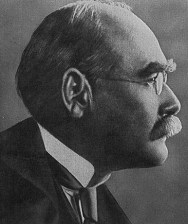
Rudyard Kipling

Kipling (Presumed Public Domain, via Wikipedia)

Anyhow, into the trenches. Our discussion was inspired by Rudyard Kipling’s short story “The Janeites”, first published in 1924. It’s a little tricky to read, being peppered with Cockney voices, but it’s worth the effort – and not just for Janeites. It is set in a London Masonic Lodge in 1920, during a weekly clean-up of the premises. There are three main characters – Brother Anthony, a veteran of army service in the Holy Land during World War I, now a taxi driver; Brother Humberstall, a hairdresser who is a veteran of artillery service in France and who suffers somewhat from shell-shock (now, PTSD); and the first-person narrator, ostensibly Kipling. Humberstall tells the others of his induction, during the war, into a secret society, the Janeites. He explains how he came to join this society, which included members from all ranks, and the tests he had to pass to do so. He tells how this society kept them sane during the war, and how it, in fact, saved him, when, after a terrible attack, he was his group’s only survivor:

… I walked a bit, an’ there was a hospital-train fillin’ up, an’ one of the Sisters—a grey-headed one—ran at me wavin’ ’er red ’ands an’ sayin’ there wasn’t room for a louse in it. I was past carin’. But she went on talkin’ and talkin’ about the war, an’ her pa in Ladbroke Grove, an’ ’ow strange for ’er at ’er time of life to be doin’ this work with a lot o’ men, an’ next war, ’ow the nurses ’ud ’ave to wear khaki breeches on account o’ the mud, like the Land Girls; an’ that reminded ’er, she’d boil me an egg if she could lay ’ands on one, for she’d run a chicken-farm once. You never ’eard anythin’ like it—outside o’ Jane. It set me off laughin’ again. Then a woman with a nose an’ teeth on ’er, marched up. “What’s all this?” she says. “What do you want?” “Nothing,” I says, “only make Miss Bates, there, stop talkin’ or I’ll die.” “Miss Bates?” she says. “What in ’Eaven’s name makes you call ’er that?” “Because she is,” I says. “D’you know what you’re sayin’?” she says, an’ slings her bony arm round me to get me off the ground. “’Course I do,” I says, “an’ if you knew Jane you’d know too.” “That’s enough,” says she. “You’re comin’ on this train if I have to kill a Brigadier for you,” an’ she an’ an ord’ly fair hove me into the train, on to a stretcher close to the cookers. That beef-tea went down well! Then she shook ’ands with me an’ said I’d hit off Sister Molyneux in one, an’ then she pinched me an extra blanket. It was ’er own ’ospital pretty much. I expect she was the Lady Catherine de Bourgh of the area.

Of course, you have to know your Jane Austen to get the Miss Bates reference … !

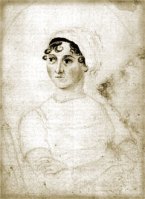
Jane Austen by sister Cassandra

Throughout the story Austen is only ever described as Jane, which bears out Harman’s comment above. There’s an entertaining description of Austen’s subject matter –

’Twasn’t as if there was anythin’ to ’em, either. I know. I had to read ’em. They weren’t adventurous, nor smutty, nor what you’d call even interestin’

– and some amusing references to various Austen characters, particularly Reverend Collins, Lady Catherine de Bugg (de Bourgh), General Tilney and Miss Bates. There’s also a comment that Austen did “leave lawful issue in the shape o’ one son”, and that was Henry James. Fair enough. At one stage, Humberstall chalks their guns with the names of Austen characters. His Janeite superiors approve, though there is some discussion about whether he’d accorded the right name to the right gun. For example:

… they said I was wrong about General Tilney. ’Cordin’ to them, our Navy twelve-inch ought to ’ave been christened Miss Bates …

Of course, much has been written about this story, including its secret society setting, the Masons, and Kipling’s intentions about that – but these other issues are not my focus here.

What is of interest is Humberstall’s statement late in the story:

“… You take it from me, Brethren, there’s no one to touch Jane when you’re in a tight place. …”

It is this that inspired our meeting because, while Kipling’s story is fiction, it is the case that Austen’s novels, among others, were provided to soldiers to read for morale. On the Kipling Society’s website is this:

In 1915, John Buchan and George Mackenzie-Brown, co-directors of Nelson, launched the highly successful Continental Library series, designed to be carried in soldiers’ pockets. Gassart [who wrote an article for the TLS in 2002] quotes the papers of W.B. Henderson, a Glaswegian schoolmaster attached to a Siege Battery in the Royal Garrison Artillery, in arguing that a book’s solace:

was its power to transport the infantryman from a world of “sergeants major and bayonet fighting, and trench digging and lorry cleaning and caterpillar greasing” into the fantasy of the novelist – and none was better at it than Jane Austen.

Her novels were also used during the war as part of therapy with shell-shock victims. Indeed, the above-mentioned Clare Harman says that three of Austen’s novels were “at the top of a graded Fever-Chart”. Academic Claire Lamont (in her paper, “Jane Austen and the nation”) suggests that this was because Austen’s “Englishness expresses itself as the standard of where and how one might live…”. Other critics have other ideas – though many of them are variations on this theme. One member of my group found a report that novels like Austen’s were used to gee-up damaged soldiers to get them back to the front! That shocked us somewhat. Bibliotherapy, it seems, is not a new thing.

Kipling, himself, was, not surprisingly, an Austen fan. As well as his story “The Janeites” (which term was coined by a critic back in the 1870s), he wrote a poem, whose final lines are used as an epigram for “The Janeites”:

Jane lies in Winchester, blessed be her shade!
Praise the Lord for making her, and her for all she made.
And while the stones of Winchester – or Milsom Street – remain,
Glory, Love, and Honour unto England’s Jane!

OK, so it’s a bit sentimental I admit, but he wrote it and that’s my excuse for using it to close today’s little commentary!

Rudyard Kipling
“The Janeites”
First published: Hearst’s International, MacLean’s, and the Story-Teller Magazine, May 1924
Available: Online at UWYO

Jarrah Dundler, Hey Brother (#BookReview)

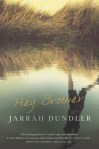
Jarrah Dundler, Hey BrotherIs she ever going to write another actual review you’ve been probably wondering but yes, I am – and it’s for the young protagonist book I mentioned in my recent Reading Highlights post. The book is Jarrah Dundler’s debut novel, Hey Brother, which was shortlisted for the The Australian/Vogel Upublished Manuscript Award in 2017 under the title Tryst. Tryst is quite a clever title: it’s the nickname of the 14-year-old protagonist Trysten, and suggests actual and hoped for trysts between the teen couples, but maybe it also has overtones of something more genre-like so was rejected? As it is, the published title conveys both the familial and broader meanings of brotherhood, which are played out nicely in the novel.

Publisher Allen & Unwin categorises Hey Brother as Popular Fiction, and describes it as “a genuine and compellingly portrayed family drama of a tough kid from rural Australia”. I would describe it, however, as a coming-of-age novel, and it reads to me as more Young Adult than Adult. There’s nothing wrong with this, but it explains my uncertainty about how to read it – or, to be more specific, how to write about it.

So, the book. Hey Brother has a first person narrator, the aforementioned Trysten who lives on a property in northern New South Wales with his mother, Kirsty, and his big brother Shaun. His father, Old Greggy, is there too, but prior to the novel’s start he’d been exiled by Kirsty to a caravan down by the river. So, it’s a somewhat fractured family, but not devastatingly so, because it becomes quickly clear that there’s an underlying love and respect between them all. The novel starts with big brother Shaun going off to fight “the Taliban in Afghanistan”, where he’d “been keen to head from the get-go, back when the dust from the Twin Towers was still settling”.

Into this mix comes uncle Trev who turns up to support his sister, Tryst’s mother who is worrying about her son off at war. Her form of “worrying” includes self-medicating with alcohol and letting her other responsibilities fall by the wayside. Unfortunately, Trev, who has some lovely moments of wisdom, also self-medicates his own demons the same way. It’s not a lethal mix, but it creates its challenges, and in fact offers Trev some insights. There is also Tryst’s best friend Ricky, and, as the book progresses, their girlfriends, Jessica and Jade. It’s a tight little community, and Dundler handles the relationships well. They feel real, with the tensions authentic, understandable, and not over-dramatised. In fact, Dundler’s characterisation is a strong point. His people live and breathe from the moment they appear on the page.

Hey Brother, then, features the typical YA narrative – a young teen meets his first love and is desperate to spend more time with her. But this particular story is complicated by the teen’s relationship with his brother whom he hero-worships but who returns from war psychologically damaged, suffering from PTSD. The novel’s crisis is, in fact, triggered by Shaun’s mental distress, and complicated by the conflict confronting Tryst between his love for Jessica and for his brother.

The novel is told first person by Tryst, in the vernacular of a rural, teenage boy. It’s fresh, direct, immediate, full of the profanity and colloquialisms that are appropriate to the context – but, here’s the thing, it is also more descriptive than reflective. Tryst comes across as a loving, heart-of-gold young man, but he is about the moment. To some extent we can see the deeper issues at play here – the PTSD, the complexity in the adult characters’ lives and relationships – but these are not the novel’s focus. The focus is Trysten, his life and, ultimately, his growth. This, to me, makes the novel Young Adult – and makes it quite different from, say, Laguna’s The choke (my review) where, although the story is young Justine’s, the themes focus on the impoverished environment – economically, socially, spiritually – that makes her life the way it is.

Did, then, I enjoy the novel? Yes, in that its protagonist and setting are foreign to my experience and I like to read about lives different to mine, and because the writing was engaging, lively, and appropriate in language and imagery. Here, for example, Tryst describes Trev confessing to past troubles:

It was like he wanted the words to go straight down the plughole after he’d uttered them.

And Trev, late in the novel, gives Tryst some advice:

‘Decisions, mate. That’s what defines you in the end. Some advice for ya–before you make one, try and give it a little thought beforehand, would ya? ‘Cause, believe me, regret’s a f****n c**t of a thing to live with.’

I also liked that late in the novel, we learn, in passing, that Ricky, Tryst’s friend, is indigenous. The reference is somewhat didactically done, but Dundler clearly wanted to do what we need more of, that is, to include indigenous characters without their indigeneity being an issue in the story. How you do this is the challenge.

However, Young Adult Fiction is not really my interest. Young Adult concerns belong to a long-ago part of my life. I appreciated Dundler’s skills in plotting and characterisation, not to mention his heart and desire to give life and air to some big issues, but I did tire at times of Tryst’s concerns, perspective and voice. Not his fault, mine. I would unhestitatingly recommend this book to YA readers – and would willingly check out Dundler’s next work. A good debut.

For a beautiful post on this book, check out Theresa Smith’s (Theresa Smith Writes).

Jarrah Dundler
Hey brother
Sydney: Allen & Unwin, 2018
281pp.
ISBN: 9781760631123

(Review copy courtesy Allen & Unwin)

Note: The asterisked words in the quote are to defect the wrong sort of hits coming my way.

Rodney Hall, A stolen season (#BookReview)

Rodney Hall, A stolen seasonRodney Hall is one of those Australian authors who deserves more attention than he seems to get. Consequently, I’m thrilled to at last include him in my blog, with his latest novel A stolen season. I was introduced to Hall back in the late 1980s when my reading group read his surprising novel, Just relations, and I’ve also read another surprising novel by him, The day we had Hitler home. Hall is good at surprising, because A stolen season isn’t exactly run-of-the-mill, either, in terms of its characters and set-up.

It’s a tricksy book comprising three different, more-or-less alternating, story-lines. The chapters go like this: Adam and Bridget, Marianna, Adam and Bridget, John Philip, Adam and Bridget, Marianna, Adam and Bridget. Adam and Bridget, then, form the driving story, and there seems to be no connection between the three sets of characters for a very, very long time. Indeed, by the middle story, John Philip, the only literal connection is a minor character from the first Adam-and-Bridget chapter appearing as a rather minor character in this one. Later, a similarly loose, not-exactly-direct, connection occurs between Adam and Marianna. What gives, we wonder? Who are Marianna and John Philip? Why are we also reading about them? And, will they all ever actually meet, as we expect in novels like this? Well, all I’ll say is that Hall does not, as is probably his wont, do the expected. No, I’ll say more in fact: if we focus our energies on worrying about this structural plot issue, we risk missing what’s important, which is the overarching idea that gradually reveals itself, an idea relating to money and power, and to the way they can not only deceive but actively generate inhumane/anti-human values.

The main story, Adam and Bridget’s, centres on soldier Adam. He returns from fighting with the Coalition of the Willing in Iraq so severely damaged that he can only live, get around, by means of an exoskeleton (the “Contraption”) that is activated and controlled by his brain, something which Hall explains at the end is not complete science fiction. Adam and Bridget’s story is surprising from the beginning, because, while we realise that this injured soldier, Adam, whom we’ve just met, has a wife, we don’t realise, until he arrives home, that the marriage was essentially over by the time he’d gone to war. This was not because they hated each other but because they’d married on a whim – “it seemed a fun thing to do at the time, but they were just kids and kidding” – and the marriage had run its course. Unfortunately for Bridget, she had never got around to legally leaving Adam after he had physically left her to go to war, because it had never seemed necessary. Now what was she to do?

Adam and Bridget’s story is darkly humorous, but also deeply moving, not least because Hall imbues them with a humanity that we can relate to and recognise. They embody the sorts of inner conflicts anyone would experience in a situation like this – Adam, desiring his wife but incapable of achieving what he most wants, wants, genuinely, generously, to set her free, and Bridget, feeling trapped but empathetic, increasingly tender, wants to do the right thing by this decent strong man. Hall writes their story – writes all of the stories in fact – from the individual characters’ third person points of view. Not only does this make for engrossing reading, but it reveals Hall to be a writer who knows, fundamentally, what makes us human.

Meanwhile, Marianna, a German-born Australian, is on the run in Belize after discovering that her husband had seriously deceived her and was implicated in the greed that underpinned what we Australians call the GFC. While Adam and Bridget’s story is the most personal one, hers is the more mysterious, mystical one. Why is she in Belize, and what does she want with the Mayan pyramid? It’s all to do with numbers, mathematics, and end-of-the world predictions. Hers is the hardest story to pin down, because of its more mystical quest. She sees the temple:

… the structural puzzle of steps and platforms on all sides forming a pyramid crowned by a little room with a single doorway–like the lonely eye of the soul.

Marianna gets it. With neither front nor back, nor left nor right, the geometry is inward looking.

And then there’s John Philip, 70-something, indolent and mega wealthy from family money, who suddenly finds himself in possession of a strange bequest – a long-lost book of “the” artist Turner’s erotic sketches of female pudenda. What he does with these is to thumb his nose at his family in a stylish but shockingly public way while, at the same time, making a statement about art. His is the central or peak story to and from which the other chapters formally if not narratively move. It is satiric, rather than tragic, and has a guffaw-producing, conversation-ending last line, but, in placing him at the centre of his story, Hall is surely presenting his manifesto on the meaning and role of art. John Philip realises:

‘The thing about art’–he finds words for the revelation taking shape in his mind–is that art can be a gift. It’s for whoever sees what it is. That’s what makes it art in the first place.’ He probes deeper. ‘I suppose that also makes it political. I mean, if you can’t stop it speaking the truth.’

Back to Adam and Bridget. What is so special about their story is the way Hall weaves the political into the personal so closely that they are almost indistinguishable. It is here that the “cost” of war is plain to see; it is here that the “money” theme – the idea that “the accountants” are at “the wheel” – is played out to its bitter end; and yet, it is also here that people’s ability to be quietly heroic in the only important way, in our treatment of each other, is laid bare. It’s an astonishing novel about some specific issues of our time, namely the Iraq War and the GFC, and about those wider questions concerning being human and the meaning of art.

Now, however, I’m kicking myself, because this book deserves a wider audience than I’ve seen it getting – and, unfortunately, its turn came up on my reading pile at the slowest time of year for blog reading. It’s a time when readers might peruse various “best-of” lists, but, at least as I’ve observed in previous years, pay less attention to more serious posts. This is a real shame, because both Rodney Hall and this, his latest book, deserve some real attention. It’s a book that will pay the reader who likes to take time to ponder in spades.

Lisa (ANZLitLovers) also enjoyed this book.

Rodney Hall
A stolen season
Sydney: Picador, 2018
342pp.
ISBN: 9781760555443

(Review copy courtesy Pan Macmillan Australia)

Raphaël Jerusalmy, Evacuation (#BookReview)

Raphael Jerusalmy, EvacuationRaphaël Jerusalmy, for those who, like me, hadn’t heard of him, is a French-born and educated writer living in Tel Aviv. He had a career in the Israeli military intelligence services, worked in humanitarian and educational fields, and is now an antiquarian book dealer in Tel Aviv, where his novella, Evacuation, is set. In some ways, the book is a love letter to Tel Aviv – but it is more than that, too …

Evacuation is a short, quick, but powerful read. The narrative is structured around a road trip, in which twenty-something Naor is driving his mother from her kibbutz home to Tel Aviv. As they drive he tells her what happened in Tel Aviv, after he, his girlfriend Yaël, and his grandfather Saba, had jumped off the bus that was taking them out of the city, as part of a mandatory evacuation process.

The thing about this book is that although we realise the war is part of the ongoing Middle-eastern conflict, no specifics are given. No dates, no enemy, just, later on in the story, that peace negotiations were taking place in Geneva. By the time the novel starts, that peace had been achieved (for the moment anyhow) and Naor is dealing with the aftermath. The lack of specificity universalises the story, focusing us on the characters’ experience more than on the whys and wherefores, rights and wrongs, of the war.

So, their experience. Firstly, I should explain that it was Saba and Yaël who had decided not to evacuate, with Naor feeling obliged to stay with them. They are all artists – Naor a filmmaker, Yaël a visual artist, and Saba a writer – so there is also an underlying thread about art and resistance. They go to friend Yoni’s house in the already evacuated part of the city, and from there they learn how to survive – how to find food, water, clothes – and how to occupy their time. They roam further and further, taking risks to enjoy a dip in the sea; they enjoy strolling down Tel Aviv’s beautiful Rothschild Boulevard; and, they decide to make a film, titled Evacuation, to Naor’s script and with Saba and Yaël acting.

It’s while filming a critical scene in a synagogue that a long-range missile attack occurs, forcing them to take cover. After this attack, Yaël decrees that they are not going to let air-raid sirens disturb their peace again – “From now on, we were going to behave as if there was no war” – setting us up for the tragedy that we have been sensing through Naor’s narration.

Now, I said that the novel focuses more on the characters and their experience, than the war. However, there are occasional references to Zionism and the ongoing political situation, including this on Saba’s opinion:

Deep down Saba wasn’t unhappy about what was happening to Tel Aviv … He said it did no one any harm to get a kick up the arse from time to time. And that we Israelis badly needed it. Because we had got stuck in a stalemate. Not only with the Palestinians, which was of course unfortunate. But also and especially with ourselves, which was much worse.

So the evacuation was timely. It gave us an undreamt-of chance to wipe the slate clean. To start again. In his mind, Zionism as an idea was not a failure. But it was stagnant. It had come unstuck in its application. Because of this and that. Those were his exact words. This and that. He spoke about restarting our attempts at Jewish socialism. About the importance of education. ‘Everything stems from that.’ And about being kinder in general. To poor people, and to Arabs.

There’s also Yaël’s stronger statement that Tel Aviv was the only place she “felt safe. From those at war with us. From those who have morality and justice on their side.” [my stress]

All this is narrated by Naor to his mother as they continue their trip – and as he does, certain things become clear. One is that there’s been some falling out between his mother and Saba, her father, and that this trip is partly a peace-making one (subtly paralleling the political war-and-peace background to the story.)

Now, I daren’t say any more for fear of giving the whole lot away. While it’s written nicely (albeit I read it in translation), its main appeal, besides the story, is its engaging narrative structure and gentle tone. I loved the way Naor’s story is interrupted regularly by comments from his mother (not to mention road signposts). These interactions, while hinting at some of the tensions needing to be resolved, also imbue the book with a lovely normal intimacy, unexpected perhaps in a book with such subject matter.

Evacuation is an open-ended book, one the reader can consider from various perspectives, including the choices we make, love and family, art and resistance, war and peace. I found it a surprisingly enchanting read, which I hope doesn’t make me sound insensitive to its seriousness, because I felt that too.

Raphaël Jerusalmy
Evacuation
(Trans. by Penny Hueston)
Melbourne: Text Publishing, 2018 (Eng. ed.)
150pp.
ISBN: 9781925603378

(Review copy courtesy Text Publishing)

Jan Wallace Dickinson, The sweet hills of Florence (#BookReview)

Jan Wallace Dickinson, The sweet hills of FlorenceThere are several reasons why I enjoyed Jan Wallace Dickinson’s historical novel The sweet hills of Florence, the first being Florence itself. I fell in love with Italy in Florence. Brunelleschi’s dome, Giotto’s belltower, the Uffizi and all the other gorgeous places of art and architecture, not to mention the food, combined to capture my heart. It was the first foreign place to do so, and so remains today a special memory. Dickinson, who has apparently lived and worked in Italy for many years, clearly loves Florence too, because it is described in this book with such love.

However, that’s not the only reason for liking this book. Another is the history. I’ve read many, many novels set during the second world war, but not many set in Italy, let alone in Florence. When I visited Florence way back in 1980, it was the art that drew me. I knew very little of its war history, and I don’t recollect its being much on display. Dickinson, though, tells a fascinating story, one that captures both the horror and chaos, the brutality and bravery of war, and particularly of Italy’s war, well.

In some ways, the book could be described as historical romance, except that it doesn’t fit the bodice-ripper formula that I, of admittedly limited experience, see as the definition of this historical fiction sub-genre. What I’m saying in other words, is that in this book, although the love story underpins the plot, it doesn’t drive it in a suspenseful way. This enables Dickinson to explore the main relationship in a more subtle, dare I say, more nuanced way – and to focus on other themes as well.

The story, then, concerns two cousins, Enrico and Annabelle, who are in their late teens to early twenties, during the period of war – 1941 to 1945 – covered by the book. It’s clear from the beginning that Annabelle loves Enrico, and it doesn’t take long before we realise her love is reciprocated. The story follows their lives as partisans, with the Giustizia e Libertà movement within the Italian resistance movement. It’s a story of love, loyalty and camaraderie, but also of courage, deprivation, brutality, and chaos. Dickinson writes this convincingly, though I must say that all the names and places sometimes made my head spin! Here are a couple of examples of her descriptions, describing the German occupation of Florence:

There was no shortage of good citizens ready to settle a score by denouncing someone to Major Charity. The war lifted a rock and from under it, unimaginable creatures emerged, creatures who could not survive in the sunlight, who could thrive only in the dank shady corners of a civil war.

AND

This was the real Florence, the Florence of sobbing and wailing and tearing of hair, not the painted and decorated Florence put on show by the authorities to distract the popular, like the dance of a painted harlot before an audience of terminally ill patients in a madhouse.

Another aspect of the book which made it interesting reading is its structure. The novel is divided into 6 parts, and flips between war-time and the 2000s (up to 2008). The main war action is told chronologically through the middle parts of the novel, while at the beginning and end, we alternate somewhat between past and present. Again, this structure forces us to focus on the characters and their development, on the ideas and themes, rather than the plot.

There’s also paralleling of Annabelle’s love for Enrico, with Clara Petacci’s love for Benito Mussolini. I enjoyed this too. Dickinson spends some time describing Clara and Ben’s relationship. In her Acknowledgements she describes them as “fictionalised characters constructed from my interpretation of diaries, reports and histories.” Clara and Ben’s story serves a few purposes in the novel besides being a focus for Annabelle’s thinking about love. It humanises the two characters, for a start; it encourages us to consider the complexities of their relationship; and it makes the manner of their deaths all the more shocking.

We have no choice, do we?

In the end though, the ideas and themes were what I most enjoyed about the book, particularly those regarding the brutality of war and the lessons learnt or, to be more precise, not learnt. Dickinson makes very clear several times through the novel that there are no saints in war – and that Enrico and Annabelle themselves were capable not only of “justifiable” killing but of more brutal acts:

We cross a line. We decide killing os justified. We have no choice, do we? After that, nothing is taboo. Nothing is unthinkable. We are Freedom Fighters. We are heroes. We have rights on our side. Then wars end. We sleep and try to forget. But beneath it all we are still killers. We stand on the other side of the line. (from Annabelle’s diary)

Dickinson’s main theme, though, concerns the lessons of war. Annabelle’s reaction on the brutal death of Mussolini and Clara, and the subsequent way the bodies were treated, was

I wept for what we have become. Have we learned nothing?

Then, late in the novel, she makes a similar comment, quoting a partisan colleague who’d said:

“Italians … do not learn from the past. They live in the continuous present.”

There were times when I wondered about the reason for the epic nature of this novel, for its spanning so many decades and for, something I haven’t mentioned before, also spanning two countries, Italy and Australia to which Enrico went after the war. Dickinson, through Annabelle and her beloved niece Delia, consider the differences between Italy and Australia, seeing, for example, the former as kinder and the latter as more free. I’m not sure I agreed with all their conclusions, and I’m not sure what these discussions added to the novel, but …

… what did add to the novel were the references to the leering Berlusconi’s re-election in 2008 despite his increasingly fascist tendencies. Seen by a horrified Delia and Annabelle as “a leap back into the past”, it leaves us with, indeed, the question, “have we learned nothing?” The sweet hills of Florence, then, is an engrossing read if you like a strong story about “real” characters, that asks the important questions.

Lisa (ANZLitLovers) also enjoyed this book – I promise I hadn’t read her review when I wrote my introduction, which is suspiciously similar!! I decided not to change it.

AWW Badge 2018Jan Wallace Dickinson
The sweet hills of Florence
Melbourne: Hybrid Publishers, 2018
401pp.
ISBN: 9781925272840

Review copy courtesy Hybrid Publishers.

Viet Thanh Nguyen, The sympathizer (#BookReview)

Viet Thanh Nguyen, The sympathizerA cover blurb on my edition of Viet Thanh Nguyen’s Pulitzer Prize winning novel, The Sympathizer, captures the novel perfectly when it calls it “intelligent, relentlessly paced, and savagely funny” (Wall Street Journal). I loved reading it. It’s quite coincidental that I read this straight after Hoa Pham’s Lady of the realm (my review) but they make an interesting pairing because both deal with the Vietnam (or American) War and its aftermath, both are written in first person from a Vietnamese character’s point of view, and both question what happens when revolutions win. But, their approaches couldn’t be more different.

The sympathizer starts with an in-your-face statement by a never-named narrator: “I am a spy, a sleeper, a spook, a man of two faces.” It is April 1975 and the war has ended with the capture of Saigon by the North Vietnamese Army, but in the second paragraph we discover something else about our narrator. He is not talking to us but to a “Commandant”. So, where is he, and why is he talking to a Commandant? We don’t fully find out until near the end, although we soon discover that he is being held captive and is writing his “confession”. The story he tells, the story we read, is his confession. And what he confesses to is his life as a North Vietnamese mole in the close employ of a South Vietnamese General.

In this role, he leaves Saigon in the chaotic evacuation and ends up in Southern California, still working (now unpaid) for the General, while at the same time sending covert reports back to his “aunt” in Paris. In other words, in the USA, he maintains his life as a man of “two faces”, a man who is “able to see any issues from both sides”. He can do this, not only because of his role as a mole, but also because he is a bastard, the son of a Vietnamese woman and a French priest who had seduced her and had never acknowledged his son. With feet in both camps – the Orient and the Occident – he is well-placed to comment on their respective cultures and actions while, at the same time, symbolising their conflicts, confusions and misunderstandings. Near the end he says:

I was always ever divided, although it was only partially my fault. While I chose to live two lives and be a man of two minds, it was hard not to, given how people had always called me a bastard. Our country itself was cursed, bastardised, partitioned into north and south, and if it could be said of us that we chose division and death in our uncivil war, that was also only partially true. We had not chosen to be debased by the French, to be divided by them into an unholy trinity of north, centre and south, to be turned over to the great powers of capitalism and communism for further bisection …

What makes this book such a great read – besides its heart and themes – is its writing. Nguyen migrated to the USA with his parents when he was 4 years old. In the notes at the back of my edition, he describes growing up in a Vietnamese enclave in California, and how he’d decided that he couldn’t live life well with two languages, so decided to “master one and ignore the other. But in mastering that language and its culture, I learned too well how Americans viewed Vietnamese”. This seems to the main driver for this book – to tell a story about the Vietnam War from a Vietnamese perspective – but his aim is wider than that too. It is to comment on war, on its futility, and on the way American culture seems to thrive on it.

The first chapter introduces us to the central feature of Nguyen’s writing, satire, and my, it shows how well he mastered his adopted language. If the pace is relentless, as the Wall Street Journal says, so is the satire. Its targets are broad, and non-discriminatory, though, admittedly, American life and culture bear the major brunt. In Chapter 3, he discusses prostitution:

I am merely noting that the creation of native prostitutes to service foreign privates is an inevitable outcome of a war of occupation, one of those nasty little side effects of defending freedom that all the wives, sisters, girlfriends, mothers, pastors, and politicians in Smallville, USA, pretend to ignore behind waxed and buffed wall of teeth as they welcome their soldiers home, ready to treat any unmentionable afflictions with the penicillin of American goodness.

The language is sly and wry, as our narrator of the divided-soul teases us – provokes us – again and again with dualities and paradoxes. Literally, he is a communist sympathiser, but his true sympathies are broader. “Although it’s not correct, politically speaking”, he says, he feels “sympathy” for the South Vietnamese poor who were attacked by their own soldiers. “No one asks poor people if they want war”, he writes.

And so the book continues. There are comic set-pieces such as his role as a Vietnamese expert on the making of a film that reads very much like Apocalypse Now. The experience teaches him that not controlling the way you are represented results in “a kind of death”. There are also awful scenes of torture and violence, including those where he is ordered by the General, even in the USA, to eliminate apparent opponents. He says of the General’s plans:

The General’s men, by preparing themselves to invade our communist homeland, were in fact turning themselves into new Americans. After all, nothing was more American than wielding a gun and committing oneself to die for freedom and independence, unless it was wielding that gun to take away someone else’s freedom and independence.

This idea of “freedom and independence” is the complex conundrum that underpins the fundamental irony of the book, from its opening chapters when Ho Chi Minh is quoted as saying “Nothing is more important than independence and freedom”. What these mean, what people do in their name, and why so often they are taken away by the very people who called for them, are scrutinised by Nguyen via his narrator.

The sympathizer is, in many ways, a bitter novel, because it sees clearly into the human heart, and its messy, divided nature, its “moth-eaten moral covers” – but the bitterness is offset by a sense of resilience and a belief that it need not be like this. A big thanks to my Californian friend Carolyn for sending me this.

Lisa (ANZLitLovers) was also impressed by this novel.

Viet Thanh Nguyen,
The sympathizer
New York: Grove Press, 2015
382pp.
ISBN: 9780802124944

Hoa Pham, Lady of the realm (#BookReview)

Hoa Pham, Lady of the realm

Hoa Pham was one of the participants at the recent Boundless Festival (my post), so it’s rather apposite that her latest work, Lady of the realm, popped up as my next review copy. The very brief author bio on the Festival site describes the novel as “about a Buddhist clairvoyant in Vietnam”. Well, it is, but it’s about far more than that too.

Vietnamese-Australian Hoa Pham was born in Hobart after her Vietnamese parents went there to study in the 1970s. She has written several novels, children’s books, plays and short stories, but her novella, Lady of the Realm, is the first that I’ve read. It’s a slim book, a novella in fact, told first person in a chronological sequence that covers nearly five decades from 1962 to 2009. If you know your south-east Asian history, you’ll realise that this time-span starts during the Vietnam or American War (depending on your perspective.)

It’s quite a challenge to cover such a long and tumultuous period in less than 90 pages, but Pham achieves it by keeping her focus tight – to the experience of the Buddhist monk Liên. Before we meet her formally though, there is a short prologue, which is also in her voice, albeit unknown to us at that point. She prepares us for the vignette-style in which she tells her story:

Looking back over the years, it seems that time stretches and contracts, depending on my experience of each moment. Some moments are etched in my memory, like the sunlight patterning the water in the river, ethereal moments captured only by my mind. Other longer stretches of time are a blur ….

This makes perfect sense to me in terms of how we remember our lives, and hence works for telling a story that covers a long life in a turbulent place. However, if you are someone who likes to get lost in a character and the ongoing drama of life, this book may not work for you.

So, Liên. She is introduced in 1962 as a young girl who has a prescient dream that the Viet Minh will come and destroy her fishing village. This marks her as the one to succeed her grandmother Bà as keeper of the shrine and mouthpiece for the Lady of the Realm (as she calls the Buddhist goddess of mercy, Quan Ám). Unfortunately, the village head ignores the warning, and the village is attacked with most in the village killed. Liên, however, escapes, and lives to chronicle the aftermath.

The book then takes us through moments in Liên’s, and therefore Vietnam’s, life in 1968, 1980, 1991 and 2007, before finishing in 2009 when Liên is now an old woman living in a Buddhist monastery. She has experienced much violence and oppression – through the war and the “fall of Saigon”, through the Communist regime which she “naively believed” would bring peace but which brought “re-education” and more death, and through later “reforms” which were supposed to open up Vietnam but saw her beloved Prajna Monastery destroyed. Liên survives it all, sustained by hope:

Ever hidden away the Lady could still bring hope, I thought. I had found the Lady in many guises, but the strongest seemed to be the Lady I had inside. (1980)

This hope is sorely tested, however, and in the last section she says:

Sanctuaries are an illusion, only suffering is real. I know that this is not what Buddha taught, and my experience has made my own sayings out of his teachings. I believe that any safety I find is temporary, any refuge is not permanent. But my teacher would say, all things are impermanent and change. I hope that our situation will change. Some days I cannot bear another moment of being under siege. (2009)

The tone, here, is typical of the book as a whole – calm, somewhat resigned, and sometimes hopeful.

Now, how to describe the writing? There’s the tone, and there’s Pham’s simple, direct language (which is also evidenced in the above excerpt). There’s also her preponderant use of short paragraphs. And there’s the episodic form, with each episode/year heralded by an epigraph, the last four by Buddhist monk and peace activist, Thích Nhất Hạnh. Together, these create a sort of prose-poem, and with that, dare I venture, a higher (or perhaps just universal) plane of truth!

In other words, Pham has contrived to tell a personal, human story through her character Liên, while also conveying a philosophical attitude to life based on endurance, compassion and most of all hope. A moving, inspiring read.

Lisa (ANZLitLovers) captures the book beautifully in her review.

aww2017 badge

Hoa Pham
Lady of the realm
Mission Beach: Spinifex Press, 2017
98pp.
ISBN: 9781925581133

(Review copy courtesy Spinifex Press)

AS Patrić, Black rock white city (Review)

AS Patric, Black rock white cityWith that extended conflict known as the Yugoslav Wars (1991-2001) now over for more than a decade, we are starting to see books written about them. I’ve reviewed two on this blog to date, Aminatta Forna’s novel The hired man (2013) (my review) on the Croatian War of Independence, and Olivera Simić’s memoir Surviving peace (2014) (my review) on the Bosnian War. AS Patrić’s Miles Franklin Award winning novel, Black rock white city, (2016), which also draws from the Bosnian War, now makes three.

Like The hired man, Black rock white city explores the aftermath of war, but unlike Forna’s book, which is set within the war-torn country, Patrić’s book is set in Australia, and tells of refugees, Jovan and his wife Suzana. The novel starts about four years after their arrival and, although both were academics in Sarajevo, they, like so many refugees, work in their new country as cleaners and carers. It soon becomes clear that they have not recovered from their war experience. Gradually, over the course of the book, Patrić reveals the horrors of their experience. We learn that, like so many who suddenly find their country at war, they had to face that awful question, “should I stay or should I go”. As it turned out, they stayed too long, and Jovan feels he failed his wife by not going early. When we meet them, their relationship is stressed, and they seem unable to provide each other the love and emotional support they so badly need. It’s excruciating to read, because it’s so real, so believable.

I found this book particularly enlightening because I worked with a woman who was damaged by this war. Like Patrić’s two protagonists, she was Bosnian Serb, but unlike them she left early. However, the impact on her of this forced loss of her country, her culture, was immense.

But, I digress … back to the book. It opens with hospital cleaner Jovan cleaning graffiti in an examination room. We soon discover that the hospital is experiencing a bout of graffiti-writing, and that Jovan is the graffiti cleaning expert. No-one knows who is creating the graffiti, which becomes increasingly bizarre. It appears on all sorts of surfaces (such as a corpse’s back, a menu blackboard, the optometrists’ charts) and comprises a variety of seemingly random, though often pointed, words and phrases (such as “The/Trojan/Flea”, “Obliteration”, “Dog Eat Dog” and “Masters of Destiny Victims of Fate”), which Jovan starts to read as messages to him. The graffiti artist is dubbed Dr Graffito. This storyline gives the book the patina of a mystery or even, perhaps, a thriller.

However, while the graffiti provides a plot-line for the novel, the main narrative concerns Jovan and Suzana, their relationship with each other and with other people, including a lover (for Jovan, because Suzana, in her pain, has withdrawn sex), work colleagues, friends and neighbours. Underpinning this narrative is the ongoing trauma of war. Jovan, for example, is frequently dogged by “the black crow”. He “feels as though he uses a rail for a pillow – always listening to the vague rumblings of oncoming annihilation”. Once, Suzana remembers, he could

turn almost anything over to a new perspective, see something deeper, redeeming, more beautiful even if painful. It was what made him such a superb poet back in Yugoslavia … He doesn’t write anymore and it’s as though he never did.

There is poetry in his head though – including a mantra that gets him through his days: “Maroochydore and Mooloolaba, Noosa and Coolum”. Language – the loss of his own, his inability (or is it refusal?) to speak proper English, not to mention the disturbing graffiti – functions as a metaphor for his sense of displacement.

Meanwhile, Suzana, notes Jovan,

is spending more of her time scribbling into her notebooks. The only place safe for her in the time since Bosnia, was somewhere buried underground. Coming to the surface isn’t going to be easy.

Patrić crafts the story skilfully. It’s a debut novel, but Patrić has published two short story collections and is a teacher of creative writing. It shows. The story is told third person, initially from Jovan’s perspective, but later Suzana’s is alternated with his, which fleshes out our understanding of Suzana, while keeping the perspective tightly focused on their experience. The plot unfolds stealthily, as we shift between two questions: will the graffiti artist be discovered, and can Jovan and Suzana pull through? By the end, the strands come together – so cleverly, so shockingly. And then there’s the sure, controlled writing. The pacing, the wordplay and touches of humour, the imagery, the dialogue, and the changing rhythms, make it delicious to read, even while the content confronts and distresses.

Late in the novel, Suzana suggests to Jovan that Dr Graffito is “putting his pain into someone else”, and that seeing his “madness in someone else might make it feel more bearable”. I don’t want to spoil the novel, but Suzana seems to be right, until the end where Dr Graffito’s actions force a confrontation that bring it all to a head.

What is Patrić’s motive for writing this? Early in the novel, Jovan finds one of the many notes Suzana loves to leave around, a quote from her favourite author, Nobel-prize winner, Ivo Andrić:

You should not be afraid of human beings. I am not, only of what is inhuman in them.

Jovan, on the other hand, says that “so much of what happens, shouldn’t happen”. These two ideas form the crux of the book. We have a cast of human beings, who are all real, all flawed in some way. They muddle on, some better than others, some needing a bit of “moral flossing”, some a bit of “ethical cleansing” (and what a clever wordplay that is, keeping war’s horrors close to our minds.) We see what happens, during and after war, when people let hate get the better of themselves and release the “inhuman” within, thereby wreaking what “shouldn’t happen” on others. This is a big book, for all its mere 250 pages, because it tackles the fundamental question of how are we imperfect humans to live alongside each other.

Fiction, Suzana says, is writing for the soul. If that is so, Black rock white city is one soul-full book – and a worthy winner of the Miles Franklin.

Lisa (ANZLitLovers) was also impressed by this book, as was Bill (the Australian Legend).

AS Patrić,
Black rock white city
Melbourne: Transit Lounge, 2015
248pp.
ISBN: 9781921924835

Ellen N. La Motte, Alone (Review)

I decided to read Ellen N La Motte’s story “Alone” from recent Library of America (LOA) Story of the Week offerings because it was a war story, but as I read LOA’s notes I became more and more intrigued. I hadn’t heard of La Motte (1873-1961) before, but she was an American nurse. Two years before the US formally joined the First World War in 1917, she offered to work at the American Hospital of Paris.

She wasn’t pleased by what she saw. Rather than a serious “warzone” she found a bunch of “alleged do-gooders crowding out the recuperating soldiers”. In an essay written at the time, “An American Nurse in Paris,” she described the workers, as follows:

nearly all are dressed in the becoming white gowns of the French Red Cross and a few are pearled and jeweled, rouged and scented till they are quite adorable. . . . This system floods the institution with a mass of unskilled labor, some of which is useful, much superfluous, and some a positive menace to the patients themselves.

Not surprisingly, La Motte decided to move on, and worked for a year in a military hospital in Rousbrugge outside Dunkirk. She was little prepared, LOA writes, for the horror she witnessed. She herself described it as “beyond and outside and apart from the accumulated experience of a lifetime.”

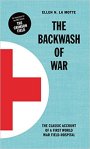
Ellen N LaMotte, The backwash of warWhile working at the hospital, she wrote of her experiences, and upon her return in 1916 published a dozen or so sketches in The backwash of war: The human wreckage of the battlefield as witnessed by an American hospital nurse. However, it was withdrawn in 1918 by her publisher, due to government pressure. It was too “unpalatable”, and wasn’t published again until 1934!

“Alone” is one of the sketches in the book. It tells the story of injured soldier, Rochard, who has gas gangrene. It’s a straightforward story – story-wise, anyhow. Rochard is brought into the hospital within six hours of being injured, but his wounds are inoperable and all know he will die. All they can do is offer pain relief and nursing care to keep him as comfortable as possible. What impressed me about the piece was La Motte’s insight, her humanity, and her ability to write, all of which turn this sad story into something more powerful.

La Motte describes the doctors in the hospital as comprising, primarily, young recent graduates from medical schools, and old doctors who had graduated long ago. She writes that

all those young men who did not know much, and all those old men who had never known much, and had forgotten most of that, were up here at this field hospital, learning. … there were not enough good doctors to go round, so in order to care for the wounded at all, it was necessary to furbish up the immature and the senile.

Oh dear. She describes the initial treatment given to Rochard in rather gruesome detail – which I won’t share here – and then describes his dying. He is given morphia, which “gives a little relief, at times, from the pain of life, but it is only death that brings absolute relief”. She never mentions euthanasia but, from her description of Rochard’s horrendous pain, you sense she’d support it. His death is a long and painful one. She writes, after one trying night:

So when the day nurse came on in the morning, there was Rochard strong after a night of agony, strong after many picqures of strychnia, which kept his heart beating and his lungs breathing, strong after many picqures of morphia which did not relieve his pain. Thus the science of healing stood baffled before the science of destroying.

As Rochard nears death, the screams of pain reduce and he becomes quiet. She writes that:

he had been decorated with the Médaille Militaire, conferred upon him, in extremis, by the General of the region. Upon one side of the medal, which was pinned to the wall at the head of the bed, were the words: Valeur et Discipline. Discipline had triumphed. He was very good and quiet now, very obedient and disciplined, and no longer disturbed the ward with his moanings.

Bitter, eh. The piece moves to its inevitable end – Rochard’s death – but the language La Motte uses to describe it and the way she controls the narrative to deliver a punch at the end, is impressive. This woman could have been a writer – well I suppose she was! – but her passion lay elsewhere, nursing and public health.

After the war La Motte, who wrote many books and articles on her nursing experiences, travelled in Asia and saw the devastation caused by opium addiction. According to the Johns Hopkins Medical Institutions, where her papers are stored, she became an authority on opium trafficking, and reported to the League of Nations. She was awarded the Lin Tse Hsu Memorial Medal by the Chinese government in 1930 and received the Order of Merit from the Japanese Red Cross.

But, she did more, too, so I’m going to conclude with the final paragraph from the American National Biography Online:

Ellen La Motte’s professional life was devoted to causes she analyzed through the lens of public health advocacy. Her efforts on behalf of the antituberculosis campaign, woman suffrage, and the anti-opium crusade emerged from a firm belief that promoting ways to improve the health of the larger community could create a more equal and just society for all.

Someone well worth knowing about … I’m glad I decided to read this LOA story.

Note: The backwash of war is available in entirety at Project Gutenberg.

Ellen L. La Motte
“Alone”
First published: The backwash of war: The human wreckage of the Battlefield as witnessed by an American hospital nurse (1916)
Available: Online at the Library of America