Jane Austen’s The Watsons in Trove: Finishing the unfinished

While searching Trove recently for my Monday Musings 1923 sub-series, I came across some articles on Jane Austen’s unfinished novel, The Watsons, and can’t resist sharing them with you.

I have written about unfinished books before, including on Jane Austen’s unfinished novels, The Watsons and Sanditon. Unfinished books aren’t to everyone’s taste but, if you love an author, you’ll read anything they wrote. Such is the case for me with Jane Austen.

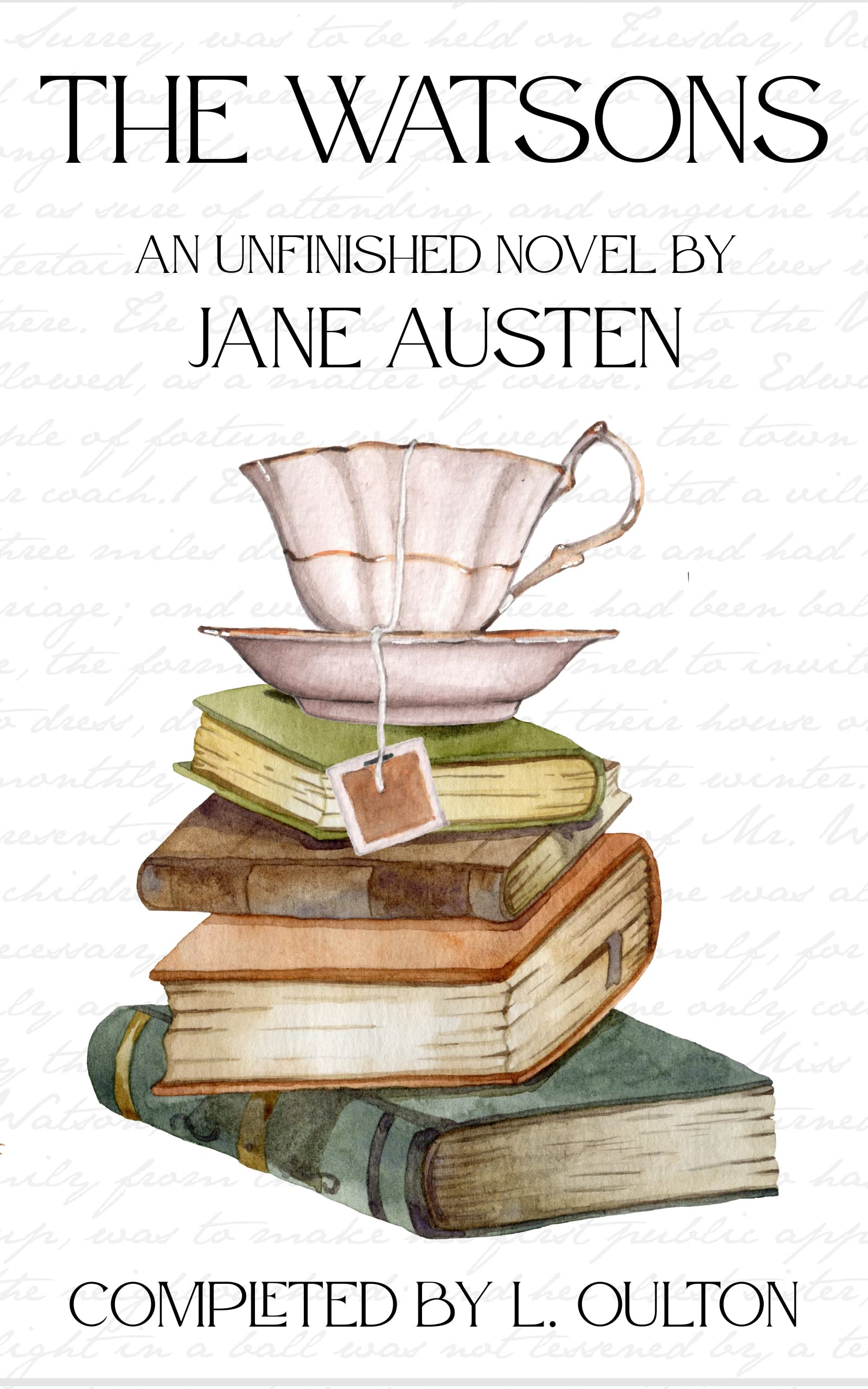
So, The Watsons. Just as writers can’t seem to stop writing sequels, prequels and multifarious other versions of Austen’s six published novels, they are also drawn to her unfinished novels. The Watsons, for example, which Austen abandoned around 1805, has been “finished” several times. The first appeared in 1850, and was not presented at the time as a continuation. Wikipedia provides a good summary, explaining that it was an “adaptation” written by Austen’s niece Catherine Hubback, who titled it The younger sister. The initial chapters were based on Austen’s writing, but Hubback did not copy her words verbatim. The first real continuation came in 1923, and was written by L. Oulton. Since then, there have been several more, including versions of Hubback’s version! And so it goes ….
You can read all about it in the Wikipedia article above. Meanwhile, I’m returning to Trove, and the two articles that inspired this post. Both appeared in May 192 – in Melbourne’s The Age (May 5) and in Sydney’s The Sun (May 13). They refer to the publication of two “editions” that year of The Watsons – an unfinished edition with, says The Age, “a pleasant and informative introduction by A. B. Walkley”, and one completed by “Miss L. Oulton”. The Sun describes these two editions:

One firm publishes this fragment with an introduction by A. B. Walkley; the other firm actually calls upon L. Oulton to finish the story! The reader is advised to read only to the place where Jane Austen threw down her pen.

Good advice, I say – but that’s because I am more interested in Austen’s writing than in what others might think were her intentions. This, however, is not why I wanted to share these pieces. What interested me were their attitudes to Austen.

The Age says:

A return to Jane Austen after a course of modern fiction is an experience. The prim dignity of her diction; her bookish, almost stilted, conversation; her expression of fine sentiments and descriptions of good manners; her special acquaintance with the somewhat narrow insular life of the well-to-do in the English provinces a century and a quarter ago; her well-bred young ladies, whose only ambition in life is to secure husbands; her shrewd insight into the human heart, and her capacity as a storyteller— the reader renews acquaintance with much pleasure.

Not surprisingly, I don’t agree with this assessment of Austen’s writing. “The prim dignity of her diction”? Good diction perhaps, but prim? Not my Jane. Her conversation does tend to be formal compared with today’s writing, but you just have to read Lydia’s slangy “Lordy” to know that Austen can capture the nuance of character through her dialogue. Further, describing her subject matter as “the somewhat narrow insular life of the well-to-do in the English provinces” is, in fact, “somewhat narrow”. Of course, I agree with “her shrewd insight into the human heart, and her capacity as a storyteller”.

It is this – “her well-bred young ladies, whose only ambition in life is to secure husbands” – that most offends. It reduces Austen’s concerns to something not worth reading, or, to something worthy only of a few hours of escapism. Her heroines do tend to be “well-bred” in terms of manners, but many are by no means “well-to-do”. Marriage is the outcome of her novels, but her themes and her heroines’ ambitions are far more complex.

The Sun was more off-handed about why we might read Austen:

The story bears all the characteristics of the author, though it does not compare with her other established works … Through this fragment, however, the modern reader may pleasantly peer at a vanished age, with a ballroom etiquette already long forgotten, sententious speeches, a slavish admiration of “the quality” in the county, love affairs that are hidden by hints and evasions, and a painful obedience to the conventions.

“Pleasantly peer at a vanished age” and “painful obedience to the conventions”? Even in the beginning of The Watsons we see Austen’s eye for superficiality versus substance in her society, and her willingness to expose it. We also see her awareness that not all women were well-to-do, as shown in this quote from the novel. In it, our not-so-well-off heroine Emma speaks to the aristocratic Lord Osborne:

‘I wonder every lady does not. – A woman never looks better than on horseback. –’
‘But every woman may not have the inclination, or the means.’
‘If they knew how much it became them, they would all have the inclination, and I fancy Miss Watson – when once they had the inclination, the means would soon follow.’
‘Your lordship thinks we always have our own way. – That is a point on which ladies and gentlemen have long disagreed. – But without pretending to decide it, I may say that there are some circumstances which even women cannot control. – Female economy will do a great deal my Lord, but it cannot turn a small income into a large one.’

Sure, Austen’s heroines were not in the poor-house, but not all were carefree either when it came to money. Indeed, several – Fanny Price and the Dashwoods, for example – rely on the kindness or generosity of others to live in reasonable comfort. And many minor characters – such as the Bateses in Emma – were identifiably poor. Marriage was a necessity not a luxury for many (Emma’s Emma notwithstanding!)

You are welcome to check my Austen posts to see my thoughts on these and other matters.

I enjoyed finding these articles, but was disappointed to find the same-old misunderstandings of Austen in vogue then as they continue to be now.

Monday musings on Australian literature: Unfinished books (2)

“Literary history is replete with unfinished novels which ought never to have seen the light of day.” (Alan Taylor, Scotland’s The Herald.) 

Back in 2018, I wrote a Monday Musings post on unfinished novels. I was more interested there in why they were published and what the authors may have intended. This time, I’m focusing more on how reviewers have responded to reading unfinished novels.

I have read several unfinished novels over the years, Jane Austen’s The Watsons (my review) and Catharine, or the bower (my review), for example. As many of you know, another of her unfinished works, Sanditon, was recently developed into a television series. The less said about that the better, but I am horrified that a second series has now been commissioned from this, what, 11-chapter unfinished novel. It’s all about the money. Andrew Davies and his team are not the first to “finish” this novel, but my post is on the unfinished version. Reading the unadulterated work is always my preference, because my interest is in the writer and wanting to know them better, to see where they were heading, perhaps, or gain insight into the development of their ideas or their methodology.

On reading the unfinished

All this, though, is by way of introduction, since my Monday Musings focus is Australia.

So let’s start with Patrick White, and his unfinished novel The hanging garden (on my TBR). As I wrote in my first post, he had instructed his literary agent Barbara Mobbs to destroy all handwritten papers after his death. She didn’t, and eventually acquiesced to the requests and allowed a verbatim transcription of it to be published in 2012, the 100th anniversary of White’s birth.

Being a White novel, it was, of course, reviewed by many. James Hopkin, writing in the TLS Literary Supplement, described posthumous publication against the author’s wish as “questionable, if not distasteful”, but that didn’t stop him reading it. He concluded that, although unfinished, “it works as a self-sufficient novella, and a fine one at that. (So, in this case, the publisher may be vindicated.)” I’m not sure that’s a moral justification, but it is an artistic one! Alan Taylor, whose quote starts this post, agrees that it was worth publishing. He calls it “haunting and tantalising”, and says that “the feeling that remains after reading its 200-plus generously spaced pages is one of regret and sadness at its incompletion”.

Hopkin and Taylor aren’t Australian, but Michelle de Kretser is, and she starts her discussion with:

The publication of an unfinished draft is the writer’s version of that nightmare in which you find yourself naked in the street.

But, she doesn’t exactly address the moral issue either. Instead, she looks at it from an author’s perspective, writing that “White is manifest in this book – especially in the first half, where greatness marks every page.” But as this unfinished work progresses, she says

the sense of draft, barely perceptible earlier on, comes close to the surface. Most tellingly, the grand pavane of White’s style slows and slackens. In these pages, our dominion over the dead seems brutal – surely White would never have allowed the publication of this fragmented work.

Yet the coldblooded living gain.

Ultimately, she says, “it feels like a gift”.

I also mentioned George Johnston’s A cartload of clay in my previous post. It completes his My brother Jack trilogy, and was published in 1971, the year after his death in 1970. Responses to it represent the more common gamut of responses to reading unfinished works. John Lleonart who reviewed it in The Canberra Times called it “a mellow, often distinctly melancholy autobiographical essay”. He says that while Johnston had intended it to be a novel, its incomplete nature does not detract from it. “[T]he absence of a contrived ending is, indeed, a factor in the book’s impact as a human document”.

Papua New Guinea Post-Courier‘s reviewer only partially agreed, arguing that its incomplete nature makes it “inherently unsatisfying, though it constitutes a fine piece of poignant and reflective writing”.

Writing nearly 50 years later – in 2020 in The Guardian‘s Unmissables series (see my post) – writer Paul Daley says he has often reread the trilogy, and that this third, unfinished volume, “emerges with rereading as equally compelling, and as the most stylistically elegant and, without doubt, melancholic, of the trilogy”. But, the best line comes from Johnston’s biographer, Garry Kinnane, whom Daley quotes:

“Just as in autobiography, the most complete form of ending in autobiographical fiction is the unfinished work, in which the final interruption to the self-exploration has been made by death itself.”

Love it!

My last example comes from a writer who died very recently, in 2018, the crime fiction writer, Peter Temple. I’ve reviewed his Miles Franklin winning novel, Truth. In 2019, Text Publishing published The red hand: Stories, reflections and the last appearance of Jack Irish. It includes the unfinished Jack Irish novel found in Temple’s drawer. Titled High art, it is, says Text, a “substantial fragment” which “reveals a writer at the peak of his powers”.

Text shares some responses. ABR described it as “dazzling…instantly engaging” and Michael Robotham called it “vintage Temple with black humour, crackling dialogue, suspense and achingly beautiful descriptions…I kept turning the page and holding it up to the light, hoping for more words between the lines”. Love that, too.

But it’s Anna Creer, in The Canberra Times, who gets to the heart of the experience of reading an unfinished novel:

The delight of reading High art eventually turns to reading despair as it ends abruptly with a body being discovered in a drain.

This seems the perfect point to hand it over to you. Do you read unfinished novels, and if so, what is your experience?

Monday musings on Australian literature: Unfinished books

Regular readers here will recognise that this post was inspired by my recent posts on Jane Austen’s unfinished novels, The Watsons and Sanditon. They made me think more generally about unfinished novels, and who is interested in them. I thought it might be fun to write about this, referencing Australian literature. But first, lest this sound too esoteric, it’s worth noting that literature is peppered with such books, including Charles Dickens’ The mystery of Edwin Drood, Herman Melville’s Billy Budd, Edith Wharton’s The buccaneers and F Scott Fitzgerald’s The last tycoon. Wikipedia even has a category for unfinished novels.

Googling the topic revealed an article in The Spectator by critic-and-novelist Philip Hensher titled “Why we love unfinished art”. His focus is visual art, but some of his ideas can be applied more broadly. He lists the main reasons works are unfinished: the creator dies, the patron or commissioner doesn’t pay up (which is more applicable to art and music), or the creator loses interest. Whatever the reason, though, he says:

Since classical times, their appeal has been understood, and artists have had to accept that what they leave unfinished may be exposed to the public, and may even be more admired than their finished productions.

I’m not sure that the last point about being “more admired” applies much to literature – at least not in my experience – but the first point about artists accepting that “what they leave unfinished may be exposed to the public” does. I don’t believe Patrick White accepted it when he asked that his unfinished work not be posthumously published. Nor did English writer Terry Pratchett. Claire Squires, in her article “Should authors’ unfinished works be completed?” in The Conversation, writes that:

it was his wish that any unfinished works remained unpublished, and so he instructed that the hard drive containing his remaining works be crushed by a steamroller.

And so, that’s exactly what happened.

All this begs the question, though, of why we want to read such works? Squires says, referencing Austen, Dickens and F. Scott Fitzgerald, that

their unfinished texts add to our accumulated knowledge of their writing, their rich imagination, and the development of their thinking.

Patrick White, The hanging garden

That’s certainly so for me, and for my Jane Austen group. And it’s why, in the end, White’s literary executor Barbara Mobbs gave in to requests that White’s unfinished novel, The hanging garden, be published.

The trickier question, for me anyhow, relates to completions of these works by others. I’m far less interested in these, because it’s the original author’s writing that I want to see, not someone else’s attempt to emulate it and/or guess where the unfinished work was going. However, completion is quite an industry. For example, Tolkien’s son has worked on finishing his father’s works, and Stig Larsson’s executors have commissioned a ghostwriter to create new works using his characters. There’s clearly money in it … but it also serves fans who don’t want to let go.

Some Aussie authors and their unfinished works

  • George Johnston’s A cartload of clay: the third in Johnston’s Meredith trilogy, A cartload of clay was published posthumously, the year after Johnston’s death. Wikipedia quotes reviewer John Lleonart as saying the novel “is a mellow, often distinctly melancholy autobiographical essay. Johnston had intended it to be a novel but the fact that it is structurally incomplete does not detract from it. The absence of a contrived ending is, indeed, a factor in the book’s impact as a human document…” So, it was published as is, and there’s nothing to suggest that Johnston asked for it not to be published.
  • Eve Langley: Langley left behind ten unpublished novels that are housed at Sydney’s Mitchell Library. There have been many attempts to publish them, but permission has been refused by Langley’s daughter. However, in 1999, Lucy Frost published her book Wilde Eve, which is a “memoir” of Langley that she constructed from Langley’s unpublished writings. Bill (The Australian Legend) has written about this book.
  • Henry Handel Richardson’s Myself when young: this memoir, which the Australian Dictionary of Biography says is not reliable, was unfinished at Richardson’s death in 1946, and was published two years later. It apparently ends on her marriage to Professor Robertson, and was fleshed out with notes from her husband’s diaries and an essay on her art. I found no evidence that she did not want it published.
  • Arthur Upfield’s The Lake Frome monster: detective fiction writer Upfield is not the typical author to appear on my blog, but he was an Australian author and has an unfinished novel so is relevant here! It was published posthumously, using the manuscript and copious notes Upfield left “for this purpose”.
  • Patrick White’s The hanging garden: as mentioned above, this unfinished novel by Australia’s – to date – only Nobel Laureate for Literature was published despite White’s request that his unpublished work not be published posthumously. Literary executor Mobbs agreed to its publication to commemorate the centenary of White’s birth, and justified her decision by saying that White had burnt much of his writing before his death, but not this one, suggesting he may not have felt as strongly about it! Well, who knows, but of course the literary world is very pleased to have this work which, the front matter tells us, was “transcribed from Patrick White’s handwritten manuscript and, in the absence of a living author to consult, not edited.” So, it is his work, unadulterated, uncompleted-by-others. I must read my copy soon …

And now I’ll finish with novelist David Francis’ conclusion in his article on The hanging garden, in the Los Angeles Review of Books:

I, for one, am grateful that those 50,000 words have been laid out for us, unadorned, like an almost-ripe bowl of cherries. While it was likely tempting for editors to cover White’s pages with their own red ink, the Venus de Milo does just fine as it was found, without prosthetic arms, and Shubert’s [sic] Unfinished Symphony is pretty splendid as it is.

I know just what he means.

Are you interested in reading unfinished novels – either in their original form or as completed by others?

Jane Austen, Sanditon (Unfinished) (#Review)

Jane Austen, Lady Susan, The Watsons, Sanditon

I first read Jane Austen’s unfinished novel, Sanditon, in the early 1970s, when I was deep into my love of Austen and had to read everything she wrote. This meant reading her two unfinished novels (the other being The Watsons which I’ve written about here twice before) and her Juvenilia, parts of which I’ve also discussed here. A little later I read the Sanditon completion “by Jane Austen and Another Lady” that was published in 1975. Since then I’ve read Sanditon again, but before I started this blog.

Austen started Sanditon in January 1817, and wrote 12 chapters before leaving it in mid-March, presumably because of her ill-health. She died in July of that year. Like The Watsons, it tantalises Austen fans – even moreso in a way, because we have no information about how she planned to finish it. Here’s what we have …

The novel is set in Sanditon, which Mr Parker and his partner, Lady Denman, are developing into a seaside resort. Due to a carriage accident at the novel’s opening, Mr and Mrs Parker stay at the home of the Heywoods in the country some distance from Sanditon. When they return to Sanditon two weeks later, they bring the Heywoods’ eldest unmarried daughter, the 22-year-old Charlotte, with them. Much of the rest of the novel is seen through her eyes as she meets the various residents of, and visitors to, Sanditon. Like all of Austen’s novels, it is set in a small place and focuses on a few families. But, was it moving in new directions?

The book’s subject is the new fascination with health, and the associated belief in the value of sea-bathing. Some of the fragment’s best comedy comes from descriptions of Mr Parker’s two sisters and brother, Susan, Diana and Arthur, and their various ailments, most, if not all, of which seem imaginary. Indeed, sensible Charlotte suspects “a good deal of fancy” in their “extraordinary state of health.” In her opinion, the number of their “disorders and recoveries” that are “so very much out of the common way, seemed more like the amusement of eager minds in want of employment than of actual afflictions and relief”. She suspects most of their sufferings were

from fancy, the love of distinction and the love of the wonderful. – They had charitable hearts and many amiable feelings – but a spirit of restless activity.

They are kind, and well-intentioned, but she feels

there was vanity in all they did, as well as in all they endured.

Seekers of information about early 19th century health attitudes and practices can learn something from these few chapters.

But there’s more to Sanditon than this health and hypochondria theme, and it relates to money. Of course, money features in Austen’s previous books, but mostly in association with marriage prospects, as it does also in Sanditon. But there’s something new in this novel, something broader about how money operates – about the making of money, and  consumerism. Mr Parker’s sisters are actively involved in finding people to go to Sanditon to take advantage of its health benefits. Mr Parker is thrilled to see cottages in the village “smartened up with a white curtain and ‘Lodgings to let’” signs, but Lady Denman is concerned that lodgings are “underlet”. She is therefore pleased to hear about the possibility of more people coming, through the exertions of Mr Parker’s siblings: “That sounds well”, she says. “That will bring money”. These people include West Indians, who are known to have “full purses” and to “spend more freely.” Lady Denman knows, however, that ensuring stable economics is not simple:

But then, they who scatter their money so freely, never think of whether they may not be doing mischief of raising the price of things – and I have heard that’s very much the case with your West-injines – and if they come among us to raise the price of our necessaries of life, we shall not much thank them Mr Parker.’

Before this, just after Mr Parker had enthused about Sanditon, Mr Heywood had said:

‘Yes – I have heard of Sanditon,’ replied Mr Heywood. – ‘Every five years, one hears of some new place or other starting up by the sea, and growing the fashion. – How they can half of them be filled, is the wonder! Where people can be found with money or time to go to them! – Bad things for a country; – sure to raise the price of provisions and make the poor good for nothing – …’

All this suggests Austen was aware of the changes coming to post-war England. What a shame, she didn’t get to show us what she was thinking.

I’m not going to explore this idea further, nor the tantalising appearance in Chapter 12 of “half-mulatto” Miss Lambe, but move on to a couple of delicious “bits”. One that intrigued me this read is a passing reference to something that’s often discussed, now, regarding the degree to which we separate art from the artist where the artist’s values or behaviour contradict our own. In Sanditon, the man we expect to be the villain, Sir Edward, praises poet Robert Burns. However, our sensible commentator Charlotte is more measured:

‘I have read several of Burns’ poems with great delight,’ said Charlotte as soon as she had time to speak, ‘but I am not poetic enough to separate a man’s poetry entirely from his character; – and poor Burns’s known Irregularities, greatly interrupt my enjoyment of his Lines.

If Charlotte is Austen’s mouthpiece and our guide to life in Sanditon, as she seems to be, this could also be Austen’s condemnation – but with so little of the novel finished, I wouldn’t want to say definitively. However, I love that she raises this contentious issue.

Another “bit” I want to share relates to Austen’s awareness of “modern” expressions. Here she is on the introduction of two sister to Sanditon society:

… the Miss Beauforts were soon satisfied with ‘the circle in which they moved in Sanditon’ to use a proper phrase, for everybody must now ‘move in a circle’, – to the prevalence of which rotatory motion, is perhaps to be attributed the giddiness and false steps of many.

This is pure Austen, complete with a sting in the tail.

I’ll finish here by saying that although Sanditon comprises an early draft of just 12 chapters, and we don’t know where Austen was going, there’s much to enjoy in it – and to ponder, particularly regarding her writing direction – if you love Austen’s work.

Jane Austen
“Sanditon”
in Lady Susan, The Watsons, Sanditon
London: Penguin Books, 1974
ISBN: 9780141907901 (eBook)

Jane Austen, The Watsons (Unfinished) Redux

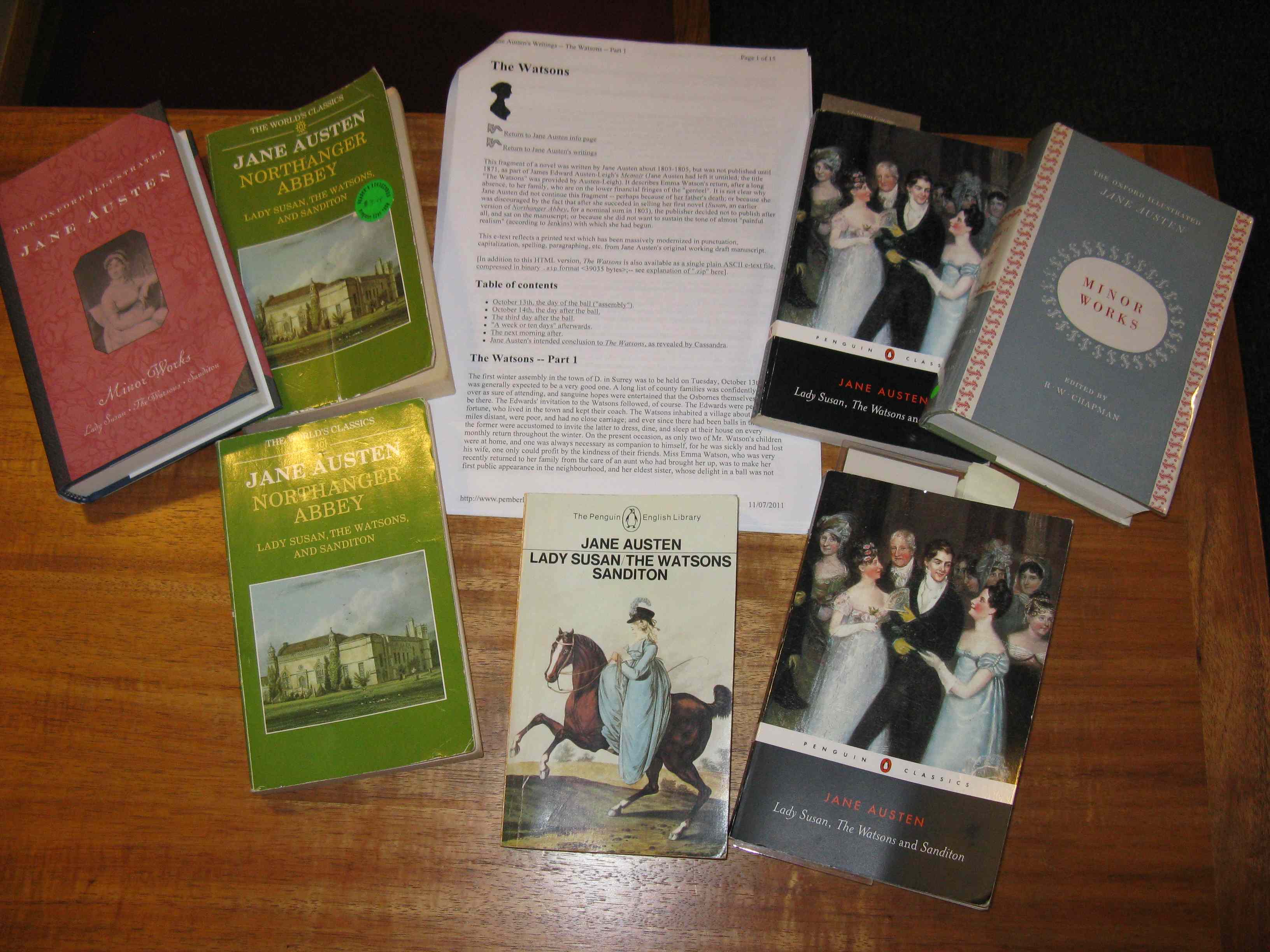
Book covers for Jane Austen's The Watsons

Book covers for Jane Austen’s The Watsons

Jane Austen fans, as you probably know, do a lot of re-reading. Given we only have six complete novels, plus her juvenilia and a couple of unfinished novels, we have little choice. Fortunately, it’s not a chore! And so, having completed rereading all her novels over the last few years for their respective 200th anniversaries, my local Jane Austen group decided to return to her two unfinished novels, starting this month with The Watsons. This was the third time we’ve done it in our relatively short existence. We did it in 2008 and again in 2011 (at which time I wrote my own reflections for this blog).

I do not plan here to write a “proper” review, so if you are interested in my thoughts, please check the link above. However, there are a couple of additional comments I’d like to make, starting with the question I posed in my 2011 post. The question relates to its unfinished nature. There are in fact two main questions regarding this: why did she stop writing it and why didn’t she pick it up again? And here I’ll quickly recap the novel’s background for those who don’t know it. The Watsons was written in Bath probably around 1803-1805, though there isn’t complete consensus about this. It’s commonly believed that she abandoned it after her father’s death in 1805 because of sadness and the resultant uncertainty in her living conditions. Whether this is true or not, it is true that she didn’t take up serious writing again until she settled in Chawton in 1809.

Now, it was at Chawton that she took up two earlier works, which became her first two published books, Sense and sensibility and Pride and prejudice. Why did she not then take up The Watsons and rework/finish it too? This is the more interesting question, I think, than why she stopped it in the first place. There are some theories around, though I haven’t investigated them thoroughly. However, her nephew James Austen-Leigh, who wrote the first “memoir” we have about her life, conjectures that Austen had become aware of “the evil of having placed her heroine too low, in such a position of poverty and obscurity” but I’m not sure I buy it.

My group discussed this idea, and we all felt that Austen had other “poor” heroines, of whom Fanny Price is the obvious example. But, the Dashwood girls were not well-to-do either. It’s true that Austen’s plan for The Watsons, as Cassandra reported, was for things to get worse for our heroine, but still …

No, my idea is different. The Watsons is broadly about four sisters and their marriage prospects – as is Pride and prejudice and Sense and sensibility. When we look at The Watsons, which Austen started after drafting those two books, we can see characters and storylines which remind us of these first two books. And so, I wonder whether, having published P&P and S&S, Austen felt she didn’t have enough new ideas to add to this storyline and wanted to try something different. Certainly, the next book, Mansfield Park, was something different. The marriage plot is still there, but it’s about a poor relation who is taken in by her wealthier ones. The interesting thing is that The Watsons commences with the return of 19-year-old Emma Watson to her family having spent 14 years with a wealthy uncle and aunt. Perhaps Austen decided to explore the story of the poor relation from a different angle, from the time of arrival at the new home?

Another thing about The Watsons is that as well as having characters who remind us of those first two novels, it also has characters reminiscent of some in later books, particularly in Emma. This suggests that while she didn’t finish The Watsons, her work on it wasn’t wasted – and she knew it.

We’ll never know of course. There’s so much we don’t know about our Jane, but it is fun trying to fill in the gaps.

A couple of apposite quotes

There’s more I could explore about this tiny fragment of around 17,500 words, but I’ll save those for the next re-read! Instead, I’ll conclude with two excerpts which grabbed my attention this time.

Gender and money

The first is a conversation between the heroine Emma and the wealthy aristocrat, Lord Osborne, who is interested in her, though his regard is not returned. In this conversation, he suggests that all women should ride horses:

‘I wonder every lady does not. – A woman never looks better than on horseback. –’
‘But every woman may not have the inclination, or the means.’
‘If they knew how much it became them, they would all have the inclination, and I fancy Miss Watson – when once they had the inclination, the means would soon follow.’
‘Your lordship thinks we always have our own way. – That is a point on which ladies and gentlemen have long disagreed. – But without pretending to decide it, I may say that there are some circumstances which even women cannot control. – Female economy will do a great deal my Lord, but it cannot turn a small income into a large one.’

Here we see Emma’s mettle. She stands up to Lord Osborne – to his assumptions about women and to his obliviousness that not all people have the means he has.

On reading to escape

And finally, The Watsons contains another of those wonderful quotes by Austen about books and reading. Here, right near the end of the fragment, Emma is thinking about the downturn in her fortunes through the death of her uncle:

The evils arising from the loss of her uncle were neither trifling, nor likely to lessen; and when thought had been freely indulged, in contrasting the past and the present, the employment of mind, the dissipation of unpleasant ideas which only reading could produce, made her thankfully turn to a book.

So, even in 1805, reading was seen as a way to occupy the mind and so escape, for a while, the troubles of life.

Jane Austen
“The Watsons”
in The Oxford illustrated Jane Austen. Vol VI, The minor works (ed. R.W. Chapman)
London: Oxford University Press, 1969
pp. 315-363

Jane Austen, The Watsons (Unfinished)

Book covers for Jane Austen's The Watsons

Book covers for Jane Austen's The Watsons

In one of those coincidences that we often bother about in fiction, my local Jane Austen group scheduled Jane Austen’s unfinished novel, The Watsons, for our July discussion. A coincidence because, if you are an Austen fan, you’ll know that just this week the manuscript was sold at auction for nearly £1 million. Thank goodness it was bought by an institution – the Bodleian at Oxford. Next time I’m in England I know where I’ll be going!

Anyhow, onto The Watsons. This unfinished novel was written in Bath probably around 1803-1805, though there is not consensus about this. A common belief is that she abandoned it after her father’s death due to sadness and the resultant uncertainty in her living conditions. Whether this is true or not, it is a fact that she didn’t take up serious writing again until she settled in Chawton in 1809 – which gives rise to the more interesting challenge. That is, why didn’t she take this one up again as she did with other early works such as First impressions which became Pride and prejudice. Enough of that, however, as all we can do is speculate. Let’s look at the work instead.

English novelist Margaret Drabble describes The Watsons as “tantalising, delightful and highly accomplished”. And it certainly is tantalising. We have only 68 pages (manuscript count). The story concerns 19-year-old Emma Watson who has returned, after living with her well-off aunt and uncle for 14 years, to her “poor” family. At the time of her return, just her oldest sister, the 28-year-old Elizabeth, is at home with their invalid father. The family however comprises four daughters and two sons, of whom only one son is married. The main plot-line is, of course, likely to be marriage, and so in these first chapters we are introduced to three men who could vie for Emma’s hand. We are also introduced to the characters belonging to Austen’s favourite subject, “3 or 4 families in a Country Village”. We know, from her sister Cassandra, how Austen intended the plot to play out. So tantalising that we never saw her do it!

Drabble’s next word is “delightful” and it is that too … because it contains those wonderful character descriptions and social observations that we have come to expect of Austen. I’ll share just a couple. The first one describes Emma (at the Ball where we meet three potential beaux):

… a lively Eye, a sweet smile, & an open Countenance, gave beauty to attract, & expression to make that beauty improve on acquaintance …

Contrast this to the following description of her sister Margaret:

Margaret was not without beauty; she had a slight, pretty figure, & rather wanted Countenance than good features; – but the sharp & anxious expression of her face made her beauty in general little felt.

There are also those delightful little set pieces we are used to finding in Austen, pieces that illuminate character as much as they move the plot along. One concerns Emma’s offer to dance with a 10-year-old boy when the snooty aristocrat Miss Osborne, doesn’t follow through on her promise to dance with him. “Oh Uncle”, the young lad says to one of the possible beaux, “do look at my partner. She’s so pretty.”

Sweet as she is, Emma proves herself to be well able – rather like Elizabeth Bennet – to hold her own. She refuses to pander to the flirtatious Tom:

Emma’s calm curtsey in reply must have struck him as very unlike the encouraging warmth he had been used to receive from her Sisters, & and gave him probably the novel sensation of doubting his own influence, & of wishing for more attention than she bestowed.

The last sentence of The Watsons starts, “Emma was of course uninfluenced …”. How sad we didn’t get to see more of this resourceful, delightful heroine.

Finally, “highly accomplished“. I’m not sure I totally agree with Drabble here. What we have is intriguing, tantalising us with its potential. It demonstrates much of what we know and love about Austen – and yet, despite evidence of extensive editing in the recently auctioned manuscript, it has (to my mind anyhow) an element of clumsiness. I find this particularly in an overuse of dialogue to convey information which the characters involved would surely already know – such as Elizabeth’s saying to her sister, Emma, “though I am nine years older”. It works well enough in the context but I believe the later, experienced Austen would have better conveyed this through authorial comment.

Nonetheless, it is accomplished. Its realism is remarkable and, like all her novels, it is clear from the beginning just what the targets are going to be. In this case, I see a major theme being the contrast between exterior and interior “refinement”. The fragment we have focuses heavily on the distinctions of class, often contrasting the superficiality of those who possess this so-called “class” with Emma whose refinement is more of the interior kind. This has the makings of a fascinating novel.

And yet, while it was not to be, we can point to many characters in later books who seem to draw, albeit with variations, from the characters here: the invalid father in Emma, the money-fixated brother in Sense and sensibility, the independent-thinking heroine in Pride and prejudice, the flirty young man of means in Mansfield Park, to name just a few. For whatever reason, Jane Austen did not return to this manuscript, but it’s obvious that she did not forget the characters nor some of the ideas behind their creation.

Jane Austen
“The Watsons”
in The Oxford illustrated Jane Austen. Vol VI, The minor works (ed. R.W. Chapman)
London: Oxford University Press, 1969
pp. 315-363