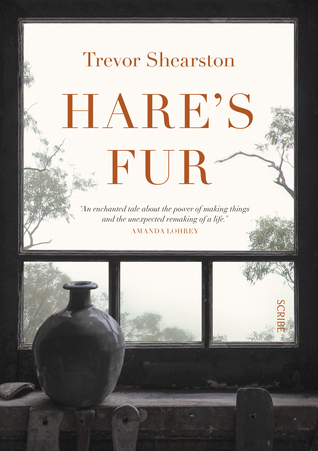
While I want to, I often don’t manage to follow up books recommended by Lisa but Trevor Shearston’s Hare’s fur particularly caught my attention. He was an Australian author I didn’t know; the novel is set in the Blue Mountains; and the protagonist is a potter, which sounded intriguing. So, I bought it – over a year ago, in fact, when I had a bookshop gift voucher to spend – but have only just managed to squeeze it into my schedule.
It’s a lovely read. However, I was surprised to discover that Shearston has published several novels, and a short story collection. His 2013 novel Game, about bushranger Ben Hall, was longlisted for the Miles Franklin Award, and shortlisted for the Christina Stead and Colin Roderick awards. Hare’s fur is quite a different book – at least, ostensibly, as I haven’t read Game to know its style or underlying concerns!
So, Hare’s fur. It tells the story of Russell Bass, a recently widowed 70-something potter living in the beautiful Blackheath area of the Blue Mountains. Unlike his potter son-in-law, Hugh, Russell sources the rock for his glazes in the canyons below his home. On one of his forays – to a remote creek that he thinks only he visits – he hears voices, and, on further investigation, discovers three children living in a cave, teen Jade who is looking after her younger sister Emma and little brother Todd. They are, he discovers, hiding from child welfare (DoCS) and the police. What would you do? The novel – novella, really, I’d say – tells the story of the relationship that develops between these four, and how Russell navigates this tricky human, legal and moral territory.
Now, before I go further, I was interested to see in Trevor Shearston’s GoodReads author page a book called The impact of society on the child: Proceedings of the inaugural annual meeting. I can’t find what his role was. It doesn’t seem he was editor or assistant editor, but, assuming he was involved, it suggests a formal interest in children’s well-being. Certainly, that is the essential theme of this novel. It’s about deciding what’s responsible and being generous, in the face of justifiable fear and lack of trust.

What’s lovely about this novel is that the adults involved – not just Russell, but, peripherally, his daughter and son-in-law who live 30-minutes walk away, and his neighbour – are open to solving this problem. They recognise the very real risks and challenges of Russell’s desire to protect the children, but they don’t resort to black-and-white solutions. I will leave what happens there, because one of the joys of the novel is following the various characters’ decisions and actions as they navigate this tricky situation.
Other joys of the novel include the writing, and particularly the descriptions of the landscape. Here is part of Russell’s walk down to his creek:
Tea-tree and lomandra had grown across the opening of the abandoned lookout. He pushed through the clumps of blades to the apron of lichened concrete and found the faint pad that only his feet maintained, skirting to the right of the platform through wind-sculpted casuarinas and hakea and more tea-tree to the cliff edge. There he stopped and removed his beanie and took the sun on his face and scalp. It was the last direct sunlight he would know until he stood again on this spot. …
He describes the birds and flowers, the colours and the misty coldness of the mountains, so beautifully.
The characterisation is good too. Told third person but from Russell’s perspective, we are privy to the feelings of this man who is still grieving his wife but is getting on with it. His daughter and son-in-law, and his neighbour, invite him over for dinner or drop meals on his doorstep, but he’s not helpless. He’s sad and a bit lonely, but he has his work. His relationship with the children is gentle, thoughtful and respectful. His response to Jade is wise,
She lacks education, he told himself, not intelligence. Don’t talk down to her.
Then there’s the title – hare’s fur. Hands up, if you know what it means? I didn’t, but it’s a special kind of brown glaze. Jade asks him how he turns the rocks into glaze. He tells her
… when it’s heated to a high enough temperature it’ll melt again. And, having lots of iron in it, that gives a black glaze. If I’m lucky, with streaks of dark blue, or red, or sometimes little brown flecks that look like animal fur.
One of Russell’s most treasured possessions is a valuable, 900-year-old hare’s fur tea bowl bequeathed him by a collector. Why the novel is titled for this is not obvious, but presumably part of it relates to the fact that this glaze is precious and rare, and needs to be nurtured like the children he has found. There’s a point where he shows Jade this bowl and lets her hold it. He tells her she can go look at it in his room any time, but asks her not to pick it up. Trusting her like this, with an object precious to him, is significant – but not laboured in the novel.
Hare’s fur is a positive book about the importance of trust and respect, and of being open to others. It’s also about how lives can be remade. Russell is as lucky as the children that they found each other.
Trevor Shearston
Hare’s fur
Melbourne: Scribe, 2019
194pp.
ISBN: 9781925713473
 Whispering Gums