Teffi, The examination (#Review, #1925 Club)

Mostly for the Year Clubs, I read an Australian short story, usually from one of my anthologies. However, for 1925, I couldn’t find anything in my anthologies, so turned to other newspaper-based sources, including Trove, but I mainly found romances or works that were difficult to access. And then, out of the blue, I found something rather intriguing, a story titled “The examination”. It was written by a Russian woman named Teffi, translated into English by J.A. Brimstone, and published in The Australian Worker, an Australian Workers’ Union newspaper, on 25 November 1925. I don’t know when it was originally written, nor have I been able to found out who J.A. Brimstone was.

Who is Teffi?

The Australian Worker ascribes the story to N. Teffi. This nomenclature is interesting. My research suggests that Teffi, not N. Teffi, was the pen name of Nadezhda Lokhvitskaya (1872-1952). Wikipedia gives her pen name as Teffi, but its article on her is titled Nadezhda Teffi. Curiously, the article’s history page includes a comment from a Wikipedian, dated 11 June 2014, that “Her pen name is only Teffi, not Nadezhda Teffi”. This Wikipedian “moved” the article (Wikipedia-speak for changing titles) to “Teffi”, but it was later moved back to “Nadezhda Teffi”. Seems to me it should be under “Nadezhda Lokhvitskaya” or “Teffi”. But, let’s not get bogged down. There’s probably more I don’t know about how she used her name over time.

The more interesting thing is who she was. Wikipedia provides what looks like a fair introduction to her life, so I won’t repeat all that here. Essentially, it says she was a Russian humorist writer who could be both serious and satirical, but whose gift for humour was “considered anomalous for a woman of her time”. However, she proved them wrong, “skyrocketing to fame throughout Russia with her satirical writings, so much so that she had candies and perfume named after her”.

Literary scholar Maria Bloshteyn, writing in the LA Review of Books in 2016, would agree. She starts her piece by describing Teffi as “once a Russian literary superstar”, and says that “Nadezhda Lokhvitskaya claimed that she took the comic-sounding and intentionally androgynous nom de plume for good luck”. Bloshteyn writes:

She began to publish in her early 30s and tried her hand in various genres, but it was her short stories, with their keen and hilarious observations of contemporary society, that were read by everyone from washerwomen to students to top government officials. They won her literary success on a scale unprecedented in pre-Revolutionary Russia.

My short story, however, was written post-Revolution, given we are talking 1925. But, I’m jumping ahead. Tsar Nicholas II was a big fan, Bloshteyn says, as was Vladimir Lenin “with whom she worked in 1905 at the short-lived New Life [Novaia Zhizn’] newspaper”. She left Russia in 1919, during the “Red Terror” when things started to turn sour. Her popularity continued in the émigré world. After the collapse of the Soviet Union, her books were read again and “celebrated as recovered gems of Russian humor”.

This potted history sounds very positive, but Bloshteyn explains that there was also darkness in her life, including the death of her loved father when she was young, difficult relationships with siblings, a failed marriage, mental health problems, and more. Also, “she became a victim of her immensely successful but severely confining brand”, meaning editors and readers “only wanted the Teffi they knew” and, worse, “they perceived all of her stories as funny, even when they were clearly tragic”. How frustrating that would be, eh?

She was inspired by – and has been likened to – Chekhov. Bloshteyn says:

Her appreciation of the absurd, of the comic minutiae of life, helps set off the darker or more transcendent aspects of our existence, but her main focus, in the tradition of the great 19th-century Russian writers, was always human nature itself: what makes us tick and why.

I’ll leave her biography here, but if you are interested, start at Wikipedia, and go from there.

“The examination”

“The examination” tells the story of a young girl, Manichka Kooksina, who is sitting for her end-of-year exams which will decide whether she moves on to the next grade. Important things ride on passing them, including staying with her friend Liza who has already passed and getting the new bike her aunt promised her if she passed. However, instead of knuckling down to study she fritters her time, trying on a new dress, reading, and finally filling her notebooks with a prayer “Lord, Help”, believing that if she writes it hundreds or thousands of times she will pass. Needless to say, she does not do well.

The story is beautifully told from her perspective, with much humour for the reader as she flounders her way through preparation and the exam itself. She feels persecuted, an animal being tortured, and resorts to the absurd solution of writing lines, while her nervous peers have at least tried. I wondered why this particular story of hers was chosen by The Australian Worker. Was it the only one available to them in English? Did the examination theme feel universally relevant? According to Bloshteyn, Teffi said that “even the funniest of her stories were small tragedies given a humorous spin”. This is certainly a “small tragedy” for the – hmm, foolish, procrastinating, but believable – Manichka.
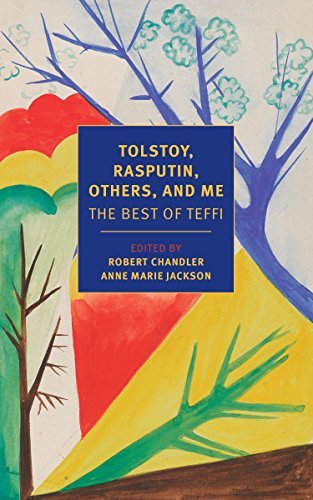
Bloshteyn’s essay is primarily a review of two books that had been recently published, Tolstoy, Rasputin, others, and me: The Best of Teffi and Memories: From Moscow to the Black Sea. The former includes sketches and some of her “best loved short stories”. GoodReads says of it that “in the 1920s and 30s, she wrote some of her finest stories in exile in Paris … In this selection of her best autobiographical stories, she covers a wide range of subjects, from family life to revolution and emigration, writers and writing”. I don’t know whether “The examination” is one of them, but Bloshteyn writes, of the child-themed stories she mentions, that all “show children in the process of getting to know the world around them and finding the means to cope with it”. Manichka, although showing some resourcefulness, has a way to go.

I was thrilled to find this little treasure in Trove, and will try to read more Teffi. Has anyone else read her?

* Read for the 1925 reading week run by Karen (Kaggsy’s Bookish Ramblings) and Simon (Stuck in a Book).

N. Teffi
The examination” [Accessed: 21 October 2025]
in The Australian Worker, 25 November 1925
Olga Tokarczuk, House of day, house of night (#BookReview)

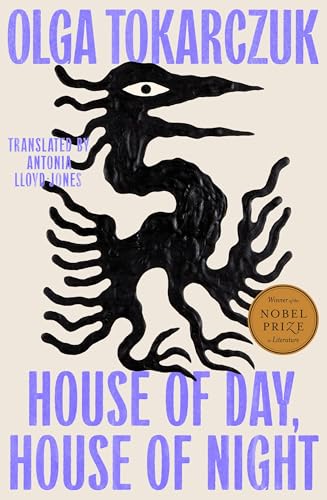
About 30 pages into Olga Tokarczuk’s novel, House of day, house of night, I turned to Mr Gums and said, I have no idea what I am reading, which is unusual for me. I certainly don’t pretend to understand everything I read, but I can usually sense a book’s direction. However, something about this one was throwing me, so …

I had a quick look at Wikipedia, and found this “synopsis”:

Although nominally a novel, House of Day, House of Night is rather a patchwork of loosely connected disparate stories, sketches, and essays about life past and present in … a Polish village in the Sudetes near the Polish-Czech border. While some have labeled the novel Tokarczuk’s most “difficult” piece, at least for those unfamiliar with Central European history, it was her first book to be published in English. [Accessed: 1 October 2025]

That made me feel better! I am more than comfortable with “loosely connected disparate stories” but am only generally-versed in Central European history. So, I decided to relax and go with the flow. From that point on, I started to enjoy my reading more, but it was slow going, because the “disparate stories” demand attention. It’s not a book you whizz through for story, but one you savour for thoughts and ideas, and for the connections you find along the way.

Tokarczuk calls it, in fact, a “constellation novel”, which I understand builds on thinking by the German critic and philosopher, Walter Benjamin (1892-1940). According to academic Louis Klee, who has written on “the constellational novel”, “these novels are recognizable by the presence of a first-person narrator committed to drawing affinities and making connections among disparate things”. They can be non-linear and incorporate various forms of writing from essayistic to lyrical to fragmentary, and encourage readers to find their own connections (like finding patterns in a constellation).

This well encapsulates House of day, house of night. It comprises numerous individually titled chapters (or sections or parts), some just a few paragraphs long, and others several pages. At first it felt disjointed, but it wasn’t long before an underlying structure started to reveal itself, one held together by a first-person narrator, a woman who had come to live in a small Polish village with her partner R – just like Tokarczuk and her husband did – three years before the novel opens. She tells of life in the village, and particularly of the relationship she develops with her neighbour, a somewhat mysterious old woman named Marta, who embodies a wisdom that she sometimes shares but other times must be gleaned from what she doesn’t say.

Interspersed with our narrator’s story, are other stories – some real, some magical, some past, some present – about the region and people in it. There’s a gender-fluid monk named Paschalis who is writing the life of the female saint Kummernis. There’s the unnamed couple who think they have it all, until each is visited by the same lover, a female for “he” and a male for “she”. There’s a religious community called the Cutlers who make knives and believe that “the soul is a knife stabbed into the body, which forces it to undergo the incessant pain that we call life”. There’s the wonderfully named Ergo Sum who had tasted human flesh in frozen Siberia, where he’d been deported in 1943, and believes he is turning into a werewolf. And so on. Some of these stories continue, for several chapters, woven around our narrator’s story, while others stand alone. Some are about people who think they have life worked out, while in other stories, the people don’t have a clue.

There’s more though, because scattered through the stories are ruminations on disparate things like dahlias, nails, comets and grass allergies. And threading through it all are various motifs, usually providing segues between chapters, encouraging us to see links and to ponder their meaning for us. These motifs include dreams, names, time, death, borders, mushrooms (potentially deadly), and knives. The more you read, the more connections you see between them and the stories. Many are philosophically-based, but are not hard to understand. In other words, the challenge is not in understanding, but in how we, individually, process the links we see. You might have already noticed some in my examples above, such as the idea of identity. Even the mysterious Marta, who disappears every winter, is unsettling. Who is she really?

“people are woefully similar”

This is the sort of book you would expect of a Nobel prizewinner. The writing is simple but expressive, and is accompanied by a rich, dark, and often ironic humour. We have border guards who don’t want to deal with a dead body so they quietly shove it to the other side of the border. And Leo the clairvoyant who says “Thank God people have the capacity for disbelief — it is a truly bountiful gift from God”. That made me splutter.

Underpinning all this – the thing that gives the book its heft – is a quiet but somewhat resigned wisdom. It interrogates some big questions – our willingness (or not) to see what is happening in front of us, our relationship to place, how we comprehend time, and who we are. These are explored through universal binaries, not only the night-and-day contained in the title, but life and death, change and stasis, ripening and decay. How do we live with – and balance – these parts of ourselves, of life?

But, House of day, house of night is also set in a particular place and time, southwest Poland, just post World War 2. This area, explains the Translator in her note, was part of the German Reich until 1945, when the Allies agreed to move Poland’s borders west. Many Poles left their old lands of the east (now part of the USSR), and resettled in this once German area in the west, occupying homes left by the evacuated Germans. This specific history is also found in the book, with Polish families hopefully, greedily, digging up German treasures, for example, and Germans sadly returning to see their old places.

House of day, house of night offers no answers, but it sure asks a lot of questions – about how, or whether, we can move forward into more humane, and hence more fulfilling lives.

This brings me to the ending. I won’t spoil it – it’s impossible in a story like this anyhow – but we close, appropriately, on the idea of constellations and finding patterns, and a hope that it is possible to find a pattern that explains it all. It is deliciously cheeky. And, on that note, I will end.

Olga Tokarczuk,
House of day, house of night
Translated from the Polish by Antonia Lloyd-Jones
Melbourne: Text publishing, 2025 (Orig. pub. 1998; Eng trans. 2002)
298pp.
ISBN: 9781923058675

Review copy courtesy Text Publishing

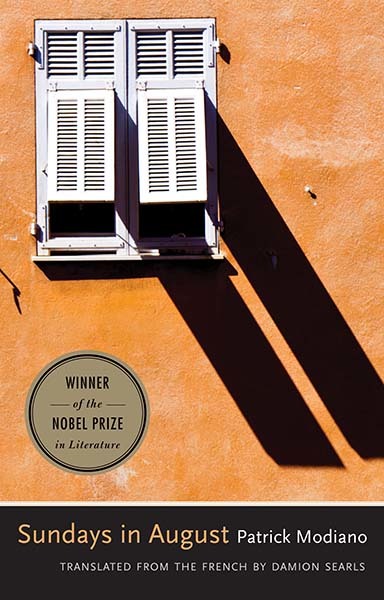
Patrick Modiano, Sundays in August (#BookReview)

Disappointingly, I ended up missing my bookgroup’s discussion of the book I had encouraged us to read, Sundays in August by 2014 Nobel prize-winner Patrick Modiano. I have no-one else to blame but myself, since I did the schedule and should have remembered that I was going to be in Hobart for my brother’s exhibition. C’est la vie.

I recommended this book for a couple of reasons, one being high praise from Kim (Reading Matters) and the other being to include translated fiction in our reading diet. Also, the book intrigued me. Kim described it as a “jewel heist”, albeit qualified by “with a difference”. That seemed unusual subject matter for a Nobel prize-winner. Having now read it, however, I see that he is a skilful writer. I loved reading it. But the subject matter?

According to Wikipedia, Modiano (b. 1945) is “a noted writer of autofiction, the blend of autobiography and historical fiction”. He has published over 40 books, and in them, Wikipedia continues, has “used his fascination with the human experience of World War II in France to examine individual and collective identities, responsibilities, loyalties, memory, and loss. Because of his obsession with the past, he was sometimes compared to Marcel Proust”. I’m not sure about the “was” here, as he is still alive. Anyhow, it is this obsession with the past, with its associated exploration of memory and loss, that made Sundays in August (Dimanches d’août) so fascinating. I am drawn to stories about the past that are told in well-controlled melancholy tones, stories that involve a later reflection on what had happened and the implications for the protagonist’s present. (By the way, this does not appear to be one of Modiano’s autofiction works.)

The novella is set in Nice, and starts with a first person narrator (identified partway through the book as Jean) spotting someone he’d known seven years ago. The man is Villecourt, and he is selling leather goods in the market. Neither man, in fact, has done well in the years since they’d met. Both are alone, and not living the apparently secure lives they had been. We quickly realise that this is not a case of old acquaintances happily re-uniting. Instead, there is palpable tension. After they meet for a drink, Jean makes clear he wants nothing more to do with Villecourt, while Villecourt tries to keep the contact going. He does little to ingratiate himself, however, reminding Jean that he, Villecourt, was the only man someone called Sylvia had loved. He also says that he and Sylvia had not been married. Why had she lied to him about that, Jean thinks to himself?

In this way, in the first few pages, we are drawn into a mystery involving these three. Soon after, the aforementioned jewel – a diamond, with a “long and bloody history”, called the Southern Cross – is introduced, and we learn that Jean and Sylvia had been on a mission to sell it. Then, a little further down the track we meet the mysterious Neals, who seem to live in a grand home named Château Azur, and who all too soon offer to buy the diamond.

It sounds like a simple story involving a love triangle and a heist, but in fact, it is a complex crime story in which it behoves readers to attend carefully for hints and clues about what’s really going on. These are conveyed through the narrative, as Jean tries to “rejoin the invisible threads”, and through gorgeously written imagery that creates an oppressive, foreboding atmosphere, occasionally lightened by the Riviera’s bright sun, and blue skies and water.

“blurred … dissolving”

As we read, the ground constantly shifts beneath our feet. People appear and disappear, and sometimes shapeshift. Virgil Neal, for example, sounds American, then he doesn’t, then he does again, before finally turning out to be someone else. Cars and buildings, too, aren’t always what they seem. Nonetheless, through cleverly managed flashbacks and foreshadowings, we gradually start to see – or, think we see – the set-up. It is all complicated, however, by that tricky beast, memory. Jean writes:

I don’t know anymore whether we met the Neals before or after Villecourt arrived in Nice. I have searched my memory, looking for points of reference, but am unable to sort out the two events. Anyway, there’s no such thing as “events.” Ever. It’s a false term, suggesting something definitive, spectacular, brutal. In fact it all happened gently, imperceptibly, like the slow weaving of a design into a carpet…

Soon after this reference to meeting the Neals, Jean says

The word “meet” doesn’t apply, any more than “event.” We didn’t meet the Neals. They slipped into our net.

Who slipped into whose net is the question. And how many nets were there? Jean will probably never know it all, but by the end he’d learnt that “our anxiety didn’t come from our contact with that cold stone with glints of blue – it came from life itself”.

Typical for a novella, the book is tightly written. Every word counts, and is worth noticing. I loved, for example, that Jean was a photographer who now can’t seem to remember the necessary details, and that Sylvia’s last name is (ironically?) Heureux. These little details aren’t casual, and make us readers think and question at every step, as we are alternately unsettled then proffered glimmers of light.

Sundays in August is an accessible, noir-ish tale about loss and the emptiness that accompanies it. It explores life’s shadows and uncertainties, shows how innocence can be so easily taken advantage of, and it doesn’t wrap everything up neatly, leaving us to ponder the possibilities. I won’t spoil the ending, but it is spot on, and explains, at last, the title, leaving us on a little up despite it all. I’ll be reading more Modiano, if I can.

POSTSCRIPT: I believe we know the main culprit in it all, but the question is, who else was in on it and who else was taken in. It would take more reads to work through that, but in the end I think we can’t ever know it all because we can only know what Jean saw and tells us.

Read for Novellas in November.

Patrick Modiano
Sundays in August
Translated from the French by Damion Searls
New Haven & London: Yale University Press, 2017 (Orig. French pub. 1986)
156pp.
ISBN: 9780300223330 (Read on Kindle)

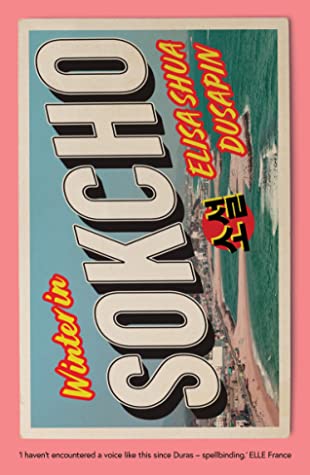
Elisa Shua Dusapin, Winter in Sokcho (#BookReview)

French Korean writer Elisa Shua Dusapin’s award-winning debut novella, Winter in Sokcho, was published when she was just 22 years old. As the title conveys, it is set in Sokcho, a tourist town in the Republic of Korea near the border between the two Koreas. In fact, when the Korean peninsula was divided into two countries following World War II, Sokcho was on the Northern side, but became part of the South after the 1953 Korean War armistice 1953. I suspect Sokcho was chosen as the setting partly for its “divided” history, this being in-between, neither one thing or the other,

But, more on that later. The novel’s unnamed first person narrator is a 24-year-old French Korean woman who works in a struggling guesthouse. She seems to do everything – reception, cooking, cleaning – but with little enthusiasm. The novel opens with the arrival of an unexpected guest, the 40-something French graphic novelist, Yan Kerrand. The two are drawn to each other in some way, but, at least from Kerrand’s point-of-view, it doesn’t seem to be romantically driven. For our protagonist, the situation is a little more complex. She has a boyfriend – Jun-Oh – but it’s not a satisfactory relationship from her perspective. However, her fish-market worker mother is expecting an engagement any day. The situation is ripe for something different to happen in her life, but will it – and what, anyhow, does she want? She seems betwixt and between.

Winter in Sokcho has many of the features I like in a novella, starting with spare expressive prose, a tightly contained storyline, and a confined setting. There’s also a small cast of characters, with little or no digression into backstories. All we have is what’s happening now.

And, what is happening now is that the stranger’s appearance has affected our narrator. In the second paragraph, while registering him as a guest, she says

I felt compelled for the first time since I’d started at the guest house, to make excuses for myself. I wasn’t responsible for the run-down state of the place. I’d only been working there a month.

We then move to her visiting her mother, and another thread begins to appear, that of body image. We’ve already been told that one of the guesthouse guests is “seeking refuge from the city while she recovered from plastic surgery to her face”, and now we are introduced to our narrator’s mother’s concern about her appearance. She’s too thin, her mother says. Our narrator rejects this, but soon after, in a photograph her boyfriend has taken of her, she sees “a wasteland of ribs and shoulder blades receding into the distance … her bones sticking out” and is “surprised at how much”. When she’s with her mother, she binges on the food her mother makes, only to feel “sick” and later repelled by her “misshapen body”. There is a tension between this single mother and her daughter that pervades the novel. We sense that our narrator would like to leave Sokcho. Indeed, there’s a reference early on to the “literary world” suggesting she has aspirations in that area, but she feels she cannot leave her mother. Betwixt and between.

Throughout the novella, there’s an atmosphere of things being out of kilter or not quite right. Early on, the narrator describes Sokcho’s beach:

I loved this coastline, scarred as it was by the line of electrified barbed wire fencing along the shore.

This is not your typically loveable beach view, but she herself bears a physical scar on her thigh to which she often refers. It’s unexplained but there are hints later of self-harming. Meanwhile, later in the book, Kerrand tells her that he prefers the beaches of Normandy to those in southern France, because they are

Colder, emptier. With their own scars from the war.

And so the novella progresses, in this clipped spare prose, with a sort of wary dance going on between the narrator and Kerrand. He’s there for inspiration for the last book in his series about “a globe-trotting archaeologist … A lone figure. With a striking resemblance to the author.” She is intrigued by him. She offers to show him some local sights – the border region, with its checkpoint “No Laughing” rule, and the nearby national park, with its snowy mountains and waterfalls. She watches him, surreptitiously, as he draws by night, but always the drawings are destroyed by morning, because they are imperfect.

What does Kerrand see in her, what is he looking for? This being a first person narrative, we see it all through her eyes. She is as reliable a narrator as she can be, but like any first person narrator her viewpoint is limited by her perspective.

Winter in Sokcho does not have a simple resolution, but I’ll return to that idea of Sokcho being chosen as the setting. Its divided history mirrors our narrator who is also divided – in her French Korean heritage and her torn sense of self. Further, Sokcho is described as “always waiting”, as it seems also is our narrator, though for what, even she doesn’t really know.

How much is this a personal story and how much political? Two-thirds through, as she and Kerrand discuss their scarred beaches, she tells him (and just look at this writing):

Our beaches are still waiting for the end of the war that’s been going on for so long people have stopped believing it’s real. They build hotels, put up neon signs, but it’s all fake, we’re on a knife edge, it could all give way any moment. We’re living in limbo. In winter that never ends.

There can be no neat ending to such a story, but without spoiling anything, I’ll share something she sees in Kerrand’s final drawing:

A place, but not a place. A place taking shape in a moment of conception and then dissolving. A threshold, a passage …

Does this suggest hope, albeit tenuous – for both the narrator and her Korea? I’m reading it that way. As for the closing lines … they are glorious.

Read for Novellas in November, Week 2: Novellas in Translation.

Elisa Shua Dusapin
Winter in Sokcho
Translated from the French by Aneesa Abbas-Higgins
Melbourne: Scribe, 2021 (Orig. pub. 2016)
154pp.
ISBN: 9781922585011

(Review copy courtesy Scribe)

Ida Vitale, Byobu (#BookReview)

Uruguayan writer Ida Vitale’s Byobu was my reading group’s second book of the year. Originally published in Spanish in 2018, with the English translation released in 2021, Byobu is Vitale’s first book of prose to be translated into English. Few, if any of us, had heard of her – and yet, this now 98-year-old woman was, in 2019, named by the BBC as one of the 100 most influential women of the year. The things we don’t know!

Anyhow, Byobu is a curious book. It has no clear narrative, and only one character, the eponymous Byobu. It’s just 85 pages, and comprises 34 “chapters”. It is replete with allusions to a diverse range of writers, thinkers, musicians. In other words, it’s one of those books you can struggle with, if you don’t come up with a way of reading it. For me, this was to jettison preconceptions about what a novel is and go with the flow to see what fell out. And what fell out was a mind-opening, and sometimes witty, series of thoughts and observations about life and living. I can’t say I understood all of it, but I thoroughly enjoyed the reading experience.

The best way I can encapsulate Byobu is to describe it as a sort of modern Everyman story, the story of an individual in a world that can be confusing, if not sometimes downright hostile. The overall theme seems to me to be: How do you live in this world?

Before I explore this more, some basics. Byobu is set in Uruguay, and although there’s no plot per se, there is some structure. (I’d probably find more structure had I time to read it a few times). The opening chapter introduces the idea of “story” – and clues us into the idea that we are going to be unsettled:

a story’s existence, even if not well defined or well assigned, even if only in its formative stage, just barely latent, emits vague but urgent emanations. (“A story”)

The next few chapters introduce us to Byobu, conveying a general sense of who he is. These are followed by chapters that consider bigger issues in contemporary life.

However, although we are introduced to Byobu, he remains somewhat shadowy. We don’t know how old he is, but one member of my reading group suggested he was old, like his author, and that he encompasses an old person’s thoughts about life. I can accept that. Regardless, besides not knowing how old he is, we don’t know whether he is (or has been) married, has a family, is working, and so on. A family home is mentioned, and there are references to daily activities including attending a conference. All this vagueness supports the idea of him as an Everyman (albeit, possibly, an old one!)

We do, though, learn some things about the sort of person Byobu is. He can be indecisive. He has “an intractable inclination to complicate things”, and hates change. He’s not a good storyteller, but he likes nature and enjoys minutiae. Unfortunately, though,

often distracted by some minutia captivating him at a particular moment, he misses fragments of conversations that later turn out to be important. (“On anodyne things”)

I found him very human and engaging, to the degree I could, given his shadowiness.

I fear though that I’m not selling the book, so I’ll try now to share some of its joys and intellect. I’ll start by talking a little about the style. Many of the “chapters”, and I put them in quotation marks because some are only a paragraph long, start with what you could call truisms, but they don’t read as cliches, like:

Everything important lies below the surface. (“Terrestrial labours”)

Byobu concludes that he must begin by ending. (“Knots”)

Byobu has heard it said that ‘every mile has its rough patch’. (“Epiphanies”)

Byobu is not always able to predict how the situations he gets involved in will end. (“Dangerous misunderstandings”)

How can you be sure that the avenue, boulevard, or ordinary road you’re facing is not actually a blind alley? (“Crossroads”)

Just look at that sentence, “Byobu concludes that he must begin by ending”. So terse, so clever. “Knots”, in fact, is one of those one-paragraph chapters. It concerns Byobu’s realisation that if he doesn’t end his “trepidations” and “tepid transactions”, if he doesn’t “lay limbos aside” and “ignore everything initiated by the iniquitous” – he will have to “accustom himself” to “the cage”. But, can he recreate himself?

“Crossroads” addresses another recurrent idea in the book, the importance of the imagination, of mystery, over the mundane. Opposing mystery and imagination are “straight lines” which also recur, starting in the second chapter, “Life is not a straight line”. In “Knots”, Byobu learns that straightness “lays snares” and in “Against the Argive Way”, he is aware that “The world loves conversations in straight lines and single-minded strides. Intersections divert. Labyrinths confound.”

A few chapters in, then, it dawned on me that Byobu was about more than a man muddling through life, that it’s a commentary on modern life. Byobu pleads for the imagination, for not going in straight lines. It critiques conformity, power and authority, commercialisation, urbanisation, inhumanity, and resistance to change. “Internal coherence” explores resisting social pressure. It is “immoral”, it suggests, to accept a world “governed by the boorish authorities who rule during these evil times we inhabit”. Yet, Vitale realises resistance is not easy, so her Byobu “resists on the inside, while staying quiet and feigning surrender”.

In the penultimate “chapter”, “Byobu and the traffic light”, traffic lights are a metaphor for “supervision and compliance”. Here “the defiant … recognise the bad example of a behaviour that is a silent hymn to obedience to all authority”. Vitale goes on to suggest that traffic lights should, in fact, “innervate the pedestrians” (who are “increasingly incongruent elements in the city”) to “assume their role as essential antagonists”. This chapter is a call to defy, to rebel.

Lest this all sound rather bleak, let me say there’s beauty here too. There are, for example, some lovely descriptions of nature:

In the garden, jasmines reign supreme. At night the star jasmine is a vertical Milky Way, delirious with aroma. (“Seasons”)

And, there is quite a bit of humour. Much is of the quiet, understated sort, but it made me laugh. “It’s true”, thinks Byobu, “there were three Wise Men; not quite a battalion” or “They’d better not count on him. He’s not an abacus”.

I hate leaving this book, but of course I must, so, I will leave you with two ideas. The first comes from one of the two epigraphs. Neither were translated, but the second is by Henri Michaux, and it roughly translates as “In case of danger, joke”! Joking is part of this book, but it is also deadly serious. Speaking of “story”, the opening chapter exhorts Byobu (our Everyman) not to “underestimate its flexible, disordered density”. And neither should we, because this novel has much to offer those willing to go with its flow.

Ida Vitale
Byobu
Translated from the Spanish by Sean Manning
Edinburgh: Charco Press, 2021 (Orig. Pub. 2018)
85pp.
ISBN: 9781913867023

Jayant Kaikini, No presents please: Mumbai stories (#BookReview)

Book cover

Jayant Kaikini is an Indian (Kannada) poet, short story writer, playwright, a public intellectual and a lyricist in Kannada Cinema. Kannada is new to me, but it’s the language widely spoken in the Indian state of Karnataka, where Kaikini was born (in 1955). He is regarded, according to Wikipedia, as one of the most significant contemporary writers in Kannada and is “credited with revolutionising the image of Kannada film songs”. I make this point because references to film and film songs abound in No presents please.

No presents please is a collection of short stories that are both ordinary and extraordinary at the same time, but before I talk about them I’d like to share some insights from the translator, Tejaswini Niranjana, who was also involved in selecting the stories. She shares the issues she faced in translating Kaikini’s work, particularly “the flavour of the speech, the hybrid Hindu-Urdu-Dakhani speech, that is the cultural vernacular of Bombay” and is prominent in the stories. It’s clear that there were vigorous discussions about translating this speech. Kaikini apparently complained about her “frugality”, but she was worried about how the book would challenge readers not proficient in Hindustani. She solved it “by doing parallel translations–leaving in the Hindustani but giving the meaning in English either close by or elsewhere in the sentence so that the attentive reader eventually understands the meaning”. I read this discussion after reading the book. I must say that there were times when I was a little challenged, but my reading philosophy is to go with the flow and, overall, Niranjana’s approach combined with my strategy worked!

The other point I want to share is Niranjana’s insight into the content of these stories which, as the subtitle clearly states, are about Mumbai. But, here’s the thing: Kaikini has, Niranjana writes, “mastered the ruse of the ordinary”. By this she means that every story “begins with an extremely ordinary person or situation–sometimes both” but that “the ordinary often reveals itself as surreal”. Her challenge was

to maintain the ordinariness of the narrative until it could be maintained no longer, and to let the translation lead the reader along without drawing attention to itself. At the same time, when the surreal began to seep into the story, and the ruse of the ordinary opened out onto a different terrain of engagement for the characters, the translation had to find the right words to signal this “turn”.

She’s right about the stories moving, almost imperceptibly at times, from the ordinary to the surreal. I suspect that Kaikini’s (sometimes subtle, sometimes less so) references to cinema help us readers have the right mindset for shifting between reality and illusion, which is more how I would describe most of the funny little moments, than actual surrealism.

So, the collection. Titled by last story in the book, it contains sixteen stories, dated between 1986 and 2006. All are written third person, and explore Mumbai as it is experienced by its “ordinary” inhabitants. The first story, “Interval”, is about a young couple who meet at a cinema where he works and she’s an audience member:

That these two were planning to run away together early tomorrow was a fact nestling snugly in the dark, like the secret of a bud that had not yet blossomed.

You can tell here that Kaikini was first a poet. What happens is not at all what you would expect – which is one of the delights of this collection. The stories are not predictable, but neither do they have dramatic twists. Things just work out differently, quite often. In a neat rounding off, the last, titular, story, is about a young engaged couple with no family, and what happens as they draft their wedding invitation.

“the friendships among strangers” (City without mirrors)

In between are stories about, for example, a father looking for a husband for his daughter (“City without mirrors”), the despairing father of a very naughty but irrepressible 6-year-old-boy (“A spare pair of legs”), a bus-driver wanting to return to his village for an annual festival (“Crescent moon”), a stunt man (“Toofan Mail”), roommates who suddenly become estranged (“Partners”), a loyal maid who becomes ill (“A truck full of Chrysanthemums”), and a child quiz contestant (“Tick tick friend”). These stories pull no punches about the lives of people living on the margins or struggling in some way. Kaikini is not afraid to expose some of Mumbai’s (and India’s) underbelly. In “City without mirrors”, a bachelor is “aghast at the cruelty of a situation in which an old man had to speak to a complete stranger about the proof of virginity of his nearly forty-year-old daughter”.

Many of the stories, like “City of mirrors”, involve chance meetings between strangers, strangers who tend to offer something positive, rather than danger. “Tick tick friend” is about a young quiz contestant coming to the big city to compete in a television studio that happens to be in the basement of a hospital. Schoolgirl Madhu and her father meet a young man in the hospital canteen. His cheeky, positive attitude to life buoys them. Mogri (“Mogri’s world”) grows up in a chawl with her mother and frequently absent father. Early on, she realises that sex can be women’s downfall, but learns through meeting an older waiter at work that there are different ways of being between men and women.

In “Water”, two men, one ill with cancer, meet on a plane and spend a night with the third, their taxi-driver, when a huge storm creates havoc in the city. It’s a moving story, full of philosophical observations about life. Taxi-driver Kunjbhai, answering whether life seems “like hell or like heaven”, says:

Well, everything depends on how we think about it. If I think I’m happy, it’s happy I am. If I think I’m sad, then I’m sad.

That may sound a bit pat, I suppose, but in the context, it’s beautiful. I liked this story for the warmth generated between three strangers.

And that’s the thing about this book. For all the challenges most of its characters face, there is also warmth and humour in the telling, the end result being stories that don’t drag you down but that also don’t lull you into thinking all is well. There’s acceptance and resilience, but also little glimmers of hope in the stories.

No presents please won the DSC Prize for South Asian Literature in 2018. It’s the first translated work to win the award, and the jury particularly noted “the outstanding contribution” of the translator. That tells you, I think, how special this book is.

Jayant Kaikini
No presents please: Mumbai stories
Translated from the Kannada by Tejaswini Niranjana
Melbourne: Scribe, 2020 (Orig. pub. in India, 2017)
267pp.
ISBN: 9781922310187

(Review copy courtesy Scribe)

Emuna Elon, House on endless waters (#BookReview)

Book coverI’ve said before that I’m surprised by how many takes there can be on World War II, and on the Holocaust, in particular – and once again I’m here with another such story, Emuna Elon’s House on endless waters. I hadn’t heard of Elon before but, according to Wikipedia, she’s an Israeli author, journalist, and women’s rights activist. Her first novel translated into English, If you awaken love, is about life on the West Bank, where she lived for many years.
House on endless waters, however, is historical fiction – or, at least, one of those novels which flips between the present and the past. It tells the story of successful Israeli author Yoel Blum who had been told by his late mother to never go to Amsterdam, from which they’d emigrated. However, the time comes when the middle-aged and internationally successful Blum is urged to Amsterdam by his literary agent to promote his latest Dutch-translated novel. While there, he and his wife visit the Jewish Historical Museum, and here, in a little looping video, he catches an image of his mother Sonia in Amsterdam during the war. Next to her is a man holding a little girl, his sister Nettie, but the baby she is carrying is not he! Who is this baby, and where was he?

Yoel returns to Israel, but, after obtaining the incomplete information his sister is able to provide (which is not divulged to the reader), he goes back to Amsterdam, alone, to research his past and write a novel about it. The result is one of those novels within a novel, as we follow Yoel’s journey alongside reading the story he is writing as he uncovers his family’s – and his – past. How much is “true” and how much Yoel imagines is not the point. We are carried along in the horrors of war-time Amsterdam, in stories of decent hardworking people’s disbelief that life could change so horribly so quickly, of Jewish collaborators, of the hidden children, of the most difficult choices people have to make. Elon conveys viscerally the shock felt by Jewish citizenry as one by one their rights are removed and as the foundations of their lives – something they thought immutable in such a place as Holland – crumble.

Much of this story has been told before. Anne Frank comes to mind of course, and many novels have dealt with the ways in which Jewish people were gradually ostracised and betrayed by their own society (the yellow stars, the loss of jobs, the resumption of homes, the rounding up, the transporting to concentration camps, and so on). What makes this one a little different – at least in my reading to date – is its exploration of the hidden child phenomenon, within a larger story of collaboration, betrayal, resistance and difficult choices.

The important thing, however, is less this difference than that it is a deeply absorbing read. Elon’s ability to manage her two story threads, and maintain our interest in both, speaks to a practised, skilled writer. There is no rigid chapter by chapter alternating of stories. Rather, as Yoel becomes increasingly invested in the life of his mother, Elon starts to blend the two stories, with Yoel sometimes feeling himself in both stories at once. As his sense of self becomes increasingly discombobulated, the line between past and present starts to blur:

Yoel would have liked to write about the architectural significance of Amsterdam, about the implication behind the labor invested in the rows of tiny reddish bricks, about the stylized cornices above the windows and the artistic embellishments that adorn every single building. But early the next morning, Sonia is walking along the street, and across the road the police are evicting a Jewish family from their beautiful art-nouveau-design house. The members of the banished family are trying to walk proudly to the truck that has come to take them away …

For Yoel, unlike the tourists he sees blithely enjoying the sun and culture of Amsterdam, “the past is still here” and it begins to overwhelm him.

Why a story-within-a-story?

This bring me to the question of why would Elon use the story-within-a-story-device? I can think of three reasons, the most obvious being that it draws the reader into the story, engaging us in its unravelling along with the protagonist. Secondly, in this case, it also mirrors how many children of the Holocaust generation didn’t know their parents’ stories – weren’t told them – and therefore had to work out those stories piece by piece. Finally, also in this case, it enables Elon to expose the personal development of her narrator, Yoel, who is initially revealed to be decent but emotionally remote. Very early in the novel, we learn this about him:

Perhaps the day will come when he’ll even train himself to live, a day when he will walk the earth like everyone else without being overcome by the thought that in fact it’s odd , even ridiculous to be a human being …

He is, says his wife, “scared of living”. This novel, then, is partly about identity. Yoel didn’t know his past but it’s clear that the traumas of that past had unconsciously impacted him, as we now know they do. Slowly, as he comes to understand who he is, he also starts to live, to be an engaged human being.

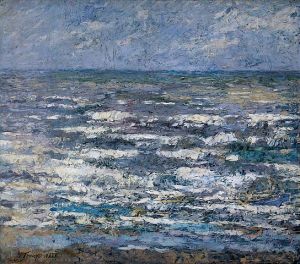
Jan Toorop, The Sea at Katwijk, 1887 (Public Domain)

There is much to this book, with Elon and her novelist Yoel drawing on art and music to reflect both Holland’s cultural achievements and its darker side. A motif running through the book is a stolen work of art – Jan Toorop’s The Sea at Katwijk – that had belonged to Sonia’s friends, Anouk and Martin, who are implicated in what happens. Martin suggests to Sonia that the painting is more about Toorop – “every painter evidently knows only how to depict himself” – than place. However, Sonia also sees herself in it: “there she is in black, there in red, there she is borne from wave to wave, moving in the infinite.” For Yoel, this sea “is a huge finite vessel containing infinite waters”. All this contributes to the novel’s message, one which Yoel finally realises Sonia was telling him:

Whatever was, was. Those waters have already flowed onward.

The trick is to know when to fight those waters, and when to let your “heart encounter the heart of the sea” and be at peace.

House on endless waters came to me out of the blue, but what a find. A Holocaust novel, it contains the horrors of that time but is also imbued with a generous, philosophical spirit that, without excusing atrocity, recognises the humanity of those who made selfish decisions and those who had to live with them. We need perspectives like this.

Emuna Elon
House on endless waters
Translated from Hebrew by Anthony Berris and Linda Yechiel
Sydney: Allen & Unwin, 2020 (Orig. ed. 2016)
309pp.
ISBN: 9781760877255

(Review copy courtesy Allen & Unwin)

Bill curates: Orhan Pamuk’s Snow

Bill curates is an occasional series where I delve into Sue’s vast archive, stretching back to May 2009, and choose a post for us to revisit.

Sometimes I think I am well read and sometimes I come upon a post like this and realize just how far I have to go. Pamuk, I discover, is a famous Turkish novelist and the winner of the 2006 Nobel prize.

_______________________

My original post titled: “Orhan Pamuk, Snow”

Book coverOne of my rules of reading is that when I have finished a book I go back and read the first chapter (or so) and any epigraphs the author may have included. These can often provide a real clue to meaning. This rule certainly applies to my latest read, Snow, by Nobel Prize winner, Orhan Pamuk.
(WARNING: SOME SPOILERS)

Snow, in fact, has no less than four epigraphs:

  • lines from Robert Browning’s “Bishop Blougram’s Apology” describing the paradoxical nature of things: “the honest thief, the tender murderer,/the superstitious atheist”;
  • a quote from Stendhal’s The charterhouse of Parma which warns about the ugliness of “politics in a literary work”;
  • a quote from Dostoevsky’s Notebooks for the Brothers Karamazov which suggests ideals like the European Enlightenment are “more important than people”; and
  • Joseph Conrad’s statement in Under Western eyes that “The Westerner in me was discomposed”.

These four epigraphs pretty well sum up the concerns of the book. What about the title? The second chapter begins with:

Veiling as it did the dirt, the mud and the darkness, the snow would continue to speak to Ka of purity, but after his first day in Kars, it no long promised innocence.

Here then is the first paradox: snow is pure but not innocent, and it covers dirt, mud and darkness. Already, you can see that this book is going to be ironic. Just how ironic though is a matter for contention but my suspicion is that its very foundation is ironic, as it grapples with what it means to be an artist in a political society, with how one is to live in a conflicted nation. The plot centres on a coup – a coup which is variously called a military coup and a theatrical coup! In fact, it is a coup by a theatrical group that is supported by the military! Art and politics could hardly be more entwined.

Snow though is not an easy read. It is my third Pamuk, but only the second one I have completed. I loved his memoir-cum-history Istanbul but could not, hard as I tried, finish My name is red.

What then is it about? The main action covers three days in the life of Ka, a Turkish poet recently returned from 12 years exile in Germany, who comes to Kars (in far east Turkey) ostensibly to write about the suicide epidemic among young women, but whose secondary (or perhaps primary!) reason is to fall in love with an old school-friend, Ipek. Soon after he arrives, however, the coup occurs and Ka is, rather unwillingly, caught up in the intrigue between the competing interests: the secularists, the Islamic fundamentalists, and the Kurdish nationalists. This sets the stage for exploring the art-politics nexus. Ka says to Sunay, the leader of the coup AND of the theatrical troupe that comes into town:

I know that you staged the coup not just for the sake of politics but also as a thing of beauty and in the name of art … you know only too well that a play in which Kadife bares her head for all of Kars to see will be no mere artistic triumph; it will also have profound political consequences.

Here then is one evocation of the second epigraph. The third and fourth epigraph refer to the running conflict in the book between European/Western values and Turkish/Eastern values. There is very much a sense that the people of Kars feel condescended to by European culture, but as a teen-ager says at one point, “We are not stupid! We’re just poor”. The people of Kars do not understand Western notions of individualism, and they see Western ideas of secularism and atheism as equating with immorality. Ka, as a Westernised Turk, acts as an uncomfortable, to him, bridge between the two worlds.

The core of the book is Ka. He is a sad and highly conflicted individual who, in his youth, had used words to argue that people should act for “the common good” but now finds himself using them to further his own happiness. Once politically active, “he now knew that the greatest happiness in life was to embrace a beautiful, intelligent woman and sit in a corner writing poetry”. The irony is that, for all his attempts to achieve this, he ends up with neither and dies four years after the coup a sad and lonely man.

The novel is interesting, stylistically and structurally. It is essentially a third person story about Ka but is told by a first person narrator, Ka’s friend, the novelist Orhan(!). This metafictional narrative technique, by adding another layer to the “conversation”, rather deepens the “artist in society” and art/politics themes of the book. Much of the story is foreshadowed: we learn of Ka’s death in Chapter 29, though the book has 44 chapters. The tone of the book is imbued with huzun, that very particular Turkish sense of melancholy that Pamuk explores beautifully in his book Istanbul. And, while it is about a coup and has a body count of 29, there are some very funny scenes, one being the political meeting at which the competing rebels prepare a statement about their beliefs for the Western Press. Anyone who has attended a political meeting will feel at home here!

All this said, the book is a challenge to grasp: there are a lot of characters, comings-and-goings, and ideas to track. Just why Ka is the way he is, just what did happen to him in the end, and just what Orhan is saying about art and politics are hard to pin down. I love the way the book is underpinned by paradox and irony – and yet at times the meaning can be a little tricky to discern. What is clear though is that Ka has found living by his political beliefs deeply unsatisfying but, ironically, is unable to bring about a situation in which he can live “happily” any other way.

Kadife, the leader of the headscarf girls, says (fairly early in the book):

…do not assume from this that our religion leaves no room for discussion. I will say that I am not prepared to discuss my faith with an atheist, or even a secularist. I beg your pardon.

Oh dear! Some reviewers call it a brave book. With its fearless exploration of the tensions in modern Turkey, it certainly feels that way. I am very glad that I put in the effort to read it.

Orhan Pamuk
Snow
Translated by Maureen Freely
London: Faber & Faber, 2005 (orig. Turkish ed. 2002)
426pp
ISBN: 0571218318

____________________

I know what Bill means. I too keep stumbling across authors I should know but have never heard of. I would like to read more Pamuk, including The museum of innocence which is on my TBR. Meanwhile, though, my heart really belongs to his mesmerising memoir, Istanbul. I’d love to read it again.

Have any of you read Pamuk? If so we’d love to hear what you think about his writing.

Shokoofeh Azar, The enlightenment of the greengage tree (#BookReview)

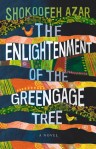
Book coverI bought Shokoofeh Azar’s novel The enlightenment of the greengage tree when it was longlisted for the 2018 Stella Prize, for which it was also shortlisted. However, it was its shortlisting this year for the International Booker Prize that prompted me to finally take it off the TBR pile.
Born in Iran, artist and writer Azar was still a child when the Islamic Revolution started in 1979. She grew up there, and, as an adult, obtained work as an independent journalist. However, after being imprisoned three times, she fled Iran by boat, ending up on Australia’s Christmas Island, and was eventually accepted as a political refugee by the Australian government. She has written a children’s book and two short story collections, but The enlightenment of the Greengage tree is her first novel. Like many first novels, it feels autobiographical, though given the narrator is a ghost and Azar is clearly still with us, it is not exactly autobiography!

The story chronicles the lives, experiences, and reactions of a family caught up in the chaos and brutality of post-revolutionary Iran. This family comprises father Hushang, mother Roza, son Sohrab, daughter Beeta, and another daughter, the above-mentioned ghost narrator, Bahar. Following the 1979 Revolution, they flee Tehran for the remote village of Razan, which was untouched for years by the revolution, until it came there too during the Executions of 1988.

While the story is roughly linear, it does slide around a bit, so you need to keep your wits about you. It starts in Razan with Roza’s attainment of enlightenment “at exactly 2:35pm. on August 1988, atop the grove’s tallest greengage plum tree”, the same moment at which her son Sohrab is executed amongst hundreds of other political prisoners in Tehran. This, of course, is told to us by thirteen-year-old Bahar who, we don’t discover until chapter 5, had died in a fire set in her father’s library in 1979 by Revolutionary Guards.

Now, the book is described on its back cover as magical realist, but this is term I have been uncomfortable about ever since hearing Alexis Wright question it. I fear that with our rationalist Western minds, the description “magical” can carry a hint of condescension. Alexis Wright said that “Some people call the book magic realism but really in a way it’s an Aboriginal realism which carries all sorts of things.” Toni Morrison has spoken similarly. Azar, on the other hand, embraces the term, describing it like this: “People of old or ancient cultures sometimes seek the metaphysical solution for realistic problems”. That makes sense. I also rather like this description in Wikipedia by Mexican critic Luis Leal. He says “to me, magical realism is an attitude on the part of the characters in the novel toward the world” or, to be more specific, toward what happens to them. I guess it’s really a matter of a rose by any other name, and that the issue is less the term, than how we readers understand or approach what we read?

So, when I tell you that Roza finds enlightenment at the very top of a greengage tree, that the ghosts of 5000 executed people confront the Grand Ayatollah Khomeini in his bedroom, that Beeta becomes a mermaid and joins the merpeople to escape the sorrows of the world, that forest jinns place curses, or, even, that the novel is narrated by a ghost, I am accepting that this is how the characters experience their world.

The enlightenment of the greengage tree is, then, the story of people in extremis. The background is the repressive regime, but the book’s ambit is much bigger. It’s about life and death, love and loss, and how those play out in brutal, politically-charged times. While “most people”, says Hushang, “wanted to get used to everything”, his family heads to the jungle town of Razan, where they think, foolishly as it turns out, they will be safe. When the revolution does reach them, the people are unprepared, and are left

wondering how they’d ended up in a game whose rules they hadn’t written. The game of aggressor and victim. A game in which it didn’t take long for the victims to become the aggressors; become victim aggressors… it wasn’t long before they forgot their myths and dreams, their history and balance …

With Sohrab soon arrested, our family soldiers on, each reacting to the brutality they confront in their very different, beautifully differentiated, ways.

Roza leaves home early in the novel because:

… she wanted to lose herself.  She didn’t want to sit in her newly rebuilt house and look at the freshly-painted walls, and the new furniture and carpet, and imagine how Sohrab was killed or how I suffered as I burned.  She didn’t want to think about the future and what other calamities might befall Beeta and Hushang.  She wanted to run away from herself, from her fate.  She didn’t want to be wherever she was.

Beeta, on the other hand, who had stayed and struggled, eventually transforms into an aquatic creature, “so as to experience and live life with a freedom that had been impossible as a human”. Meanwhile, Hushang, who also stayed, reads. He had “a thirst for reading”, a desire to be “connected with the world’s thinkers”, to distance himself “from the contemporary world of intellectual midgets that had overrun his country.” Eventually though, his reading brings him to “contemporary Iranian history; the place where all his questions turned to bottomless chasms”.

History is, in fact, a constant thread in the novel, one that is pored over from every angle – including an attempt by the people of Razan to discard it altogether. Azar shows, graphically, the damage done by those regimes which try to quash people’s past, their heritage.

Late in the novel, there’s a confrontation between Hushang and his brother Khosro who had taken a mystical path. Hushang is furious, arguing that “this mysticism game” had done nothing against the various atrocities and traumas, and criticising “smart people” like Khosro for hiding “in the safety of temples instead of doing something to fight the corruption and injustice.” Khosro, though, believes, probably realistically, that nothing can be done to avert the ongoing destruction of Iranian culture. He argues that “all I can do is not become tainted by something I don’t believe in.”

The enlightenment of the greengage tree is a wonderful read if you like books which pose these sorts of fundamental questions about how to live in difficult times. It could be a grim read, given the brutality contained within, but it’s not. It’s tragic, of course, but it has a sort of unsentimental, slightly melancholic tone that doesn’t weigh you down. Two-thirds of the way through the novel, Beeta tells Bahar that “imagination is at the heart of reality”. A perfect description of what Azar has done in this book.

In the front matter, Azar expresses gratitude to the Australian people for accepting her “into this safe and democratic country” where she can “have the freedom to write” such a book. We, however, should be grateful, in return, to have such a creator in our midst.

Lisa (ANZLitLovers) also liked this book.

Challenge logoShokoofeh Azar
The enlightenment of the greengage tree
Translated by Adrien Kijek*
Melbourne: Wild Dingo Press, 2017
268pp.
ISBN: 9780987381309

* Translator’s name is a pseudonym; the European edition was published with translator as anonymous.

Monday musings on Australian literature: Australian novels in Japan

Here is my second Monday Musings inspired by my current Japanese travels. It is, loosely, a companion piece to one I wrote three years ago on Australian literature in China. That was inspired by an article I found in Trove. This one, however, was been inspired by a program I discovered via Google, called The Masterpieces of Australian Contemporary Literature.

The website describes the series as follows:

The Masterpieces of Australian Contemporary Literature Series was established by Gendai Kikakushitsu Publishing in 2012. With the support of the Australia-Japan Foundation, the program aims to increase the recognition of contemporary Australian literature by translating and publishing Australian novels in Japan. Not only showcasing the excellence of Australian literature, the series looks to reveal ‘Contemporary Australia’ and share with the Japanese audience the diversity of its culture and society.

ABC RN Books and Arts Daily discussed the project after the launch of the first book. The Australian ambassador to Japan at the time, Bruce Miller, comments that Japanese interest in Australian Aboriginal culture comes from their interest in ancient cultures, and because it’s unique. He also talks about the Department of Foreign Affairs and Trade, which is supporting the project, being comfortable with sharing the positive and negative aspects of our culture. Professor Kate Darian-Smith from the University of Melbourne says that part of the project is to support and foster the teaching and discussion of Australian literature in universities and by the public.

So far, apparently, six books have been so translated and published – and here they are in the order they were done (with the date they were launched, and links to my post on that book, if any!)

  • David Malouf’s Remembering Babylon, trans. by Rumi Musha (2012)
  • Tim Winton’s Breath, trans. by Keiji Sawada (2013, my review): the launch included a discussion between Japanese writer Natsuki Ikezawa and Kate Darian-Smith.
  • Christos Tsiolkas’ The slap, trans. by Keiji Minato (2014, my review): Tsiolkas attended the launch and took part in a symposium.
  • Kate Grenville’s The secret river, trans. by Tomoko Ichitani (2015): Grenville attended the launch, along with “Ms Yukiko Konosu, a well-known translator of foreign literature”.
  • Kim Scott’s That deadman dance, trans. by Masaya Shimokusu (2017, my review): Scott attended the launch, along with two prominent Japanese writers, Ms Akiko Shimoju and Mr Masaaki Nishiki, to talk about “Australian culture and literature, and the role literature plays in multicultural societies”.
  • Helen Garner’s This house of grief: The story of a murder trial, trans. by Megumi Kato (2018, my review): Garner attended the launch, and took part in a panel discussion with Japanese author Kyoko Nakajima discussion Australian and Japanese perspectives on “the non-fiction novel”. You can read a report of the launch event here.

I’m thrilled that I have read, and liked (in different ways and for different reasons) every one of these six books, some, of course, before blogging. I wonder what the next book will be?

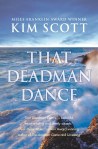
Kim Scott That Deadman DanceAll these books have won major awards and/or been bestsellers (by Australian terms, anyhow). None are simple or easy books, and none present Australia at its best. In this sense they represent “true” literature that grapples with real issues, and clearly meet the goal of revealing ‘Contemporary Australia’ (in all its messiness.) Clearly, they appreciate that historical novels also say something about “contemporary” Australia. It’s encouraging that the program is still going, and is supported, it seems, by quality launch events. So many visionary programs like this seem to flounder.

Oh, and by-the-by, I discovered that in July this year, Monash University held a Translation in transition: Australian literature in Japan. It was to focus in particular on this Masterpieces program, which they describe as a 10-year project. The seminar was being given by Tomoko Ichitani who translated Grenville’s book for the project. She is apparently working on a “collaborative translation of Alexis Wright’s Carpentaria“. I wonder if that’s for this program?

Anyhow, what book would you choose next? (I have a few ideas.) And do you have any comments on those chosen to date?