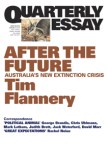
Quarterly Essay 48 cover (Courtesy Black Inc)
Tim Flannery is an Australian palaeontologist-cum-environmentalist who has been on the public stage for a couple of decades now. He has published several books on environmental issues, some best-sellers, including The future eaters and The weather makers. He was Australian of the Year in 2007, has starred in three television documentary series with comedian John Doyle, and is currently Chief Commissioner of Australia‘s Climate Commission. With the environment being his passion, he is used to controversy, but many of us regard him as a national treasure. There, I’ve shown my hand!
Needless to say, I enjoyed his current Quarterly Essay titled After the future: Australia’s new extinction crisis. In it he analyses the causes of the second wave of extinctions, and suggests solutions.
The essay is divided into 8 short sections. Near the end of the second section, Flannery writes
I hope the message is loud and clear. Australian politics, and the bureaucracy that supports it, is failing in one of its most fundamental obligations to future generations, the conservation of our natural heritage.
It’s scary stuff. On the preceding page he discusses public ignorance, arguing that most people are unaware that a new wave of extinction is happening, and that those who are aware “commonly believe that our national parks and reserves are safe places for threatened species”. I fall into this latter camp, I’m afraid. I knew it wasn’t all hunky-dory but I had assumed that the parks and reserves were working. Apparently not. The reasons are complex. Funding is of course one aspect and underpins some of the issues he raises, such as the lack of resources and support for effective planning and management, and a decrease in scientifically trained staff able to research and monitor the situation.
However, Flannery argues there are more systemic issues, mostly relating to “politics”. One is the increasingly risk-averse behaviour of governments, resulting in their being prepared to do nothing rather than risk failure. Another is the fact that the environment is no longer the bipartisan issue it once was, with the right increasingly seeing the environment as a left issue. The conservatives are, paradoxically, losing interest in conservation! Environmental stewardship, Flannery argues, once inspired leaders of the right, like Theodore Roosevelt and Ronald Reagan in the USA, and Malcolm Fraser in Australia. It was Malcolm Fraser “who first used federal powers to prevent sand mining on Fraser Island, who proclaimed Kakadu a national park, and who ended whaling in Australia”. However, the rise of green parties (here and in other first world nations) is alienating the right, and yet are not always friendly to conservation. “Animal rights issues, such as opposition to the culling of feral species”, for example, “can sometimes get in the way of environmental stewardship”. The result of environmental issues being seen through the lens of party politics and ideology is that the effort to discredit conservation has resulted in the rejection of science as “a guide to action”. This, says Flannery, is dangerous territory.
While Flannery spends around a third of the essay setting out the problem and discussing the causes, his main thesis is that the current focus of environmental programs on preserving ecosystems is not working – and he presents some convincing arguments for changing the focus to saving individual species. He describes programs in the Kimberleys which are managed by the Australian Wildlife Conservancy (with which he is connected) in partnership with indigenous groups, using their fire management techniques. But his most impressive example is a privately managed program in Papua New Guinea, the Tenkile Conservation Alliance, focused on saving a tree kangaroo. He argues that it “is a prime example of saving an ecosystem by concentrating on saving a species”, and asks:
How is it that one Australian couple has almost single-handedly transformed the fortunes of a people and the biodiversity of a mountain range while trying to save an endangered species of tree kangaroo? The answer is simple: the Thomases [zoologists] set clear goals, used scientific methods to monitor their progress, and reported back to the people.
I’m not sure I’d call that simple. Or, perhaps I’d say the process is simple, but deciding on environmental priorities and finding the right mix of people/organisations to manage it is not so simple. Flannery’s solution is there needs to be:
- a legislative commitment to zero tolerance on further extinctions;
- the establishment of a Biodiversity Authority [yes, I know, another bureaucratic body] that is independent of government, that has “unequivocal targets”, and which faces strong consequences [what, I wonder?] on failure to deliver; and
- the acceptance and formal involvement of non-profit organisations in managing biodiversity programs.
The Conversation, an Australian academic and research sector blog, is currently running a weekly series on endangered species. A commenter on last week’s post suggested outsourcing the listing of endangered species to peak groups, pretty much mirroring Flannery’s argument regarding partnerships between the government and non-government sectors.
Overall, the essay is clearly argued, but occasionally Flannery makes a statement that jars. One is his statement that “even under Labor governments with a strong green bent, national parks are not always safe” which he supports using the example of the Bligh Government’s starting the process of de-gazetting a part of the Mungkan Kaanju National Park with a view to returning it to its traditional Aboriginal owners. He doesn’t elaborate on this. I wrote in the margin, “Is this wrong”? Not surprisingly, at least one indigenous leader, Marcia Langton, took offence. I suspect it was a case of Flannery finding a poor example to support his argument regarding national parks being threatened even by supposedly sympathetic governments, but I don’t know.
Despite odd moments like this, I did find his argument convincing. However, as I’m sure he’d say himself, it’s not a guaranteed solution. Early in the essay he makes a point of discussing scientific method, arguing that “science is not a search for the truth” but about “disproving hypothesis”. The hypothesis he proposes here is surely worth testing given the failure of current methods. It begs his early questions, though, regarding political and social will, which may in fact be the critical variables that we need to resolve.
Tim Flannery
“After the future: Australia’s new extinction crisis”
in Quarterly Essay, No. 48
Collingwood: Black Inc, November 2012
107pp.
ISBN: 9781863955829
(Review copy supplied by Black Inc.)
 Whispering Gums