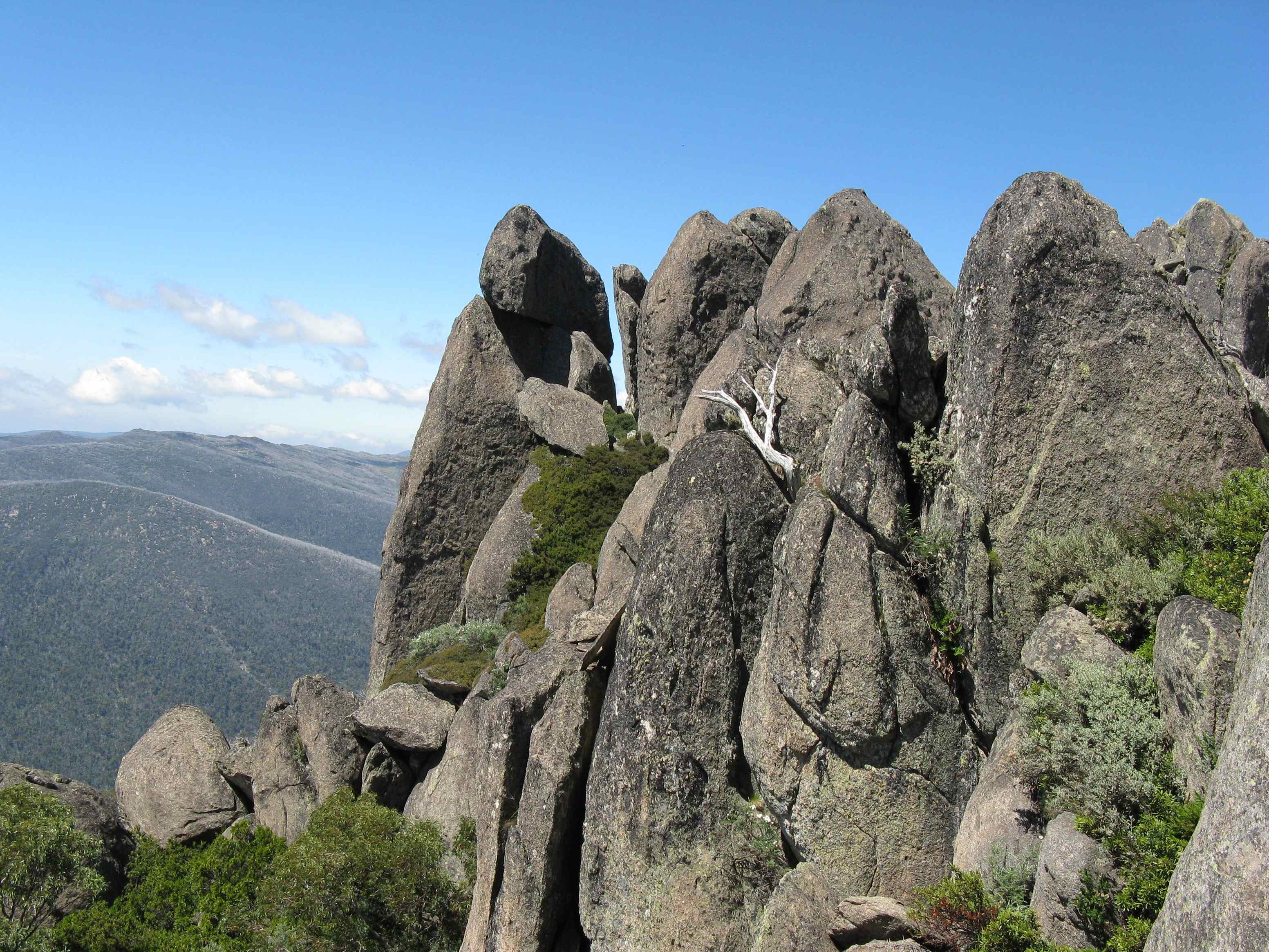
Porcupine Rocks, Kosciuszko National Park
Having just returned from Japan where stones are revered, I thought it might be apposite to share one of the poems from Adrienne Eberhard’s section “The Magic of Stones” in her suite of poems about Jane, Lady Franklin.
Blocky, grain-growing, cast in the stance
of a thousand others
Embedded, spore-emblazoned, lying in layers
of limb-lost wist
Forging, fossil-jawed, timing the hours
of a mute universe
Gravelled, facet-shattered, your end
is never nigh
Stoning the earth, shelving the soil
(“Rock”)
It’s not my favourite poem in the book, but I like the way it conveys the paradoxical nature of rocks – their longevity and their mutability. Their time, geological time, is almost beyond human (at least, my) comprehension and yet they do change, which gives an organic (life-like) dimension to their inorganic nature. Lichen grows on them, water and wind act upon them, trees and other plants force their roots into them. The original shape-shifters perhaps!
Anyhow, it’s no wonder, I think, that stones/rocks are a common symbol across time and space. They feature, for example, in the Arthurian legend (with the sword-in-the-stone) and in Christianity (with Peter, the rock). A well-known Australian representation is in the book/film, Picnic at Hanging Rock, where the rock has multiple meanings from the earthy (sexuality and loss of innocence) to the mystical/spiritual. Paradox again … but that’s rocks for you.
 Whispering Gums