
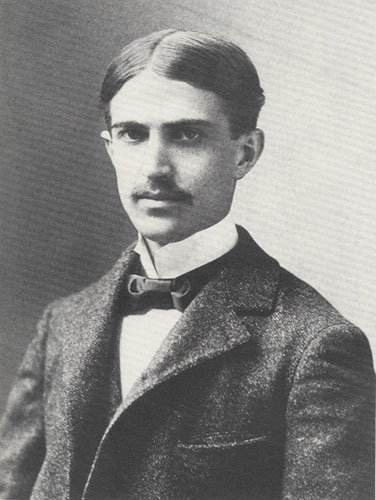
Stephen Crane, 1899 (Photographer unknown; Presumed public domain, via Wikipedia)
I haven’t reviewed a Library of America offering for a while and so have decided it’s time I dipped again into its offerings. Willa Cather‘s essay/journalistic piece “When I knew Stephen Crane”, which they published last month, appealed to me because of a couple of synchronicities. One is that Lisa of ANZLitLovers reviewed Crane’s The red badge of courage a few days ago, reminding me that I have yet to read Crane. The other is a little more obscure. Colleen of Bookphilia wrote a post earlier this week in which she complained about Anthony Trollope‘s admission that he would, in order to meet a deadline, submit work that he believed was not very good. The synchronicity is that in her essay Cather writes that Crane
gave me to understand that he led a double literary life; writing in the first place the matter that pleased himself, and doing it very well; in the second place, any sort of stuff that would sell. And he remarked that his poor was just as bad as it could possibly be …
Not having read Crane, I don’t know whether he really did present poor stuff, but Colleen, I suspect, would not be impressed with this admission!
“When I knew Stephen Crane” was first published in 1900, two weeks after Crane’s death. It documents 21-year-old Cather’s meeting with 23-year-old Crane in 1895 at the offices of the Nebraska State Journal not long after the journal had published The red badge of courage. The introductory notes state that she changed some facts and suggests she did this “to foretell his tragic fate and to reflect [her] own interest in writing and literature”. I can believe this may be the case as the article is peppered with foreshadowings of his early death. Nonetheless, the notes argue that her report “sounds authentic”.
Certainly, she doesn’t try to present him in a heroic light. She describes him as “thin to emaciation, his face was gaunt and unshaven … His grey clothes were much the worse for wear … He wore a flannel shirt and a slovenly apology for a necktie.” He had, in other words, “a disreputable appearance”. She writes that she had read and helped edit, for the journal, The red badge of courage:
… the grammatical construction of the story was so faulty that the managing editor had several times called on me to edit the copy. In this way I had read it very carefully, and through the careless sentence structure I saw the wonder of that remarkable performance.
She writes eloquently of her moment of revelation from Crane, saying that
The soul has no message for the friends with whom we dine every week. It is silenced by custom and convention … It selects its listeners wilfully, and seemingly delights to waste its best upon the chance wayfarer who meets us in the highway at a fated hour.
Hmm … I think there’s a lot of truth in this, at least in my experience as a giver and receiver of such “messages”. Anyhow, Cather, on a night when “the white, western moonlight threw sharp, blue shadows below us”, felt lucky to have had such a moment with Crane, one in which he talks about his craft, “his slow method of composition”. He tells her that while The red badge of courage had been written in 9 days, he had been unconsciously working on it throughout his boyhood. He also tells her that it would be months after he got an idea for a story before he’d feel able to write it:
‘The detail of a thing has to filter through my blood, and then it comes out like a native product, but it takes forever’, he remarked.
Cather also briefly refutes the criticism by some that Crane is “the reporter in fiction”, arguing that his newspaper account of a shipwreck he’d experienced was “lifeless” but his “literary product” (“The open boat”) was “unsurpassed in its vividness and constructive perfection”.
She concludes the article on a somewhat sentimental note which is not surprising given its publication so soon after his death … but even this sentimentality is expressed in the robust language that we know Cather for:
He drank life to the lees, but at the banquet table where other men took their ease and jested over their wine, he stood a dark and silent figure, sombre as Poe himself, not wishing to be understood …
It is for Cather’s own writing and her insights into character, as much as for what I learnt about Crane, that I enjoyed reading this offering from LOA. I will still, however, read Crane one day.
 Whispering Gums