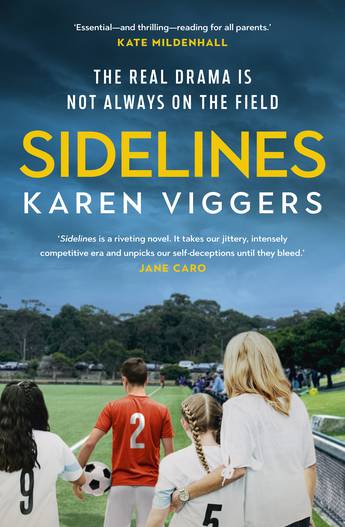
Karen Viggers, Sidelines (#BookReview)

I don’t usually start a book review by relating its content to my own experience, but local author Karen Viggers’ latest novel Sidelines invites exactly this. Sidelines is about children’s sport and what happens when the competitiveness gets out of hand. It was largely inspired by Viggers’ own experience as the mother of sporty children, and by an ugly parental brawl at a children’s football match that happened during those years.

My children’s sport experience was blissfully different. Our son played cricket, and his coach’s last name was McPhun – I kid you not. He was the perfect children’s sport coach. His focus was on “phun” and teamwork. He encouraged those kids, was fair about opportunity, did not favour his own son, and we parents had the best time. I loved seeing the enthusiasm with which the kids played, and their resilience when they were out for a duck, despite having gone in to bat with dreams of sixes and high scores. You won’t be surprised, perhaps, to hear that our kids were not in the elite division, but this should not make any difference. Unfortunately, however, it probably does.

So, Sidelines. As Viggers explained at the meet-the-author event I attended – and as is obvious if you read it – her novel has a structure rather like Christos Tsiolkas’ The slap*. This means that the novel’s story or plot is progressed through a sequence of different, third person, points of view encompassing the parents and children involved in the sport. Sidelines is a little different though because in Tsiolkas’ book, the slap occurs in the first chapter and we then watch the fall-out from that action. Viggers’ novel commences with a prologue describing an ambulance arriving at a sports ground where a badly injured child is lying far from the goal-posts. “What the hell happened here?” We then flash back to nine months earlier and, through those sequential voices, we work our way towards what had happened and why.

“It’s not meant to be fun” (a football father)

The novel focuses on two families – the well-to-do Jonica, Ben, and their 13-year-old twins, Alex and Audrey; and the Greek-Australian working class family of Carmen, Ilya, and their daughter Katerina. Into this mix comes Griffin and his single-parent Dad, Lang. Griffin is a natural, and his appearance upsets the team’s sporting and interpersonal dynamics. The characters telling the story are Jonica, Carmen, Audrey, Katerina, Ben, and finally, Griffin. For each voice, there is a thematic word or phrase that provides insight into, and commentary on, that character.

The first voice, Jonica’s, initially made me feel I was reading one of those stories about a dysfunctional family. You know, the well-to-do family with the successful, professional, and controlling husband, the privileged children, and the wife and mother caught somewhere in the middle. And there is some of this aspect in the novel, because, as becomes clear, part of the story Viggers is telling is one of class. So, in Jonica’s story we see the tropes of her class. Everything is laid on in a material sense, but the two females, in particular, aren’t happy. Jonica, like her husband, is a lawyer, but she is frustrated about not working. Ben, you see, “likes having her at home”, and insists she is needed to look after the children. He will “support her” (and the family) while she supports the children. There’s an irony in this word, “support”, which is Jonica’s theme, because, as Viggers said during the author talk, there’s a fine line between “support” and “pressure”. Audrey certainly feels more pressure than support.

The next voice is that of the other mother, Carmen, whose daughter, Katerina, like Audrey, is trying out for a place in the boy’s team where, as Ben had told Jonica, girls will learn “speed and aggression”. While Jonica tries, unsuccessfully, to resist her husband’s pressure to push the children, Carmen is more like Ben. She wants her daughter to achieve where she had failed, and she will manipulate and kowtow as much as is necessary to ensure this happens. Her theme or motif is “goal poacher”, the one who “attempts to shoot goals from loose balls … and uses other non-traditional ways of scoring”. Perfect for the resourceful Carmen.

And so the novel progresses through to Audrey’s and Katerina’s voices, where we see the pressures that their parents don’t. These girls do want to play well, but they also want other things in their lives. They are teens, for heaven’s sake! And Viggers’ rendition of them convinced me.

The penultimate voice is Ben’s, and here, in particular, is where Viggers’ choice of a multi-voice structure shines, because, while he’s still unlikable, we also see his point of view. Ben is the alpha male, no doubt about it, but he loves his family and he’s not so tuned out that he doesn’t sense something is wrong with Audrey in time to take critical action. This is the value of reading, being able to see a situation from another point of view. We don’t have to agree with Ben – I’m sure few of us do – but we can see where he’s coming from and that he’s human. This awareness can be achieved with third person voices, of course, but Viggers has effectively used first person voice here to directly confront readers with her protagonists’ thoughts.

By the end of the novel I was impressed by the careful and sophisticated way in which Viggers had developed and explored her main idea, which is to encourage us to think about our attitudes to and behaviour around competitive children’s sport. She offers no easy solutions. This is not a didactic book. There are many points left open for readers to think about. Can you play for fun, for example, and what does that look like?

In the above-linked interview with Viggers, she said she has realised that she is an issues-based writer. This is exactly what I thought as I started reading Sidelines. On the surface, it departs from her previous, environment-themed novels but, in fact, like those novels, it takes an issue Viggers cares about and explores it through characters who are real on the page. I enjoyed the read, but more than that, I hope it gets read and talked about in places where it matters.

* Interestingly, another Tsiolkas book, Barracuda (my post), starts with elite children’s sport, but while class is also an element, it takes a long view of what happens when things don’t go to plan.

Karen Viggers
Sidelines
Crows Nest: Allen & Unwin, 2024
343pp.
ISBN: 9781761470714
Unbreakable: Conversation with Jelena Dokic

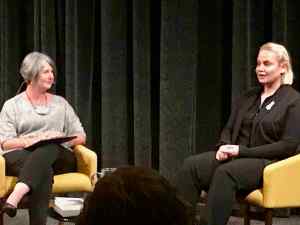
Louise Maher and Jelena Dokic

If you are a fan of professional tennis you will probably have heard of Jelena Dokic who hit the world stage during the 1999 Wimbledon Championships. She was just 16 years old, and, as Wikipedia writes, “achieved one of the biggest upsets in tennis history, beating Martina Hingis 6-2, 6-0. This remains the only time the women’s world No. 1 has ever lost to a qualifier at Wimbledon.” If you were an Australian tennis fan this was very exciting – or should have been. Unfortunately for Croatian-born Dokic, her tennis trajectory was one dogged by controversy, much of it caused by her abusive, controlling father. Her story, which she has documented in her book, Unbreakable, co-written with Jessica Halloran, is a tough one.

An author talk with a sportsperson about a co-written memoir would not necessarily be high priority for me, but if there’s one sport I love, it’s tennis, and Dokic’s story has implications that extend beyond tennis. So, with no competing events on that night, Mr Gums and I decided to go. It was in the form of a conversation between Dokic and local ABC presenter Louise Maher.

Jelena Dokic, Unbreakable

The conversation started with some introductory information. This included that Dokic had reached 4th in the world by the age of 19 years old, and that, due to the Yugoslav wars, she and her family had left Croatia for Serbia when she was 8 years old, and then emigrated to Australia in 1994 when she was 11. By 11 years of age, then, she’d already experienced far more trauma than most her age had experienced. When you add to this the fact that her father – who saw tennis as the opportunity for a good life – started abusing her from the minute he introduced her to tennis when she was 6 years old, you get the picture of a sad and lonely young person. It’s no wonder that the Australian tennis community – fans and players – found it hard to warm to her. No wonder, I say, but that’s no excuse. The failure of duty of care for this young person is clear – and her book has, apparently, got the international tennis world talking.

Now, I’m not going to give a blow-by-blow summary of the conversation, partly because it covered a lot of ground that is covered in the book, as well as in the various stories about her life that you can read on the Internet. Instead, I want to focus on the lessons and messages from the book (well, from what she told us about the book, as I haven’t read it.)

She had a few reasons for writing the book. One was to help others: she hopes by sharing her story, she will increase awareness of abusive parent-child relationships, particularly in sport, and thus help ensure it doesn’t happen to others.

Another reason is a more distressing one, in a way, and that is to enable Australians get to know her better – because the truth is that, due to her father’s abusive control of her, spectators never really got to know her, and as a result, they sometimes gave her a hard time. Some of this was racially or ethnically based – indeed she was told “to go back where you came from” – by several within and without the tennis world. The worst time for her, though, was when her father suddenly withdrew her from Australia, when she was 17 years old, to play for Yugoslavia. Her first major tournament after this was, unfortunately, the Australian Open – and the crowds jeered her. That’s hard enough for any-one, but for a 17-year-old girl who had no say in the matter, who was being abused by her father, it increased her sense of loneliness, of isolation, of having no support.

This issue of having no support is something she repeated several times in the conversation. When Louise Maher pressed her about her mother’s role, Dokic answered that her mother didn’t intervene. She wanted the family to stay together, and trusted her husband knew what he was doing!

Dokic provided various examples of her father’s abusive behaviour towards her, and of her desperation for a little praise that apparently never came (even after significant wins). She finally managed to “escape” home when she was 19-years-old – but life was tough, as she left with nothing, no money, no credit card. This is when, she said, she particularly needed support, but there was none.

I won’t continue, but there are some too-familiar lessons here, particularly the one that I’ll call the “turning a blind-eye syndrome”! There were people, Dokic said, who knew things weren’t right, but they were reluctant to get involved. And the media focussed on her father, enjoying the sensationalism of reporting on his behaviour – “Media thought he was funny, but he wasn’t”, she said. The didn’t pay any attention to what was happening to Dokic, or to the impact of their reporting on her. (I wished, that night, that I’d thought of my question about what she’d have liked the Media to do, before, not after, question-time finished!)

Dokic loved playing tennis, she said, but her father ruined her career. Tennis aficionados will, I’m sure, agree with her. She did look like achieving a come-back in her mid-to-late twenties but injury, illness, and surely the impact of all she’d suffered, meant there wasn’t the fairy-tale ending. Today she does sports commentating, motivational speaking and coaching.

There was a lot lot more – but if you’re interested, read the book!

Meanwhile, there are lessons to be learnt by the media, by spectators, and by tennis organisations about duty of care, particularly when reporting on, watching, or managing young players. What happened to Dokic could not have been completely avoided – its having started at home when she was a beginning 6-year old player – but it should not have gone on for as long as it did if people who knew, or even suspected, things were amiss, did something about it. I do hope this book has the effect that Dokic would like.

(Oh, and sitting next to me at this event was one of the ACT Litbloggers, the lovely Angharad of Tinted Edges. I look forward to seeing her post on it.)


Christos Tsiolkas on success and failure

I will soon post my review of Christos Tsiolkas’ latest novel Barracuda, which is about a young man who fails in his quest to become an Olympic swimmer. It tears him apart. In tonight’s news, here in Australia, we heard that one of our successful Olympic swimmers is going into rehab for addiction to Stillnox. Another recently went into treatment for depression.

Tsiolkas’ Danny didn’t make it the way these Olympians did, but I wonder whether their (apparent) suffering has the same roots as Danny’s – the loss of a future. Danny lost it because he “failed” (in his eyes) at a crucial moment. For post-Olympians (as I’ll call them), it seems to be more about what to do after they’ve achieved the goal. Danny thought that his future was set, but even if he had achieved his goal, would it have been?

Here’s Danny:

He flexed his right hand, opening and closing it, stretching his fingers till he could feel the tingle, then clenching them in tight. Sometimes in the garden he came across dried-up plum kernels from fallen fruit that had been buried all winter and then resurfaced. He’d pick up a kernel, it would be shrivelled, the colour of the soil, and it would disintegrate into dust in his hand. That was the future, that’s what had become of it.

His hand open and closed.

He’d had a future. It had been as hard and as strong as the stony heart of an unripened plum, so strong it would have taken a hammer blow to crack it. He’d had that future for years but it too had crumbled into dust. His theory was that you only got one future to dream. He’d f****d it up. He’d failed and now it was gone.

Only one future to dream? Therein lies the rub, perhaps, regardless of whether you succeed or fail (in sport or other single-minded endeavour)?

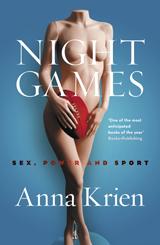
Anna Krien, Night games: Sex, power and sport (Review)

Anna Krien, Night Games

Night Games (Courtesy: Black Inc)

Towards the end of her most recent non-fiction work, Night games, Anna Krien writes:

I wish I’d chosen to follow an ‘easier’ rape trial.

She’s concerned that what she’s written, what she’s finding, won’t “sit well with feminists or footballers”. She might be right, but that would be a shame, because what she’s produced is a rational and, yes, provocative analysis of football culture and the way society enables it. It’s about power, entitlement, complicity – and, of course, sex.

“… despite the verdict, I still don’t know who is guilty and who is innocent”

Like Helen Garner (The first stone and Joe Cinque’s consolation) and Chloe Hooper (Tall man), Anna Krien, whose Into the forest and Us and them I’ve previously reviewed, writes in the narrative non-fiction genre. It uses literary techniques to create a narrative about a real issue or event, and can involve the author putting herself (in this case) in the story. I like the style. If well done, it feels honest because the author is clear from page one about the facts (and their limits) she’s presenting, the ideas she’s exploring and, significantly, the challenges she personally faces during her exploration. Krien doesn’t shy away from confronting her feelings, but neither does she let them overshadow her ability to reason.

And so to Night games. The book tracks the rape trial of an AFL footballer. This has implications for the narrative. The name of the complainant must be suppressed, so Krien decides to suppress the defendant’s name too. The complainant’s testimony was given in closed court, so cannot be reported. This could seriously skew Krien’s story, except that she structures the book in such a way that, although the connecting narrative is the trial, the main game (ha!) is the surrounding culture. Also, Krien reverses traditional trial narrative (fictional and factual) and reports the verdict in her Prologue. This de-emphasises the trial drama, and focuses us on the issues she wants to explore. It’s intelligently done – and once again convinced me that Krien is a writer I want to watch.

The book has six parts – the Prologue, an Epilogue, and four parts in between in which Krein tackles what she sees as the critical issues. These are football culture, particularly regarding male bonding rituals, and attitudes to women and minorities such as black and gay players; rape and what she describes as the grey area surrounding consent; and the broader role of women in football, in various guises, including management and media. These parts could almost be read as separate essays, except that they are connected by the trial narrative, and by their thematic connections to each other.

“an abnormal society…”

Some of my family and friends looked a bit askance when I told them what I was reading. After all, rape is an unpleasant subject and I’m not a football follower – but, I am interested in gender and power, social relationships, and ethical behaviour, which are the book’s real subjects. The picture Krien paints of football culture is not pretty, but neither is it particularly new. Who hasn’t seen and heard, in recent years, news stories about drunken parties and sexual assaults involving footballers? Krien teases out what’s behind these behaviours, and it’s mostly to do with male bonding, a bonding that is characterised by bullying and by a “macho culture of humiliation” in which women become the objects through which the men (try to) prove themselves. It’s not quite that simple of course – and women can try to play the game too, can want footballer notches on their belts – but the pervading attitude, until recent moves to change it, has been one of male power and entitlement.

“… a moral quagmire”

More interesting to me was Krien’s discussion of “the grey area, the gulf of uncertainty between consent and rape”. She quotes academic Catherine Lumby, Rugby League’s advisor on gender and cultural change:

Yes, there are many instances of behaviour that we found in our research into players’ experiences that did not equate to sexual assault but are definitely extremely unethical behaviour – such as after having sex with a girl, throwing her out of your hotel room naked without her clothes for a joke. Or suddenly asking, ‘Do you mind if I invite my mate back?’

How easy, Krien asks, is it for women to say “no” in many of the, usually powerless, situations they find themselves in – and if they don’t say no, have they consented? Is acquiescence consent? If not, what is it? The issue of consent was the critical issue in the rape trial Krien follows in the book – and hence her wish for an ‘easier’ rape trial. I’m aware that, except for that stereotypical violent, sociopathic rapist we all think of, consent is the critical issue in many rape cases. But, what I liked about Krien’s discussion was her analysis of the consent issue within this particular culture and her questions concerning how it might be better negotiated and understood at the time the sex occurs and how it might be better handled legally. Underlying this, though, is the idea that there would be less need to worry about grey areas surrounding “consent” if the culture itself fostered respect and equality, not to mention ethical or moral behaviour.

I’ll leave my discussion of Krien’s arguments and thesis here, otherwise I’ll end up writing an essay myself. I’ll simply add that I like Krien’s self-questioning and analytical, rather than emotional, approach. There’s no list of sources at the end, which I missed, but she clearly identifies her extensive research as she goes, naming the people and works she consulted. I also like her writing. It’s accessible and logical, but has fresh turns of phrase that lift it out of dry reportage.

If you weren’t inclined to read this book, think again, because I found Night games to be illuminating beyond its specific focus on football culture. It is also an excellent read.

Anna Krien
Night games: Sex, power and sport
Collingwood: Black Inc, 2013
268pp.
ISBN: 9781863956017

(Review copy courtesy Black Inc)

Monday musings on Australian literature: It’s all about sport, or is it?

I’ve written previous Monday Musings on themes and motifs in Aussie literature – like the lost child, the beach, mountains and even sheep – so, with the Olympics now on, it seemed appropriate to add sport to this list.

Whether we all like it or not, Australia has somewhat of a reputation for being a sports-focused country. We’ve had our moments in the sun as a cricketing nation, a tennis nation, a swimming nation, a golfing nation, and so on. We’ve even won the Tour de France and the America’s Cup! Given all this, I started to wonder last weekend about how sport has been presented in our literature … and I must say I struggled to come up with many examples (from my own reading anyhow). This will be a short post, methinks, but it has to be done!

My first encounter with sport in Aussie literature was in my childhood, through ballads. My two favourite examples are Thomas E Spencer’s “How McDougall topped the score” (1898) and Banjo Paterson‘s “The Geebung Polo Club” (1893). The former is a comic poem about a country cricket match between two towns. It celebrates the triumph of the underdog (a popular Aussie theme) through (bush) cunning. While Spencer’s poem is about one of Australia’s most popular sports, “The Geebung Polo Club” is about a far less widespread sport, polo (of course). Polo works as an effective vehicle for depicting another common theme in Australian culture, the ordinary man versus the toff (which, in this poem, is compounded by the country versus the city conflict). The ballad also celebrates the “never say die” spirit, and is what I’d call a tragicomedy. I can’t resist giving you a flavour:

Here are the Geebungs:

But their style of playing polo was irregular and rash –
They had mighty little science, but a mighty lot of dash:
And they played on mountain ponies that were muscular and strong,
Though their coats were quite unpolished, and their manes and tails were long.

And here is a description of their opponents, the Cuff and Collar team:

For the members were distinguished by exclusiveness and dress.
They had natty little ponies that were nice, and smooth, and sleek,
For their cultivated owners only rode ’em once a week.
So they started up the country in pursuit of sport and fame,
For they meant to show the Geebungs how they ought to play the game;

You get the drift, I’m sure.

The next work dealing with sport that comes to my mind is a play (later made into a film) by Australia’s best known contemporary playwright, David Williamson. Much of his work is satirical and his play The club (1977) is a great example. The sport in question is a particular type of football, Australian Rules, and the play explores the tensions between commercialism and traditional club loyalties, which, reminding me of “The Geebung Polo Club”, also translates into an exploration of class conflict. More broadly, though, it is about the struggle for power, something Williamson explores in other settings besides sport.

Okay, so I’ve discussed a couple of poems (ballads) and a play, but when I turn to literary fiction my mind goes pretty blank. There is Tim Winton‘s Miles Franklin Award winning novel Breath (2009). It’s about surfing, and is primarily about masculinity and risk-taking. Winton’s interest is more psychological than the socio-political explorations of the other works I’ve mentioned. And there’s Gillian Mears‘ recent novel, Foal’s bread, about horse high jumping. As I wrote in my review, I loved the way it, like Breath, introduced me in the most visceral way to a sport I have never experienced. It draws on some of the themes from those 19th century ballads – in particular the hardship of country life – but while they tend to romanticise the lives they depict, Mears’ work, while having an element of the heroic about it, also deals with the struggle to survive, psychologically as well as physically.

There are many novels in which sport appears (like say, Craig Silvey’s Jasper Jones) but not many, that I can dredge up, for which sport provides the principal setting. Is this because sportspeople and writers tend to be diametrically opposed? I’d love to hear your thoughts on this, and whether you have any favourite novels in which sport is centre stage.