If you asked my kids what my favourite mantras are, they would probably include “less is more” as one of them. This is not to say that I don’t enjoy flamboyance and “over-the-topness”, because I most certainly do, but it is true that I am more often drawn to what I would call “the spare”.
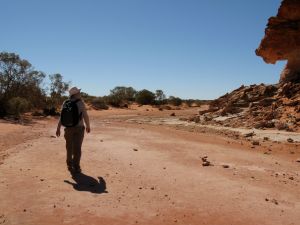
Claypan in Wurre (Rainbow Valley), south of Alice Springs
As we drove recently through Central Australian desert country, I started thinking about why it is that I love deserts, why I am drawn to them – and it suddenly occurred to me that my love of deserts can probably be equated with my love of spare writing. There are similarities: deserts and spare writing look deceptively simple and even, at times, empty on the surface but, hidden beneath this surface is a complexity that you can only find by looking and, particularly, by knowing what to look for. Conversely, in say a rainforest or a big fat nineteenth century novel, you are confronted with an embarrassment of riches. This is not to say that they, too, don’t have their complexities, but the “wow factor” is in your face!
And so what exactly is spare writing? I realised that I have often called something spare but this has been an intuitive thing – I’ve never actually sat down and defined what I mean by it. I’m going to now – for my benefit even if not for anyone else’s!
What typifies spare writing?
Of course, nothing that I write below is exclusive or absolute – there are, as they say, exceptions to every rule, but there are too, I think, some generalities we can identify:
- preponderance of short sentences
- minimal use of adjectives and adverbs
- apparent focus on the concrete rather than the abstract
- simple dialogue
- repetition
- strong (often more staccato like) rhythm
- short paragraphs and more white space on the page
By excluding anything that could be seen to be superfluous to the intent, the author can cut to the chase…and the chase is often the most elemental, the most intense of experience or emotion. In this sense spare prose is reminiscent of poetry – and in fact can often feel and sound poetic. Spare writing, though, can also be its own worst enemy: it can be so pared down, so concise, that it becomes elliptical; so non-florid, so unsentimental, that it can seem cold. But then, this is no different from any other style is it? There are those who use a style effectively and those who don’t. Used well, a spare style can grip me quickly and, often, viscerally.
Some proponents of the style
While Ernest Hemingway is the writer most often cited, I think, as a spare writer, I have read little of his work – something I would like to rectify. Albert Camus, particularly in works like The outsider, is spare: the protagonist Meursault explains little leaving it to the reader to untangle who he is and what he feels and believes (or not as the case may be!). JM Coetzee’s Disgrace is another rather spare work, exemplified by its detached tone, by the refusal of the main character to explain himself, and by its matter-of-fact description of fear and horror.
A recent very obvious example is Cormac McCarthy’s The road. This book is elemental in more ways than one: everything is pared down to the minimal – the landscape, the characters, the language. It is in fact about the struggle for life – literally and spiritually. The spare style – with its rhythmic repetitions – makes sure that we see that! And guess what? Its landscape, while not originally a desert has been made so by cataclysm. This is one of the sparest books I’ve read – and also one of the most mesmerising.
An observation
Have you noticed something about the above? All the examples are male. Is a spare style more suited to the male psyche? While I can’t think of any specific examples of women writing quite like the male writers I’ve described, I’d suggest that writers like – yes, I admit it, my favourites, Jane Austen and Elizabeth Jolley – are closer to the spare end of the writing spectrum. Austen, for example, is quite out of step with her female contemporaries, most of whom were writing Gothic or so-called sentimental novels. She is more rational, witty and ironic than descriptive and emotional…which is why, really, Charlotte Bronte, child of the Romantic age, didn’t much like her!
And here, in the interests of following my own “less is more” mantra, I shall close! I would though love to hear others’ thoughts on the matter.
 Whispering Gums