COVID-19, history tells us, is a one in 100 year event, the last such event being the Spanish flu of 1918 to 1920. This week, I thought I’d share some references to the Spanish flu from Trove – not news reports about the course of the flu itself, but some random references that indicate the flu’s legacy in various ways over the succeeding decade.
Jokes at the time …
Just like we are seeing now. Here is one from the Fitzroy City Press of 3 January 1920:
GETTING EVEN.
It was in the Spanish ‘flu period, and old Oppigar lay at death’s door. The priest came and told him he must forgive his enemies. Oppigar promised to do so with the single exception of Peter Svingen, against whom he had a very special grudge. But the priest insisted that even Peter must be forgiven. “All right then,” said Oppigar, ” I will forgive Peter also – but if I get well I’ll have it out with the old scoundrel!”
References in the following years …
In 1925, Perth’s Sunday Times of 31 May 1925 ran a story about the new cross-word craze that was sweeping the world, even reaching places like France and Italy. The article, ascribed to Twilight, is titled “The cross-word flu”. It takes the form of a conversation between a cynic, a cynosure (how many newspaper readers today would know that word), and others about the cross-word craze. The cynic starts it off:
“It was hardly to be expected,” re-marked our cynic, “that France would embrace the cross-word puzzle. France has suffered too many cross-purposes, double-crosses, and heard too many cross-words because she cannot forget the myriad crosses that dot, like forests, her fair provinces, to become enamored of a game whose name re-minds her of the bitterest things.”
To which the cynosure replies:
“True,” replied the cynosure, “France has puzzles enough at home, and the crosses that everywhere make memorial of her infinite sacrifice in the cause of the world’s liberty are at the same time mute warnings of what lurks threatening at her northern border; and further north in the land of the Bear. The marriage of the Bear with the Monkey has provided too big and perturbing a problem, without the importation of play puzzles from America.”
And here the cynic refers to the Spanish flu:
“As dangerous as Spanish ‘flu,” re-joined the cynic, “is the label French journalists have tagged to ‘cross-words.’ They warn the people to keep away from the new trans-Atlantic craze. One paper reminds its readers of a Frenchman who, before he died in a lunatic asylum, used to carry a paper, and pencil in his pocket and at parties would say, “Help me, my dear. I have lost my appetite and sleep because I cannot solve this problem.'”
I love the idea of cross-words being so popular, so engrossing, they were “as dangerous as the Spanish ‘flu“. The article goes on at some length discussing the craze. “A big tea-room proprietor” suggests “that nowadays all of us had mental worries enough without manufacturing new ones and calling them games”. It’s an entertaining piece – but interesting too with its references to the political situation, to the just-finished war, and also for its discussion about whether cross-words improve your mind or are just fun! Sounds exactly like current discussions about whether doing cross-words and sudokus ward off dementia, or just make you better at doing them!
As the years wore on, other references were made to the ‘flu, including by Canadian-American humorist and poet Walt Mason, whose pieces were published in Australian papers. On 24 April 1927, Brisbane’s Sunday Mail ran a piece of his called “No certainty”,
No man can with safety wager that the luck he knows to-day,
be it minor luck or major will not wilt and blow away.
None can say with show of reason that disease will pass him by,
that he won’t be, for a season, on a sick bed high and dry.
None can say what passing motor may assault and knock him flat,
flatter than a Yarmouth bloater, ruining his Sunday hat.
When we’re feeling strong and nifty, fit to struggle and to win,
it seems folly to be thrifty; better blow the money in.
We feel sure the future’s holding every blessing we desire,
and the wise man’s constant scolding only fills our breasts with ire.
But, behold, we faint and sicken as our labors we pursue,
and our pulses throb and quicken, and we’re down with Spanish flu.
Or perchance an auto climbs us where the hoaking lizzies fly,
and an undertaker times us, figuring on when we’ll die.
Then for weeks we loll and languish, wearing plasters night and day,
thinking in the deepest anguish of the bills we cannot pay.
While the torment racks and rages we resolve, if we get well,
we will listen to the sages and the shining truths they tell.
I’ve quoted the lot because Mason died in 1939 which I believe puts this out of copyright.
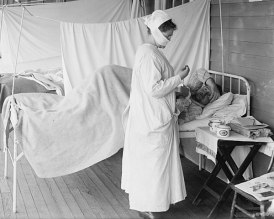
Walter Reed Hospital Flu Ward, 1918-19, Harris & Ewing photographers, via Library of Congress, Public Domain
Two years later, and about a decade after the flu, The Port Macquarie News and Hastings River Advocate published another piece by Walt Mason called “After the ‘flu” (21 September 1929). I found this also-rhyming piece in multiple Australian papers. Only some were attributed to Mason; others had no attribution at all.
The piece starts:
I had nine kinds of Spanish ‘flu, with sundry German brands thrown in; all day I coughed and said, ‘Ker-choo!’, all night I coughed and sneezed like sin.
The doctor said, as at my side he mixed up pills to feed my face, ‘The wonder is you have not died! I never saw so bad a case. I’ve seen a hundred taken down, I’ve seen them like the ripe grain fall; a thousand men are sick in town, but you are sicker than them all. It is a feather in my cap that I have pulled you through the strife; that you still loiter on the map, and breathe the well-known breath of life.’
And on it goes, describing what a wonder it is that he survived. Pronounced cured, he wants to brag to his friends:
There is no sense in being ill unless it gives you an excuse to talk about the doctor’s bill, and boast of pain to beat the deuce.
But they show no interest, calling his sickness fake, or telling him
You have your gall to talk of pain! A tin-horn ailment like the ‘flu. Your talk is frivolous and vain. Just wait until you have the gout, your toe swelled bigger than a brick! Then you may prance around, old scout, and claim that you really have been sick!
Our poor narrator concludes:
Alas, no matter what I do, my friends will never let me brag; in vain I hoped my siege of ‘flu would give a chance to chew the rag.
Simple humour by today’s standards, but interesting to see the lighthearted – but gently moralising – take on what was a terrible scourge at the time. Some describe Mason as a poet-philosopher.
Will we be writing about COVID-19 in similar tones over the next decade?
 Whispering Gums