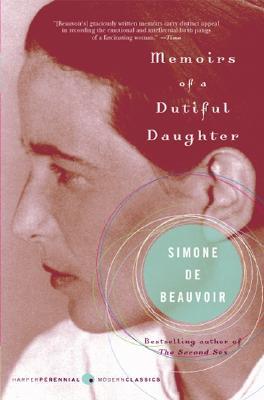
More on Simone de Beauvoir’s Memoirs of a dutiful daughter

My recent review of Simone de Beauvoir’s Memoirs of a beautiful daughter was a little dry, focusing on some specific ideas or issues that interested me, rather than on her writing. It’s a pretty dense book, containing detailed description of her life and thoughts, but her fearless and often evocative writing carries it. I’d like to share a few examples to round out my review – but of course, in doing so, I can’t help but also discuss the book a little more too!

Nature

Beauvoir and her family would spend their summers with relations in the country – with her father’s sister at La Grillière and her father’s father at Meyrignac. In these places she developed a deep love of nature. Early in Memoirs, from when she is still a very young schoolgirl, she writes that

… I was learning things that are never taught by books or official syllabuses. I learnt to recognise the buttercup and the clover, the phlox, the fluorescent blue of the morning glory, the butterfly, the ladybird, the glow-worm, the dew, the spiders’ webs, and the strands of gossamer; I learnt that the red of holly is redder than the cherry laurel or the mountain ash, that autumn blooms the peach and bronzes the leaves, that the sun rises and sets in the sky though you cannot see it moving. The wealth of colours and scents excited me. Everywhere in the green water of the ponds, in the waving grasses of the fields, under the thorny hedgerows and in the heart of the woods were hidden treasures that I longed to discover.

This love of being in the natural world continues with her – at least until she is 21 when these memoirs end. Indeed, at one point, when she is 19 or 20 years old, she admits to a mystical experience:

… the fact of existing here and now sometimes took on a glorious splendour. During those few days, the silence of nature often plunged me into joy and horror. I went even further. In those woods and meadows undisturbed by man, I thought I touched that superhuman reality I aspired to. I knelt down to pick a flower, and suddenly I felt riveted to the earth, with all the weight of the heavens on my shoulders; I couldn’t move: it was both an agony and an ecstasy which brought eternity within my grasp.

One of the threads running thought the novel is her desire to find “the meaning of life”. With this “mystical” experience, she was tempted, she writes, to “believe that I had attained the Unknown”. However, being the intellectual she was, she continues, “I didn’t want to take myself in” so asked some respected confidantes. Their responses bring her to the conclusion that “one can’t base one’s life on such giddy notions and I did not try to bring them on again”.

“I am alone”
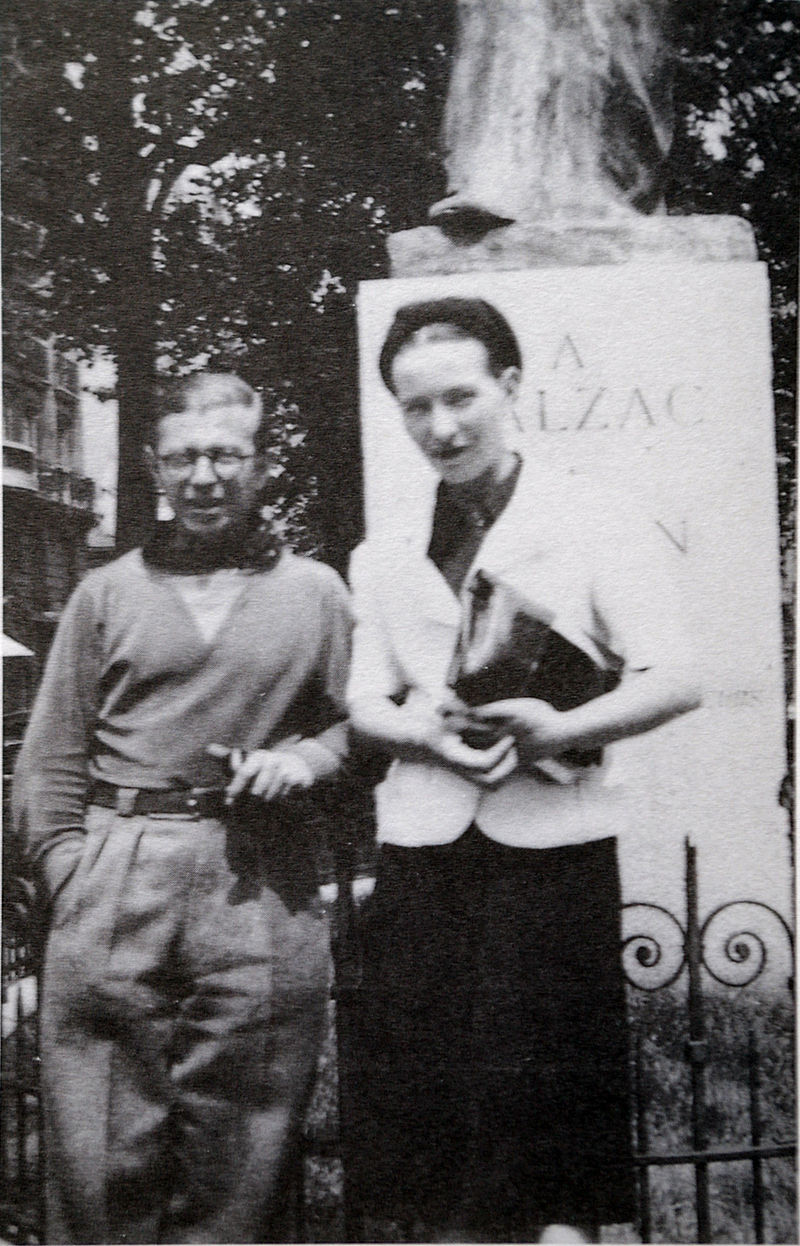
Sartre and Beauvoir

Sartre and Beauvoir, Balzac Memorial (Presumed Public Domain, via Wikipedia)

In my review, I likened her autobiography to a bildungsroman, and nowhere is this more applicable than in her descriptions of what we would now call teenage angst. Sometimes I think I have forgotten my youth, but Beauvoir’s descriptions of her own inner conflicts brought the memories back – reminding me, as if I needed it, of one of the reasons I love to read. What teenager can’t relate to the feeling of being “alone”? Beauvoir certainly could. Being the daughter of a devout Catholic mother and an atheistic but socially conservative father, in a society in which women were (or, at least she felt) “cabined, cribbed and confined”* left her frequently feeling alone, in “exile”.

In today’s discussion of the book on ABC Radio National’s Books and Arts Daily, literary critic Geordie Williamson quoted a heart-rending section from the book (p. 188-9) in which she discusses this issue, when she realises the error of her belief that

it would be possible to rise above bourgeois mediocrity without stepping out of my own class. Its devotion to universal values was, I thought, sincere; I thought I was authorised to liquidate traditions, customs, prejudices, and all kinds of political and theological particularism in the light of reason, beauty, goodness and progress.

She thought she would be praised if she wrote a book that “trampled conformity in the dust”, but she discovers that she’s wrong, that “people did not accept me at all; instead of weaving laurel crowns for me, people were banishing me from society”.  She “would always be ostracised”. Painful, painful.

This sense of aloneness – of “exile” – continues. Part of it is, of course, typical for adolescents. She writes, when she’s 20, that “I would fall into an arid despondency of heart, and then be bounced up into happiness again”. But it’s clear too that she was different from most of her peers. Joining Sartre and his little group brought her, finally, to “her” people, and she knew at last that she didn’t have “to face [the] future all on my own”.

A novelist’s eye

In my review I suggested that Beauvoir’s autobiography has some of the sensibility of a novel – particularly in language and characterisation. At my reading group’s discussion, one member shared her favourite quote. It’s a perfect example of the fiction writer’s ability to capture a moment. Here it is (with thanks to Kate):

On the evenings when my parents held parties, the drawing-room mirrors multiplied to infinity the scintillations of a crystal chandelier. Mama would take her seat at the grand piano to accompany a lady dressed in a cloud of tulle who played the violin and a cousin who performed on a cello. I would crack between my teeth the candied shell of an artificial fruit, and a burst of light would illuminate my palate with a taste of blackcurrant or pineapple: all the colours, all the lights were mine, the gauzy scarves, the diamonds, the laces; I held the whole party in my mouth.

* Roughly quoted from Macbeth.

Simone de Beauvoir, Memoirs of a dutiful daughter (Review)

Courtesy: HarperCollins Australia

Courtesy: HarperCollins Australia

I have only read one other work by Simone de Beauvoir – and I’m ashamed to say that it wasn’t The second sex (which still sits in my long-in-the-tooth TBR pile). It was, instead, one of her autobiographical novels, She came to stay. I enjoyed it as I recollect, but that was a long time ago. Then this year, my reading group decided to choose one of the books being discussed in ABC Radio National’s European classics series – and we opted for the first of Beauvoir’s autobiographies, Memoirs of a dutiful daughter.

Now, the things is, it’s a pretty dense book that can be looked at from multiple angles, too many to explore in one review. Consequently, my plan is to focus here on a few that interest me, and to later post a Delicious Descriptions containing examples of her gorgeous descriptive writing.

First though, as always, a brief summary of its content. Published in 1958, the book chronicles her youth from her birth in 1908 to when she turned 21 in 1929. It deals at some depth with her childhood, school and university days; her relationship with family and friends; her youthful thoughts about and experience, such as it was, of love; and, most importantly, the foundations of the ideas that drove her adult life. It shows the inner conflict she experienced as an independent thinker growing up in a conservative Catholic bourgeois family. I’d describe it as the autobiographical equivalent of a bildungsroman, which sounds silly since autobiography is intrinsically about the development of self. But this particular autobiography ends at the moment when she formally leaves childhood behind, and, like a bildungsroman, is primarily the story of her “formation”.

Autobiography

WARNING: THERE BE SPOILERS IN THIS SECTION – DOES THAT MATTER IN AN AUTOBIOGRAPHY?

BeauvoirMemoirsHarperPerennialThis leads nicely into the first aspect of the book I’d like to discuss, its form. It is a traditional autobiography in that it starts with her birth and moves in a linear way, with the occasional foreshadowing, to her chosen endpoint which is when she turned 21, finished her schooling and left home. Like an autobiography it contains many characters. (There is a comprehensive index if keeping track becomes difficult, though I didn’t find it that hard).

The book also, though, has some novelistic elements. While at times the style is dry and almost diary-like, at other times it is highly evocative, particularly when she describes her experience of nature. More relevant though to my argument is her use of characters, because while we meet many, there are three that she focuses on – herself, her first cousin and first love, Jacques, and her closest friend Elizabeth “Zaza” Mabille. These two significant people provide coherence to the narrative line and a semblance of a plot. Will she or won’t she marry Jacques? And how will Zaza develop?

Beauvoir doesn’t marry Jacques, but while the book ends when she’s 21 and he’s about 23, she briefly describes what happens to him in the rest of his life, which ends, sadly, when he’s 46. Zaza, on the other hand, could be seen as her alter ego. As we read the book, focussing on Simone as “the dutiful daughter”, we become aware that Zaza is also one. The difference between them is that while Simone is dutiful in an obey-the-parents sense, she is an independent thinker and learns to distance herself intellectually from her parents. Zaza, on the other hand, exemplifies the tragedy that can happen to “dutiful daughters” who don’t achieve this. She, in other words, rounds out the theme implied in Beauvoir’s title.

This sense of Jacques being her potential future and Zaza being her alter ego gives this autobiography some of the sensibility of a novel.

Gender

I couldn’t of course write on this book without discussing gender. But first, it’s important to remember when she was born – 1908 – and the community into which she was born – conservative, Catholic, bourgeois. It was intriguing to see how her ideas developed in this early part of her life.

Early in her childhood she saw that mothers had a life of “servitude”, and were “overburdened with a thousand tiresome tasks”. Her response was to decide not to have children but be a teacher. In her teens, she states that “I believed in the absolute equality of human beings” but doesn’t engage with  the idea of universal suffrage. A few pages later, she is a little fuzzy on this idea of equality when she considers her future husband:

I should be in love the day a man came along whose intelligence, culture, and authority could bring me into subjection.

Why, she says, did she think this? She continues

I never thought of myself as a man’s female companion; we would be two comrades [but, she goes on] My education, my culture, and the present state of society all conspired to convince me that women belong to an inferior caste.

She goes on to explain that the man she loved would be “the model of all I wished to become; he would therefore be superior to me”.

Overall then, her thinking was a little confused. Theoretically she believed in equality and demanded independence for herself, resulting in much conflict with her parents in her later teens, and yet she saw her ideal partner as being “superior”. Part of her belief in equality was an absolute rejection of the double standard. She ascribed to the Christian morality of her times but felt “that men should be subject to the same laws as women […] I saw no reason why my future partner in life should permit himself liberties which I wouldn’t allow myself”.

By the end of the book, that is, by the time she turned 21, her thinking hadn’t developed much beyond this. She believed in equality, she didn’t want to be constrained as she saw married women with children were, but she had not developed the ideas that she presented in The second sex, which she wrote around the age of 40Tellingly, Beauvoir-Sartre biographer Hazel Rowley writes in my edition that it was Sartre who told Beauvoir that if she were to write her memoirs she would need to look into “what it had meant to be a woman”. Beauvoir was apparently dismissive, believing that being a woman had never really affected her but, she decided to do some research. What she discovered was “a revelation” and resulted in her putting her memoirs aside to write The second sex.

Literature and truth

The other issue that spoke strongly to me as I read the book was the importance of literature, of books and reading, to her – and, related to this, her search for truth. Reading was, she writes, “the great passion of my life”. If you are well-versed in French literature, as I am not, you could track her intellectual development through her reading. She discusses the books she read as a young school girl, her reaction as a young teenager to Jo in Little women and Maggie in Mill on the floss (both English books, I know!). She talks of engaging in her late teens with contemporary literature of “the disquiet” through writers like Gide (whom I have reviewed here), and of then moving on from them.

She learns much through reading, not only intellectually and morally, but practically. Books, for example, provided her with much of her sex education, so that when her mother finally decided it was time to tell her the facts she could say “I know all about that” – though what she knew about sex and what she understood about the world were two different things!

She learns that literature and reality are not the same thing, saying at one point that

Literature takes its revenge on reality by making it the slave of fiction.

At times she argues that literature is the truth, while at other times she feels its connections with truth are dubious, but this is all part of a portrait of the writer as a young girl. “Real” truths are not found easily, and she, we see, worked hard for hers.

Finally – and how long we readers had to wait for it – it’s her meeting with Sartre, “the dream-companion I had longed for”, that grounds her, as she reaches the end of her formal childhood. He is, she says, her intellectual superior, and she is, she knows, still naive, but

I no longer asked myself: what shall I do? There was everything to be done, everything I had formerly longed to do: to combat error, to find the truth, to tell it and expound it to the world, perhaps to help to change the world.

And so she did.

Simone de Beauvoir
Memoirs of a dutiful daughter
(Trans. by James Kirkup)
New York: Harper Perennial, 2005
(First pub. 1958; Translated 1959)
364pp.
ISBN: 9780060825195