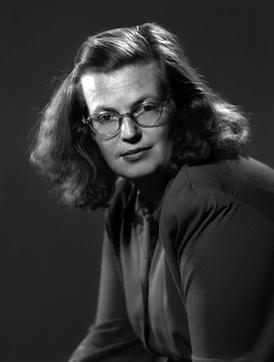
As a lover of short stories, I have wanted to read Shirley Jackson’s “The lottery” for some time. With Kate selecting it as October’s Six Degrees starting work, now seemed the perfect time!
Shirley Jackson (1916-1965) pops up on blogosphere with some consistency, and is clearly well-regarded. Her career spanned two decades and, during that time, as the thorough Wikipedia article says, she wrote six novels, two memoirs, and more than 200 short stories. Her debut novel, The road through the wall, and “The lottery”, were both published in 1948, though she had had short stories published over the preceding decade.
It was “The lottery”, however, which established her reputation – particularly as a master of horror stories. Wikipedia says it resulted in over 300 letters from readers, many “outraged at its conjuring of a dark aspect of human nature”. In the San Francisco Chronicle of July 22, 1948, Jackson responded to persistent queries from her readers about her intentions:
“Explaining just what I had hoped the story to say is very difficult. I suppose I hoped, by setting a particularly brutal ancient rite in the present and in my own village, to shock the story’s readers with a graphic dramatization of the pointless violence and general inhumanity in their own lives.”
Many of you probably know the story, but, just in case, I’m not going to “spoil” it beyond that. I will, however, make a few comments.
I’ll start with Wikipedia’s succinct synopsis: it is about ‘a fictional small town which observes an annual rite known as “the lottery”, in which a member of the community is selected by chance’. It’s a great read, because the build-up is so good and the ending so powerful. If you were not forewarned, you’d have no idea you were reading a “horror” story, because there’s nothing Gothic about the setting, no eeriness, no overt build up of fear even. Instead, there’s the coming together of this village’s 300 people coming for this annual event. It’s summer, “the flowers were blossoming profusely and the grass was richly green”. Idyllic, in other words, or, so we are set up to see it is (or, could be?)
The children are described, then the men and women. It all seems benign, though there are tiny hints of something else, that you may not notice if you’re not expecting it. The emcee of “the lottery” is the ironically named Mr. Summers, who has the “time and energy to devote to civic [my emph] duties”. Many of the names in the story sound normal, but they also carry symbolic weight – Graves, Adams, Delacroix (pointedly, as it turns out, perverted to Dellacroy by the townspeople).
Anyhow, there is a long discussion of the “black box” that is used for the lottery, but, although it is “black”, it sounds quaint and unimportant. No great care is taken of it between lotteries. There’s a bit of camaraderie and joking between the townspeople; there’s confirmation of the formalities; but, slowly tension builds. Mr Summers and the first man to draw from the black box, grin at each other “humorlessly and nervously”. We are now half way through the story, and there’s nervousness among the attendees.
Then, plopped in here, is a little discussion about some villages – because this is not just this village’s tradition – having given up, or talking of giving up, the lottery. However, Old Man Warner (another interesting name), who has been through 77 lotteries, doesn’t approve of change. He sees “nothing but trouble in that”. When you know the end, you wonder what sort of person he is! Certainly not the archetypal dear old man, grandpa to everyone! Meanwhile, anxiety slowly builds, with another townsperson saying to her son, “I wish they’d hurry”.
The “winner”, when identified, doesn’t behave like a winner, which provides another dark hint, but which causes our aforementioned Old Man Warner to pronounce that “people ain’t the way they used to be”.
The final line of the story is shocking, but by then you have worked out what winning means, so it adds an extra layer to the story’s meaning (as you’d expect in a good short story).
You can find in Wikipedia, and elsewhere on the web, all sorts of critical reactions and theories about what it means, but I’d like to return to Jackson’s comment that she intended a “graphic dramatisation of the pointless violence and general inhumanity“. Why do the townspeople accept “the lottery”? What makes some villages give up the ritual and others not? Why do some in this town act with relish and others not? It recalls, for me, Christos Tsiolkas’ The slap. Yes, it’s a novel and a very different story, but I saw it as being fundamentally about the violence that seems to be be lying too near the surface of our so-called civilised society. I’ll leave it at that, but it makes me think, plus ça change.
Image credit: Shirley Jackson, New York City. 1940s. Contact: photography@magnumphotos.com. Low resolution version from Wikipedia, used under Fair Use.
Shirley Jackson
“The lottery”
First published in The New Yorker, June 26, 1948
Avalailable online at The New Yorker.
 Whispering Gums
