Teffi, The examination (#Review, #1925 Club)

Mostly for the Year Clubs, I read an Australian short story, usually from one of my anthologies. However, for 1925, I couldn’t find anything in my anthologies, so turned to other newspaper-based sources, including Trove, but I mainly found romances or works that were difficult to access. And then, out of the blue, I found something rather intriguing, a story titled “The examination”. It was written by a Russian woman named Teffi, translated into English by J.A. Brimstone, and published in The Australian Worker, an Australian Workers’ Union newspaper, on 25 November 1925. I don’t know when it was originally written, nor have I been able to found out who J.A. Brimstone was.

Who is Teffi?

The Australian Worker ascribes the story to N. Teffi. This nomenclature is interesting. My research suggests that Teffi, not N. Teffi, was the pen name of Nadezhda Lokhvitskaya (1872-1952). Wikipedia gives her pen name as Teffi, but its article on her is titled Nadezhda Teffi. Curiously, the article’s history page includes a comment from a Wikipedian, dated 11 June 2014, that “Her pen name is only Teffi, not Nadezhda Teffi”. This Wikipedian “moved” the article (Wikipedia-speak for changing titles) to “Teffi”, but it was later moved back to “Nadezhda Teffi”. Seems to me it should be under “Nadezhda Lokhvitskaya” or “Teffi”. But, let’s not get bogged down. There’s probably more I don’t know about how she used her name over time.

The more interesting thing is who she was. Wikipedia provides what looks like a fair introduction to her life, so I won’t repeat all that here. Essentially, it says she was a Russian humorist writer who could be both serious and satirical, but whose gift for humour was “considered anomalous for a woman of her time”. However, she proved them wrong, “skyrocketing to fame throughout Russia with her satirical writings, so much so that she had candies and perfume named after her”.

Literary scholar Maria Bloshteyn, writing in the LA Review of Books in 2016, would agree. She starts her piece by describing Teffi as “once a Russian literary superstar”, and says that “Nadezhda Lokhvitskaya claimed that she took the comic-sounding and intentionally androgynous nom de plume for good luck”. Bloshteyn writes:

She began to publish in her early 30s and tried her hand in various genres, but it was her short stories, with their keen and hilarious observations of contemporary society, that were read by everyone from washerwomen to students to top government officials. They won her literary success on a scale unprecedented in pre-Revolutionary Russia.

My short story, however, was written post-Revolution, given we are talking 1925. But, I’m jumping ahead. Tsar Nicholas II was a big fan, Bloshteyn says, as was Vladimir Lenin “with whom she worked in 1905 at the short-lived New Life [Novaia Zhizn’] newspaper”. She left Russia in 1919, during the “Red Terror” when things started to turn sour. Her popularity continued in the émigré world. After the collapse of the Soviet Union, her books were read again and “celebrated as recovered gems of Russian humor”.

This potted history sounds very positive, but Bloshteyn explains that there was also darkness in her life, including the death of her loved father when she was young, difficult relationships with siblings, a failed marriage, mental health problems, and more. Also, “she became a victim of her immensely successful but severely confining brand”, meaning editors and readers “only wanted the Teffi they knew” and, worse, “they perceived all of her stories as funny, even when they were clearly tragic”. How frustrating that would be, eh?

She was inspired by – and has been likened to – Chekhov. Bloshteyn says:

Her appreciation of the absurd, of the comic minutiae of life, helps set off the darker or more transcendent aspects of our existence, but her main focus, in the tradition of the great 19th-century Russian writers, was always human nature itself: what makes us tick and why.

I’ll leave her biography here, but if you are interested, start at Wikipedia, and go from there.

“The examination”

“The examination” tells the story of a young girl, Manichka Kooksina, who is sitting for her end-of-year exams which will decide whether she moves on to the next grade. Important things ride on passing them, including staying with her friend Liza who has already passed and getting the new bike her aunt promised her if she passed. However, instead of knuckling down to study she fritters her time, trying on a new dress, reading, and finally filling her notebooks with a prayer “Lord, Help”, believing that if she writes it hundreds or thousands of times she will pass. Needless to say, she does not do well.

The story is beautifully told from her perspective, with much humour for the reader as she flounders her way through preparation and the exam itself. She feels persecuted, an animal being tortured, and resorts to the absurd solution of writing lines, while her nervous peers have at least tried. I wondered why this particular story of hers was chosen by The Australian Worker. Was it the only one available to them in English? Did the examination theme feel universally relevant? According to Bloshteyn, Teffi said that “even the funniest of her stories were small tragedies given a humorous spin”. This is certainly a “small tragedy” for the – hmm, foolish, procrastinating, but believable – Manichka.
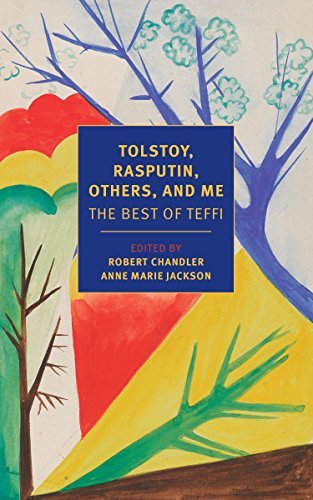
Bloshteyn’s essay is primarily a review of two books that had been recently published, Tolstoy, Rasputin, others, and me: The Best of Teffi and Memories: From Moscow to the Black Sea. The former includes sketches and some of her “best loved short stories”. GoodReads says of it that “in the 1920s and 30s, she wrote some of her finest stories in exile in Paris … In this selection of her best autobiographical stories, she covers a wide range of subjects, from family life to revolution and emigration, writers and writing”. I don’t know whether “The examination” is one of them, but Bloshteyn writes, of the child-themed stories she mentions, that all “show children in the process of getting to know the world around them and finding the means to cope with it”. Manichka, although showing some resourcefulness, has a way to go.

I was thrilled to find this little treasure in Trove, and will try to read more Teffi. Has anyone else read her?

* Read for the 1925 reading week run by Karen (Kaggsy’s Bookish Ramblings) and Simon (Stuck in a Book).

N. Teffi
The examination” [Accessed: 21 October 2025]
in The Australian Worker, 25 November 1925

Anton Chekhov, The lottery ticket (#Review)

Back in April I posted on Majorie Barnard’s short story “The lottery” for Kaggsy’s and Simon’s 1937 Year Club. Commenting on that post, my American friend Carolyn said that in looking for Barnard’s story she found Chekhov’s “The lottery ticket”, written fifty years earlier in 1887. Of course, I had to read it too. There are enough similarities to make us think that Barnard very likely had read Chekhov’s story, but had decided to put her own spin on it. Whether we are right or not, the two stories make for an interesting comparison. I will try to discuss them without spoiling them, but there will be hints.

Both stories deal with a married couple and their reaction to the idea of winning a lottery, and both stories are told third person from the husband’s point of view. Marjorie Barnard’s is set in suburban Sydney, and explores what happens when a wife wins the lottery. She doesn’t tell him immediately so he finds out from others who had read it in the newspaper. On his way home from work, he thinks about what it all means, how “he” might spend it, and he then starts to find fault with his wife. She “wasn’t cheery and easy going” and hadn’t aged well (not as well as he had, anyhow), and so on. It ends, however, with the wife having the upper hand. Barnard’s story reflects her interest in gender, in how little agency women had, and how constricted their lives were.

This is not Chekhov’s prime interest. He is writing in a different place and time. In his story, it is also the wife who had bought the ticket, but it’s the husband who checks the newspaper and sees that there’s a “probability” that her ticket had won. However, rather than reading on and confirming whether that’s the case he suggests they wait:

Looking at his wife, Ivan Dmitritch gave a broad, senseless smile, like a baby when a bright object is shown it. His wife smiled too; it was as pleasant to her as to him that he only mentioned the series, and did not try to find out the number of the winning ticket. To torment and tantalize oneself with hopes of possible fortune is so sweet, so thrilling!

The hope of course is that they will have a lovely dream about the possibilities, those dreams we all occasionally have (even if we don’t buy lottery tickets!) But, if you know Chekhov, you’ll know that he is unlikely to be interested in unrealistic dreams, but in how ordinary people traverse life and their relationships. So, he lets Ivan dream – of “a new life … a transformation”. “That’s not money,” he says, “but power, capital!” He imagines paying off debts, buying “an estate”, going abroad. Occasionally, he notices that his wife is also dreaming. But, it comes to a head when he realises she’s dreaming of going abroad too. What? She’d be no fun to go with. She’d just talk about the children, complain about the cost of the food, not to mention want to spend money on looking after her relations,

And for the first time in his life his mind dwelt on the fact that his wife had grown elderly and plain, and that she was saturated through and through with the smell of cooking, while he was still young, fresh, and healthy, and might well have got married again.

So the story continues with this man who was, at the beginning, “very well satisfied with his lot” – including presumably, having his wife at home, cooking his meals, caring for the children – feeling very different about his life by the end.

The irony, in Chekhov’s as well as Barnard’s story, is that the lottery ticket was the belittled wife’s. Barnard, however, gives her wife agency, whereas Chekhov’s focus is on how money and greed can destabilise (or, is it reveal?) one’s values. However, the little point is still there, in the irony, in that early description of the husband with his “senseless smile, like a baby when a bright object is shown it”, and in so many of the husband’s attitudes towards his wife. Gender issues are not so forward in the resolution, but they are part of the picture.

Anton Chekhov
“The lottery ticket”
First published 1887
Available online at Classic Shorts

Anton Chekhov, The lady with the little dog (#Review)

Penguin collection, translated by Wilks, book cover

“The lady and with the little dog” was an out-of-left-field recommendation for my reading group for two reasons. One is that it is a single short story – not even a whole collection which we have done before. And the other is that the member who recommended it did so on the basis of its being referred to a few times in Sebastian Smee’s recent Quarterly Essay (72), Net loss: The inner life in the digital age, which I’ll review next, hopefully.

So, what to read? We were as a group challenged, albeit was a good challenge. First, “the lady and the little dog” has appeared in many Chekhov collections over the years, accompanied by different selections of stories (though of course some individual ones do recur more than others.) Second, the story has been translated by many translators, including Constance Garnett, Ivy Low Litvinov, collaborators Richard Pevear and Larissa Volokhonsky, and Ronald Wilks. So, do we read all or some of the other stories in the collections we variously acquired (or try, even, to suggest we all read the same collection? That wasn’t going to happen! Particularly given availability challenges.) Or, do we just read the story plus the work that inspired its recommendation? (But what about the fact that there was a mix-up not resolved until late in the month about what exactly was that work!) In the end, our being a disciplined but not controlling group, we all chose our own paths, which made for an interesting meeting.

Penguin collection, translated by Garnett, book cover

Now, I have to admit that at the end of my first reading of the story – this story that is the lead story in so many collections and so must be well-regarded – I was a little underwhelmed, though why is hard to explain. After all, much as I love Guy de Maupassant’s short stories with their dramatic twists, I also love quiet stories about character, which is more Chekhov’s style. I think the issue was that I read it too fast, too distractedly, because when I reread it, Chekhov’s skill started to shine through. Chekhov, by the way, is seen as marking the transition between the mid- to late-nineteenth century realism of de Maupassant and the modernism of early twentieth century Joyce.

The story concerns an adulterous affair between 40-year-old Gurov and the much younger Anna, who meet while holidaying in Yalta without their respective, unsatisfactory spouses. Gurov’s arranged marriage was to a woman whom he considered “not very bright, narrow-minded and unrefined” and who “makes love insincerely”, while Anna sees her husband as “no more than a lackey” or “flunky” (depending on your translation!) She wants “to live life to the full”. Gurov initially sees his seduction of and relationship with Anna as “just another adventure”, not expecting to care when she returns home to St Petersburg. But, after he returns to Moscow, he realises that he’s been touched by her. Life has become meaningless:

Those pointless business affairs and perpetual conversations – always on the same theme – were commandeering the best part of his time, his best strength, so that in the end there remained only a limited, humdrum life, just trivial nonsense.

Penguin collection, translated by Pevear and Voslonsky, book cover

Consequently, he seeks out Anna, and finds that she too was unhappy, and so their affair resumes.

As the affair progresses, Gurov makes a distinction between his inner and outer lives (which is what Smee references in his essay). Gurov thinks:

He was leading a double life: one was undisguised, plain for all to see and known to everyone who needed to know, full of conventional truths and conventional deception, identical to the lives of his friends and acquaintances; and another which went on in secret. And by some strange, possibly fortuitous chain of circumstances, everything that was important, interesting and necessary for him, where he behaved sincerely and did not deceive himself and which was the very essence of his life – that was conducted in complete secrecy; whereas all that was false about him, the front behind which he hid in order to conceal the truth– for instance, his work at the bank, those quarrels at the club, his notions of an ‘inferior breed’, his attending anniversary celebrations with his wife – that was plain for all to see. …

What I noticed more on my second read through was Gurov’s personal growth. In the beginning, he is bored, misogynistic, and selfish. He found men boring, and preferred female company, and yet “he always spoke disparagingly of women and whenever they were discussed in his company he would call them an ‘inferior breed’”. Moreover,

Repeated – and in fact bitter – experience had long taught him that every affair, which at first adds spice and variety to life and seems such a charming, light-hearted adventure, inevitably develops into an enormous, extraordinarily complex problem with respectable people – especially Muscovites, who are so hesitant, so inhibited – until finally the whole situation becomes a real nightmare.

Penguin collection, translated by Slater, book cover

Then Anna appears, and this self-centred man is suddenly possessed by “those stories of easy conquests … and the alluring thought of a swift, fleeting affair, of a romance with a strange woman whose name he didn’t even know.”

By the end, though, not only has he realised that he had “genuinely, truly fallen in love – for the first time in his life”, but that he had come to a new understanding of himself:

Anna Sergeyevna and he loved one another as close intimates, as man and wife, as very dear friends. They thought that fate itself had intended them for each another, and it was a mystery why he should have a wife and she a husband. And in fact, they were like two birds of passage, male and female, caught and forced to live in separate cages. They forgave one another all they had been ashamed of in the past, forgave everything in the present, and they felt that this love of theirs had transformed them both.

There is, however, no easy conclusion – no clever twist, no clear ending, happy or tragic.

And so, of course, as I should have realised on the first read, “The lady with the dog” (or “with the little dog” or “the lap dog” or “the pet dog”, depending on your translation) is a tight, moving, ironic story about a man who, like many of Jane Austen’s best characters in fact, discovers the errors of his attitudes, and is transformed by the knowledge.

Anton Chekhov
“The lady with the little dog”
in The lady with the little dog and other stories
(trans. Ronald Wilks)
London: Penguin Books, 2002)
(“The lady with the little dog”, first pub. 1899)
ISBN (eBook): 9780141906850

Avalailable online at Adelaide University’s etext site.

Fyodor Dostoevsky, Crime and punishment (Review, hmm)

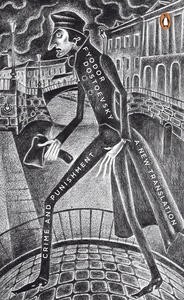
DostoevskyCrimePenguinPart way through my reading of Fyodor Dostoevsky’s Crime and punishment I wrote in my book – because, yes, I am a marginalia writer – “Who does Dostoevsky agree with?” It’s a somewhat naive question, I know, because the author doesn’t have to agree with anyone – and very often doesn’t. You just have to look at Humbert Humbert for example, or Patrick Süskind’s Jean-Baptiste Grenouille. But, in those novels, you can assume the authorial viewpoint. Crime and punishment, however, seems to me to be very different. What is Dostoevsky’s viewpoint? Does he have one?

SOME SPOILERS FOLLOW … THIS IS A CLASSIC, SO FAIR GAME I’D ARGUE.

This brings me to why I read classics. There are two main reasons: one being simply that I’m interested in our literary heritage, and the other is because they still have something to say. I guess this partly answers the question I posed a couple of posts ago doesn’t it? I read for insight into “the human condition”, to understand what makes us tick, and therefore, I suppose, to know myself and others better. Anyhow, back to Crime and punishment and my marginalia comment. The central question in the novel is, really, why did Raskolnikov do it? And his reasons are so ambiguous, so paradoxical, that he slots pretty comfortably into our post-modern world of uncertainty, self-consciousness and fluidity. Of course, he’s not modern (or post-modern). He’s a 19th century creation (and this is a mid-19th century novel with a happy ending). But he’s a creation who is hard to pin down, because he’s the creation of a writer from a society in flux, and of a writer who was perhaps himself in flux. Indeed, Raskolnikov’s name, so the translator of my edition tells me, derives from “raskol” meaning “a split or schism”.

So, Raskolnikov commits his crime. He murders not only the “old hag”, a pawnbroker with whom he’d had several problematic dealings, but her sweet, simple-minded sister Lizaveta, who surprised him in the act. Raskolnikov evinces little or no obvious guilt for his actions, though his physical illness and mental disarray post-murder are surely a psychosomatic response to what he’d done. His behaviour is quite schizoid, at one moment warm and generous, and then suddenly cold and calculating. No wonder those close to him can’t make him out. He’s a slippery beast.

And he’s a slippery beast because it seems – if I understand the various end-notes included in my edition – he’s a vehicle for Dostoevsky’s views on Russian society and intellectual life at the time. So, here I’m answering my opening question: Raskolnikov represents Dostoevsky in that he speaks to Dostoevsky’s concerns about some critical issues, but these concerns are multifarious so cannot be pinned down to one main idea. In some ways Crime and punishment could be seen as Dickensian, in its description of the grime and poverty of St Petersburg, but I don’t see Dostoevsky as a Russian Dickens. His main focus is not social justice, though the idea of “justice” features frequently in the novel, but more intellectual, political and psychological. Raskolnikov’s “motives” range from utilitarian ones (the world will be better off without the “hag”, “a useless, foul, noxious louse”) through philanthropic ones (her money could be used to help others) to megalomaniac and egotistic ones (“I wanted to become a Napoleon”, am I one of the “extraordinary” people “who dares to stoop and grab”, one who “moves the world and leads it towards a goal”?). These motives address many of the debates that were occurring in contemporary Russia, debates about socialism, Westernisation, moral responsibility versus environmental impact on human behaviour, and social Darwinism. Overlaying all this is Dostoevsky’s Christian belief. Sonya, the young girl who takes up prostitution to provide for her step-mother and siblings, is the person to whom Raskolnikov first confesses. While shocked, she listens and refuses to believe, or at least accept, his baser motives. Her solution is a Christian one, to “accept suffering and atone”.

In the end, at his trial, Raskolnikov gives practical reasons for the crime to do with his poverty and desire to use the victim’s money to help his career (except he didn’t touch the money), and admits he turned himself in because of “heartfelt remorse”. He receives a relatively light sentence (only eight years in Siberia) for various reasons, including his sickness before the crime, his generous character, and the fact he did not use the money.

Raskolnikov is one of literature’s great anti-heroes, alongside the likes of Shakespeare’s Macbeth and Camus’ Meursault, to whom he has been compared. I can see why – though he doesn’t have the clear motivation of Macbeth, nor the absence of motivation of Meursault. Like Meursault in particular, Raskolnikov is complex and engenders endless debates that are as affected by the reader’s beliefs, experiences and attitudes, and dare I say by the reader’s times, as they are by the text itself.

The novel’s ending suggests “renewal” and “rebirth”, but what exactly Dostoevsky meant by it all is not completely resolved, at least in my mind. There has been enough ambiguity and paradox throughout – for example, Raskolnikov argues that if he has to question whether he has “a right to power” then he doesn’t because one who does wouldn’t ask – and the trial is covered with such brevity to undermine complete confidence in the resolution. I like this sort of openness. It seems appropriate, therefore, to conclude with Raskolnikov’s loyal friend Razumikhin who says to Razkolnikov’s mother and sister:

Keep fibbing, and you’ll end up with the truth! I’m only human because I lie. No truth’s ever been discovered without fourteen fibs along the way … Name anything you like: science, development, thought, inventions, ideals, desires, liberalism, rationalism, experience, anything at all, anything, anything – and we are all, without exception, still stuck in the first years of preparatory school! We just love making do with other people’s thoughts.

Is Raskolnikov an original, a creative truth-teller, or just another confused human being prattling off ideas he’s heard from others? That is the question.

Fyodor Dostoevsky
Crime and punishment
(Trans. by Oliver Ready)
London: Penguin Books, 2014 (Orig. ed. 1866)
702pp
ISBN: 9780141192802