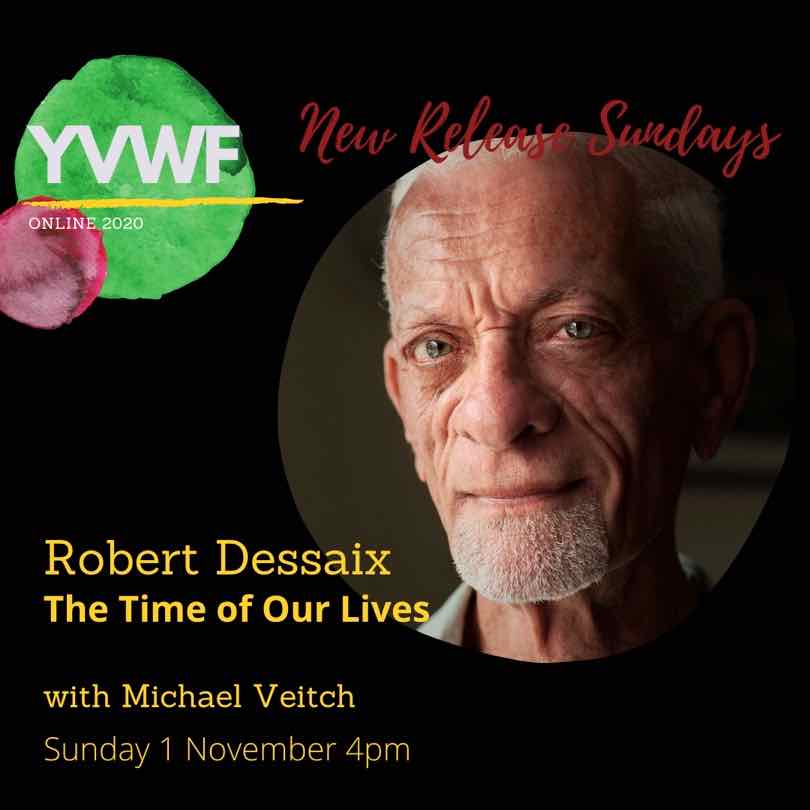
Back in May, I attended several sessions of the Yarra Valley Writers Festival (YVWF), a COVID-19 bonus, as most of you know. The Festival also runs two regular events, a weekly New Release Sundays and a monthly Bookclub. I haven’t managed to attend any, until today, which involved Festival Ambassador Michael Veitch speaking with Australian novelist, essayist and journalist, Robert Dessaix. I read Dessaix’s memoir, A mother’s disgrace, before blogging, and I used to love his ABC RN radio shows, Lingua Franca, and Books and writing (which he did for a decade.) Today’s session was about his new book about growing older, The time of our lives: Growing older well.
The session’s promo described the book as “a wise and timely exploration of not just the challenges but also the many possibilities of old age”. Given I have had nonagenarians, and now a centenarian, continuously in my life since 2004, and given my own aging, this topic interested me.
The conversation
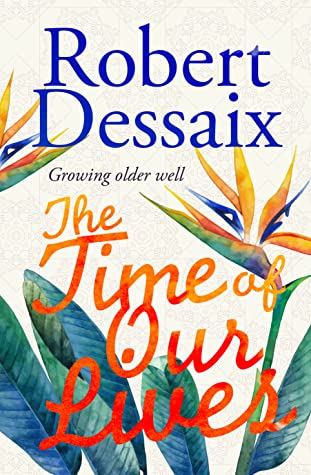
Michael Veitch started, of course, by introducing Dessaix, telling us that The time of our lives is Dessaix’s 10th book. He described the book as “joyous”, but hard to define – not a novel, not short stories, not a guide. More, he said, a kaleidoscope of impressions, spiritual and intellectual.
Dessaix liked that image, saying that kaleidoscope describes how he lives: he takes shards from what happens around him, shapes them, and hopes “a beautiful pattern will emerge”.
Several themes ran through the conversation, kaleidoscope being one, plus there being “bulwarks” against the ravages of age, the importances of having an inner life, the value of curiosity, and the idea of dance. The book begins with a dance (“Voulez-vous couchez avec moi”!) and ends with a Javanese dance, which nicely encapsulates his transition from loving Europe to being interested in Asia (particularly India and Indonesia.)
Later in the conversation, Veitch mentioned the death of Dessaix’s partner’s mother, Rita. It seems that she was the (or a) major impetus for the book. She was living in a retirement village – “village” being the wrong word Dessaix felt for such homogenous places – until she had the fall that resulted in her moving into aged care. I’ll return to this later …
Veitch read an excerpt from the book describing the inner life. This definition included that it’s like “a cherished piece of music [that is] shaped by our our individual memories”. (This is a tiny part of the full description, so please don’t quote me!) Dessaix said his aim is not to shut out the outer world, but simply to keep certain things in. The inner self is a conversation, and is something that “holds us together against nothingness”. Hmm, that sounds more like the time of Sartre and TS Eliot than now!
“of course, I’m curious”
Anyhow, Veitch moved onto the idea of curiosity, suggesting that it drives the book. Dessaix agreed, saying “of course I’m curious”. We are only here for a short time!
Dessaix went on to say that a major interest as he’s grown older is other people. How do people cope with what the world has served up to them? He loves to visit India, but not for the sights, which are purely background. He likes getting close to people, to understand their lives. Women, he said, are easier to become close to.
During this conversation he said something that spoke to me, which is that coping is “such a difficult thing to do”. We think, he said, that it will be easy. that we follow the path – get a job, marry, having family, etc – and that it will all just fall into place. I remember thinking that in my angsty teen years. But, he said, it’s not like this, “we have to cope every day with something”. He described the world as “an abattoir”, which is a strong image for what is apparently not a dark book.
This led to a discussion of friendship, but there was nothing particularly new here (for me anyhow), so let’s move on. He did, though, comment that the older you get, the things you care about become less. Now he will say what he thinks, and “take negative responses on the chin”. Around here, he commented that in the 1960s, we (and I became a teen in the 1960s so I was with him) believed everything would get better, but that euphoria of has evaporated into nothing. So sad, because we really did think we were on the way to becoming kinder, gentler, fairer.
“a stupid foreginer”
Veitch asked him about his current interest in Asia. Dessaix replied that Europe started to become tedious. He wanted to go somewhere where he would be a blank, “innocent”, so he started with India, and now visits (except this year) Java. Being in a place where he feels “not at home” stimulates him “to have important conversations with himself”.
He admitted that he is granted liberties because he’s “a stupid foreigner”; he feels open to saying things he would not say in Paris or Berlin.
Veitch read another excerpt which, if I got it correctly, described a secret door going from the formal European gardens of Dessaix’s younger days to the more riotous gardens of places like Java. He said he was humbled to discover he had shut out these intricate civilisations and now he’s too old. These are sensual places. Europe preens, and positions itself as sexy, but is not sensual.
“play and discipline”
Dessaix equated the inner life with a dance, the tango, which he said combines “play and discipline”. It is sexy, sensual, beautiful but also demands discipline. His aim is to hone these two – play and discipline.
At this point, the conversation turned to the aforementioned Rita, who died during the writing of the book. She, Dessaix said, did not have an inner life (though how he really knows, I’m not sure). Born in 1922, she, Dessaix suggested, was one of those women “crushed by the men they lived with”. He believes she did not feel she was worthy of having an inner life.
Veitch wondered whether you have to learn how to have an inner life? Dessaix thought yes, but that class is also involved. Rita was told she was a “stupid woman”. She was, he said, bored out of her mind. Dessaix said her aged care home “smelled of boredom”. This could be a judgement from someone not there yet, though I’m sure boredom does exist in aged care. Dessaix doesn’t feel he will be affected because “there is too much going on inside”.
Now, here’s the thing … many aged care places (here in Canberra, anyhow) offer many opportunities for residents to be engaged and mentally active, but it depends on one’s brain staying healthy, and on hearing and sight being good. Father Gums has quite an inner life. I know, because he tells me about the things he thinks about, but time can, nonetheless, hang heavily, because sight and hearing difficulties make it difficult to partake of opportunities offered to feed the mind.
“happiness & contentment”
The discussion turned to the difference between happiness and contentment. Dessaix initially saw little difference but refined his ideas as the book progressed. Fortunately, what he came up with is how I see it, because I’m bothered by the focus on “happiness”. Contentment – a sort of inner comfort – is what we aim for, he said, but it can never be complete, while there is suffering in the world. Happiness, on the other hand, can be complete, but it “drops on you”. There is no mystery to it. As Veitch said, happiness falls on you, while contentment settles on you.
Continuing this theme, Dessaix said that he doesn’t like “tranquility”, preferring “animation”. For this reason he likes the god, Ganesha, who dances! Apparently, grief guru Elizabeth Kubler-Ross said at the end of her life, “I wish I’d danced more”. I love it!
There was more, including a discussion about attitudes to death. Mainly, though, the conversation reiterated in different ways the main theme of continuing to “play” and engage in life actively, and of accepting ageing without fear. Ever the writer, Dessaix equated life with sitting on your own “Persian carpet”: it is beautiful, has repetitions, and is different from the one next to it.
However, he did add an element of reality, which I approved. Life, he said, is about maintenance – your eyes, your ears, your … well, you get the picture.
Dessaix said he found ageing liberating, meaning that things he had hoped for – like the Catholic Church disappearing – won’t happen, and he no longer cares, because he has his inner life. He is more tolerant now, accepting that some things can’t be changed.
As you age, said Dessaix, you can still be happy: there’s a shrinking list of things to be happy about but that happiness can be deeper.
Veitch concluded the session by saying that the book is not a dark book, and is more about life than age. He liked, he said earlier, that the book is called “growing older” not “old”.
Overall, a good session about a book I’d like to read, but it is clear – and he would probably admit it – that Dessaix is a privileged person for whom ageing and an inner life will come easier than for some.
From Yarra Valley Writers Festival 2020 (Online): New Release Sundays
1 November 2020, 4:00 – 5:00 PM
Livestreamed
 Whispering Gums