Price Warung, Selected tales of Price Warung (#BookReview)

Price Warung, as I wrote in my previous post on him, is the pseudonym used by English-born Australian writer, William Astley, who came to Australia with his parents in 1859 when he was still a child. Astley became a radical journalist and short-story writer, with particular interests in transportation/convict literature, and the Labour and Federation movements. Tales of the early days, the book I reviewed in my first post, was republished by the Sydney University Press, and was entirely convict-focused.

I didn’t expect to see Price Warung again, but here he is, a few years later, in a book containing a selection from three of his five books: Tales of the convict system (1892), Tales of the early Days (1894), and Half-crown Bob and tales of the riverine (1898). Given I’ve already devoted a post to the convict stories – four of which are included in this collection’s eleven, including the well-regarded “Secret Society of the Ring” – I will focus here on editor Lucas Smith’s introduction to the collection and Warung’s riverine stories, which are new to me.

Introduction

The first thing to say is that these stories were written between 1888 and 1898, but are mostly set decades earlier.

Smith starts by stating that, after Marcus Clarke’s For the term of his natural life (1874), “no writer did more to forge the myth of Australia’s convict heritage than William Astley”. However, Astley’s work a journalist included rural newspapers, like the Riverine Herald in Echuca, where gathered material for his “poignant and humorous stories about early steamboat traffic on the Murray River”. Smith says that these stories, which were “reminiscent of Joseph Furphy*”, were “his only departure from depictions of the convict system’s grimness”.

Astley’s popularity was brief, but it did make him a prominent “literary and political figure”. He is, claims Smith, “our Chekhov to Clarke’s Tolstoy”. Big claim, eh? Smith says that, with Clarke, Warung “is responsible for our colloquial [my emph.] understanding of the convicts as victims (although usually not innocent ones) of an inhuman system.” While historians like Russell Ward describe “how Australian convicts often enjoyed higher-quality food and working conditions than the labouring classes in England”, the brutal images of “striped backs”, “broken bodies” and “unrepentant gangs bent of revenge” persist. They are based in fact but were “a small aspect of the transportation system”.

Smith goes on to briefly discuss the origins – the facts and fiction – of the “convict myth”, before explaining why Warung is worth reading:

Warung is far from the supreme stylist of colonial Australia. He is often sub-Dickensian in his sentimentality, and rigid in his humour. Nevertheless, his realism, irony and humour, as well as his diligent research, exhaustively undertaken from both archival research and his associations with “the ghosts of Old Sydney”, make him worthy of reintroduction to a contemporary audience.

This collection, he says, represents “a cross-section of his work: the lured convict tales, the laconic riverboat yarns, and the anti-System diatribes”.

Regarding Warung’s reputation, Smith says that unlike some of the other men and women of the Bulletin school of the 1890s, Warung has attracted little academic attention, being seen, with a few exceptions, as an also-ran. One of these exceptions is, intriguingly, an American, Edward Watts, who believes that Warung has been “unfairly marginalised”. While not quite convinced by Watts’ suggestion of a “faint comparison to the infamous neglect of Herman Melville prior to the 1920s”, Smith argues that Warung is “more than a penny-a-liner and well deserving of further study”.

The Riverine

Smith says of the riverine stories that, “freed from the grim and technical language of the penal system”, they contain Warung’s “most fluid and picturesque writing”. He’s right, though these stories have their own technical language to confront. They are more humorous, but can also be “political”, with issues like labour practices, land-deals, political bribery, and so on, revealed through their narratives. Smith suggests that the convicts were violent to authority, while the riverine folk were “merely contemptuous”.

Book cover

The four riverine stories – “The last of the Wombat Barge”, “Dictionary Ned”, “The incineration of Dictionary Ned”, and “The doom of Walmsley’s Ruby” – all concern the steamboats that plied the river system, carrying cargo, particularly wool, from producers to ports, and bringing needed goods back. Given this industry’s demise by the 1930s, Warung’s stories offer insights from one who knew (versus Nancy Cato’s more romanticised historical fiction, All the rivers run trilogy). Echuca, where Warung spent some time, was a major port on the Murray.

“The last of the Wombat Barge” revolves around a woman working on the boats. While Jim, who managed the river pontoons to let boats through, was partial to “womanines”, others were not impressed by a woman taking a man’s job (whether it directly concerned them or not). Indeed, “the whole river population … were in agitation”:

The mate, whom Mrs Kingsley had displaced had almost as much to say as Sooty Bill the loafer, who never had a wash except when he was thrown in the river in a squabble, and who never did an honest day’s work out of gaol.

Various men try to change Captain Kingsley’s mind, but things turn to custard when the deckhands, for whom “the idea of being bossed by a woman galled their manhood” quit, and he is forced to employ scab Chinese labour. While “missie mate” was good at her job, the Kingsleys are, ultimately, brought down by pride and greed. However, the language used to describe the Chinese is shocking, with the novel’s moral being not to employ the Chinese, whose intelligence was limited to “imitation”, who lacked “initiative and readiness of wit”, and who brought disease.

“Dictionary Ned” is my favourite riverine story. Bargeman Ned buys a dictionary when he’s around forty years old, “in the vain hope of making up the deficiencies his early education”. He carries it everywhere, studying it, rigorously, at every opportunity, “when other men smoked, or swapped yarns, or drank”. He is also scrupulous about keeping his person and clothes clean. He is noticed by College Bill who, in addition to being of “odorous carcass”, has squandered his education. He accosts Ned, but comes off worse in a game of words, resulting in Ned’s star rising among his river peers, who had previously ridiculed him. The story’s end, though, is one of kindness and redemption. “The incineration of Dictionary Ned” is an entertaining tale about Ned’s desire for cremation, but it also exposes some of the politics and land deals between squatters and selectors in colonial Australia.

Warung’s stories aren’t particularly subtle but even the more gruesome ones exude a life and energy in their characters that engaged me. The stories also offer insights into the times about which he writes, and the times from which he writes! Worth reading.

* You can follow Bill’s current slow reading engagement with Furphy here.

Price Warung
Selected tales of Price Warung: Selected and introduced by Lucas Smith
Bonfire Books, 2020
236pp.
ISBN: 9780646819273

(Review copy courtesy Bonfire Books)
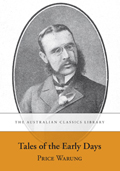

Price Warung, Tales of the early days

Tales of the early days (Cover: Courtesy Sydney University Press)

Tales of the early days (Cover: Courtesy Sydney University Press)

Okay, I admit it, I have convict ancestors (plural even!). Consequently, I was particularly interested to read Price Warung’s 1894 collection of short stories, Tales of the early days, when I discovered it was part of the Australian Classics Library recently published by the Sydney University Press. My convicts include John Warby who, with another labourer, stole two donkeys and was transported to Australia on the Pitt in 1791, and Sarah Bentley who stole several items of clothing from her mistress in 1795 and was transported on the Indispensable. In 1796, John married the 16-year old Sarah. Fortunately (for me and for them), they were a hardworking pair. John had been given land by Governor Phillip in 1792, and he and Sarah made a good life for themselves, so much so that there is now a primary school named after him, the John Warby Public School in the Campbelltown area west of Sydney.

Enough about my family, though. What about Price Warung? He was, in fact, William Astley, and was born in Liverpool, England, in 1855 but came to Australia with his family in 1859. He became, according to the succinct little biography at the back of the book, a radical journalist and short-story writer, with particular interests in transportation (or, convict) literature, and the Labour and Federation movements.

Now to Tales of the early days. This was his second published collection, and comprises 8 stories set in Norfolk Island, Hobart, Sydney and London. They explore various aspects of convict life, and many draw on real people and events. In fact, my city’s new (and first) prison is named after the penal reformer/prison commandant, Alexander Maconochie, who features in the first two stories. The eight stories are worth listing for their titles, most of which convey a strong sense of personality:

  • Captain Maconochie’s ‘Bounty for Crime’
  • The Secret Society of the Ring
  • In the Granary
  • Parson Ford’s Confessional
  • The Heart-Breaking of Anstey’s Bess
  • The Amour of Constable Crake
  • The Pegging-Out of Overseer Franke
  • At Burford’s Panorama

These stories can be described as “historical fiction”. In a new introduction to this collection, Laurie Hergenham quotes Thomas Keneally, who has written a deal of historical fiction. Keneally says:

the novelist need not prove his reliability to scholars … the only warrant a writer needs for his ideas about the past is that they reek of human, poetic, dramatic, symbolic veracity and resound in his imagination.

Like many writers of historical fiction, Warung draws on documentary fact. He writes largely in the social realism style that was typical of the nineteenth century. A strong theme runs through the book, and it can be best described by quoting Robert Burns’ “man’s inhumanity to man”. Warung’s particular argument is that this inhumanity is worse in the “System” (aka The Establishment) than in the convicts.  As one of the convicts says in the longest and, generally regarded to be, the best story, “The Secret Society of the Ring”:

Th’ System finds orl its orf’cers men, an’ leaves ’em orl brutes. Orl o’ we don’t get ‘ardened, but there ain’t one o yer wot doesn’t.

And so Warung, with his own apparently anti-British sentiment in the lead up to Federation (and Australia’s independence), perpetuates the myth that the convicts were poor souls turned bad by the System: “the beast-nature with which the System had superseded that granted unto him by his Creator”. It is true, if you read the histories, that some (many?) convicts were victims of poverty in Britain and were transported for comparatively minor offences, but there were also many who were violent, serial offenders. It is also true, though, that the treatment of convicts in Australia was, overall, very harsh – particularly in the secondary penal establishments like Norfolk Island and Hobart (at nearby Port Arthur). It’s not for nothing that Warung, with the fire clearly in his belly, chooses these as the settings for most of his stories of horror.

The first story, “Captain Maconcochie’s Bounty of Crime” serves as a useful introduction to the longest and most complex in the book, “The Secret Society of the Ring”. It introduces us to Maconochie and his desire to improve “the monstrous conditions of penal life at Norfolk Island” but, we are told, the System does not want him to succeed because his failure would mean “that the System was right and its administrators were wise”. And so, the cynicism (or is it simply realism?) starts:

Therefore the failure was only to be expected. Men do not care about being proved wrong, even if it could be shown that a few dozen souls were saved in the process of correction.

This truth, as Warung conceives it  and which encompasses related truths relating to the behaviour of men in power, is played out again and again in the stories that follow – but it is no more ironically conveyed than in “The Secret Society of the Ring” in which the Ring, which is the convicts’ own “system”, turns out to be every bit as cruel and inflexible as the System that controls them. Maconochie’s attempt to appeal to convicts’ (“society’s wrecks”) sense of fraternity and loyalty to each other – and along the way provide them with a more comfortable prison life – is undermined by the loyalty demanded of the Ring. This is a devastating story – and the most sophisticated in the collection in terms of style and structure.

The third story, “In the granary”, is no less devastating, and turns on the irony of a granary, designed by “a genial officer”, being put to far from genial purposes. This story has an interesting, given Warung’s own work as a journalist, discussion of the power of newspapers. “Parson Ford’s Confessional” is the only one of the collection that doesn’t focus on convicts. Rather it explores corruption among those in power just, I suppose, to make sure we know that this corruption does not only occur in relation to convicts. The next three stories chronicle events in the life of a particular character: Anstey’s Bess, a convict woman whose maternal love nearly brings her down; Constable Crake whose lust does bring him down; and Overseer Franke, the ironically nick-named Cherub who selects the architect of his downfall (but the triumph here is rather Pyrrhic). The final story is set in London and nicely shows us what those “at home” were seeing of the colony while also providing a final opportunity for corruption and power to again ensure that the downtrodden remain that way. (It is also the only story to refer to the Aboriginal people of Australia – and the reference is surely ironic when he describes the “Savage King” Bennelong’s recognition of “the new era of civilisation”!)

Warung’s style is not subtle – he uses irony heavily, foreshadowing, symbolism, some wordplay, the occasional repetition and understatement, and authorial intrusion – and he can over-explain at times, not trusting always that the reader gets it. It would be a very dull reader, though, who didn’t! The tales are, it has to be said, pretty black and white. The System is demonstrated again and again to be corrupt and cruel, with no attempt made to explore the privations those in power also suffered. That said, the stories are powerful and, despite their lack of “balance”, convey enough truths to make reading them worthwhile for both their narratives and the messages underpinning them. It is good to see them brought to life again.

(Review copy supplied by Sydney University Press)