Fridays with Featherstone, Part 2: Writing about men

Today, as promised last week, I bring you the second part of Nigel Featherstone’s Wet Ink interview with Susan Errington. But first, a brief intro. Back in early November, Nigel wrote a guest post for my Monday Musings series on writing about family, on how this is what he finds himself writing about. In this part of the interview, Susan talks with Nigel about his writing about relationships, and particularly his writing about men. Read on …

INTERVIEWER

Your first novel Remnants asks the big questions about life’s meaning. Fall on Me seems to be on a more intimate scale, about the relationship between a father and son. Do you agree? Tell us about the different development of these works.

FEATHERSTONE

Remnants began as a manuscript developed during my studies for a Master of Creative Arts (Creative Writing) at the University of Wollongong, which I completed in 2001. The idea was to pit a conservative older brother against a radical younger brother and send them across Australia in the Indian-Pacific train. But after graduation, the characters and their story wouldn’t leave me alone, so for five years I kept working on the manuscript, until Ian Templeman at the now defunct Pandanus Books accepted it for publication. The novel has a quote from George Bernard Shaw as an epigraph: ‘Man can climb to the highest mountains; but he cannot dwell there long.’ I wrote the book during the long, twisted guts of John Howard’s reign over Australia, and even though it’s a gentle tale it’s a rallying against the one-eyed – and treacherously arrogant – culture of wealth that was so prevalent at the time (and hasn’t really abated). Where Remnants took six years from idea to bookshelf, the first draft of Fall on Me was written in seven days during that crazy month in Launceston, and then reworked over eighteen months before it was published at the end of 2011; it was a quick gestation. And you’re right: it’s a more intimate book. Being a novella its stage is necessarily smaller, focussing on a father-son relationship under strain. Perhaps there’s something about Tasmania that’s in Fall on Me, a sense of smallness, inwardness even.

INTERVIEWER

Central to your work is the variety of male relationships, fathers, sons, brothers, friends, colleagues, lovers, husbands or partners. These relationships are sharply and distinctly drawn and matter a great deal to your characters. Why do you explore these relations so deeply in your work?

FEATHERSTONE

I’ve always been nosy about what makes men tick. I’m the youngest of three brothers. I went to an all-boys private school on the north shore of Sydney, although it was sufficiently enlightened to have girls for the final two years. Growing up in the seventies and eighties, those post-women’s-movement decades, might have given me a sense that women were – at last – able to claim what was rightfully theirs. As a result, perhaps, some men have been asking themselves: where do we fit in, what are we meant to be, how are we to contribute? I’m not sure that they’ve found the answers. As a writer, I’m interested in the grey areas (it’s my middle name – literally), so I want to know how men relate to each other: unreconstructed men, reconstructed men, gay men who find themselves attracted to women, straight men who find themselves having an intense relationship with another man. Having said that, I’m interested in the feminine as much as the masculine. The feminine is alluring, because it feels powerful, whereas there’s a flatness to masculinity that can be difficult to penetrate.

INTERVIEWER

Why do they matter to you?

FEATHERSTONE

Well, they say it’s important to write about what you know. More seriously, I think I’m writing about what I’d like to know better. I think gender and sexuality is endlessly intriguing; it’s rarely black and white, and it always makes rich pickings for fiction.

INTERVIEWER

Do you believe male relationships have been neglected in literature or overshadowed by female ones?

FEATHERSTONE

The only way I can answer this question is by saying that as reader I look for life on the page, or, as James Wood in How Fiction Works calls it, “lifeness”. It doesn’t matter whether the story is about men and men or men and women or women and women. As a reader I want to be moved. As a writer I want to move readers. I’m not aiming to address any kind of imbalance.

INTERVIEWER

Do male writers often view this as a difficult or even dangerous area?

FEATHERSTONE

I don’t know what male writers consider difficult or dangerous, but someone like Christos Tsiolkas has shown that stories that traverse the full spectrum of gender and sexuality can be popular.

INTERVIEWER

In Fall on Me, the principle character Lou grapples with the idea that his son is open to male influences beyond his parental one, in this case the artist Marlow. Yet as a character Marlow has already left Launceston and the novel. Why remove him before the action starts?

FEATHERSTONE

Good old Lou – the more I think about him, the more people ask about him, the more I love him. He’s someone I’d enjoy being with in person: he’s open-minded and progressive, but also aware of his limits, even elements of his thinking that are conservative; he knows he’s a contradiction; he also fights to be himself, and will fight for everyone else to have that right. But to your question. Sometimes in smaller communities someone – including an artist – can have a profound impact. For the past two years I’ve lived in Goulburn, a regional town on the Southern Tablelands of New South Wales, so I’ve been able to observe how some individuals can have considerable influence. In Fall on Me, Marlow flies over from London to live in Launceston for a month; he plays his role of inspiring people and then leaves. Luke, an intelligent but impressionable teenager, is stirred to take risks, very real risks, which may put his somewhat precarious family-life in danger. In the writing of the novella I was keen to explore the father-son relationship more than the artist-boy relationship, so the novella starts with Lou being forced to find out what his son has done.

INTERVIEWER

In Remnants, the role of absent but influential male is played by the dead father. Are you saying something about male power here?

FEATHERSTONE

I think I’m saying more about the power of the past than male power, or any kind of gender power. The novel’s main character, Mitchell Granville, a retired barrister, has gone through his life believing that he’s done the right thing by his father, who wanted his younger son out of the family and never to return. However, during the course of the story, Mitchell is forced to realise that he did the wrong thing. There’s a line in the novel that I’ve never forgotten: ‘obedience breeds loneliness’. (It may seem big-headed to quote dialogue that I’ve written, and perhaps it is, but in this case I feel as though the dialogue is the novel’s, and that novel no longer feels like mine.) To me, I was writing about how sometimes it can take us years, decades even, to find the right path by being disobedient. And sometimes it’s important to disobey men, and sometimes it’s important to disobey women.

INTERVIEWER

By contrast your female characters in both novels are very nice people, some might say too nice to be true. How do you develop a female character in your writing?

FEATHERSTONE

This is probably a fair criticism of my work and perhaps one day I will do something about it. In my own life, my closest female friends are such strong women, witty and clever and independent and brave and tenacious and – sometimes – contrary. They are loving, and they can be sweet, but I’d hardly call them nice because they’d hate me for it. In terms of writing, regardless of the character’s gender, it all comes down to this: what sort of people need to be in the story so that it becomes breathtakingly alive? When a character is working they have a spirit, a moral fibre, and a sense of history. I’m not the kind of writer that has a checklist of characteristics: black hair, short of stature, a pink plastic ring on the left-hand forefinger, that kind of thing. As much as possible I try to go with instinct: who am I really seeing in my mind’s eye? Perhaps my mind’s eye is better at seeing men than women.

Look for Part 3 next Friday …

Fridays with Featherstone, Part 1: Thoughts on literary form

What do writer Nigel Featherstone and the now sadly defunct literary magazine Wet Ink have in common? An unpublished interview, that’s what! When Nigel approached me, with the agreement of his interviewer Susan Errington, asking whether I would like to run the review on Whispering Gums, I of course said yes – for several reasons. Over the last year I have reviewed two lovely novellas by Nigel Featherstone, Fall on me and I’m ready now. Nigel also wrote a guest post for Monday Musings on the relationship between family and children in some recent Australian fiction, including his own. And, yesterday, Nigel won the fiction section of this year’s ACT Writing and Publishing Awards for Fall on me. Then I read the interview – and I enjoyed it. Not only does it provide insight into Nigel’s writing, but he speaks on a range of issues regarding literary style and form and, of course, divulges some of his favourite writers. How could I not take up the offer?

It’s a long interview – magazine essay-length – but it breaks neatly into some thematic sections, so with Nigel’s agreement I am running the interview over a few weeks, followed by an updating interview between Nigel and me. So, with thanks to Nigel Featherstone and Susan Errington, here is Part 1 …

Featherstone, Fall on me

Fall on me bookcover (Courtesy: Blemish Books)

INTERVIEWER

You describe your latest work, Fall on Me, as a novella, but many current novels are not much longer. What is it about this story that makes it a ‘novella’?

FEATHERSTONE

Perhaps the best way to answer this question is to briefly talk about how Fall on Me came into being. In early 2010 I spent a month in Launceston as part of the Cataract Gorge Artist-in-Residence Program. Up until that point I’d spent five years working on a major project that had gone close to publication but in the end it got the red-light, not the green-light. More than a little wounded, I took the opportunity of the Launceston residency to return to where I’d started my writing ‘career’ back in the early 90s: creating short stories. I set myself a goal of writing the first draft of six stories. But there were other goals, too: write by hand, as in pen to pad; write what I wanted to write and what I’d like to read; and take creative risks, meaning don’t censor myself.

At the end of the first week I had the sketchy draft of what I supposed was a very long story, something around the 30,000-word mark. The second week I again tried to write a short story, but at the end of that week I again had the sketchy draft of a very long story around 30,000 words. And so it went until, after a 28-day mad storm of writing, I had the sketchy drafts of three of these very long stories. What had happened to me in that dark, dark Launceston gorge? I remember jumping on the plane to come home and thinking, what on earth am I going to do with these? What I did was keep working on them – editing, rewriting, polishing, editing some more – until, damn the bloody things, they grew in length; I’d had hoped they would go in the opposite direction. But there was something about the length that I really liked: story concentration, but also character expansion, and it intrigued me.

Thankfully Blemish Books, a Canberra-based independent press, was looking for fiction manuscripts up to 40,000 words so I submitted the first two of my novellas. And here we are. In the end, I think, that time in Launceston was all about psychology: I conned myself into believing that I was only writing short stories, and I certainly didn’t want to attempt another novel, so somehow I decided to write in that halfway space that novellas like to inhabit. Of course, there’s more to it than that: as a reader I love a book that can be gobbled up in one sitting, for example Hemingway’s The Old Man in the Sea, or The Sense of an Ending by Julian Barnes. What these two books achieve with a minimum of words is astonishing.

INTERVIEWER

You have also published a large number of short stories, at least forty I think, as well as two collections. What attracts you to the short story?

FEATHERSTONE

Short stories are closer to poetry than novels: they’re great at suggesting, rather than explaining every crinkle in the forehead. And they have focus – amazing focus, the focus of poetry. A well-structured short story is exquisite. Although it’s at the longer end of the spectrum, Annie Proulx’s ‘Brokeback Mountain’ is mind-blowing. Or Chekhov’s ‘Gusev’ – what that man achieves with this story, which is one of his shortest works, is truly miraculous. The making of short stories is interesting, too. Sometimes I’ll have an idea logged in my journal for months, if not years. Then something happens – the stars align – and I’m ready to write the thing. I like to write the sketchy first draft in a day, type it up the next day, and then there’ll be months, if not years of rewriting, editing and polishing; one story took five years to find a home in a journal. In terms of short stories, I always come back to that word: miraculous. Short stories are indeed almost inexplicable, especially those that do so much with so few words. Take Hemingway’s classic six-worder: ‘For sale: baby shoes, never used.’ Or Margaret Atwood’s: ‘Longed for him. Got him. Shit.’ See? Miraculous.

INTERVIEWER

What for you is the critical difference between short stories and novels, or novellas for that matter?

FEATHERSTONE

I wish I knew. That sounds off-hand, and for that I apologise. But every short story is different, every novella is different, every novel is different – in the writing, in the reading. Every story has its own internal logic, its own ecology, if you will. Established writers say that each time they start a new story they have to relearn the craft, and they’re speaking the truth. However, perhaps we can define the categories, just for the heck of it. If short stories are about brevity, novels are about complexity. So that’s what I might love about working with the novella: they offer the best of both worlds: succinctness and sophistication. Thomas Mann’s Death in Venice and George Orwell’s Animal Farm are cases in point. Of course, these definitions of story form are ultimately meaningless: some short stories are about complexity, while some novels use up 200,000 words by saying not much about anything. A story must find its natural length, that’s the beginning and end of it.

INTERVIEWER

Which short story writers are important to you?

FEATHERSTONE

I mentioned Chekhov before, and Tolstoy is a hero, too – what he does in The Death of Ivan Ilyich is almost hard to believe. (At heart I’m a melancholic, and the Russians know all about melancholia, don’t they.) Proulx, of course, needs a second mention. I much prefer Peter Carey’s short stories to his novels – ‘The Last Days of a Famous Mime’ has had a huge influence on me because of its playfulness. Speaking of playfulness, the last collection I read that I fell in love with was Shooting the Fox by Marion Halligan – she really knows how to put words and sentences and characters together so sparks fly. But if my house was burning down and I had only a nano-second to make a decision, I’d clamber for my Chekhov and Tolstoy books. These two men strip back life until the truth is almost too much to bear.

Look for Part 2 next Friday …

Poor novellas?

Having just reviewed two novellas in succession – Nigel Featherstone’s I’m ready now and Gerald Murnane‘s The plains – I was intrigued to receive an email this week from AbeBooks titled “The best novellas: Literature’s middle child”. It linked to an article which starts:

Poor novellas. They are the middle-child, the Jan Brady of the book world – too short to be novels, too long to be short stories.

Joe Fassler in The Atlantic earlier this year also used a family-based metaphor to describe novellas:

Longer than a short story but shorter than a novel, the form has been the ugly stepchild of the literary world.

So, are novellas poor? Are they “the ugly stepchild”? Well yes, in some ways they are because, as I understand it, publishers are not keen to publish them. Fassler confirms this, stating that novellas are “an unfairly neglected literary art form that’s been practiced for centuries by celebrated writers” and yet face “an ongoing struggle for commercial viability”. One of the problems seems to be that they “hog too much space to appear in magazines and literary journals, but they’re usually too slight to release as books”. This made me wonder whether the the e-Book might result in a greater acceptance of novellas. You can’t, after all, see that you’re taking home a slim volume can you!

Things are changing, though, says Fassler. American publisher, Melville House, decided in 2004 to publish a series of classic novellas by such writers as Joseph Conrad, Fyodor Dostoevsky, James Joyce and Virginia Woolf. They were apparently derided in the industry for publishing novellas and for using plain covers. Had the critics never heard of Penguin?  But, the novellas sold – and sold – and kept on selling.

There is a catch, however: they’re classics. Apparently, it’s not so easy to sell contemporary novellas. They are more expensive to produce because their authors are alive and need to be paid. Fair enough, eh, Nigel and Gerald? So, people will buy classic novellas because they are by well-known authors and cheap, but are not so keen to buy contemporary ones. Melville House is not giving up though. They are apparently looking at using the electronic media (told you!) and adding curated materials “to extend the experience”. They’re starting with some classics, but plan to move onto contemporary works.

Joe Fassler ends his article with a definition – always the challenge – which goes like this:

a narrative of middle length with nothing wrong with it, an ideal iteration of its own terms, that can [be] devoured within a single day of reading. I think I’m not alone when I say this is the kind of reading I like best. On a summer Sunday, sometime. We fall under the book’s spell in the morning. A friend knocks, the phone rings, the mail clunks through the mail slot. There won’t be any stopping until there’s nothing left to read. The tempo builds until the pages turn with feverish speed, the sun burns hot and starts to dim. Finally, we’re released sometime before dinner. The spell lingers on all through the evening until, at night, we dream.

Good one, but I also rather like John Clanchy’s definition which novella writer Nigel Featherstone quotes in his blog:

Whatever we call it, the novella isn’t a novel that’s run out of puff; it isn’t a short story that’s meandered beyond its natural length and lost its way. I like working with the novella because it shares some of the most attractive features of the novel – its expansiveness, its multiple layers of theme and plot – at the same time constraining them with features normally associated with the short story: intensity of focus, singularity of narrative voice and architecture, discipline of length. But all the while remaining a distinct species, not a hybrid.

Funnily enough, Melville House’s new novella initiative is called Hybrid Books. Ah well, each to their own … I don’t care what novellas are called really as long as they continue to be written and published because, as I’ve said before, I like the form.

Gerald Murnane, The plains (Review)

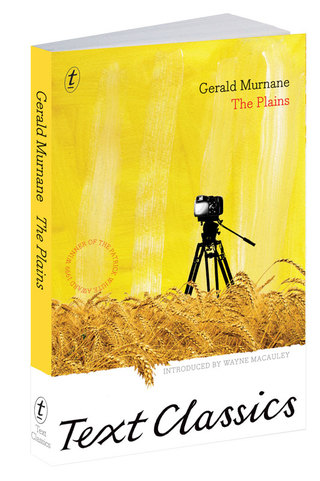
Gerald Murnane, The Plains, bookcover

Bookcover (Courtesy: Text Publishing)

Wayne Macauley, he of the Most Underrated Book Award fame, wrote in his introduction to my edition of Gerald Murnane‘s The plains that “you might not know where Murnane is taking you but you can’t help being taken”. That’s a perfect description of my experience of reading this now classic novella. It was like confronting a chimera – the lower case one, not the upper case – or, perhaps, a mirage. The more I read and felt I was getting close, the more it seemed to slip from my grasp, but it was worth the ride.

The plains was first published in 1982, which is, really, a generation ago. Australia had a conservative government. We still suffered from cultural cringe and also still felt that the outback defined us. All this may help explain the novel, but then again, it may not. However, as paradoxes and contradictions are part of the novel’s style, I make no apologies for that statement.

I’m not going to try to describe the plot, because it barely has one. It also has no named characters. However, it does have a loose sort of story, which revolves around the narrator who, at the start of the novel, is a young man who journeys to “the plains” in order to make a film. It doesn’t really spoil the non-existent plot to say he never does make the film. He does, however, acquire a patron – one of the wealthy landowners – who supports him in his endeavour over the next couple of decades. It is probably one of Murnane’s little ironies that our filmmaker spends more time writing. He says near the end:

For these men were confident that the more I strove to depict even one distinctive landscape – one arrangement of light and surfaces to suggest a moment on some plain I was sure of – the more I would lose myself in the manifold ways of words with no known plains behind them.

Hang onto that idea of sureness or certainty.

The book has a mythic feel to it, partly because of the lack of character names and the vagueness regarding place – we are somewhere in “Inner Australia” – and partly because of the philosophical, though by no means dry, tone. In fact, rather than being dry, the novel is rather humorous, if you are open to it. Some of this humour comes from a sense of the absurd that accompanies the novel, some from actual scenes, and some from the often paradoxical mind-bending ideas explored.

So, what is the novel about? Well, there’s the challenge, but I’ll start with the epigraph which comes from Australian explorer Thomas Mitchell‘s Three expeditions into the interior of eastern Australia, “We had at length discovered a country ready for the immediate reception of civilised man …”. Bound up in this epigraph are three notions – “interior”, “country” and “civilised”. These, in their multiple meanings, underpin the novel.

Take “interior”. Our narrator’s film is to be called The Interior. It is about “the interior” of the country, the plains, but it is also about the interior, the self, and how we define ourselves. While there are no named characters, there are people on the plains and there’s a sense of sophisticated thinking going on. Some plainspeople want to define the plains – their country, the interior – while others prefer to see them almost as undefinable, or “boundless”, as extending beyond what they can see or know. The plainspeople are “civilised” in the sense that they have their own artists, writers, philosophers, but it is hard for we readers to grasp just what this “civilisation” does for them. Is it a positive force? Does it make life better? “Civilised”, of course, has multiple meanings and as we read the novel we wonder just what sort of civilisation has ensconced itself on the plains.

These concepts frame the big picture but, as I was reading, I was confronted by idea after idea. My notes are peppered with jottings such as “tyranny of distance” and boundless landscapes; cultural cringe; exploration and yearning; portrait of the artist; time; history and its arbitrariness; illusion versus reality. These, and the myriad other ideas thrown up at us, are all worthy of discussion but if I engaged with them all my post would end up being longer than the novella, so I’ll just look at the issue of history, illusion and reality.

Towards the end of the novel we learn that our narrator’s patron likes to create “scenes”, something like living tableaux in which he assembles “men and women from the throng of guests in poses and attitudes of his own choosing and then taking photographs”. What is fascinating about this is the narrator’s ruminations on the later use of these “tedious tableaux” which have been created by a man who, in fact, admits he does not like “the art of photography”, doesn’t believe that photographs can represent the “visible world”. The landowner contrives the photos, placing people in groupings, asking them to look in certain directions. Our narrator says

There was no gross falsification of the events of the day. But all the collections of prints seemed meant to confuse, if not the few people who asked to ‘look at themselves’ afterwards, then perhaps the people who might come across the photographs years later, in their search for the earliest evidence that certain lives would proceed as they had in fact proceeded.

In other words, while the photos might document things that happened they don’t really represent the reality of the day, who spent time with whom, who was interested in whom and what. They might in fact give rise to a sense of certainty about life on the plains that is tenuous at best.

Much of the novel explores the idea of certainty and the sense that it is, perhaps, founded upon something very unstable. Murnane’s plainspeople tend to be more interested in possibilities rather than certainties. For them possibilities, once made concrete, are no longer of interest. It is in this vein that our narrator’s landowner suggests that darkness – which, when you think about it, represents infinite possibility – is the only reality.

The plains could be seen as the perfect novel for readers, because you can, within reason, pretty much make of it what you will. If this appeals to you, I recommend you read it. If it doesn’t, Murnane may not be the writer for you.

Lisa at ANZLitLovers, a Murnane fan, has reviewed The plains

Gerald Murnane
The plains
Melbourne: Text Publishing, 2012 (orig. published 1982)
174pp.
ISBN: 9781921922275

Nigel Featherstone, I’m ready now (Review)

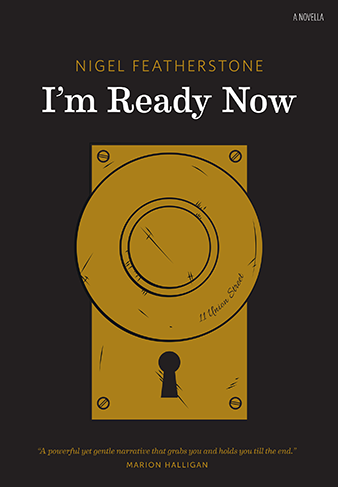
Featherston, I'm ready now, book cover

Book cover (Courtesy: Blemish Press)

Way back in my youth when I started studying literature, I thought I had to get the “right” interpretation. It made reading a little scary, I must say. However, as I gained confidence, I discovered that there are as many responses to a novel as there are readers, something I was reminded of when I attended this week’s launch of Nigel Featherstone’s novella, I’m ready now. And here’s why…

The book was launched by Canberra journalist and biographer, Chris Wallace. She spoke eloquently about the book telling us that it’s about how you can make a change in your life no matter how old you are – whether you’re 30 as Gordon is in the book or 50 as his mother, Lynne, is. She said too that it promotes the idea of living an imaginative life. I thought, yes, she’s right, it does do these things. And then Nigel spoke, and he said that for him the book can be summed up in one word, liberation. And I thought, yes, I can see how it’s that. But I had framed it a little differently from my reading.

Before I give you my different-but-on-a-similar-track take, I’d better tell you something about the plot. It has a small cast of characters, which is pretty much what you’d expect in a novella. They are Gordon, a gay man turning 30 who lives in Glebe and works as a photographer; his old schoolfriend Shanie, who followed Gordon to Sydney; Levi, Gordon’s boyfriend of a year or so; and Gordon’s mother Lynne who, recently widowed, comes up from Hobart to stay with Gordon for a short while. Lynne has put the large family home on the market, and the auction will be held while she’s away. Meanwhile, Gordon is almost at the end of his Year of Living Ridiculously, which is a year of rather self-destructive high living that he designed, and is doggedly keeping to, for his 30th year. He plans to crown this year with something he calls The Ultimate. But then Mum, Lynne, arrives, and puts The Ultimate at risk. What Gordon doesn’t know is that his mother has a grand plan herself, now that she’s free. (Ha! Liberation you see.)

This sounds pretty simple, really, doesn’t it? However, there are complications. Lynne’s husband, Eddie, was not Gordon’s father. Gordon’s father, Patric Finn, walked out on him and his mum when he was around a year old, and neither has completely resolved the abandonment. It’s not that Eddie wasn’t a good husband and father, because he was, but he never fully understood Gordon, and for Lynne he was “a head kind of love, not a heart kind of love”.

What is lovely about Featherstone’s writing – as I also found in his Fall on me – is that he manages to build tension and mystery around his characters’ behaviour without undermining their realness or humanity, and without alienating us readers. We warm to them even while we wonder about the wisdom of their decisions and motivations. Featherstone also uses imagery and allusions lightly. Water, for example, can be a cliched symbol in stories of change and growth, but here it’s appropriate and not laboured. What more logical thing is there to do on a hot night in Sydney than to go for a dip in the sea?

Besides the characterisation, I also like the novella’s voice and structure. It’s told first person in the alternating voices of Lynne and Gordon, and is effectively paced, largely through varying the length of the chapters*. The book opens with a mere half-page chapter in Lynne’s voice, and then moves to mostly longer ones in the main part of the book. They shorten towards the end as the pace builds, keeping us involved and wondering what these two will finally decide to do and what role Shanie and Levi might play in it all.

Now though to how I would describe the novel – and for me it is about coming to terms with the past. Both Gordon and Lynne have not had unhappy lives but both have in some way been damaged by their abandonment. Almost half way through the novel, they both say something significant. Lynne, reflecting with real generosity on Patric’s unheralded departure, says

I think he wanted to be free, a free young man. There have been times – many times – when I’ve found myself actually admiring his audacity to grab life, to run with it, to run as far as he could.

She then tells us that her plan is to leave Australia to live in “a farmhouse on a hill in the beloved country [Ireland] of my mother”. In the next chapter, Gordon’s, we learn in a flashback why he commenced his Year of Living Ridiculously. It’s to discover “what it is that makes me feel most alive”. He wants to “to lean over the cliff, figuratively speaking … to live as vividly as possible” – but his chosen method is clearly not working. The idea, though, reminded me of Fall on me in which the son tells his dad that “safety doesn’t always equal life”. Both these novellas, in a way, explore what Wallace described as “living an imaginative life”.

They are both, too, about something Lynne says towards the end, which is that “life must move forward; anything else is sacrilege”, and yet, paradoxically, her wish for Gordon could be seen to be the opposite: she wants him to go back to find what “hurt him all those years ago”.

And so for me, the book is about “living imaginatively” and about liberation, but it is also about how the past can stall us if we don’t get it in the right perspective. Featherstone opens the book with two epigraphs, one being TS Eliot’s “Home is where one starts from”.  I think that, in a way, says it all.

Nigel Featherstone
I’m ready now
Canberra: Blemish Books, 2012
156pp.
ISBN: 9780980755688

(Review copy supplied by Blemish Books)

* for want of a better word for the numbered parts.

Julian Barnes, The sense of an ending (Review)

I should have known I wouldn’t be the first to think of it, but during my reading Julian Barnes‘ Booker Prize winning novel, The sense of an ending, I was suddenly reminded of TS Eliot‘s The love song of J. Alfred Prufrock. It was the melancholic tone, the sense of life having passed one by, that did it:

What did I know of life, I who had lived so carefully? Who had neither won nor lost, but just let life happen to him?

Doesn’t that remind you of “I have measured out my life with coffee spoons”? I don’t usually read reviews before I write my own, but I wondered if my thought had come to anyone else. Of course it had. I googled “julian barnes sense of an ending prufrock” and up came several hits. Oh well, I thought, at least I’m not going to sound totally foolish. There is safety in numbers, after all, which brings me back to Tony, the novel’s protagonist, who says, at another point in the novel:

I’m not odd enough not to have done the things I’ve ended up doing with my life.

I admit to having a certain fellow feeling with Tony, a self-confessed “average” person who’s led an average life “of some achievements and some disappointments”. But, enough self-revelation, let’s get on with the review.

I’ll start by saying that this book is right up my alley. Firstly, it’s a novella and regular readers here know how I love a good novella. Secondly, it’s a good novella, by which I mean it’s tightly constructed and sparely written. And thirdly, plot is not the main point; character and life are Barnes’ focus.

Nonetheless, while there’s not a strong plot, there is of course a story, and it concerns the aforesaid Tony. He’s the first person narrator and is a reliably unreliable one. He tells us this on the second page, while at the same giving away the novel’s essential form:

But school is where it all began, so I need to return to a few incidents that have grown into anecdotes, to some approximate memories which time has deformed into certainty. If I can’t be sure of the actual events any more, I can at least be true to the impressions those facts left. That’s the best I can manage.

This tight little para tells us a few things about what’s to come. The word “deformed” combined with the idea that he “can’t be sure of the actual events” tells us to beware, that imperfect (for whatever reason) memory is at play. The mention of returning “to a few incidents” describes the basic structure of the novel, as it does indeed focus on and tease out the ramifications of a “few incidents”.  And the reference to school hints that there might be something of the bildungsroman about it.

I still haven’t told you anything about the story, though, have I? It’s divided into two parts. In Part One, Tony is in his teens and twenties and focuses on his three male friends and his first serious girlfriend, Veronica. This part is less than 60 pages and, as Tony promises at the beginning, primarily comprises a few scenes from his life, linked by some running commentary. There are classroom scenes and a particularly memorable one involving his first  (and only) weekend visit to his girlfriend’s home. We come back to this scene in the second part. I loved how, after spending some 50 pages on his youth, Tony wraps up around 40 years of his adult life in two pages. Impressive writing.

In Part Two, Tony is confronted again with some of the major incidents from his youth and is forced to reconsider his sense of self. The most important of these incidents concerns the suicide of one of his friends … and gradually we get a whiff of a mystery, albeit one just hovering around the edges. This is because the mystery is not the main point.

Tony, in this part, is bequeathed, out of the blue, the diary of the friend who had committed suicide 40 years previously. Now, Tony believes that it is the witnesses to your life, those you spent time with, who “corroborate” who you are. As these people drop away, there is, he says “less corroboration, and therefore less certainty to what you are or have been”. He therefore sees this diary as potentially significant:

The diary was evidence; it was – it might be – corroboration. It might disrupt the banal reiterations of memory. It might jump start something – though I had no idea what.

The bequest does “jump start something” but to what purpose is the moot point. An issue that occupies Tony is that of change. “Does character develop over time?” he asks and then continues, in one of those little postmodern touches we’ve become used to, “In novels of course it does, otherwise there wouldn’t be much of a story”. You said it, Tony/Julian, we are tempted to respond, except that by this time Tony had so captured my attention that the minimal story was neither here nor there.

And this is where I’ll leave the story … and return to an issue I raised earlier in the post, that regarding its being something of a bildungsroman. It’s not a traditional coming-of-age novel because only the first part of the novel chronicles his development as a young man. But, something is jump started for Tony in his 60s that forces him to rethink who he had been and who he had become. Memory, he says, can lock you into

the same loops, the same facts and the same emotions. I press the button marked Adrian or Veronica, the tape runs and the usual stuff spins out. The events reconfirm the emotions – resentment,  sense of injustice, relief – and vice versa. There seems no way of accessing anything else; the case is closed.

Occasionally, however, something happens to break the loop, as it does for Tony. He is suddenly confronted with new (or, different) memories which bring new emotions. He looks at “the chain of responsibility” and sees “my initial there”. He learns that the things he’d thought fixed or certain can be dissolved, that memory cannot be relied upon and can, in fact, come back to bite you. Time and memory, Barnes shows us, are malleable, suggesting, to me at least, that perhaps we never really do come of age.

Julian Barnes
The sense of an ending
London: Vintage, 2011
150pp.
ISBN: 9780099564973

Jahnavi Barua, Rebirth (Review for the Shadow Man Asian Literary Prize, 2011)

Shadow Man Asian Literary Prize 2011 Badge

Image by Matt Todd of A Novel Approach

What a shame Jahnavi Barua‘s novel, Rebirth, is, to the best of my knowledge, available “for sale in the Indian Subcontinent only” (backcover). Our Shadow Man Asian team had real problems tracking this one down, but I’m very glad we did manage to obtain some copies, eventually, because this is a beautiful book.

The title, Rebirth, might give you a sense of its subject matter – but, then again, it mightn’t! The novel – novella really – is a first person monologue by a mother to her unborn child. The child is waiting to be born – not reborn – but there is a sense that for the mother, Kaberi, a rebirth might be in the offing as she explores the state of her shaky arranged marriage, and of some tricky or unresolved relationships with family and friends.

While set in India – in Bangalore and Guwahati (in the troubled province of Assam) – this novel does not have the noise and energy that often accompanies stories from the subcontinent. It’s quiet and contemplative. Moreover, while it is imbued with gorgeous descriptions of the plants and landscapes of India, and while it refers to the ongoing political unrest in Assam, it is not specifically Indian in theme. Its story is universal, that of the desire for love between husband and wife, and of the love of a mother for her child. And here is the difficult part, because it is hard to describe this largely plotless novel without making it sound twee or mawkish, but somehow it is not that at all. Barua manages to find a voice for Kaberi that is tender but matter of fact, that is tentative but also confident. The progression is chronological, commencing with her husband leaving her for another woman at the beginning of the novel just as she discovers she is pregnant (after many years of trying). She doesn’t tell him – or her family and friends – for some long time as she considers her life. In the opening paragraphs we are given a picture of her as somewhat passive and inward-looking. Before her husband left, she says she

had been partial to the large soft sofa in front of the television, from where I had a good view of the screen, but from where I also looked inwards, into the heart of the house. I did not see much of the sky or buildings clustered around our own, but all that, anyway, did not cross my mind very often, so focused was I on your father and myself and the home we had fashioned together.

Ah, we think … a person ripe for “rebirth”. And yes she is, but it is slow and undramatic as she gradually, by meeting friends, remembering her old childhood friend who’d died in a bombed bus in Assam, and reflecting on her marriage past and present, comes to a better understanding of who she is. Early in the novel she, a keen reader, says:

I will not buy a book today. I will try and live in my life instead.

As the novel progresses, we find that she is, in fact, stronger and more directed than we (and, more to the point, even she) had realised. She has, for example, written a book and organised for her friend Preetha to illustrate it. This is no simple thing, but her husband, “whose public manners were always nice”, knows nothing of this. Ah, we wonder, what is she saying about his private manners, the way he treats her? We learn, through more stories in the next few pages, that what she hasn’t received from him is tenderness and love. But we also receive a clear sense of strength growing in her:

I demand love. Now, especially now, at least now.

This comes about a quarter of the way through the novel … the rest explores, in the same quiet tone, how things fall out for Kaberi, how she confronts her fears and insecurities. Things do happen – her father dies and she returns home to Guwahati, she eventually tells her husband, family and friends about her pregnancy. You can’t hide that forever after all! In other words, there is a plot of sorts, but the story is mostly an internal one and the ending is appropriately open albeit also with some sense of things resolved.

A little over halfway though the novel Kaberi says:

Birds wheel around slowly in the cloudless sky. Seemingly aimless, but I know better; little happens in nature accidentally.

And, I’d say, little happens accidentally in the writing of this book. It has been carefully and subtly structured to lay the foundations for Kaberi’s growth, and this makes it an absolute pleasure to read.

For other reviews by the Shadow Man Asian team, please click on my Man Asian Literary Prize page.

Jahnavi Barua
Rebirth
New Delhi: Penguin Books, 2010
203pp.
ISBN: 9780143414551

(Review copy supplied by Penguin Books via Lisa of ANZLitLovers)

Banana Yoshimoto, The lake (Shadow Man Asian Literary Prize 2011)

Shadow Man Asian Literary Prize 2011 Badge
Image created by Matt Todd of A Novel Approach

When I saw that Banana Yoshimoto‘s novel The lake was shortlisted for the 2011 Man Asian Literary Prize I knew that it would be a high priority for me to read, because I like Japanese literature and I have read and enjoyed Yoshimoto (her novel Kitchen) before.

The first thing that struck me, however, as I started reading the book was a case of reading synchronicity. Roy’s The folded earth, the first book I reviewed for our Shadow Man Asian Literary Prize 2011 project, is about a young woman grieving the death of her husband. In The lake, the protagonist, Chihiro, also a young woman, has just lost her mother. And, in further synchronicity, both women meet men who impact their lives. This is not unusual, of course, but the thing is that in both books there is a sense of mystery surrounding these men. However, this is where the similarity ends: the mystery in The lake has nothing to do with the death of Chihiro’s mother. Rather, it relates to something the man has experienced, something that has clearly damaged him.

So, what is the plot? It is basically a romance. The first line of the novel is:

The first time Nakajima stayed over, I dreamed of my dead mom*.

Chihiro, our first person narrator, then flashes back to tell us about her background, her somewhat unusual life with her bar-owner mother and businessman father who never married due to his family’s objections. Chihiro is around 30, but this is, really, a coming-of-age novel because she doesn’t yet feel grown-up:

I’m still a child. I still need my parents, and yet, I suddenly feel I’m walking alone.

Into this solo life comes a young medical student, a “puzzling young man”, Nakajima, who lives in the apartment opposite hers. They first communicate non-verbally across the dividing space. Gradually Chihiro feels she is falling in love with Nakajima, but she is not sure, partly because he’s odd, uneasy, something he admits to but can’t (yet) explain. However, it is through learning to accept Nakajima, to not push him but simply to care for him, that Chihiro starts to grow up. At first she wants to have fun – “I didn’t want to deal with weighty matters” – but she comes to realise that she needs him, and senses that he is “the one”. All this develops before we know what happened to Nakajima. Plotting the story through Chihiro’s description of their developing relationship puts the focus less on what happened in the past – though we certainly want to know – and more on how two young “kind of weird” people might move together to a good future.

Now, here’s the rub. Do I let on what happened to Nakajima? The blurb inside the jacket hints at what it is, so perhaps it’s ok to. However, I think I won’t. All I’ll say is that the lake – to which Nakajima takes Chirihiro half way through the novel – and the brother and sister (Mino and Chii) living there are important to the resolution. Chii is bedridden and mute but she can foretell the future and she does this through Mino. This adds a supernatural element to the story, which works well enough for me though I’m not sure what it specifically adds to the novel (except perhaps a sense of “otherness” to the atmosphere?)

The more important question to ask is why has this novel been longlisted for the Man Asian Literary Prize? Is it more than a nicely written coming-of-age love story? Well, the mystery and its impact on Nakajima, Mino and Chii is a significant one, but that, from the way the story is told and how the plot is resolved, doesn’t seem to be the main point. It is clearly about grief, trauma and recovery, but I think this might be overlaid with the struggle in Japanese society, particularly for the current young generation, to not follow the norm blindly. Nakajima and Chihiro did not have “normal” upbringings. This means that, whether they like it or not, they symbolise nonconformity – and must, consequently, make active decisions about where to next. Freedom is not, I understand, a high value in Japanese society … but it is an issue that comes up regularly in the book. Chihiro’s parents aren’t, through family expectations, free to marry. The mystery surrounding Nakajima relates to a loss of freedom. In her work as a muralist, Chihiro’s only demand is the freedom to paint what she wants and, when that is threatened by a sponsor wanting her to incorporate an enormous logo into her mural, she intelligently but resolutely conducts a campaign to encourage him to change his mind.

Late in the novel, when talking about his experience, Nakajima says:

When you’re in a state of homogeneity, you’ve lost yourself.

Beyond loss and childhood trauma, then, it is the ongoing things like homogeneity, lack of freedom, the push to be normal that challenge Yoshimoto’s characters. But this is a quiet, lyrical book rather than a feisty one. It recognises that life involves “dull repetition of the same old thing” peppered by those “little leaps of your heart to put a splash of colour in the world”. Have I fully understood this novel? I’m not sure that I have … but I did enjoy reading it and thinking about the issues Yoshimoto seems to be exploring.

Matt of A Novel Approach and Lisa of ANZLitLovers, on our Man Asian team, have also reviewed it and are worth reading for their different takes.

Banana Yoshimoto
The lake
(trans. by Michael Emmerich)
Brooklyn: Melville House, 2011 (orig. Japanese ed. 2005)
188pp
ISBN: 9781933633770

* An American translation. We would say “mum”!

Nigel Featherstone, Fall on me

Featherstone, Fall on me
Fall on me bookcover (Courtesy: Blemish Books)

Nigel Featherstone is nearly a local writer for me – he lives in the country town an hour down the road – but I haven’t read him before, even though he has published a goodly number of short stories and short fiction. How does this happen? Anyhow, Fall on me is his second novel, or novella, to be exact. It is, in a way, an age-old story. The protagonist has experienced something in his past that has stalled his life, made him lose his way. From pretty early on, you know that this is what the story is about, but Featherstone tells it in such a way that it doesn’t feel old, that makes you want to keep on reading to find out exactly what did happen, and how (because you assume he will) our protagonist is “unstalled”.

How does Featherstone achieve this? I’ll explain soon, but first I’ll flesh out the plot just a little more. There are three main characters – Lou, our protagonist, who’s 38 and owns a small cafe in Lonnie (Launceston, for the non-locals); Luke, his son, who is 17 (and, significant to the plot, therefore not quite an adult yet); and Anna Denman, their boarder, who’s in her late 20s and works in a bookshop. As the back cover blurb says, the plot revolves around a decision by Luke “to risk all by making his body the focus of an art installation” which forces Lou “to revisit the dark secrets of his past, question what it means to be a father, and discover …”. Well, you’ll have to read the book – or at least find the back cover – to discover what Lou discovers!

The title of the book comes from the R.E.M. song, “Fall on me”, which is, says songwriter Stipe, a song about oppression, about the things that “smash us”. For Lou, a big R.E.M fan, what’s smashing him is his inability to move on from what happened in the past, when Luke was one month old. It is Luke’s art installation, of course, which finally precipitates Lou’s “unstalling”. Featherstone’s plotting is sure; he drops clues to what had happened, without telling us too soon but not dragging it out too long either. We realise fairly quickly that it involves a loss (after all he’s a single father) but how this occurred and who might be involved is not immediately made clear. The past is gradually filled in, through flashbacks, and the picture is slowly built up – though only sometimes in the expected direction. Where, we wonder, for example, does his old schoolfriend, Fergal, fit in?  Meanwhile, in real-time, the art installation plot runs its course.

A number of themes run through the novel, besides the “unstalling” one. One relates to art. I like the way the plot, without specifically mentioning it, reminds us of the Bill Henson “is it art or pornography” controversy which caused a furore in Australia in 2008. What happens when art pushes the edges, particularly when children are involved? Lou is shocked by Luke’s “My Exposure for You” installation and fears for his son. He wonders about “laws” that might come into play, and whether some sort of “‘artistic licence'” might apply. Luke, though, gets to the point: “But my body – ultimately – means nothing. It’s my heart that counts”. Another theme relates to parenting. Lou worries about the “installation”:

He can’t allow the exhibition to happen. He won’t – he could never – allow his son to put himself in the sort of danger that might now be coming his way, their way […]

Hang on. Is that really his responsibility, stopping his son from getting in the way of danger? Isn’t a greater responsibility encouraging his son to be all that he can be?

The writing is direct, straightforward. It’s not wildly innovative, but that doesn’t mean it’s uninteresting. There’s the occasional word-play and irony, some effective description, and apposite allusions including a sly reference to Lou reading Patrick White‘s The Twyborn affair. The characterisation is good. This is a novella, so only the main characters are developed and, even then, Anna is a little shadowy. We know what we need to know – but perhaps not as much as we’d like to know!

I enjoyed this book. It’s warm and generous, and it feels real. Around the middle of the book, when Lou expresses his desire to protect his son, Luke responds that “safety doesn’t always equal life”. Some risks need to be taken … as each of the characters realise, some later rather sooner. The end result is a story with heart … and that is a lovely thing.

Nigel Featherstone
Fall on me
Canberra: Blemish Books, 2011
130pp
ISBN: 9780980755633

(Review copy courtesy Blemish Books)

Horace Walpole, The Castle of Otranto

Tower of Horace Walpole's own Gothic house, Strawberry Hill

Tower of Horace Walpole's own Gothic house, Strawberry Hill (Public domain, via Wikipedia)

Would you believe the issue of fact and fiction is consciously raised in yet another novel I’ve read? In his preface to The Castle of Otranto Horace Walpole suggests that it’s possible the story – which he tells us that he “found” and translated – is based on fact. And he concludes that:

If  a catastrophe, at all resembling that which he [the original author, that is!] describes, is believed to have given rise to this work, it will contribute to interest the reader, and will make the “Castle of Otranto” a still more moving story. (Preface to the 1st edition)

Hmm … moving is not quite how I’d describe this Gothic tale but perhaps that’s because I’m a cynical 21st century reader and not a mid 18th century one? I did though enjoy the book, which I read as part of my local Jane Austen group’s preparation for our discussion of Northanger Abbey next month. I had planned to read a Gothic novel by a female author – such as Ann Radcliffe – but time got the better of me and so I settled on The Castle of Otranto which is a novella, but which is also interesting for its pioneer status as the first Gothic novel.

The first thing that entertained me about the novel was the preface and Walpole’s (rather postmodern-like) attempt to pass it off as a story he’d found and translated. He suggests the text had been written in medieval times during the Crusades (between 1095 and 1243). This first edition was well-received by the reading public as well as by some contemporary critics. And so in the second edition Walpole identifies himself as the author, and in its preface claims that the novel was “an attempt to blend the two kinds of romance, the ancient and the modern. In the former all was imagination and improbability: in the latter, nature is always intended to be, and sometimes has been, copied with success…”. This builds, in fact, on an argument he makes in the first edition’s preface that if we ignore the “miraculous” (read “supernatural”) aspects:

the reader will find nothing else unworthy of his perusal. Allow the possibility of the facts, and all the actors comport themselves as persons would do in their situation.

Hmm again … I think he errs on the improbable side of the pendulum, but the characters do, I accept, exhibit a reasonable level of psychological realism.

This change from the first to the second edition is interesting in itself and would be fun to research further … but it’s not something I plan to pursue in this review. I will, though, take up the issue of “the novel” further when I review Northanger Abbey in a month or so since it is in this novel that Austen argues the value of reading fiction.

This brings me to the second thing I enjoyed about the novel, and that was simply experiencing the introduction of the Gothic. Wikipedia says Walpole “introduces many set-pieces that the Gothic novel will become famous for. These includes mysterious sounds, doors opening independently of a person, and the fleeing of a beautiful [usually virginal] heroine from an incestuous male figure”. It also includes the sorts of features that we find in soap operas today – which one could argue are a continuation of the Gothic without the supernatural horror aspect. These features include mistaken identities, people returning from the dead (or, at least, when they are least expected), and love triangles (which are, of course, not only the province of the Gothic). The Castle of Otranto moves at a cracking pace. There’s a lot of dialogue, a good deal of action (human and supernatural), and not too much description.

Another thing that fascinated me is why readers enjoy such over-the-top stories. To prepare for my group’s discussion, I read a critique by Jerrold E. Hogle*. He argues, to put his academic thesis more simply, that the Gothic allows readers to “displace” real fears onto something more fictive. In Walpole and Radcliffe, these fears, he suggests, are somewhat paradoxical: a desire for and rejection of aristocracy and old Catholicism, by the middle class. My group’s discussion raised other reasons too. One is the “excitement” (sexual titillation) roused by these novels, particularly for the young women of the era like, say, Catherine Moreland and Isabella Thorpe in Northanger Abbey. Were Gothic novels that generation’s young adult novels? Another is the idea that, like crime novels, Gothic novels are about the restoration of order: “This is a bad world” says the hero earlier in the novel.

Anyhow, that’s enough of that I think. I haven’t really done a review have I? I haven’t even mentioned the plot. It’s pretty much the usual stuff. There’s Manfred, the lord of the castle, who needs to continue his line to maintain ownership of the castle, but his only son dies on his wedding day. This sets off a train of events in which Manfred decides to divorce his wife, Hippolita, to marry his son’s intended in order to, hopefully, produce more heirs. His plan is intercepted by the appearance of those who claim the castle is theirs. The story includes knights and friars, loving mothers and loyal daughters, helmets and portraits with minds of their own (“the portrait … uttered a deep sigh and heaved its breast”), and, of course, caves and tunnels. The interesting thing about the plot though, in terms of that restoration of order argument, is that not quite the perfect order is restored … but I won’t spoil the story further than that.

As for the opening quote, I’ll leave that for you to ponder …

Horace Walpole
The Castle of Otranto
Originally published 1764
Kindle edition
158Kb

* Hogle, Jerrold, W “Hyper-reality and the Gothic affect: The sublimation of fear from Burke and Walpole to The Ring“, in English Language Notes, 48 (1): 163-176, Spring/Summer 2010.